What Is Argan Oil? A Complete Guide
Argan oil went from a regional staple in southwestern Morocco to a fixture on beauty shelves worldwide in a couple of decades. Along the way it picked up plenty of hype, a few myths and a lot of imitators. This guide covers the essentials: where argan oil comes from, what's in it, what the science does and doesn't support, the different types you'll see, and how to choose a good one.
The short answer
Argan oil is a plant oil pressed from the kernels of the argan tree (Argania spinosa), which grows mainly in southwestern Morocco. Cosmetic argan oil comes from raw kernels and is used on skin, hair and nails; culinary argan oil comes from roasted kernels. It's rich in oleic and linoleic acids, vitamin E compounds and plant sterols.
Where does argan oil come from?
The argan tree
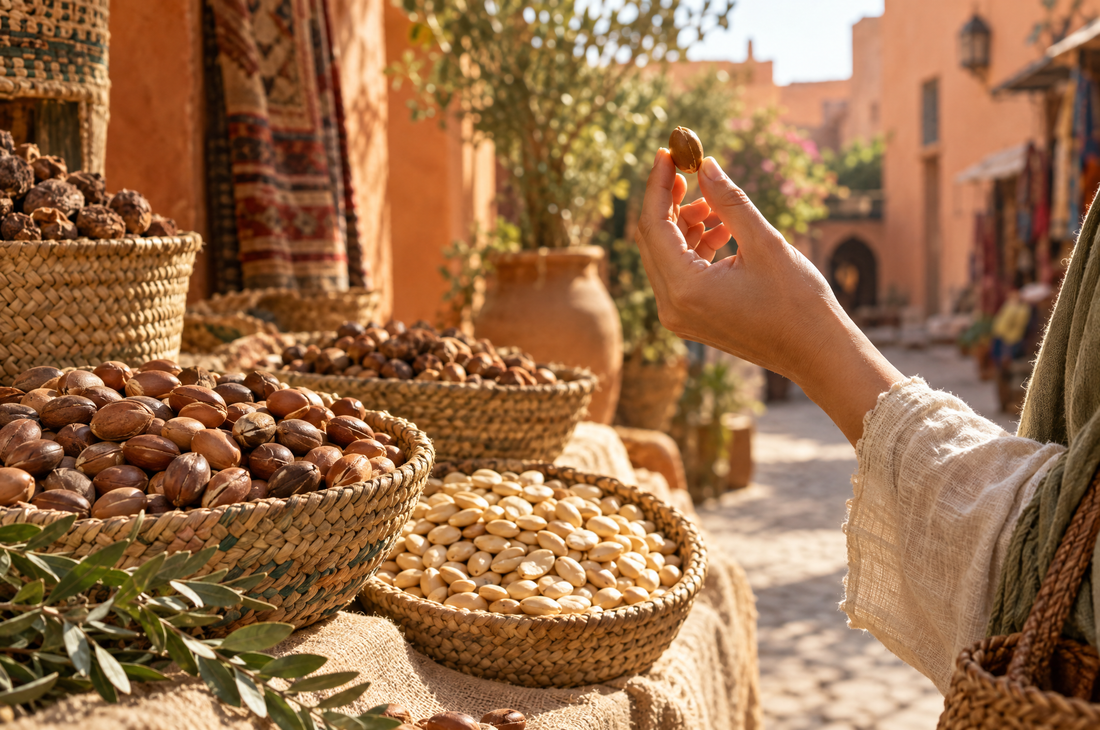
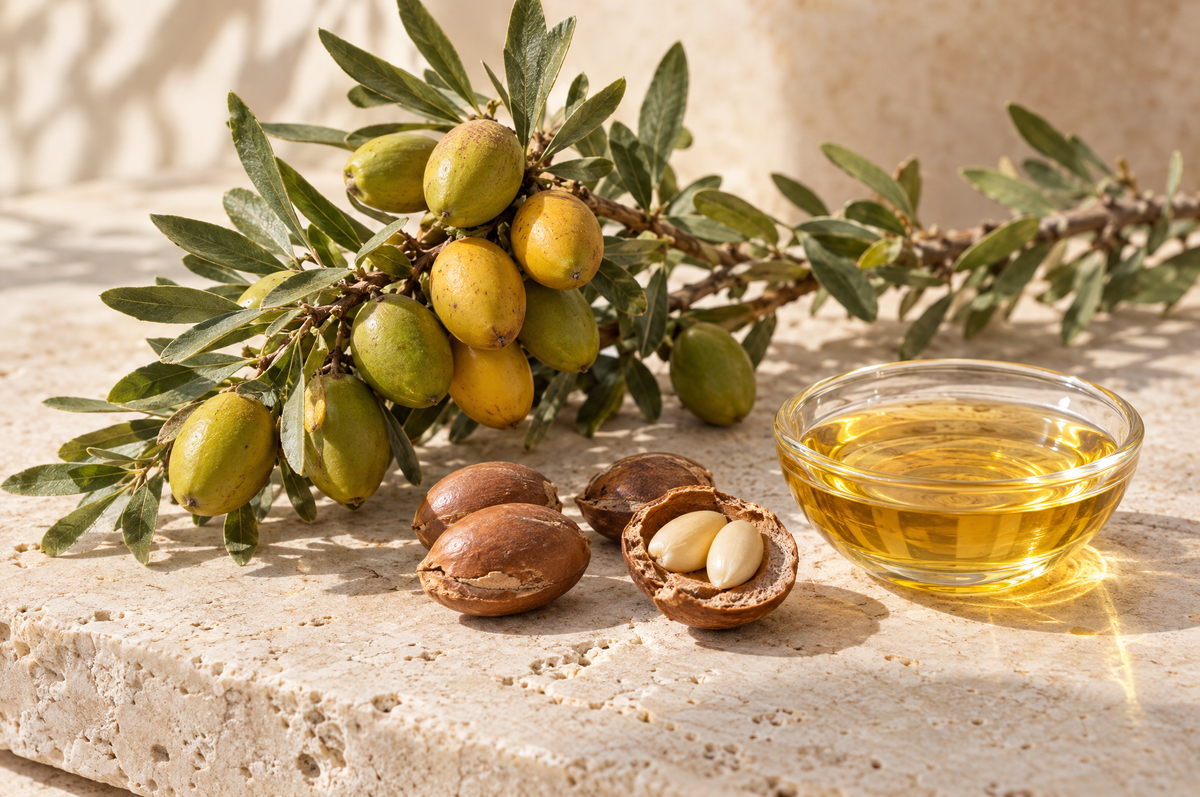
The argan tree is a slow-growing, thorny tree adapted to the drylands of southwestern Morocco, with a small native population extending into Algeria1. It is the only member of its plant family (Sapotaceae) living outside the tropics, and its deep roots help hold soil against wind and water erosion1. The United Nations notes the tree can reach around 10 meters tall, live for about 200 years and tolerate temperatures up to 50°C, and calls it a bastion against desertification2.
It has a long written history. The tree was described as early as the 13th century by the physician Ibn al-Baytar3, and for the Amazigh (Berber) communities of the region it has long provided food, fuel, fodder and oil1. More detail in where argan oil comes from.
A protected landscape
The argan forest shrank substantially over the 20th century, from about 1.5 million hectares to an estimated 800,000 hectares by around 2000, because of human pressure and drought1. Several international designations now recognize it:
- 1998: UNESCO designated the Arganeraie Biosphere Reserve, covering roughly 2.5 million hectares in southwest Morocco4.
- 2014: UNESCO inscribed argan practices and know-how on its Representative List of the Intangible Cultural Heritage of Humanity, highlighting the knowledge passed between generations of women5.
- 2018: FAO recognized the argan-based agro-sylvo-pastoral system of Ait Souab–Ait Mansour as a Globally Important Agricultural Heritage System6.
- 2021: The UN General Assembly proclaimed May 10 the International Day of Argania2.
How argan oil is made
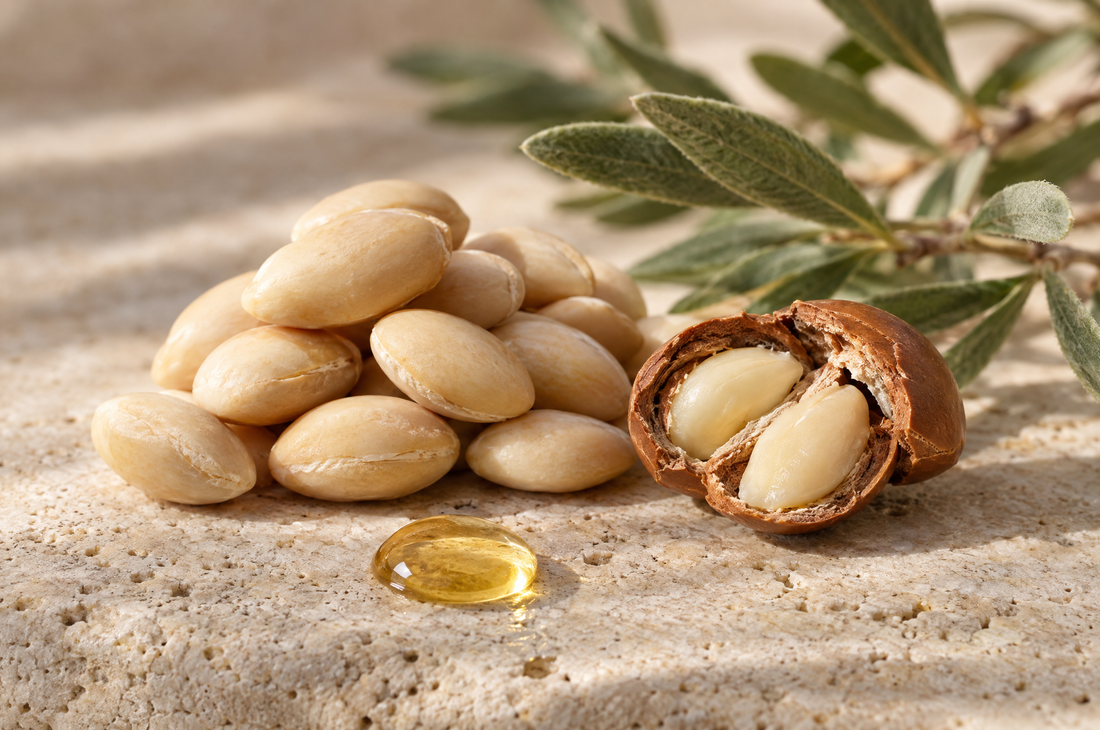
The process runs from ripe fruit to bottled oil in several steps: harvesting, sun-drying, removing the dried pulp, cracking the very hard nuts to free the kernels, optionally roasting them, cold-pressing, then decanting and filtering1. Traditionally all of this was done by hand, with a stone hand mill and warm water used to separate the oil; today most oil is pressed mechanically, often by women's cooperatives1,5. The UN estimates it takes about 150 kg of fruit to make 3 liters of oil2, which goes a long way toward explaining why real argan oil costs what it does.
For the step-by-step story, read how argan oil is made. And no, quality argan oil isn't made from nuts processed by goats; that myth is unpacked in the truth about argan trees and goats.
Types of argan oil: cosmetic, culinary and refined
| Type | Made from | Color and smell | Main use |
|---|---|---|---|
| Cosmetic (virgin) | Unroasted kernels, cold-pressed | Light gold; faint, nutty | Skin, hair, nails |
| Culinary (virgin) | Lightly roasted kernels, cold-pressed | Copper; toasted hazelnut | Food: dipping, drizzling, amlou |
| Refined | Virgin oil that has been bleached and deodorized | Very pale; little or no smell | Ingredient in finished cosmetics |
Cosmetic and culinary oils differ only in whether the kernels are roasted1. Roasting gives culinary oil its flavor and a longer shelf life1. Refining removes color and odor, but in one study it also removed some of the oil's vitamin E and left what remained far less stable during storage7. See culinary vs. cosmetic argan oil and what argan oil should smell like.

Quality grades
Morocco's national standard grades virgin argan oil by acidity (free fatty acid content): extra virgin (below 0.8%), fine virgin (0.8 to 1.5%), ordinary virgin (1.5 to 2.5%) and lampante (above 2.5%)1. You'll mostly see "extra virgin" on culinary oil labels; for cosmetic oil, "cold-pressed," "virgin" and a clean ingredient list are the more useful signals.
What's in argan oil?
Argan oil's makeup is well documented, and the Moroccan standard sets ranges for its main components1:
| Component | Typical range | Why it matters |
|---|---|---|
| Oleic acid (omega-9) | 43–49% | Main fatty acid; softening, emollient |
| Linoleic acid (omega-6) | 29–36% | An essential fatty acid found in the skin's lipids |
| Saturated fats (mainly palmitic, stearic) | About 16–23% | Contribute to texture and stability |
| Linolenic acid (omega-3) | 0.3% or less | Very low; higher levels can signal adulteration |
| Tocopherols (vitamin E compounds) | 60–90 mg per 100 g, mostly gamma-tocopherol | Natural antioxidants that protect the oil |
| Plant sterols | Up to about 220 mg per 100 g, mainly schottenol and spinasterol | A chemical "fingerprint" used to confirm authenticity |
It also contains smaller amounts of polyphenols, squalene and other minor compounds1. For a deeper dive, read what's in argan oil.
What is argan oil good for?
This is where honesty matters, because argan oil's reputation runs well ahead of its evidence.
Skin: the strongest evidence
The best human data come from two small studies of the same group of 60 postmenopausal women. Applying argan oil to the forearm daily for 60 days reduced transepidermal water loss and increased the water content of the skin8, and improved measures of skin elasticity9. A review of topical plant oils lists argan oil among those with evidence for skin barrier repair10. These are encouraging but limited studies; a 2010 review noted that the lack of clinical data is a serious gap in what we know about argan oil11. See is argan oil good for skin.
Hair: good conditioner, not a growth treatment
Argan oil smooths frizz, adds shine and softens dry ends, which is why it's so widely used in hair care. Lab work suggests it may help protect hair: in one study, hair pre-treated with argan oil lost less protein when exposed to an oxidizing chemical12. But a 2022 systematic review found no significant clinical evidence that argan oil improves hair growth or hair quality13. More in is argan oil good for hair.
Everyday uses
In practice, people use cosmetic argan oil as a face oil, an after-shower body oil, a hair serum, a cuticle oil and a beard oil. Our list of 20 ways to use argan oil covers them all, with amounts and timing.
What it isn't
Argan oil is a cosmetic. It isn't a sunscreen, and it doesn't cure or treat acne, eczema, rosacea, dandruff or hair loss. It may help with dryness and comfort alongside proper care. If you have a skin condition, a dermatologist is the right first stop.
Is argan oil safe?
For most people, yes. It's generally well tolerated, but allergic contact dermatitis from argan oil has been reported in the medical literature14, and argan oil is pressed from a kernel, so people with nut or seed allergies should check with their doctor. A simple patch test on the inner arm before using it widely is sensible. Read more in argan oil benefits and side effects.
How to choose a good argan oil
- Read the ingredients. Pure argan oil lists one ingredient: Argania spinosa kernel oil. Fragrance, silicones or other oils mean it's a blend.
- Look for cold-pressed and virgin. These indicate mechanical pressing without heat or solvents. See why cold-pressing matters.
- Check organic claims. In the U.S., the USDA, not the FDA, regulates "organic" on cosmetics made from agricultural ingredients; products labeled "100 percent organic" must contain only organically produced ingredients and may carry the USDA Organic seal15. More in organic argan oil.
- Prefer dark glass. Light speeds oxidation; cosmetic argan oil kept cool and away from sunlight still met the Moroccan quality standard after a year in one study, though the researchers advise using it within about six months16.
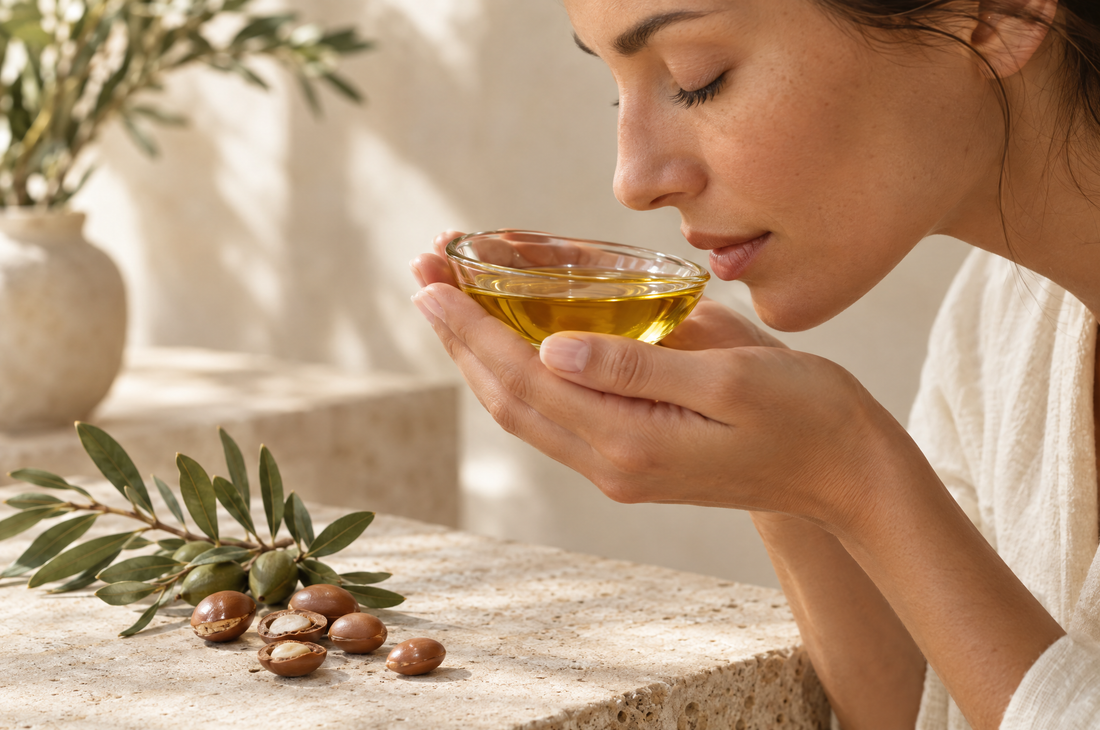
- Smell it. Faint and nutty is right. Strongly roasted, perfumed, sour or completely odorless are all clues worth questioning.
- Be wary of bargains. Given how much fruit and labor goes into each liter, very cheap "argan oil" deserves suspicion. Our guide to real vs. fake argan oil lists seven checks.
If you'd like a reference point, our 100% organic argan oil is a single ingredient, USDA-certified organic, cold-pressed from unroasted kernels sourced from Morocco, with no fragrance or dyes, in a 60 mL amber glass dropper bottle. For a broader shopping guide, see how to choose the best argan oil.
How to use argan oil
- Face: 2–3 drops, morning and/or night, pressed in as the last step.
- Hair: 1 drop through dry ends, or a little more through damp hair.
- Body: 5–6 drops on damp skin after bathing.
- Nails: 1 drop on the nail beds, ideally at night.
For timing and layering, see using argan oil on your face and how to use argan oil for hair.
Frequently asked questions
What is argan oil made from?
Argan oil is pressed from the kernels inside the nuts of the argan tree's fruit. Cosmetic oil uses raw kernels and culinary oil uses lightly roasted kernels.
Where is argan oil from?
Almost all argan oil comes from southwestern Morocco, where the argan tree grows naturally. The region is protected as UNESCO's Arganeraie Biosphere Reserve.
What is argan oil good for?
Mainly moisturizing and conditioning skin, hair and nails. Small human studies show it helps skin hold moisture and improves elasticity measures; it isn't proven to regrow hair or treat skin conditions.
Is argan oil the same as Moroccan oil?
Not necessarily. Moroccan oil is often used as a product name for hair treatments that may contain some argan oil alongside other ingredients such as silicones and fragrance. Pure argan oil has a single ingredient.
Can you eat argan oil?
Culinary argan oil, made from roasted kernels and sold as a food, is eaten in Morocco with bread, salads and couscous. Cosmetic argan oil is made for skin and hair and shouldn't be used for cooking.
Sources
- Gharby S, Charrouf Z. Argan oil: chemical composition, extraction process, and quality control. Front Nutr. 2022;8:804587. Link
- United Nations. International Day of Argania, 10 May (General Assembly resolution A/RES/75/262, 2021). Link
- Khallouki F, Eddouks M, Mourad A, Breuer A, Owen RW. Ethnobotanic, ethnopharmacologic aspects and new phytochemical insights into Moroccan argan fruits. Int J Mol Sci. 2017;18(11):2277. Link
- UNESCO Man and the Biosphere Programme. Arganeraie Biosphere Reserve, Morocco (designated 1998). Link
- UNESCO. Argan, practices and know-how concerning the argan tree. Representative List of the Intangible Cultural Heritage of Humanity, inscribed 2014. Link
- Food and Agriculture Organization of the United Nations. Argan-based agro-sylvo-pastoral system within the area of Ait Souab – Ait Mansour, Morocco. Globally Important Agricultural Heritage Systems (designated 2018). Link
- Asbbane A, Bousaid Z, Guillaume D, et al. Effects of physical refining process on quality and stability of argan oil (Argania spinosa (L.) Skeels). Sci Rep. 2024;14:23045. Link
- Boucetta KQ, Charrouf Z, Derouiche A, Rahali Y, Bensouda Y. Skin hydration in postmenopausal women: argan oil benefit with oral and/or topical use. Prz Menopauzalny. 2014;13(5):280–288. Link
- Boucetta KQ, Charrouf Z, Aguenaou H, Derouiche A, Bensouda Y. The effect of dietary and/or cosmetic argan oil on postmenopausal skin elasticity. Clin Interv Aging. 2015;10:339–349. Link
- Lin TK, Zhong L, Santiago JL. Anti-inflammatory and skin barrier repair effects of topical application of some plant oils. Int J Mol Sci. 2017;19(1):70. Link
- El Monfalouti H, Guillaume D, Denhez C, Charrouf Z. Therapeutic potential of argan oil: a review. J Pharm Pharmacol. 2010;62(12):1669–1675. Link
- Sharifi N, Hamedeyazdan S, Shokri J, Monajjemzadeh F. Argan oil as a pretreatment of human hair before exposure to oxidative damage: attenuated total reflectance and protein loss studies. J Cosmet Dermatol. 2022;21(10):5010–5017. Link
- Phong C, Lee V, Yale K, Sung C, Mesinkovska N. Coconut, castor, and argan oil for hair in skin of color patients: a systematic review. J Drugs Dermatol. 2022;21(7):751–757. Link
- Foti C, Romita P, Ranieri LD, Bonamonte D. Allergic contact dermatitis caused by argan oil. Contact Dermatitis. 2014;71(3):183–184. Link
- USDA Agricultural Marketing Service, National Organic Program. Cosmetics, body care products, and personal care products (fact sheet), April 2008. Link
- Gharby S, Harhar H, Kartah B, Guillaume D, Chafchaouni-Moussaoui I, Bouzoubaa Z, Charrouf Z. Oxidative stability of cosmetic argan oil: a one-year study. J Cosmet Sci. 2014;65(2):81–87. Link