Why Real Argan Oil Costs What It Does
Next to a bottle of olive or sunflower oil, argan oil can look wildly overpriced. Then you find a "pure argan oil" online for a fraction of what others charge, and wonder if everyone else is overcharging. Neither instinct is quite right. The argan oil price reflects a slow, hand-intensive harvest from a tree that grows in one small corner of the world, and once you understand the inputs, both the expensive bottles and the suspiciously cheap ones make more sense.
The short answer
Argan oil is expensive because the argan tree grows almost only in southwestern Morocco, the extremely hard nuts are traditionally cracked by hand, and yields are low: around 50 kg of fruit for one liter by traditional methods. A very cheap bottle usually signals dilution, refining or a blend.
Why is argan oil so expensive?
1. A tree that grows in one place
The argan tree is endemic to southwestern Morocco, where UNESCO designated the Arganeraie Biosphere Reserve in 1998.1 The argan forest covers roughly 870,000 hectares, and it has been shrinking: one review estimates deforestation of about 600 hectares a year from human activity.2 Researchers studying argan orchards report a drop in forest density of more than 40% between 1970 and 2007, and describe water scarcity as a major factor limiting productivity in this semi-arid region.3 A limited, climate-sensitive supply is the starting point for every bottle. We tell the full story in Where Does Argan Oil Come From?
2. Very little oil per kilo of fruit
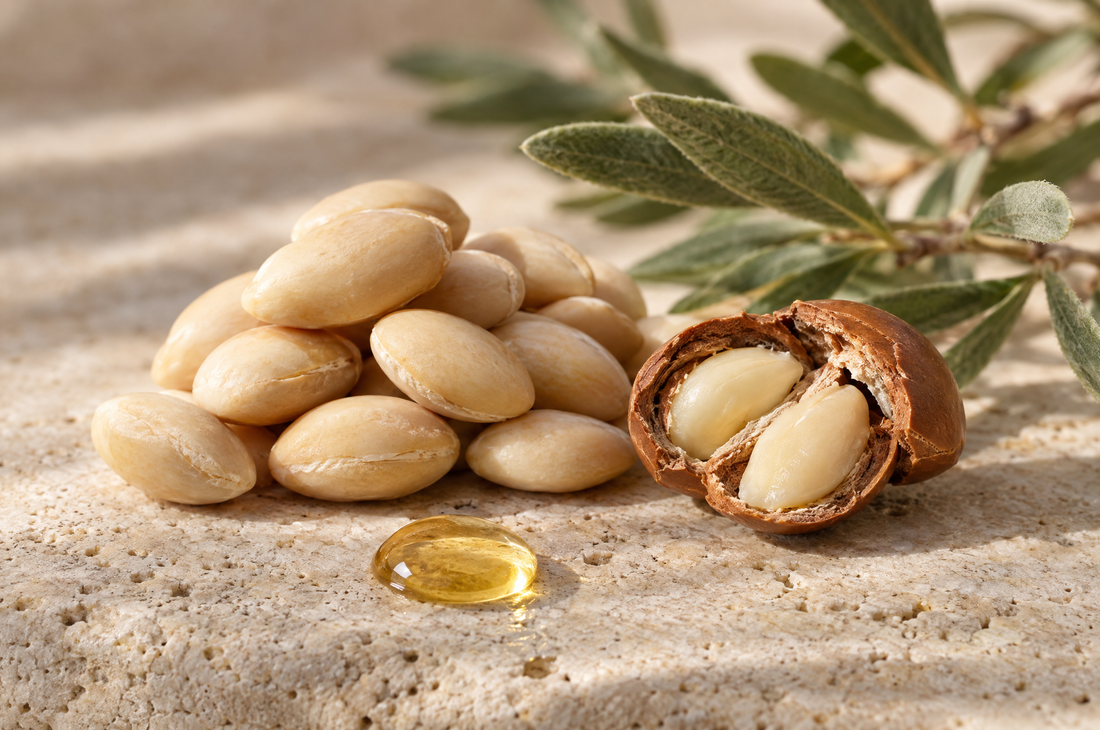
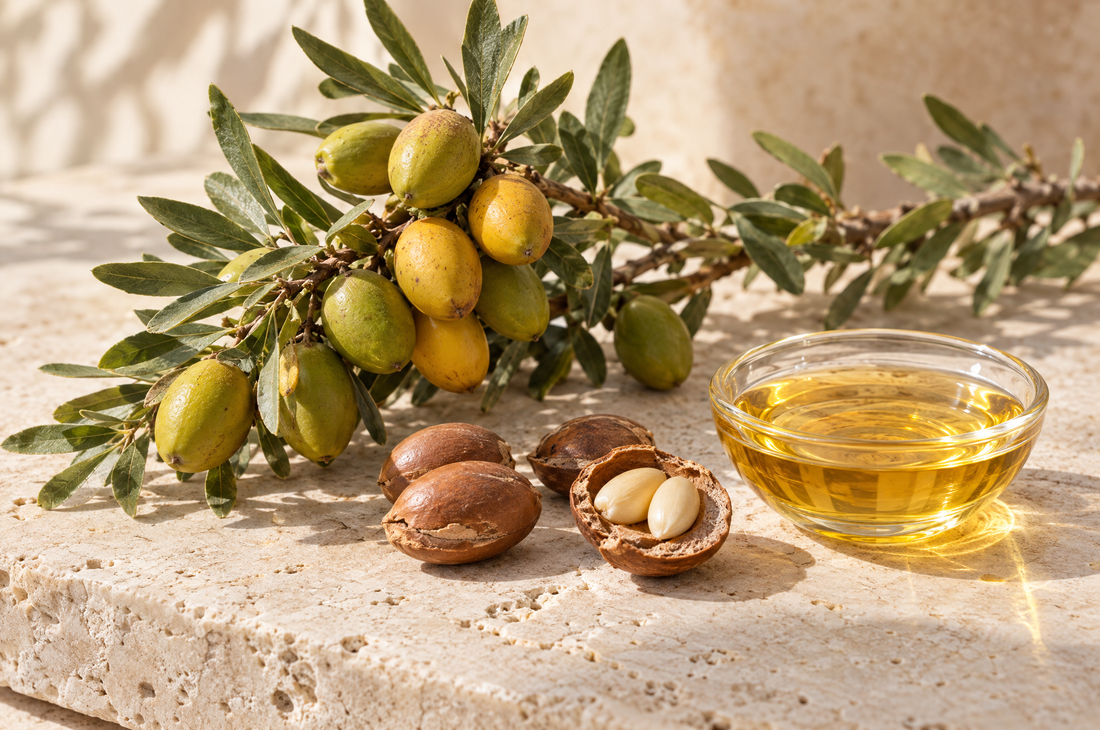
The oil comes only from the small kernels inside a very hard nut, which is itself inside a fleshy fruit. By the traditional method, about 50 kg of fruit yields roughly one liter of oil.4 Extraction efficiency matters too: traditional hand extraction has a yield of about 30%, compared with about 45% for mechanical pressing.2
3. Hard, slow hand labor
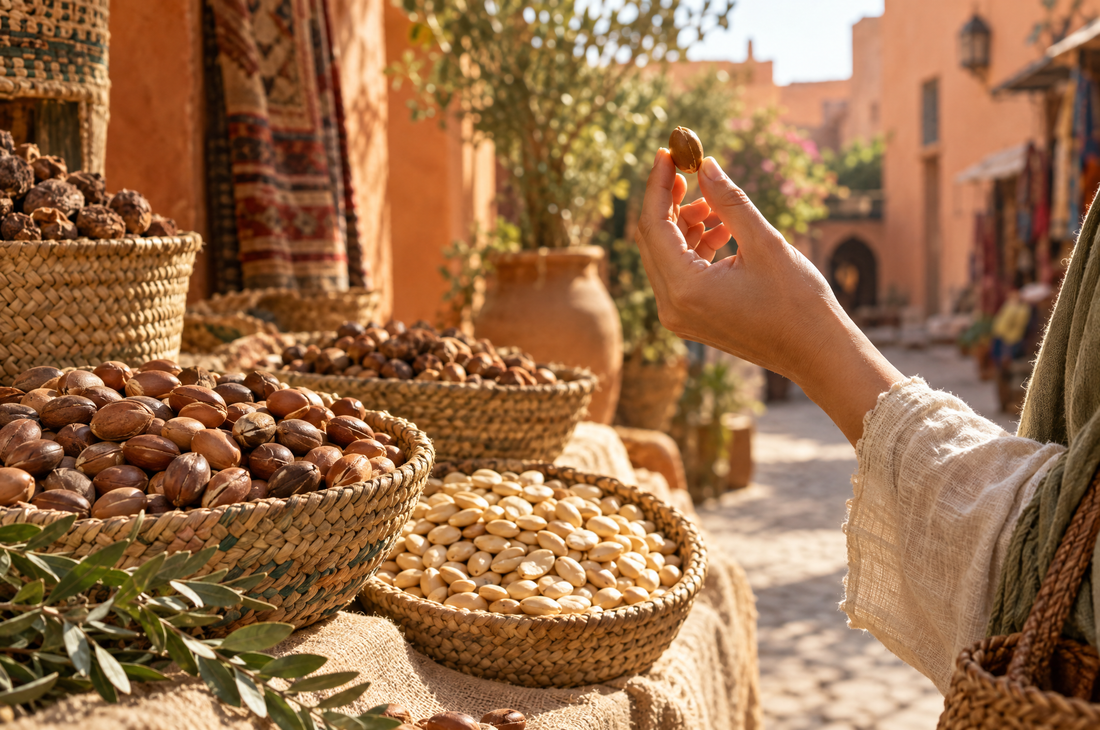
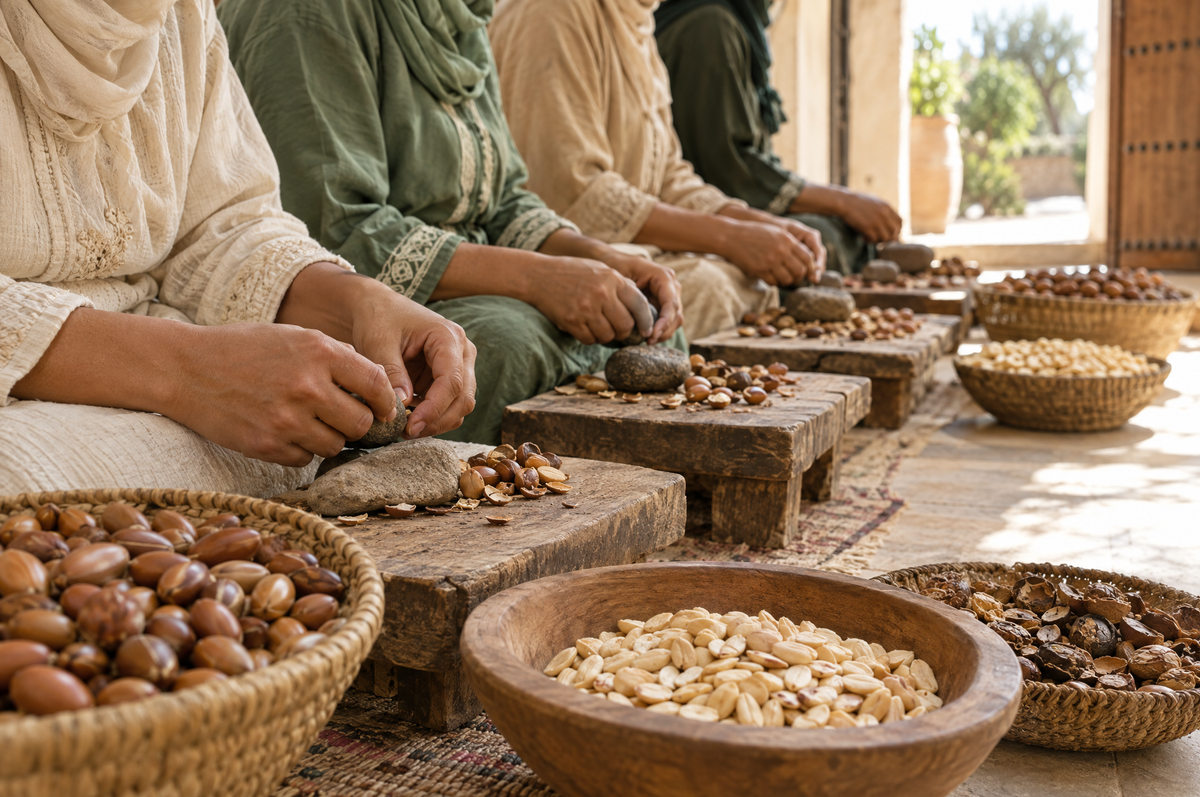
The argan nut is notoriously tough, and cracking it to free the kernels has traditionally been done by hand between two stones. Estimates for fully traditional production range from about 10 to 24 hours of work for a single liter.2,4 Mechanical presses have sped up pressing, but harvesting, drying, pulping and kernel extraction still take many hands. This know-how, carried mainly by rural women, has been recognized by UNESCO as intangible cultural heritage since 2014.5 Our guide to how argan oil is made shows each step.
4. Heritage, people and fair pay
Argan oil is tied to a living rural culture, and international recognition of it has grown: FAO designated an argan-based agro-sylvo-pastoral system in Ait Souab–Ait Mansour as a Globally Important Agricultural Heritage System in 2018, and the UN General Assembly proclaimed 10 May the International Day of Argania in 2021.6,7 Buying from producers who pay fairly for skilled, slow work costs more, and it should.
5. Certification, testing and careful packaging
Organic certification, lab testing for purity and dark glass bottles all add cost. So does shipping a fragile, perishable oil halfway around the world. Unroasted cosmetic argan oil keeps for about a year at room temperature in the dark,4 so producers can't stockpile it indefinitely.
What a too-cheap price signals
Because it's valuable and limited, argan oil is a known target for fraud. Researchers note that as a premium product, argan oil is "highly prone" to partial or total substitution with other vegetable oils,8 and documented adulterants include sunflower, olive, soybean, corn, rapeseed, sweet almond and avocado oils.2 A very low price can mean:
- Dilution with a cheaper oil that looks and feels similar.
- Refined oil, stripped of color, scent and a significant share of its vitamin E.9
- A blend or silicone serum with "argan" in the name and a small amount in the formula.
- Old stock close to, or past, its useful life.
Price isn't proof either way: an expensive bottle can still be poor. But a large bottle at a rock-bottom price deserves suspicion. Our guide to real vs. fake argan oil lists checks you can make at home.
Argan oil price in Morocco
Travelers often expect argan oil to be dramatically cheaper in Morocco, and sometimes it is, especially when bought directly from a cooperative. But many of the inputs above, such as the fruit, the labor and the yield, are the same wherever the oil is sold. Tourist markets also carry a full range of quality, from excellent cooperative oil to diluted or culinary oil sold as cosmetic. If you buy in Morocco, apply the same label, smell and color checks you would at home. Since 2010, Morocco has operated a protected geographical indication reserving the label "Huile d'Argan" for oil from the southwest made to defined specifications, which is one marker of a traceable product.2 We cover buying options, including in Morocco, in Where to Buy Argan Oil.
Cost per use: how far a bottle goes
Argan oil is concentrated, and most uses call for a few drops. A common pharmacy rule of thumb is about 20 drops per milliliter, though droppers vary. On that basis, a 60 mL bottle holds roughly 1,200 drops.
| Routine | Drops per day | Approximate days from 60 mL |
|---|---|---|
| Face only, 2–3 drops morning and night | 5 | About 240 |
| Face plus 1 drop through hair ends | 6 | About 200 |
| Face, hair and nails (1 drop) | 7 | About 170 |
| Face plus body after bathing (5–6 drops) | 10–11 | About 110 |
To compare products fairly, divide the price by the number of drops (bottle volume in mL × 20) to get a cost per drop, then multiply by your daily drops. These are estimates; your dropper, routine and hair length will change the numbers. Keep in mind that unroasted cosmetic oil keeps for only about a year even when stored well,4 so a huge bottle isn't always better value if you'll only use a few drops a day.
Does a higher price mean better oil?
Not automatically. Price reflects branding, packaging and retail markups as much as the oil itself, and a luxury bottle can contain refined or tired oil. What you're really looking for is a price that is plausible for what's claimed. A single-ingredient, organic, cold-pressed oil from Morocco can't be produced for the same cost as a commodity seed oil, so a price close to that of supermarket cooking oil doesn't add up. Equally, a premium price should come with the things that justify it: a named certifier, clear processing information, a batch and date, dark glass and a seller willing to answer questions.
How to judge whether a price is fair
- Check the ingredient list. One ingredient: Argania Spinosa Kernel Oil.
- Check the processing. Cold-pressed from unroasted kernels; see why the extraction method matters.
- Check certification. A named organic certifier if organic is claimed.
- Check freshness. Batch number, best-before date, dark packaging.
- Compare per milliliter. Then sanity-check: is this dramatically cheaper than everything else with the same claims?
- Look for a guarantee. A return policy that covers opened bottles lowers your risk.
With argan oil, the price is mostly paying for time: years for the tree, hours for the hands.
We don't list prices here because they change, but you can see current options for our organic argan oil in Single, Duo (two bottles) and Ritual Set (four bottles) sizes. Each 60 mL bottle is a single ingredient, USDA-certified organic, hand-harvested and cold-pressed in Morocco, and covered by a 30-day money-back guarantee, even if opened. For a full buying checklist, see How to Choose the Best Argan Oil.
Frequently asked questions
Why is argan oil more expensive than other oils?
The argan tree grows almost only in southwestern Morocco, the nuts are very hard and traditionally cracked by hand, and yields are low, around 50 kg of fruit for one liter by traditional methods. Supply is limited and labor costs are high.
Is cheap argan oil fake?
Not always, but a very low price is a common sign of dilution with cheaper oils, refining, or a blend that contains only a little argan. Check the ingredient list, color, scent and certification.
Is argan oil cheaper in Morocco?
It can be, especially direct from cooperatives, but quality varies widely in tourist markets. Apply the same label, color and smell checks you would anywhere else.
How long does a 60 mL bottle of argan oil last?
At about 20 drops per milliliter, a 60 mL bottle holds roughly 1,200 drops. Using 5 drops a day on your face, that's around eight months; adding hair and body use shortens it.
Sources
- UNESCO Man and the Biosphere Programme. Arganeraie Biosphere Reserve, Morocco (designated 1998). Link
- El Maouardi M, Kharbach M, Cherrah Y, De Braekeleer K, Bouklouze A, Vander Heyden Y. Quality control and authentication of argan oils: application of advanced analytical techniques. Molecules. 2023;28(4):1818. Link
- Telmoudi M, Afi C, Chabbi N, et al. Impact of climate and soil on plant dynamics and ecosystem stability in argan orchards. Plants (Basel). 2025;14(5):664. Link
- Gharby S, Charrouf Z. Argan oil: chemical composition, extraction process, and quality control. Front Nutr. 2022;8:804587. Link
- UNESCO Intangible Cultural Heritage. Argan, practices and know-how concerning the argan tree. Inscribed 2014 (9.COM) on the Representative List. Link
- FAO Globally Important Agricultural Heritage Systems. Argan-based agro-sylvo-pastoral system within the area of Ait Souab–Ait Mansour, Morocco (designated 2018). Link
- FAO GIAHS. Discover more: UN International Day of Argania, 10 May. Link
- Amaral JS, Raja FZ, Costa J, et al. Authentication of argan (Argania spinosa L.) oil using novel DNA-based approaches: detection of olive and soybean oils as potential adulterants. Foods. 2022;11(16):2498. Link
- Asbbane A, Bousaid Z, Guillaume D, et al. Effects of physical refining process on quality and stability of argan oil (Argania spinosa (L.) Skeels). Sci Rep. 2024;14:23045. Link