Is Argan Oil Good for Hair? What It Can and Can't Do
Argan oil has been used on hair in Morocco for generations and has become a staple of salon shelves worldwide. That kind of popularity tends to attract exaggeration, and plenty of what you read promises growth, repair and transformation. This guide sorts the claims into what the evidence supports, what is plausible, and what is overstated, so you can decide whether it belongs in your routine.
The short answer
Yes, argan oil is good for most hair as a light leave-in that smooths frizz, adds shine and softness, and helps hold moisture in. Lab studies suggest it reduces protein loss from coloring. It is not proven to grow hair or repair split ends, and too much on the roots can weigh hair down.
Why argan oil is good for hair: what is in it
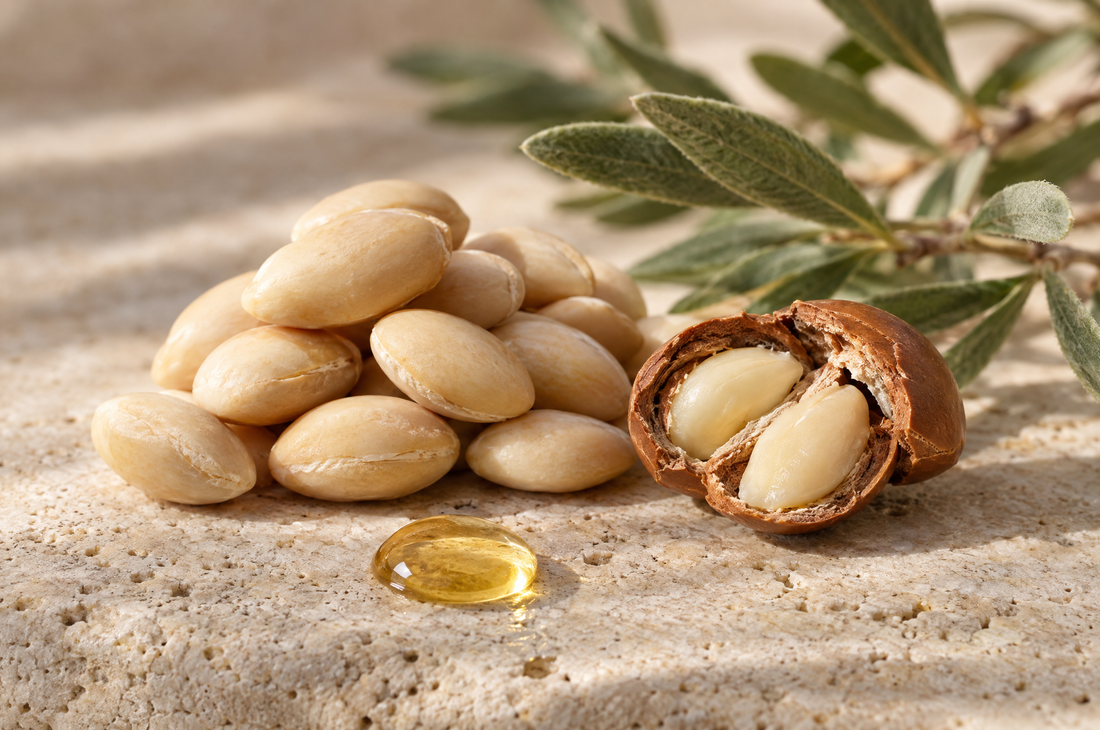
Argan oil is pressed from the kernels of the argan tree, Argania spinosa, which grows in southwestern Morocco. About 80% of its fatty acids are unsaturated, mainly oleic acid (roughly 43–49%) and linoleic acid (roughly 29–37%). It also contains tocopherols, the vitamin E family, dominated by gamma-tocopherol, and an unusual set of plant sterols.1
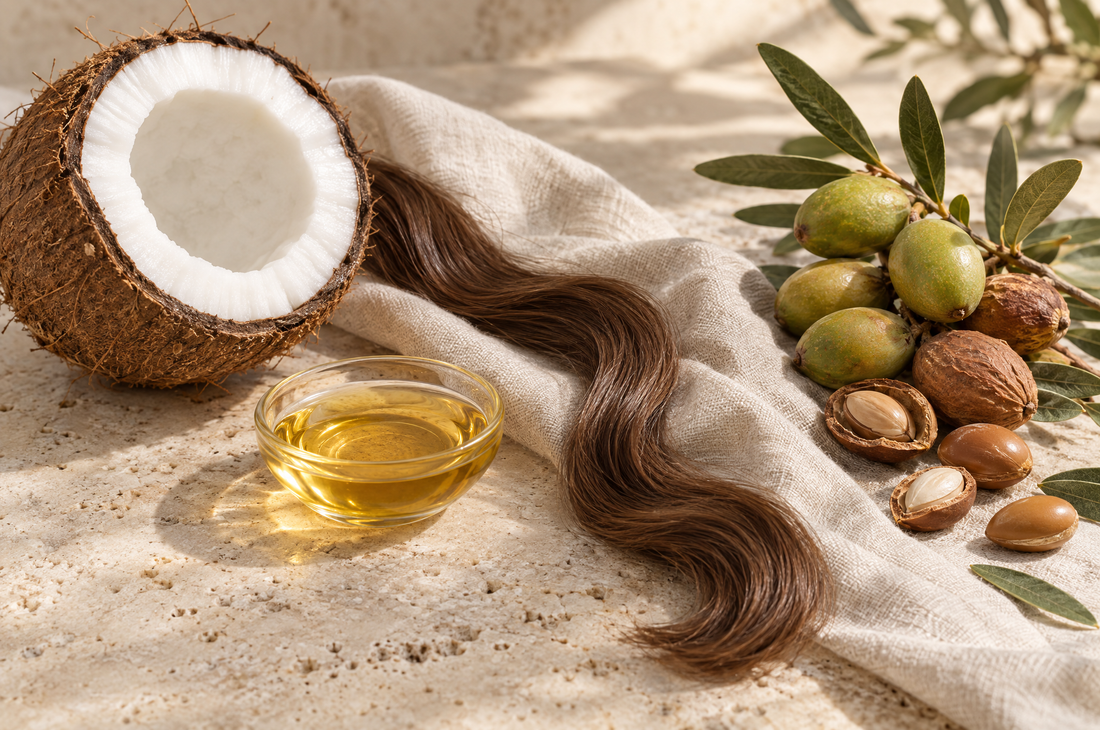
That composition gives argan oil a light, liquid texture that spreads thinly over hair. It also explains its limits: oils rich in unsaturated fatty acids appear to penetrate hair less than coconut oil, whose small, straight lauric acid molecules can enter the hair shaft.2 Argan oil is best thought of as a surface conditioner and sealant, which happens to be exactly what most people want from a hair oil.
Argan oil benefits for hair: what the evidence says
| Claim | Evidence | Verdict |
|---|---|---|
| Reduces frizz | Oil films slow how fast hair absorbs moisture from air3 | Supported (general oil research) |
| Adds shine and softness | Lubricating the cuticle smooths the surface4 | Supported; visible immediately |
| Protects colored or bleached hair | Reduced protein loss in two lab studies5,6 | Promising, lab only |
| Improves hair quality in people | No significant clinical evidence yet7 | Not yet shown |
| Grows hair | No significant clinical evidence7 | Not supported |
| Repairs split ends | Splits can be smoothed, not fused | Not supported |
| Treats dandruff | No evidence; oils may aggravate it | Not supported |
Frizz and humidity
Frizz happens when hair takes up moisture from humid air unevenly. A study of oil-treated hair found that oil films reduced moisture uptake and markedly lowered how quickly water moved in and out of the fiber, an effect the authors compared to moisturizing hair.3 This is the most reliable everyday benefit of a light oil like argan.
Shine, softness and detangling
Conditioning ingredients work partly by lubricating the cuticle, the outer layer of overlapping scales on each hair.4 A thin layer of oil reduces friction between strands, so hair combs more easily and reflects light more evenly. You will see this the first time you use it.
Protection during chemical treatments
Argan oil's most specific evidence comes from coloring. In a 2022 lab study, hair pretreated with argan oil lost significantly less protein when exposed to an oxidizing agent, and the oil stayed on hair even after washing.5 A 2013 study found that a conditioner with 1% argan oil reduced protein loss from hair lightened with oxidative dye.6 More on this in our guide to dry, damaged and bleached hair.
What the reviews conclude
It is worth being clear about the limits. A 2022 systematic review of coconut, castor and argan oils for hair found that argan oil does not have significant clinical evidence for improving hair growth or hair quality.7 A review of traditional hair oils in the International Journal of Trichology noted that the scientific literature is limited and that claims are often exaggerated.8 Argan oil's benefits are real but cosmetic: it makes hair look and behave better. For more on the growth question, see does argan oil help hair grow.
Is argan oil good for your hair type?
Fine or straight hair
Yes, in tiny amounts. One drop on dry ends, or one or two in damp hair from the mid-lengths down. Keep it well away from the roots.
Thick or coarse hair
Usually very good. Three to five drops through damp hair, with a drop or two on dry ends as needed.
Curly and coily hair
Curls tend to run drier, and dermatologists note curly hair needs more conditioning than straight hair.9 Argan oil makes a good sealant in LOC or LCO routines; see our routine for curly hair.
Low porosity hair
Good if applied correctly: after water and a leave-in, on damp hair, a few drops at most. Heavy oil on dry, low porosity hair tends to sit on top.
Oily scalp or dandruff-prone
Use it on the lengths only. Oil on the scalp can aggravate dandruff; we explain why in argan oil for dandruff and dry scalp.
How to use argan oil on hair
- Wash and condition as usual.
- Blot hair with a towel until damp, not dripping.
- Warm a few drops between your palms. Start with one or two for fine or short hair and three to five for long, thick or curly hair.
- Apply from the ends up. Smooth over the ends first, then the mid-lengths. Stop before the roots.
- Style as usual. If you use heat, use a heat protectant as well; argan oil is not one.
- Touch up dry hair with one drop pressed over the ends and flyaways.
- Once a week, try a pre-wash treatment. Apply a little more oil to dry lengths for 30 minutes to overnight, then shampoo out.
This is the routine our own oil is designed for. Our organic argan oil is 100% cold-pressed argan kernel oil from Morocco, USDA-certified organic and free of fragrance and dyes; we suggest one drop through dry ends or a little more in damp hair.
Common mistakes with argan oil for hair
- Using too much. The most common problem by far. Limp, greasy or coated hair means cut back.
- Putting it on the roots and scalp. This flattens volume, and the American Academy of Dermatology notes that oil from hair products can reach the skin, clog pores and cause breakouts along the hairline and forehead.10
- Using it instead of conditioner. Oil seals moisture in; it does not supply it.
- Expecting growth or repair. It protects and smooths the hair you have.
- Buying a blend by mistake. Many "argan" hair products contain mostly silicones or other oils.
How to choose a good argan oil for hair
- Check the ingredient list. It should say only Argania spinosa kernel oil. Anything else is a blend.
- Look for cosmetic, unroasted oil. Cosmetic argan oil is pressed from unroasted kernels and is golden; culinary oil is made from roasted kernels and has a stronger, toasted aroma.1
- Prefer cold-pressed and certified organic. Certification gives you independent assurance about how it was produced.
- Choose dark glass. It protects the oil from light.
- Smell it. Fresh cosmetic argan oil smells faintly nutty. A strong, sharp or rancid smell is a bad sign.
For a deeper checklist, see how to tell real argan oil from fake, or compare options in argan oil vs. coconut oil for hair.
The verdict
Is argan oil good for hair? For most people, yes, as long as you understand what it is: an excellent, lightweight finishing and sealing oil, with some promising lab evidence for protecting hair during coloring. It is not a growth treatment, a dandruff remedy or a cure for split ends. Used a few drops at a time on the lengths, it makes hair softer, shinier and easier to manage, which is what most of us want from it.
Frequently asked questions
Is it good to put argan oil in your hair every day?
Yes, in small amounts. One drop on dry ends or a few drops in damp hair daily is fine for most people. If your hair starts to look limp or greasy, use less or skip a day.
Should I put argan oil on wet or dry hair?
Both work. On damp hair it seals in moisture from washing and conditioning; on dry hair it smooths frizz and adds shine. Use less on dry hair because it spreads less easily.
Can argan oil damage hair?
Argan oil itself is not known to damage hair. Problems come from using too much, which causes limp, greasy hair and buildup, or from applying it to the scalp and hairline in people prone to dandruff or breakouts.
Does argan oil help hair grow?
There is no significant clinical evidence that argan oil makes hair grow. It may help you keep more length by reducing breakage, but thinning or shedding should be checked by a dermatologist.
Is argan oil good for all hair types?
Most hair types can use it, with the amount adjusted. Fine hair needs a drop on the ends; thick, curly and coily hair can use several drops. People with low porosity hair should apply it to damp hair after a leave-in.
Sources
- Gharby S, Charrouf Z. Argan oil: chemical composition, extraction process, and quality control. Front Nutr. 2021;8:804587. Link
- Rele AS, Mohile RB. Effect of mineral oil, sunflower oil, and coconut oil on prevention of hair damage. J Cosmet Sci. 2003;54(2):175–192. Link
- Keis K, Huemmer CL, Kamath YK. Effect of oil films on moisture vapor absorption on human hair. J Cosmet Sci. 2007;58(2):135–145. Link
- Gavazzoni Dias MFR. Hair cosmetics: an overview. Int J Trichology. 2015;7(1):2–15. Link
- Sharifi N, Hamedeyazdan S, Shokri J, Monajjemzadeh F. Argan oil as a pretreatment of human hair before exposure to oxidative damage: attenuated total reflectance and protein loss studies. J Cosmet Dermatol. 2022;21(10):5010–5017. Link
- Faria PM, Camargo LN, Carvalho RSH, Paludetti LA, Velasco MVR, da Gama RM. Hair protective effect of argan oil (Argania spinosa kernel oil) and cupuassu butter (Theobroma grandiflorum seed butter) post treatment with hair dye. J Cosmet Dermatol Sci Appl. 2013;3:40–44. Link
- Phong C, Lee V, Yale K, Sung C, Mesinkovska N. Coconut, castor, and argan oil for hair in skin of color patients: a systematic review. J Drugs Dermatol. 2022;21(7):751–757. Link
- Mysore V, Arghya A. Hair oils: indigenous knowledge revisited. Int J Trichology. 2022;14(3):84–90. Link
- American Academy of Dermatology. Dermatologists' top tips for using leave-in conditioner. Link
- American Academy of Dermatology. Are your hair care products causing breakouts? Link