Culinary vs. Cosmetic Argan Oil: Can You Use One for the Other?
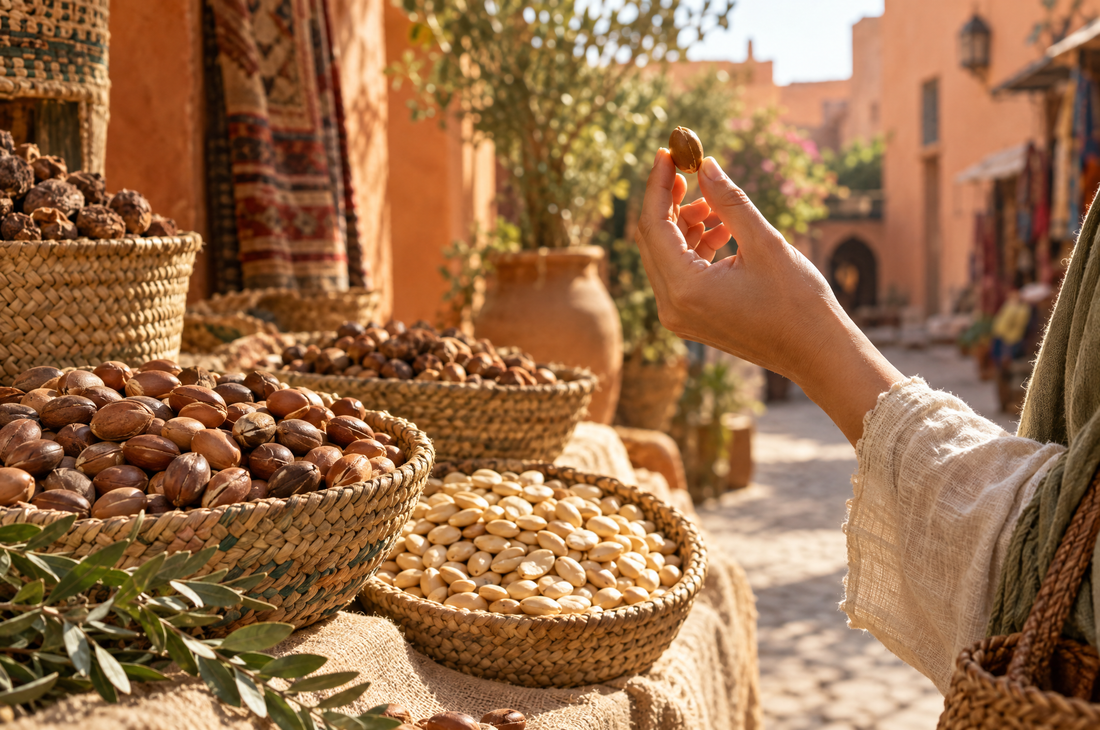
Argan oil lives two lives. In Moroccan kitchens it's a toasty, nutty finishing oil drizzled over couscous or blended into amlou. On bathroom shelves it's a pale, barely scented oil for skin and hair. They come from the same kernels of the same tree, which makes a natural question: if you have a bottle of one, can you use it for the other?
The short answer
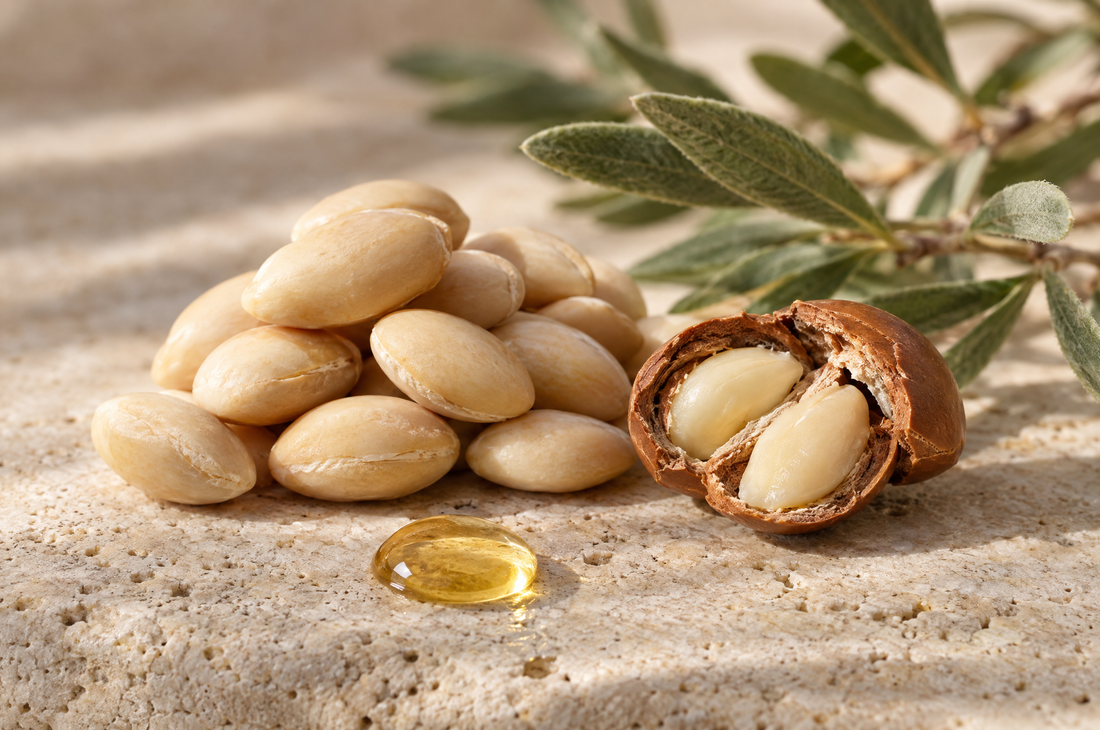
Culinary argan oil is pressed from roasted kernels, so it's darker, smells toasted and has lost some vitamin E; cosmetic oil is cold-pressed from raw kernels. You can put culinary oil on skin in a pinch, but it isn't ideal. Don't eat cosmetic oil, because it's made and labeled as a cosmetic, not a food.
What is culinary argan oil?
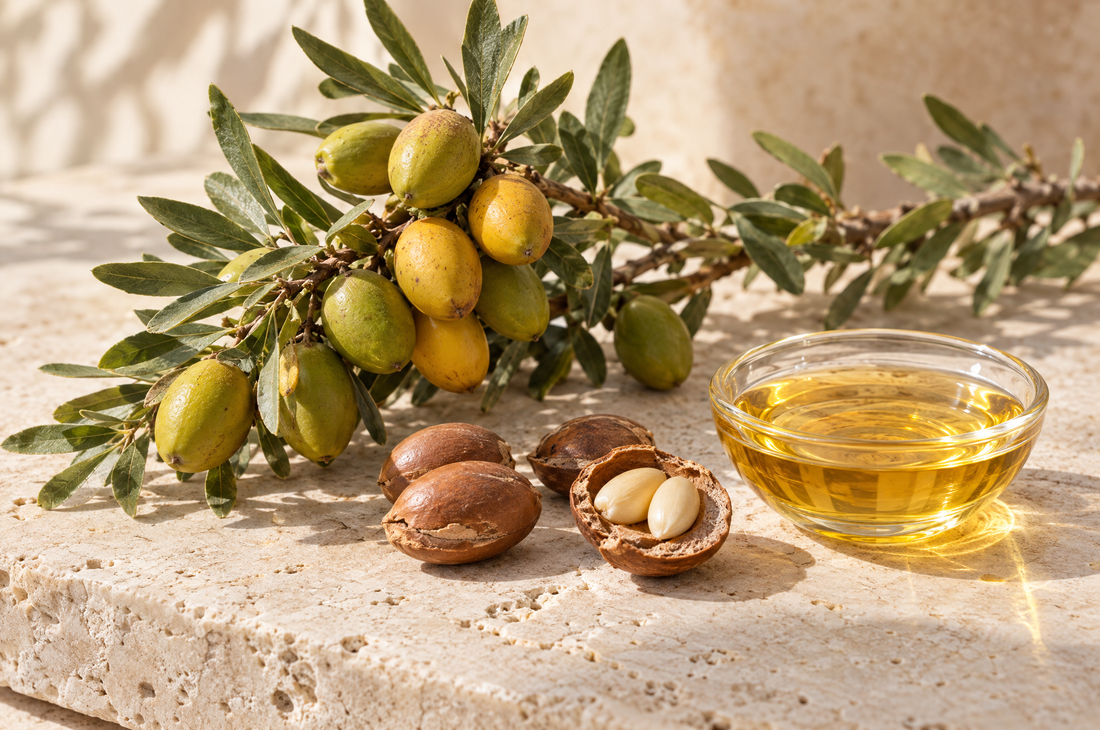
Culinary (food-grade) argan oil is made by roasting argan kernels before pressing them. The roasting gives the oil a copper color and a hazelnut flavor and aroma, and compounds formed during roasting help preserve it.1 Cosmetic argan oil is cold-pressed from unroasted kernels and is gold in color.1 Both are virgin, unrefined argan oil; the only meaningful step between them is a few minutes in the roaster. Our explainer on cold-pressed argan oil goes into the extraction methods.
Food use is the older tradition. UNESCO's description of the argan heritage notes that the oil serves culinary, medicinal and cosmetic purposes, is given as a wedding gift and features in festive meals.2
Culinary vs. cosmetic argan oil at a glance
| Culinary argan oil | Cosmetic argan oil | |
|---|---|---|
| Kernels | Roasted | Unroasted (raw) |
| Color | Copper to amber | Pale to medium gold |
| Aroma | Toasted, hazelnut-like | Faint, nutty, earthy |
| Vitamin E (tocopherols) | Similar after gentle roasting; lower after hot roasting | Retains original levels |
| Shelf life (about 25 °C, dark) | About 2 years | About 1 year |
| Intended use | Food | Skin, hair, nails |
Shelf-life estimates are from a review of argan oil quality.1
What roasting changes
Flavor and color
Above roughly 100 °C, browning (Maillard-type) reactions darken the oil and develop the hazelnut flavor of edible argan oil.3 The same study recommended roasting at 125–150 °C for about 10 minutes to develop flavor without hurting stability.3
Vitamin E
Argan oil's tocopherols are heat-sensitive. In that same research, total tocopherols dropped from about 978 to 305 mg/kg after 10 minutes at 175 °C.3 Gentler roasting is far less damaging: another study found that roasting for 15 to 30 minutes at 110 °C left tocopherol levels unchanged.4 So culinary oil isn't necessarily low in vitamin E; it depends on how hot the roast was.
Stability
Counterintuitively, roasted oil keeps longer. Oil from roasted kernels pressed with a screw press showed the highest oxidative stability in accelerated tests, and oil from unroasted kernels started out significantly less stable.5 The fatty acid profile itself barely changes with roasting.3
Can I use culinary argan oil on my skin?
You can, and it won't harm most people, but it's a compromise. Here's why cosmetic oil is the better choice for skin:
- The smell. Roasted argan oil smells like toasted nuts, and that scent lingers on the face in a way the faint aroma of cosmetic oil doesn't. More on scent in What Does Argan Oil Smell Like?
- The color. Darker oil can look slightly tinted on very fair skin or light fabrics.
- Possibly less vitamin E. Hot-roasted oil can carry substantially fewer tocopherols.3
- The evidence base. The small human studies on topical argan oil used cosmetic-grade oil. In a 60-day trial in 60 postmenopausal women, nightly topical cosmetic argan oil on the forearm was associated with improved skin elasticity and hydration measurements.6,7
If culinary oil is all you have, patch test it first on the inner arm and use just a drop or two.
Is culinary argan oil good for hair?
It will smooth hair in the same way any light oil does, but the toasted smell is the deal-breaker for most people; hair holds scent all day. Controlled research on argan oil for hair is limited in any form.8 For hair, use a cold-pressed cosmetic oil, and see How to Use Argan Oil for Hair for technique.
Can I eat cosmetic argan oil?
We'd advise against it. Cosmetic argan oil, including ours, is produced, packaged and labeled as a cosmetic, not as a food, and it isn't made or tested to food standards. If you want argan oil in your diet, buy a culinary oil sold as food. That's also the oil you'll actually enjoy eating: unroasted oil tastes flat and slightly raw compared with the rich, nutty roasted kind.
Culinary argan oil benefits: what dietary studies show
Most of the research on eating argan oil focuses on heart health markers. A 2018 meta-analysis pooled five randomized controlled trials with 292 participants and found that argan oil supplementation was associated with lower total cholesterol, LDL cholesterol and triglycerides and higher HDL cholesterol compared with control treatments.9 The authors called for larger trials, and with only five small studies, it's a modest evidence base rather than a settled conclusion.
There's also intriguing evidence linking dietary argan oil to skin. In the Moroccan postmenopausal trial mentioned above, women who consumed 25 mL of culinary argan oil a day for 60 days showed improved elasticity and hydration on an untreated forearm, while a comparison group consuming olive oil did not.6,7 That was one small, open-label study, so it's a promising lead rather than a reason to drink oil for your complexion.
A 2010 review of argan oil's therapeutic potential summed up the bigger picture well: many effects are under investigation, but a lack of clinical data is a serious weakness.10 Enjoy culinary argan oil as a delicious, traditional fat, not as a medicine. Our article on health benefits of argan oil covers more of this research.
How culinary argan oil is used in Morocco
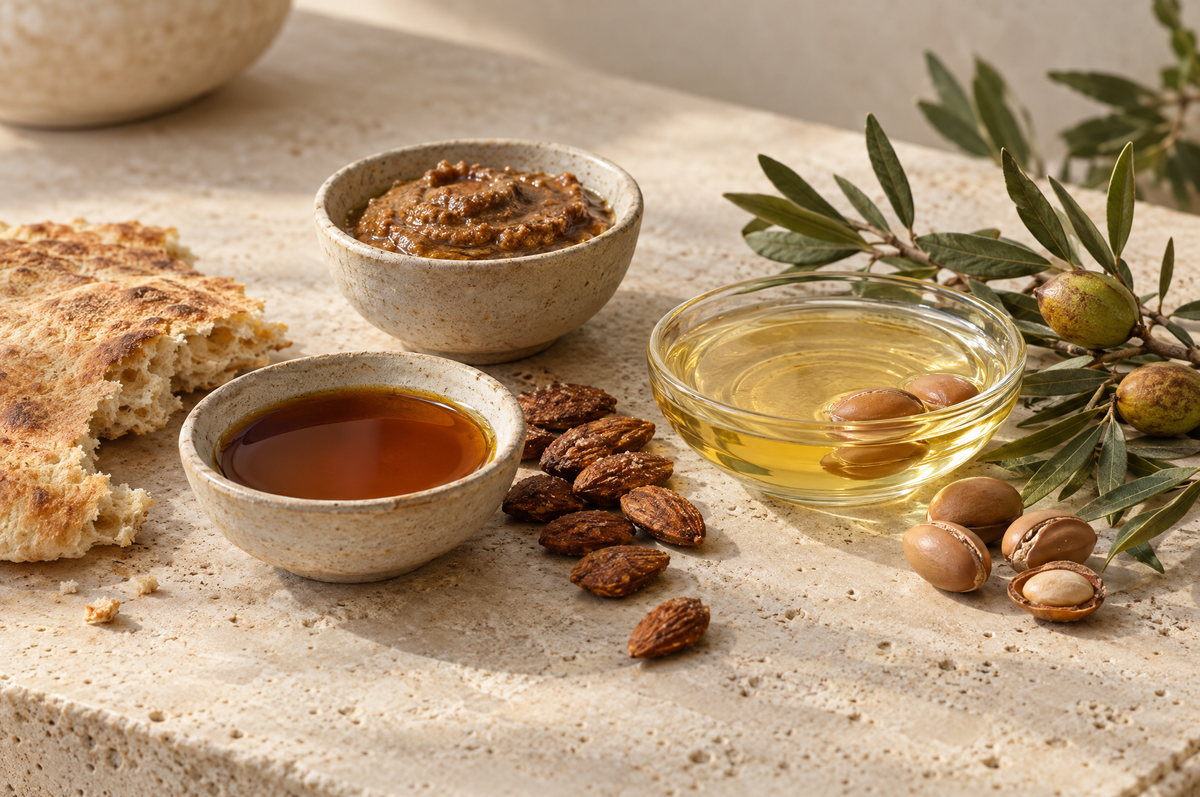
Traditionally, roasted argan oil is used raw, as a finishing oil, so its delicate flavor isn't cooked away. The best-known preparation is amlou, a spread from the Souss region made from three ingredients: argan oil, roasted almonds and honey.11 Common ways to use it at home:
- Drizzle it over couscous, tagines or grilled vegetables just before serving.
- Dip bread in a small dish of it, sometimes with honey alongside.
- Dress salads with argan oil and lemon.
- Make amlou by blending roasted almonds with argan oil and honey into a spread.
How to tell which one you have
If you've been given an unlabeled bottle from a trip to Morocco, or you're not sure what you bought, a few simple checks help:
- Color: copper or deep amber points to culinary; pale to medium gold points to cosmetic.
- Smell: a clear toasted, roasted-nut aroma means culinary. Cosmetic oil smells faint, nutty and slightly earthy.
- Taste: only if you know it was sold as food. Culinary oil tastes rich and nutty; unroasted oil tastes mild and a little raw.
- Label: food-grade oil should carry food labeling; cosmetic oil usually lists Argania Spinosa Kernel Oil as its ingredient.
When in doubt, treat an unknown bottle as cosmetic-only and keep it out of the kitchen. If you're curious about where both kinds come from, see How Argan Oil Is Made.
Which one should you buy?
Buy the oil for the job. For cooking, look for food-grade roasted argan oil with a nutty aroma and a best-before date. For skin, hair and nails, look for cold-pressed oil from unroasted kernels, ideally a single ingredient and certified organic; our guide to choosing the best argan oil has a full checklist. Our organic cosmetic argan oil is cold-pressed from unroasted kernels with no fragrance, made for face, hair, nails and body, not for the kitchen.
Frequently asked questions
What is the difference between culinary and cosmetic argan oil?
Culinary argan oil is pressed from roasted kernels, so it is darker, toasty-smelling and nutty-tasting. Cosmetic argan oil is cold-pressed from unroasted kernels and is pale gold with a faint scent.
Can I use culinary argan oil on my face?
You can in a pinch, but the toasted smell lingers and hot-roasted oil may contain less vitamin E. A cold-pressed cosmetic oil is a better choice for regular use on skin.
Can you cook with argan oil?
Culinary argan oil is traditionally used raw as a finishing oil, drizzled over dishes or used for dipping, so its flavor isn't lost to heat. Don't cook with cosmetic argan oil.
What does culinary argan oil taste like?
It has a toasted, nutty flavor often compared with hazelnut, which comes from roasting the kernels before pressing.
Sources
- Gharby S, Charrouf Z. Argan oil: chemical composition, extraction process, and quality control. Front Nutr. 2022;8:804587. Link
- UNESCO Intangible Cultural Heritage. Argan, practices and know-how concerning the argan tree. Inscribed 2014 (9.COM) on the Representative List. Link
- Belcadi-Haloui R, Zekhnini A, El-Alem Y, Hatimi A. Effects of roasting temperature and time on the chemical composition of argan oil. Int J Food Sci. 2018;2018:7683041. Link
- Harhar H, Gharby S, Kartah B, El Monfalouti H, Guillaume D, Charrouf Z. Influence of argan kernel roasting-time on virgin argan oil composition and oxidative stability. Plant Foods Hum Nutr. 2011;66(2):163–168. Link
- Matthäus B. Quality parameters for cold pressed edible argan oils. Nat Prod Commun. 2013;8(1):37–41. Link
- Boucetta KQ, Charrouf Z, Aguenaou H, Derouiche A, Bensouda Y. The effect of dietary and/or cosmetic argan oil on postmenopausal skin elasticity. Clin Interv Aging. 2015;10:339–349. Link
- Boucetta KQ, Charrouf Z, Derouiche A, Rahali Y, Bensouda Y. Skin hydration in postmenopausal women: argan oil benefit with oral and/or topical use. Prz Menopauzalny. 2014;13(5):280–288. Link
- Phong C, Lee V, Yale K, Sung C, Mesinkovska N. Coconut, castor, and argan oil for hair in skin of color patients: a systematic review. J Drugs Dermatol. 2022;21(7):751–757. Link
- Ursoniu S, Sahebkar A, Serban MC, Banach M; Lipid and Blood Pressure Meta-analysis Collaboration Group. The impact of argan oil on plasma lipids in humans: systematic review and meta-analysis of randomized controlled trials. Phytother Res. 2018;32(3):377–383. Link
- Monfalouti HE, Guillaume D, Denhez C, Charrouf Z. Therapeutic potential of argan oil: a review. J Pharm Pharmacol. 2010;62(12):1669–1675. Link
- Ait Bouzid H, Nouisse AA, Hallouch O, et al. Amlou inspired spread: formulation and characterization of new spread based on Ziziphus lotus L. fruit, argan oil, and honey. Heliyon. 2024;10(14):e34002. Link