Organic Argan Oil: What the Certification Actually Guarantees
"Organic" is one of the most common words on an argan oil label, and one of the least explained. Argan trees aren't grown in neat orchards sprayed on a schedule; most grow in a vast, semi-wild forest in southwestern Morocco. So what does certification add, and is certified organic argan oil worth choosing? Here is what the rules actually require, in plain language.
The short answer
Certified organic argan oil comes from trees on land free of prohibited substances, is handled without banned synthetic solvents or processing aids, and is tracked through a certified supply chain. Certification doesn't measure purity, freshness or potency, so still check for a single ingredient, cold pressing and a recent date.
How USDA organic labeling works
In the US, the word "organic" on food and agricultural products is regulated by the USDA's National Organic Program. The FDA, which regulates cosmetics, doesn't define "organic" itself; it explains that cosmetics using agricultural ingredients can be certified under the USDA program and must also meet FDA cosmetic rules.1 Products fall into labeling tiers based on how much of the content, excluding water and salt, is organic:2
| Label | Organic content | USDA seal allowed? |
|---|---|---|
| "100 percent organic" | 100% organically produced ingredients | Yes |
| "Organic" | At least 95% | Yes |
| "Made with organic (ingredient)" | At least 70% | No3 |
| Under 70% | Organic ingredients may be identified in the ingredient statement | No4 |
Products labeled "100 percent organic" or "organic" may carry the USDA seal and must state "Certified organic by" followed by the name of the certifying agent.5 "Made with organic" products can't show the seal, and products under 70% organic can't show the USDA seal or a certifier's organic logo at all.3,4 That makes the seal a useful shortcut: if you see it, at least 95% of the product's content is certified organic. For a single-ingredient argan oil, the honest claim is simple: the one ingredient is certified organic argan oil. Watch for wording like "made with organic argan oil" on hair serums and lotions, which tells you argan is one ingredient among several and that up to 30% of the content may not be organic.
What does "organic" mean for wild argan trees?
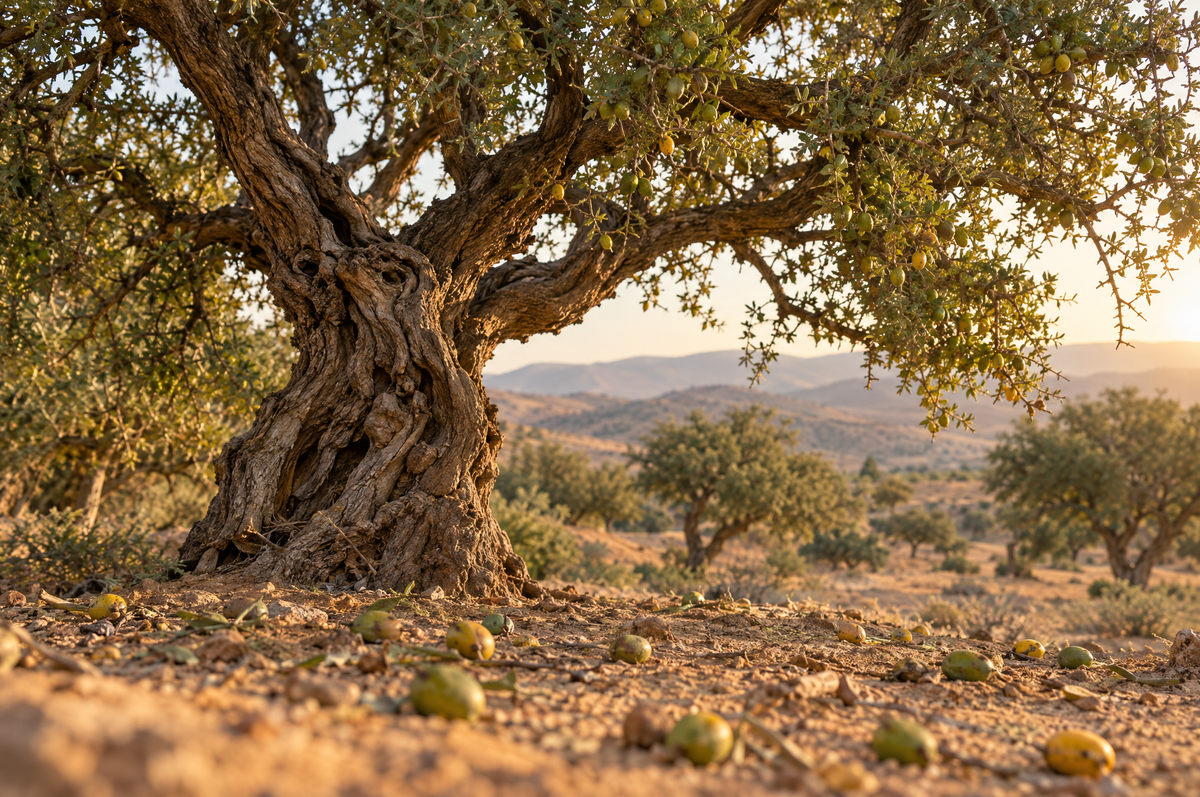
This is the part most labels skip. The argan tree is endemic to southwestern Morocco, where UNESCO designated the Arganeraie Biosphere Reserve in 1998.6 Much of the oil comes from trees in this forest, and in traditional agroforestry systems where argan grows alongside crops and grazing land on dry stone terraces.7
USDA rules include a specific standard for wild crops. A wild crop sold as organic must be harvested from a designated area that has had no prohibited substances applied for the three years before harvest, and it must be gathered in a way that isn't destructive to the environment and sustains the growth and production of the crop.8 In practice, that means organic certification of argan is less about swapping pesticides for natural alternatives and more about documented land, sustainable harvesting and a traceable chain from tree to bottle.
What organic certification guarantees
No prohibited substances or methods
Organic products must be produced without most synthetic substances, without genetically engineered (excluded) methods, without ionizing radiation and without sewage sludge, with narrow listed exceptions.9
No volatile synthetic solvents in handling
Handlers can use mechanical and biological methods such as pressing, grinding, drying and extracting, but not a volatile synthetic solvent or other synthetic processing aid that isn't on the approved list for products labeled organic.10 That matters for oils, because solvent extraction is a common industrial way to squeeze more oil from seeds. Solvent extraction of argan kernels yields more oil than pressing, about 50–55% versus around 45% for mechanical pressing, according to one review.11 A certified organic argan oil should be pressed, not solvent-extracted.
An audited supply chain
Because the certifier must be named on the label,5 there's a specific organization accountable for the claim, which you can look up.
What organic certification doesn't guarantee
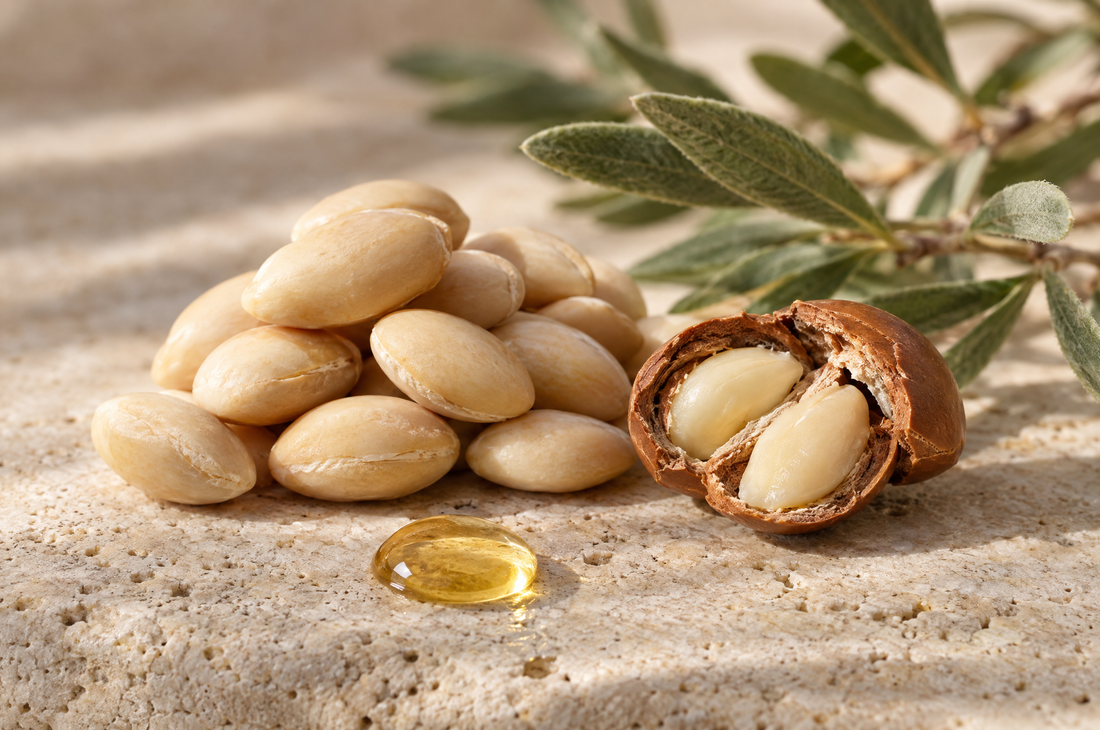
- That the oil is cold-pressed and unroasted. Organic culinary oil from roasted kernels is still organic. The cosmetic grade is cold-pressed from unroasted kernels and is gold rather than copper.12 See Cold-Pressed Argan Oil: Why the Extraction Method Matters.
- That it's unrefined. Refining (bleaching and deodorizing to strip color and scent) is a separate step from extraction, and refined argan oil loses a meaningful share of its vitamin E.13
- That it's fresh. Unroasted cosmetic argan oil keeps about a year at 25 °C, away from light.12 Organic oil can go rancid like any other.
- That it's safer or gentler. The FDA is explicit that an ingredient's source does not determine its safety, and that plants, organic or not, can contain allergenic substances.1 If you have sensitive skin, patch test regardless. Our article on whether argan oil can irritate skin covers that.
- That it's single-ingredient. An "organic" product can be 95% organic content; a "made with organic argan oil" product can be a blend. Read the ingredient list. Our guide to what "100% pure argan oil" means shows how.
USDA organic vs. COSMOS and Ecocert
Outside the US, you'll often see COSMOS logos. COSMOS is an international standard for organic and natural cosmetics, managed by a Brussels-based nonprofit founded by five European certifiers: BDIH, Cosmebio, Ecocert, ICEA and the Soil Association.14 It has two product signatures, COSMOS ORGANIC and COSMOS NATURAL, and certifies raw materials as COSMOS CERTIFIED (with organic content) or COSMOS APPROVED.14 Ecocert is a certifier rather than a standard, so an "Ecocert" mark on argan oil usually means the oil was certified to COSMOS or another organic standard by Ecocert.
For US shoppers, USDA organic is the claim with legal teeth on American labels. For a single-ingredient oil, both USDA organic and COSMOS ORGANIC are meaningful; what matters most is that a certifier is named and you can verify it.
Why organic matters for a leave-on oil
Argan oil is something you leave on your face, hair and hands, often daily. Choosing a certified organic oil is a reasonable way to reduce the chance of agricultural residues and to support harvesting standards designed to sustain the forest. It also aligns with the long tradition behind argan: UNESCO has recognized the practices and know-how surrounding the argan tree, largely held and passed on by rural women, as intangible cultural heritage since 2014.15 You can read more about that landscape in Where Does Argan Oil Come From?
Organic tells you how the oil was grown and handled. The label, the color and the smell tell you the rest.
Organic argan oil for hair and skin: how to use it
Certified or not, argan oil is used the same way. For hair, start with a single drop through dry ends, or a little more through damp hair before styling. For the face, press 2 to 3 drops into skin as the last step of your routine. For a fuller technique guide, see How to Use Argan Oil for Hair.
How to check an organic argan oil claim
- Find the certifier. Look for "Certified organic by" and a name.
- Check the tier. "100 percent organic" or "organic" with the USDA seal is stronger than "made with organic argan oil."
- Read the ingredients. Ideally one: organic Argania Spinosa Kernel Oil.
- Check processing. Cold-pressed, unroasted, unrefined.
- Check the date. Look for a batch number and best-before date.
Our USDA-certified organic argan oil is a single ingredient, cold-pressed from unroasted kernels, hand-harvested in Morocco and bottled in amber glass. For the complete buying checklist, see How to Choose the Best Argan Oil.
Frequently asked questions
Is organic argan oil better than non-organic?
Organic certification confirms the oil was produced and handled under audited rules, including no prohibited substances or synthetic solvents. It doesn't make the oil fresher, purer or more effective, so check processing and freshness too.
What does USDA organic mean on argan oil?
It means the argan oil was certified under the USDA National Organic Program. Products labeled "100 percent organic" or "organic" can carry the USDA seal and must name their certifying agent.
Can argan oil be organic if the trees grow wild?
Yes. USDA rules include a wild-crop standard: the harvest area must have had no prohibited substances for three years, and harvesting must sustain the crop and not harm the environment.
Is organic argan oil good for hair?
It's used the same way as any pure argan oil, typically a drop or two through the ends to soften and smooth. Certification affects how it's produced, not how it performs on hair.
Sources
- U.S. Food and Drug Administration. "Organic" cosmetics. Link
- Electronic Code of Federal Regulations. 7 CFR § 205.301 — Product composition (USDA National Organic Program). Link
- Electronic Code of Federal Regulations. 7 CFR § 205.304 — Packaged products labeled "made with organic (specified ingredients or food group(s))." Link
- Electronic Code of Federal Regulations. 7 CFR § 205.305 — Multi-ingredient packaged products with less than 70 percent organically produced ingredients. Link
- Electronic Code of Federal Regulations. 7 CFR § 205.303 — Packaged products labeled "100 percent organic" or "organic." Link
- UNESCO Man and the Biosphere Programme. Arganeraie Biosphere Reserve, Morocco (designated 1998). Link
- FAO Globally Important Agricultural Heritage Systems. Argan-based agro-sylvo-pastoral system within the area of Ait Souab–Ait Mansour, Morocco (designated 2018). Link
- Electronic Code of Federal Regulations. 7 CFR § 205.207 — Wild-crop harvesting practice standard. Link
- Electronic Code of Federal Regulations. 7 CFR § 205.105 — Allowed and prohibited substances, methods, and ingredients in organic production and handling. Link
- Electronic Code of Federal Regulations. 7 CFR § 205.270 — Organic handling requirements. Link
- El Maouardi M, Kharbach M, Cherrah Y, De Braekeleer K, Bouklouze A, Vander Heyden Y. Quality control and authentication of argan oils: application of advanced analytical techniques. Molecules. 2023;28(4):1818. Link
- Gharby S, Charrouf Z. Argan oil: chemical composition, extraction process, and quality control. Front Nutr. 2022;8:804587. Link
- Asbbane A, Bousaid Z, Guillaume D, et al. Effects of physical refining process on quality and stability of argan oil (Argania spinosa (L.) Skeels). Sci Rep. 2024;14:23045. Link
- COSMOS-standard AISBL. The COSMOS standard for organic and natural cosmetics. Link
- UNESCO Intangible Cultural Heritage. Argan, practices and know-how concerning the argan tree. Inscribed 2014 (9.COM) on the Representative List. Link