Cold-Pressed Argan Oil: Why the Extraction Method Matters
Most argan oil labels say "cold-pressed," and most shoppers take it as a quality stamp without knowing quite what it means. The extraction method genuinely matters, but not always in the way marketing suggests. Roasting, pressing and solvent extraction each leave a fingerprint on the oil's color, scent, vitamin E content and shelf life, and researchers in Morocco have measured those differences in detail.
The short answer
Cosmetic argan oil is normally cold-pressed: kernels are pressed mechanically without roasting or added heat, giving a gold, mild-smelling oil. Culinary argan oil is pressed from roasted kernels. Solvent extraction gets more oil out but isn't used for quality virgin oil. For skin and hair, choose cold-pressed oil from unroasted kernels.
Is argan oil cold pressed?
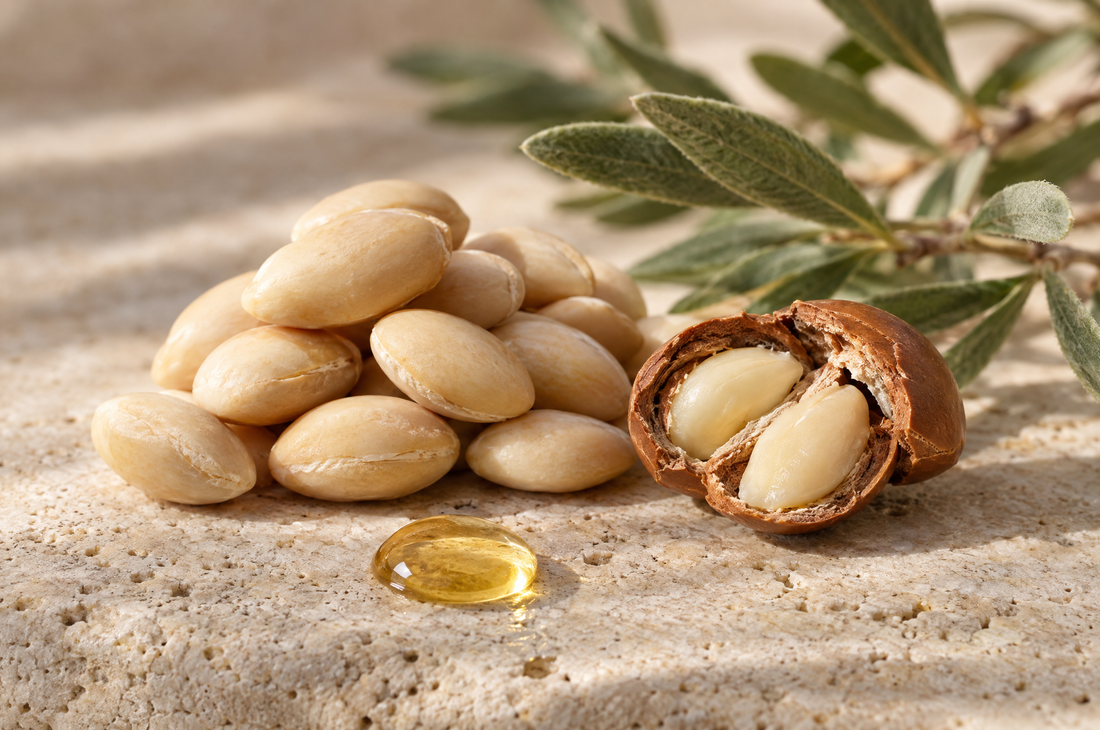
Good cosmetic argan oil is. It is extracted by pressing unroasted kernels, which produces the gold-colored oil used directly on skin and hair or in cosmetic formulas.1 Culinary argan oil is also pressed, but from kernels that have been roasted first, which is what gives it its copper color and hazelnut flavor.1 Both can be called virgin argan oil. "Cold-pressed" on a cosmetic bottle should tell you that the kernels weren't roasted and that no heat was deliberately added during pressing.
It's worth knowing what "cold" does and doesn't mean. A screw press creates some friction, so the oil isn't literally cold as it leaves the machine; the term means no external heat is applied to the kernels or the press to push out more oil. The bigger question for argan is whether the kernels were roasted beforehand, because that step changes the oil far more than pressing does. When a label says "cold-pressed" but the oil is deep copper and smells strongly toasted, the kernels were almost certainly roasted, which makes it a culinary oil whatever the front of the bottle says.
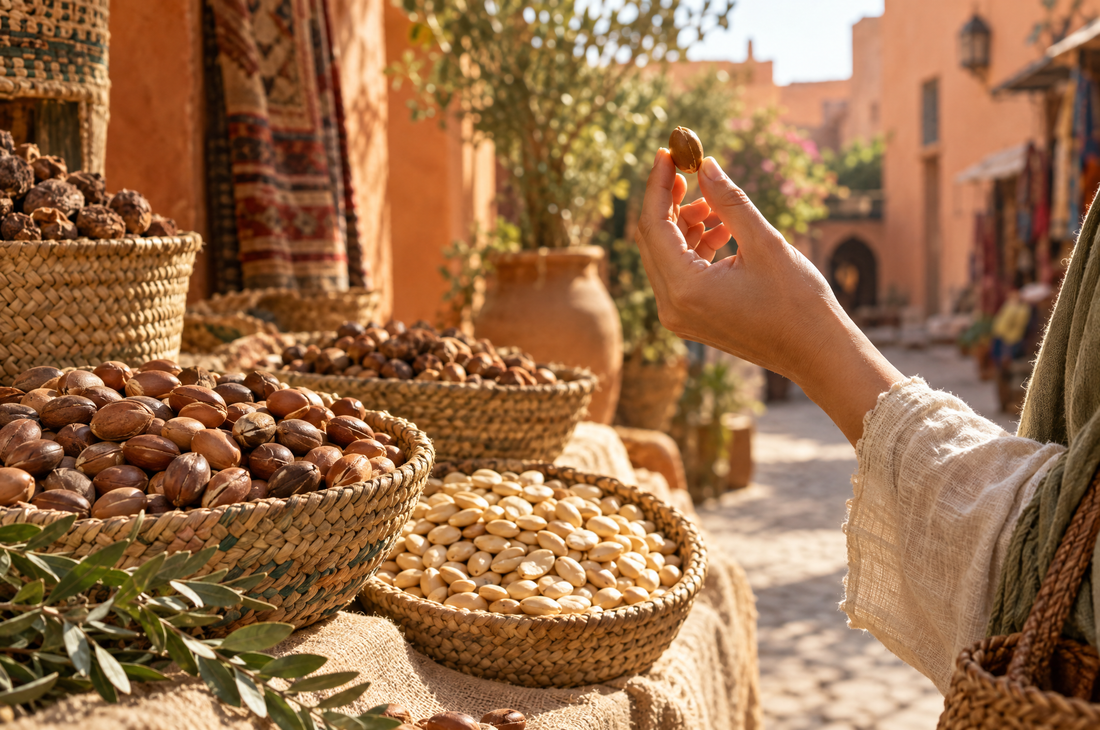
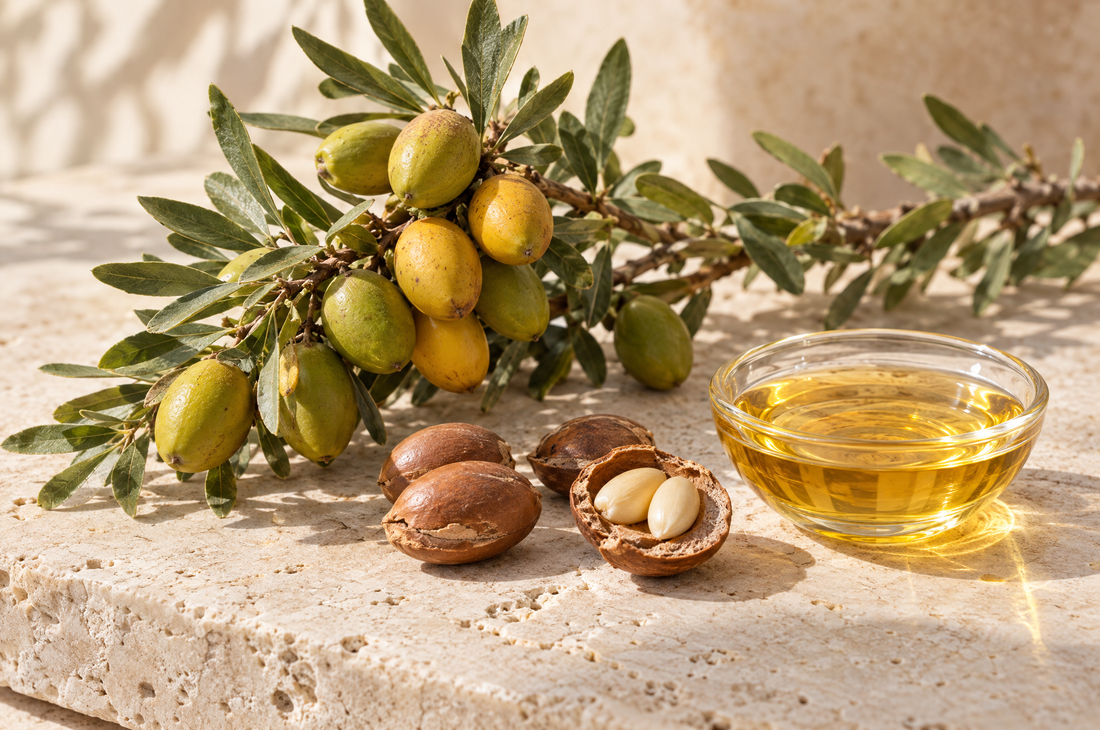
Before any pressing happens, the process is the same: the fruit is harvested and dried, the pulp is removed, and the very hard nuts are cracked, traditionally by hand between two stones, to free the small kernels inside. UNESCO's description of the traditional know-how lists the steps as harvesting, drying, pulping, grinding, sorting, milling and mixing.2 Our guide to how argan oil is made walks through each stage.
Three ways to extract argan oil
Traditional hand extraction
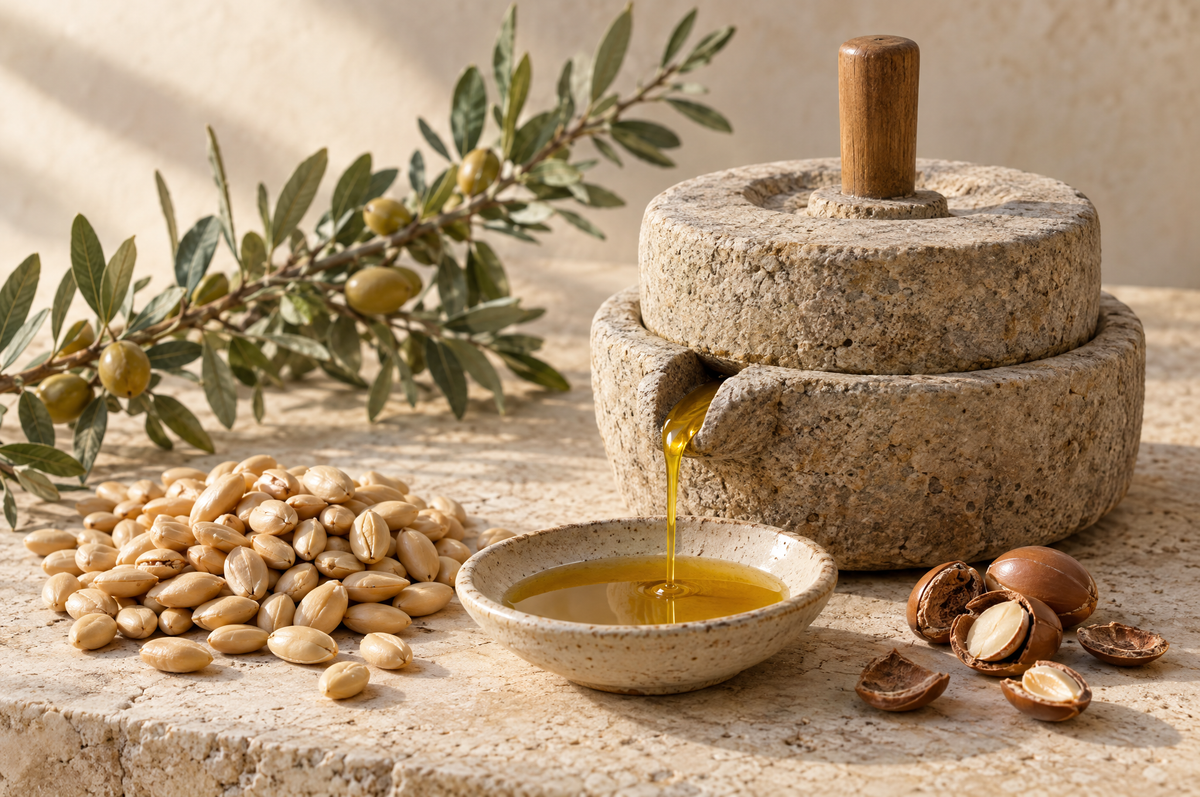
In the traditional method, kernels are roasted, ground into a paste on a stone hand mill, and kneaded with water to release the oil. It produces roasted, culinary-style oil, and it's slow: estimates range from about 10 to 24 hours of work for a single liter, from roughly 50 kg of fruit.3,1 The yield is low, around 30%, and even after extraction the leftover paste can still hold up to 25% oil.3,1 This method carries enormous cultural weight, and UNESCO has recognized the argan know-how held largely by rural women as intangible cultural heritage.2 It isn't, however, how cosmetic oil is usually made today.

Mechanical pressing
Modern cooperatives use mechanical presses, which skip the water-kneading step and give more consistent quality.1 Yield rises to about 45%.3 Kernels can be pressed raw for cosmetic oil or after roasting for culinary oil. This is what "cold-pressed argan oil" almost always refers to: mechanically pressed, unroasted kernels.
Solvent extraction
Industrial solvent extraction gets the most oil out, about 50–55% yield.3 That efficiency is why it's used for many commodity seed oils. But solvent-extracted oil generally needs refining afterward, and it isn't what you want in a bottle sold as virgin argan oil. If your oil is certified organic in the US, the rules prohibit volatile synthetic solvents in handling organic-labeled products.4 Our guide to organic argan oil explains what else certification covers.
Mechanically pressed vs. solvent extracted vs. hand-made: a comparison
| Method | Approximate yield | Typical product | Notes |
|---|---|---|---|
| Traditional hand extraction | ~30% | Roasted, culinary-style oil | Very labor-intensive; culturally significant |
| Mechanical press, unroasted kernels | ~45% | Cosmetic (cold-pressed) oil, gold | Mild scent; shorter shelf life |
| Mechanical press, roasted kernels | ~45% | Culinary oil, copper | Nutty flavor; longer shelf life |
| Solvent extraction | ~50–55% | Industrial oil, usually refined | Not used for quality virgin oil |
Yields are from a 2023 review of argan oil quality control.3
What roasting does to the oil
Roasting is the biggest processing difference between argan oils, and the research shows a genuine trade-off.
It reduces vitamin E
Argan oil's tocopherols, mostly gamma-tocopherol, are heat-sensitive. One study roasted kernels at temperatures from 75 to 175 °C and found total tocopherols fell from about 978 mg/kg to 305 mg/kg after 10 minutes at 175 °C, while the fatty acid profile barely changed.5 Gentler roasting is less damaging: another study found roasting for 15 to 30 minutes at 110 °C preserved the oil's tocopherol levels and fatty acid composition.6 Read more about these compounds in What's in Argan Oil?
It builds flavor and color
Above about 100 °C, browning reactions darken the oil and create the toasted, hazelnut aroma prized in Moroccan cooking.5 Pleasant on bread; not ideal on your face. We cover the differences in Culinary vs. Cosmetic Argan Oil.
It actually improves shelf life
Here is the counterintuitive part. Roasted oil resists oxidation better than unroasted oil. In accelerated testing, oil from roasted kernels pressed with a screw press showed the highest oxidative stability, while oil from unroasted kernels started with significantly lower stability.7 Another review reported an induction time (a measure of resistance to oxidation) of about 31 hours for food oil versus 13 hours for cosmetic oil, and estimated shelf lives of about two years and one year respectively at 25 °C.1 Compounds formed during roasting appear to help protect the oil.1
Cold-pressed cosmetic oil keeps more of its vitamin E, but it asks more of you in return: keep it cool, dark and use it within the year.
What about refining?
Some cosmetic suppliers go further and refine argan oil to remove its color and scent. That isn't pressing, but it changes the oil just as much. A 2024 study of oil from lower-grade kernels found that bleaching and deodorization removed about a quarter of its tocopherols, and over 12 weeks of accelerated storage at 60 °C the refined oil lost 92% of its tocopherols compared with 34% for the unrefined oil.8 A cold-pressed oil that has then been refined has lost much of what made cold pressing worthwhile, so look for "unrefined" or "virgin" alongside "cold-pressed."
Cold-pressed argan oil for hair and skin
Does the method change how the oil works on hair? For hair, any pure argan oil works as a light smoothing and finishing oil, and controlled research on argan oil and hair is limited.9 The reasons to prefer cold-pressed cosmetic oil are practical: it smells mild rather than toasted, it's lighter in color, and it hasn't lost tocopherols to roasting. For skin, the small human studies on argan oil's moisturizing and elasticity effects, done in postmenopausal women, used cosmetic-grade oil applied topically to the forearm.10
How to look after cold-pressed argan oil
- Store it in the dark. Argan oil keeps best sheltered from light at around room temperature.1 An amber bottle in a drawer or cabinet is ideal.
- Close it tightly. Air speeds oxidation.
- Keep it away from heat. Not on a sunny windowsill or next to the shower.
- Use it within its date. For unroasted oil, plan on about a year. Our article on whether argan oil expires explains how to tell if it has turned.
- Trust your nose. If a once-mild oil starts to smell sharp or stale, retire it.
Our organic argan oil is cold-pressed from unroasted kernels using traditional methods, hand-harvested in Morocco, and bottled in amber glass to protect it from light.
Frequently asked questions
Is all argan oil cold pressed?
No. Cosmetic argan oil is usually cold-pressed from unroasted kernels, but culinary oil is pressed from roasted kernels, and industrial oil may be solvent-extracted and refined. Check the label for cold-pressed, unroasted and unrefined.
Is cold-pressed argan oil better for hair?
It's the better choice because it smells milder, is lighter in color and hasn't lost vitamin E to roasting. Hair research on argan oil is limited, so expect a smoothing, softening effect rather than dramatic repair.
What is the difference between mechanically pressed and solvent extracted oil?
Mechanical pressing squeezes oil out physically and yields about 45% for argan. Solvent extraction dissolves out more oil, about 50 to 55%, but the oil is usually refined afterward and isn't sold as virgin argan oil.
Why does cold-pressed argan oil have a shorter shelf life?
Oil from unroasted kernels is less resistant to oxidation than oil from roasted kernels. One review estimated about one year at 25 degrees Celsius for cosmetic oil versus about two years for culinary oil.
Sources
- Gharby S, Charrouf Z. Argan oil: chemical composition, extraction process, and quality control. Front Nutr. 2022;8:804587. Link
- UNESCO Intangible Cultural Heritage. Argan, practices and know-how concerning the argan tree. Inscribed 2014 (9.COM) on the Representative List. Link
- El Maouardi M, Kharbach M, Cherrah Y, De Braekeleer K, Bouklouze A, Vander Heyden Y. Quality control and authentication of argan oils: application of advanced analytical techniques. Molecules. 2023;28(4):1818. Link
- Electronic Code of Federal Regulations. 7 CFR § 205.270 — Organic handling requirements. Link
- Belcadi-Haloui R, Zekhnini A, El-Alem Y, Hatimi A. Effects of roasting temperature and time on the chemical composition of argan oil. Int J Food Sci. 2018;2018:7683041. Link
- Harhar H, Gharby S, Kartah B, El Monfalouti H, Guillaume D, Charrouf Z. Influence of argan kernel roasting-time on virgin argan oil composition and oxidative stability. Plant Foods Hum Nutr. 2011;66(2):163–168. Link
- Matthäus B. Quality parameters for cold pressed edible argan oils. Nat Prod Commun. 2013;8(1):37–41. Link
- Asbbane A, Bousaid Z, Guillaume D, et al. Effects of physical refining process on quality and stability of argan oil (Argania spinosa (L.) Skeels). Sci Rep. 2024;14:23045. Link
- Phong C, Lee V, Yale K, Sung C, Mesinkovska N. Coconut, castor, and argan oil for hair in skin of color patients: a systematic review. J Drugs Dermatol. 2022;21(7):751–757. Link
- Boucetta KQ, Charrouf Z, Derouiche A, Rahali Y, Bensouda Y. Skin hydration in postmenopausal women: argan oil benefit with oral and/or topical use. Prz Menopauzalny. 2014;13(5):280–288. Link