What "100% Pure Argan Oil" Really Means
"100% pure argan oil" is printed on bottles that contain exactly that, and on bottles that are mostly silicone. The phrase sounds definitive, but on its own it promises surprisingly little. The good news is that the ingredient list can't be dressed up the same way, and once you know how to read it, the difference between pure argan oil and an "argan oil treatment" takes about five seconds to spot.
The short answer
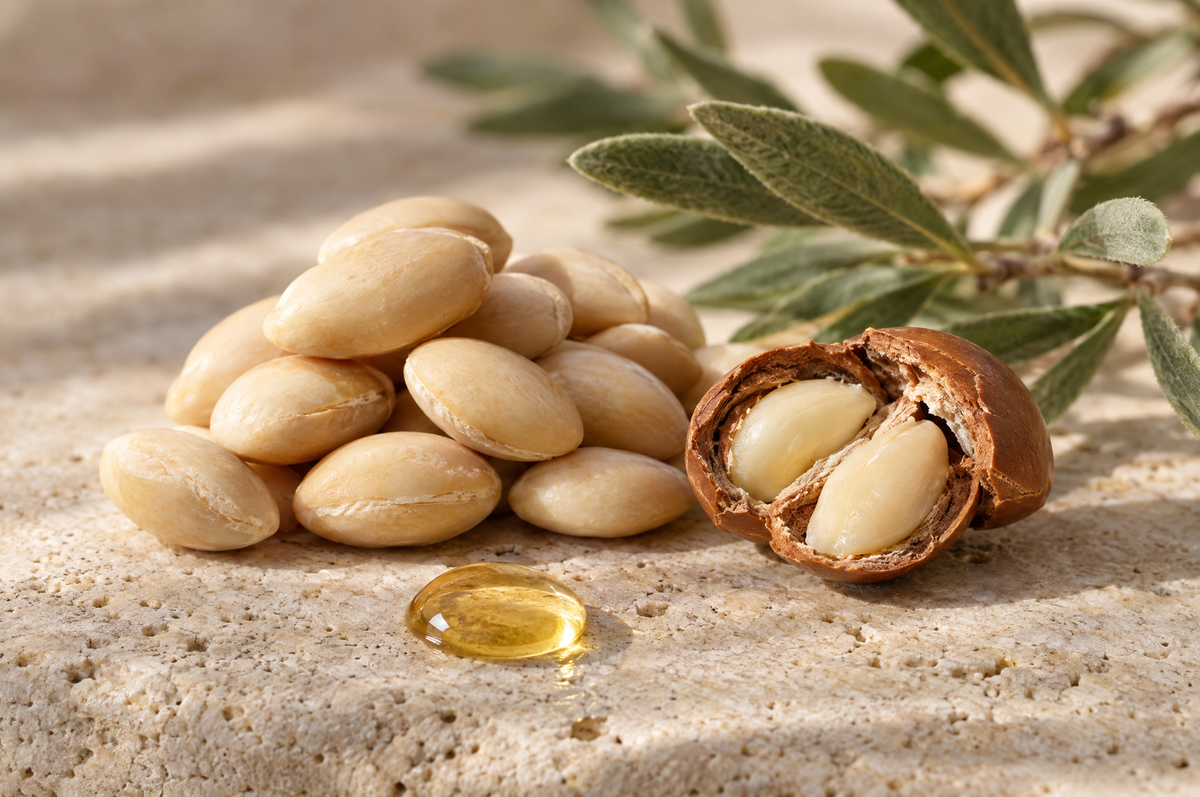
Pure argan oil means the bottle contains a single ingredient: Argania Spinosa Kernel Oil, the oil pressed from argan kernels, with nothing added. "100% pure" doesn't tell you whether the oil is cold-pressed, unroasted, unrefined, fresh or organic, so check the ingredient list and processing details too.
What should 100% pure argan oil contain?
Just one thing. In the US, cosmetic ingredients are listed by their common or usual names, generally in descending order of predominance, and the FDA permits the botanical name alongside the common one.1 For argan oil, the standard label name is Argania Spinosa Kernel Oil, after the argan tree, Argania spinosa. You may also see "argan oil" or "organic argan oil" written alongside it.
That single ingredient is a complex natural oil in its own right: roughly 80% unsaturated fatty acids (mainly oleic and linoleic acid), around 60–90 mg of tocopherols (vitamin E compounds) per 100 g, and a distinctive mix of plant sterols.2 Nothing needs to be added to make it work as a skin or hair oil.
Argania spinosa kernel oil: how to read an ingredient list
Turn the bottle around and read the ingredients. Here's how common label patterns translate:
| What the label says | What it means |
|---|---|
| Argania Spinosa Kernel Oil | Pure argan oil. This is what you want. |
| Argania Spinosa Kernel Oil, Tocopherol | Argan oil with added vitamin E, usually as an antioxidant. Not strictly "pure," though fairly benign. |
| Argania Spinosa Kernel Oil, Parfum (Fragrance) | Scented argan oil. Many people with sensitive skin prefer to avoid added fragrance. |
| Simmondsia Chinensis (Jojoba) Seed Oil, Argania Spinosa Kernel Oil… | A blend in which another oil comes first and so makes up more of the product. |
| Cyclopentasiloxane, Dimethicone, Argania Spinosa Kernel Oil, Parfum… | A silicone hair serum with some argan oil. Not argan oil. |
Because ingredients are generally listed in descending order of predominance,1 the first ingredient tells you what most of the product is. If argan oil isn't first, the product is mostly something else.
"Argan oil hair treatments" vs. pure argan oil for hair
Many of the best-known "argan" hair products are silicone-based serums. Silicones such as cyclopentasiloxane, cyclomethicone and dimethicone are common in hair care because they coat the hair surface. Dimethicone is the most widely used silicone in the hair care industry, and it helps protect the hair shaft from abrasion.3 Lightweight volatile silicones give that instant slip and then evaporate, leaving a thin film behind.
There's nothing wrong with silicone serums. They're good at reducing friction and making hair look glossy. But they are a different product from argan oil, and the argan content is often small. If you've been using an argan "treatment" and want to understand how it compares with the straight oil, we compare the two in Argan Oil vs. Moroccan Oil.
What can pure argan oil do for hair? The honest answer is that the science is limited. A 2015 review of hair cosmetics noted a lack of data on argan oil's benefits for hair,3 and a 2022 systematic review found no significant evidence that argan oil improves hair growth or quality.4 A lab study did find that argan oil pretreatment reduced protein loss in hair samples exposed to oxidative chemical damage.5 Most people use pure argan oil as a light finishing oil to soften ends and calm the look of frizz, which is a cosmetic effect you can judge for yourself. Our guide to how to use argan oil for hair covers technique, and Is Argan Oil Good for Hair? goes deeper into what it can and can't do.
What "pure" doesn't tell you
A bottle can honestly be 100% argan oil and still be a poor choice. "Pure" says nothing about these four things:
Whether it was roasted
Culinary argan oil is pressed from roasted kernels, giving it a copper color and hazelnut flavor; cosmetic oil is cold-pressed from unroasted kernels and is gold.2 Both are pure argan oil. Roasting reduces vitamin E: one study found total tocopherols fell from about 978 to 305 mg/kg after roasting at 175 °C for 10 minutes.6
Whether it was refined
Some suppliers refine argan oil to remove its color and aroma for use in cosmetic formulas. Refining is still "pure" in the sense that nothing is added, but bleaching and deodorization removed about 25% of tocopherols in one study, and the refined oil lost tocopherols much faster in storage.7
Whether it's fresh
Unroasted cosmetic argan oil has a shorter shelf life than roasted food oil, about one year at 25 °C compared with about two years, kept away from light.2 A pure oil that has been sitting in a warm, bright shop for two years may have turned rancid.
Whether it's diluted
A label can claim "100% pure" and still be wrong. Because argan oil is expensive, it's a recognized target for dilution with cheaper oils, such as sunflower, olive or soybean.8 That is a labeling problem, not a regulatory loophole, but it means the claim is only as good as the seller. Our guide to real vs. fake argan oil lists the checks that help.
"100% pure" vs. "100% organic"
These sound similar but mean different things. "Pure" describes what's in the bottle. "Organic" describes how the ingredient was grown and handled. Under USDA rules, "100 percent organic" means every ingredient was organically produced,9 and the label must name the certifying agent.10 A product can be pure but not organic, or, in principle, organic but blended with other organic oils. The ideal is both: one ingredient, certified organic. See Organic Argan Oil: What the Certification Actually Guarantees for the details.
A five-step label check
- Count the ingredients. One is ideal. Argania Spinosa Kernel Oil (or "argan oil") should be the only one.
- Scan for silicones. Words ending in -cone, -conol or -siloxane mean it's a silicone product.
- Scan for fragrance. "Parfum" or "fragrance" means added scent.
- Look for processing words. "Cold-pressed," "unroasted" and "virgin" are good signs; "refined" or "deodorized" are not what you want for skin and hair.
- Check certification. If it says organic, the certifier should be named.
How to use pure argan oil once you have it
One practical difference between pure oil and a silicone serum is dose. Serums are formulated to be pumped generously; pure oil is concentrated, so a little goes a long way. As a starting point:
- Face: 2 to 3 drops, warmed between your fingertips and pressed into skin as the last step of your routine, morning or night.
- Hair: 1 drop smoothed through dry ends, or a little more worked into damp hair before styling. Fine hair needs less; thick or curly hair may need more.
- Nails: 1 drop massaged into the nail beds and cuticles.
- Body: 5 to 6 drops on skin that's still slightly damp after bathing.
If hair looks flat or skin feels greasy, you're using too much; cut back by a drop. And because any plant oil can occasionally cause a reaction, try it on a small patch of skin, such as the inner arm, for a week before using it on your face. The American Academy of Dermatology recommends applying a new product to the same spot twice daily for 7 to 10 days and stopping if redness, itching or swelling appears.11
Our organic argan oil passes all five: the only ingredient is organic Argania spinosa kernel oil, USDA-certified, cold-pressed from unroasted kernels, with no fragrance, chemicals or dyes. For the full buyer's framework, see How to Choose the Best Argan Oil.
Frequently asked questions
What is the INCI name for argan oil?
Argan oil is listed as Argania Spinosa Kernel Oil, after the argan tree, Argania spinosa. A pure argan oil should list this as its only ingredient.
Is pure argan oil the same as Moroccan oil?
Not necessarily. "Moroccan oil" is often used for silicone-based hair serums that contain some argan oil. Pure argan oil contains only Argania Spinosa Kernel Oil.
Can I use pure argan oil on my hair every day?
Most people can. Start with one drop through dry ends, or a little more on damp hair, and adjust so hair feels soft rather than greasy.
Does pure argan oil have vitamin E added?
It doesn't need any. Argan oil naturally contains tocopherols, mainly gamma-tocopherol. If tocopherol appears as a second ingredient, it was added, usually as an antioxidant.
Sources
- U.S. Food and Drug Administration. Cosmetic ingredient names. Link
- Gharby S, Charrouf Z. Argan oil: chemical composition, extraction process, and quality control. Front Nutr. 2022;8:804587. Link
- Gavazzoni Dias MF. Hair cosmetics: an overview. Int J Trichology. 2015;7(1):2–15. Link
- Phong C, Lee V, Yale K, Sung C, Mesinkovska N. Coconut, castor, and argan oil for hair in skin of color patients: a systematic review. J Drugs Dermatol. 2022;21(7):751–757. Link
- Sharifi N, Hamedeyazdan S, Shokri J, Monajjemzadeh F. Argan oil as a pretreatment of human hair before exposure to oxidative damage: attenuated total reflectance and protein loss studies. J Cosmet Dermatol. 2022;21(10):5010–5017. Link
- Belcadi-Haloui R, Zekhnini A, El-Alem Y, Hatimi A. Effects of roasting temperature and time on the chemical composition of argan oil. Int J Food Sci. 2018;2018:7683041. Link
- Asbbane A, Bousaid Z, Guillaume D, et al. Effects of physical refining process on quality and stability of argan oil (Argania spinosa (L.) Skeels). Sci Rep. 2024;14:23045. Link
- El Maouardi M, Kharbach M, Cherrah Y, De Braekeleer K, Bouklouze A, Vander Heyden Y. Quality control and authentication of argan oils: application of advanced analytical techniques. Molecules. 2023;28(4):1818. Link
- Electronic Code of Federal Regulations. 7 CFR § 205.301 — Product composition (USDA National Organic Program). Link
- Electronic Code of Federal Regulations. 7 CFR § 205.303 — Packaged products labeled "100 percent organic" or "organic." Link
- American Academy of Dermatology. How to test skin care products. Link