Real vs. Fake Argan Oil: 7 Ways to Tell
Argan oil is one of the most expensive plant oils on the shelf, and that makes it a target. Researchers who study it describe it plainly: because production is limited and prices are high, some sellers blend it with cheaper oils for profit.1 So how do you know original argan oil when you see it? You can't run a lab test in your kitchen, but you can rule out most fakes in a couple of minutes.
The short answer
To tell if argan oil is real, check that the label lists only Argania Spinosa Kernel Oil, that it smells faintly nutty, looks pale to medium gold, absorbs without a slick film, comes in dark packaging with a batch and certifier, and isn't suspiciously cheap. Only lab testing can prove purity.
What "fake" argan oil usually is
Fake argan oil rarely means no argan at all. More often it is one of these:
- Diluted oil. Real argan oil cut with cheaper oils. Adulterants documented in the scientific literature include sunflower, olive, soybean, corn, rapeseed, sweet almond and avocado oils.1
- Silicone serums sold as "argan oil." Many hair products marketed around argan are mostly silicones such as cyclopentasiloxane or dimethicone, with argan oil further down the list. Dimethicone is the most widely used silicone in hair care, valued for coating and protecting the hair surface.2 These can be nice products, but they are not argan oil.
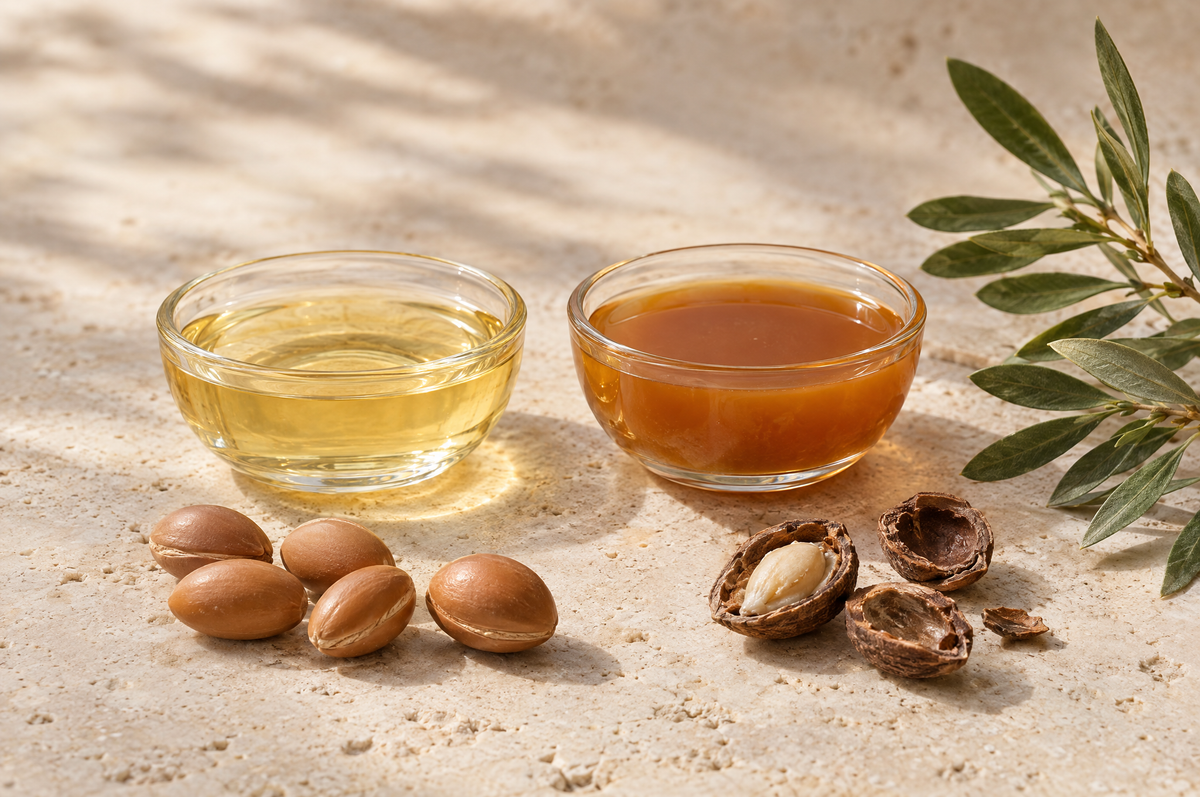
- Refined or deodorized oil. Genuine argan oil that has been bleached and deodorized to remove color and smell. This also strips a meaningful share of its vitamin E.3
- Culinary oil sold for skin. Oil pressed from roasted kernels, which is darker and smells toasted.4 It is real argan oil, just the wrong kind for cosmetic use.
Argan oil fake vs real: 7 ways to tell
1. Read the ingredient list
This is the single most reliable check you can do. US cosmetic labels list ingredients by their common or usual names, generally in descending order of predominance.5 Pure argan oil has one ingredient, typically written Argania Spinosa Kernel Oil. If you see anything else (silicones, "parfum," vitamin E added as tocopheryl acetate, another plant oil), it's a blend. If the first ingredient isn't argan, the product is mostly something else. Our guide to what "100% pure argan oil" really means covers the common label tricks.
2. Smell it
Fresh, unroasted cosmetic argan oil smells faintly nutty or earthy, and the scent fades within minutes on skin. A strong roasted smell suggests culinary oil, since roasting creates the hazelnut aroma that food oil is prized for.6 A perfumed smell means added fragrance. No smell at all can mean refining, which removes aroma compounds.3 A sharp, stale or crayon-like smell suggests the oil has gone rancid, whatever it started as. More detail in What Does Argan Oil Smell Like?
3. Look at the color
Cosmetic argan oil is gold; culinary argan oil is a deeper copper because of roasting.4 Refined argan oil is noticeably paler; in one study, refining raised light transmission through the oil from about 59 to 80 units.3 Color alone can't prove anything, because a blend with a pale oil can look perfectly golden, but water-clear or very dark copper oil in a "pure cosmetic" bottle deserves a second look.
4. Feel the texture
Rub a drop between your fingertips. Real argan oil feels silky and sinks in over a few minutes, leaving skin soft rather than slick. Silicone blends often feel unusually slippery and dry-touch, gliding over the skin almost like a powder. Heavier oils feel thick and stay greasy. Texture is a supporting clue, not proof.
5. Do the price math
Traditional argan oil production is extraordinarily labor-intensive. Estimates for fully traditional hand extraction range from about 10 to 24 hours of work for a single liter, from roughly 50 kg of fruit.1,4 Even with modern mechanical presses, the kernels still have to be cracked out of very hard nuts. A large bottle at a very low price is the most common red flag. We go deeper into this in Why Real Argan Oil Costs What It Does.
6. Check the packaging and paperwork
Look for dark glass or opaque packaging, a batch number and a best-before date. If the bottle says "organic," US rules require the label to state "Certified organic by" followed by the certifier's name.7 Origin matters too: since 2010 Morocco has operated a protected geographical indication that reserves the label "Huile d'Argan" for oil from southwestern Morocco made to set specifications.1 None of this guarantees purity, but sellers who cut corners on oil often cut corners on paperwork.
7. Ask the seller about testing
Serious producers test their oil. A reputable seller should be able to tell you where the oil was pressed, whether it is unroasted and unrefined, and whether batches are lab-tested. Vague answers, or none, tell you something.
Home tests that don't work
Some popular "authenticity tests" circulate widely. They are worth understanding, because they can make a fake look real or a real oil look fake.
| Popular test | The claim | Why it's unreliable |
|---|---|---|
| Fridge test | Real argan oil turns cloudy or solid in the fridge | Argan oil contains about 19% saturated fat,4 so it may cloud when cold, but many other plant oils cloud too. Cloudiness doesn't prove purity, and a diluted oil can still cloud. |
| Absorption test | Real argan oil "disappears" instantly | Silicone blends often feel like they vanish fastest. Absorption also depends on your skin and how much you use. |
| Shake or foam test | Real oil forms bubbles that last | Foam depends on bottle shape, temperature and how hard you shake, not on species. |
| Paper stain test | Real oil leaves no ring on paper | All liquid plant oils leave a grease mark on paper. |
What lab tests show
Laboratories authenticate argan oil chemically. Genuine argan oil has a distinctive sterol profile: the sterol campesterol makes up less than 0.4% of its total sterols, while it accounts for roughly 7.5–24% in common adulterants such as sunflower and soybean oil.1 A review of argan oil quality control notes that measuring campesterol can confirm argan oil purity up to about 98%, which is why it is a standard check.4 Argan oil is also very low in linolenic acid (at most about 0.3 g per 100 g), so a higher reading points to oils like soybean or rapeseed.4
Newer methods include infrared spectroscopy and DNA testing. A 2022 study developed DNA assays able to detect olive and soybean oil in argan oil at levels as low as 1%; reassuringly, all of the commercial food and cosmetic samples it bought in Morocco and tested contained argan DNA and no olive or soybean DNA.8 That was a small sample, so it doesn't tell us how common adulteration is in the wider market, but it does show that fraud is detectable.
The ingredient list is the one test you can always run, and it's the one most fakes fail.
How to buy real argan oil with confidence
- Start with the label. Single ingredient, cold-pressed, unroasted, certifier named if organic is claimed.
- Buy from a seller who answers questions. Origin, processing and testing should be easy for them to explain. Our guide on where to buy argan oil compares the main options.
- Check it when it arrives. Color, smell and feel should match what you'd expect from fresh cosmetic oil.
- Prefer a guarantee. Since you can't smell an oil online, a return policy that covers opened bottles lowers your risk.
Our own organic argan oil is a single ingredient, USDA-certified organic, cold-pressed from unroasted kernels and bottled in amber glass, with a 30-day money-back guarantee even if opened. If you'd like a broader buying framework, see How to Choose the Best Argan Oil.
Frequently asked questions
How can I tell if my argan oil is pure?
Check that the label lists only Argania Spinosa Kernel Oil, that the oil smells faintly nutty, looks golden and absorbs without a slick film. These checks rule out most fakes, but only laboratory sterol, fatty acid or DNA testing can prove purity.
Does real argan oil freeze or turn cloudy in the fridge?
It may turn cloudy when cold, but so do many other plant oils. The fridge test can't distinguish pure argan oil from a blend, so don't rely on it.
Why does my argan oil have no smell?
Odorless argan oil has usually been refined or deodorized, a process that removes aroma compounds along with some vitamin E. Unrefined cosmetic argan oil has a faint nutty scent.
Is argan oil in hair serums real argan oil?
Usually it contains some, but many argan hair serums are mostly silicones with argan oil lower on the ingredient list. Read the label: if argan isn't the first or only ingredient, it's a blend.
Sources
- El Maouardi M, Kharbach M, Cherrah Y, De Braekeleer K, Bouklouze A, Vander Heyden Y. Quality control and authentication of argan oils: application of advanced analytical techniques. Molecules. 2023;28(4):1818. Link
- Gavazzoni Dias MF. Hair cosmetics: an overview. Int J Trichology. 2015;7(1):2–15. Link
- Asbbane A, Bousaid Z, Guillaume D, et al. Effects of physical refining process on quality and stability of argan oil (Argania spinosa (L.) Skeels). Sci Rep. 2024;14:23045. Link
- Gharby S, Charrouf Z. Argan oil: chemical composition, extraction process, and quality control. Front Nutr. 2022;8:804587. Link
- U.S. Food and Drug Administration. Cosmetic ingredient names. Link
- Belcadi-Haloui R, Zekhnini A, El-Alem Y, Hatimi A. Effects of roasting temperature and time on the chemical composition of argan oil. Int J Food Sci. 2018;2018:7683041. Link
- Electronic Code of Federal Regulations. 7 CFR § 205.303 — Packaged products labeled "100 percent organic" or "organic." Link
- Amaral JS, Raja FZ, Costa J, et al. Authentication of argan (Argania spinosa L.) oil using novel DNA-based approaches: detection of olive and soybean oils as potential adulterants. Foods. 2022;11(16):2498. Link