How to Choose the Best Argan Oil
Search for the best argan oil and you'll find hundreds of bottles that all claim to be pure, Moroccan and organic. Some are excellent. Some are diluted, refined until they have nothing left to offer, or mostly silicone with a splash of argan for the label. The good news is that the differences are checkable, and you don't need a lab to do most of the checking.
The short answer
The best argan oil lists one ingredient (Argania Spinosa Kernel Oil), is cold-pressed from unroasted kernels, carries a real organic certification with a named certifier, comes from southwestern Morocco, is sold in dark or opaque packaging, smells faintly nutty rather than rancid or perfumed, and is priced like a labor-intensive oil.
A quick note on transparency: we sell one product, a single-ingredient organic argan oil. That gives us an obvious interest, so this guide sticks to criteria you can verify on any bottle, including ours, and cites the research behind each one.
What makes one argan oil better than another?
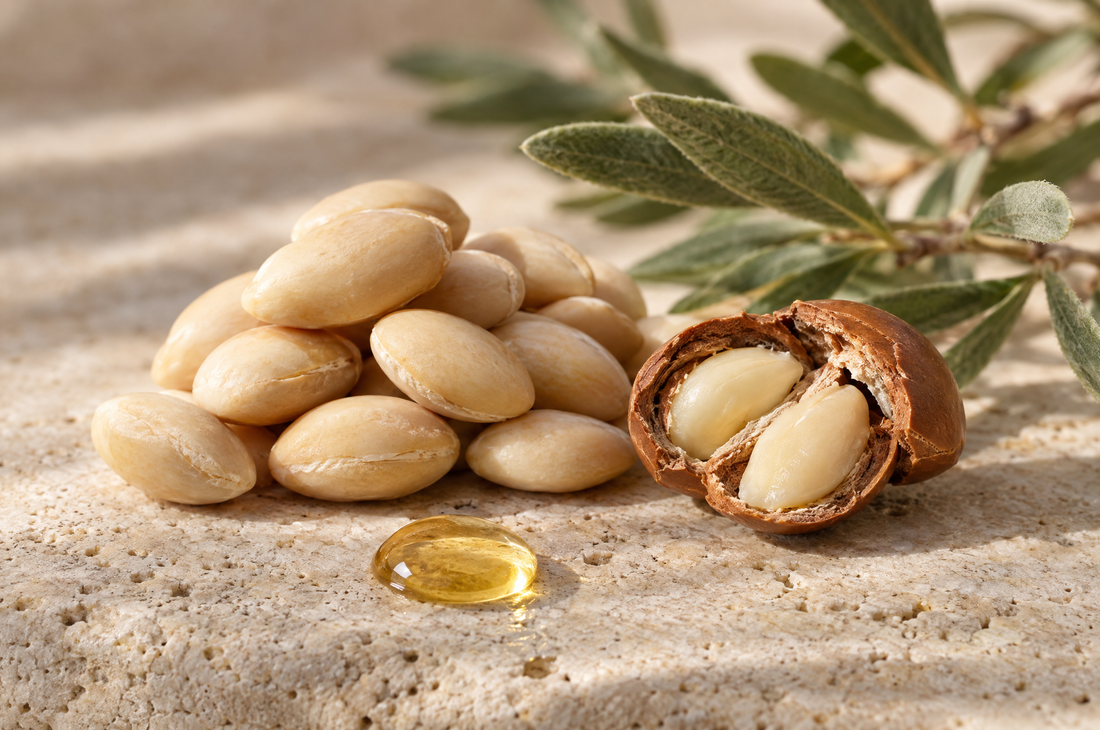
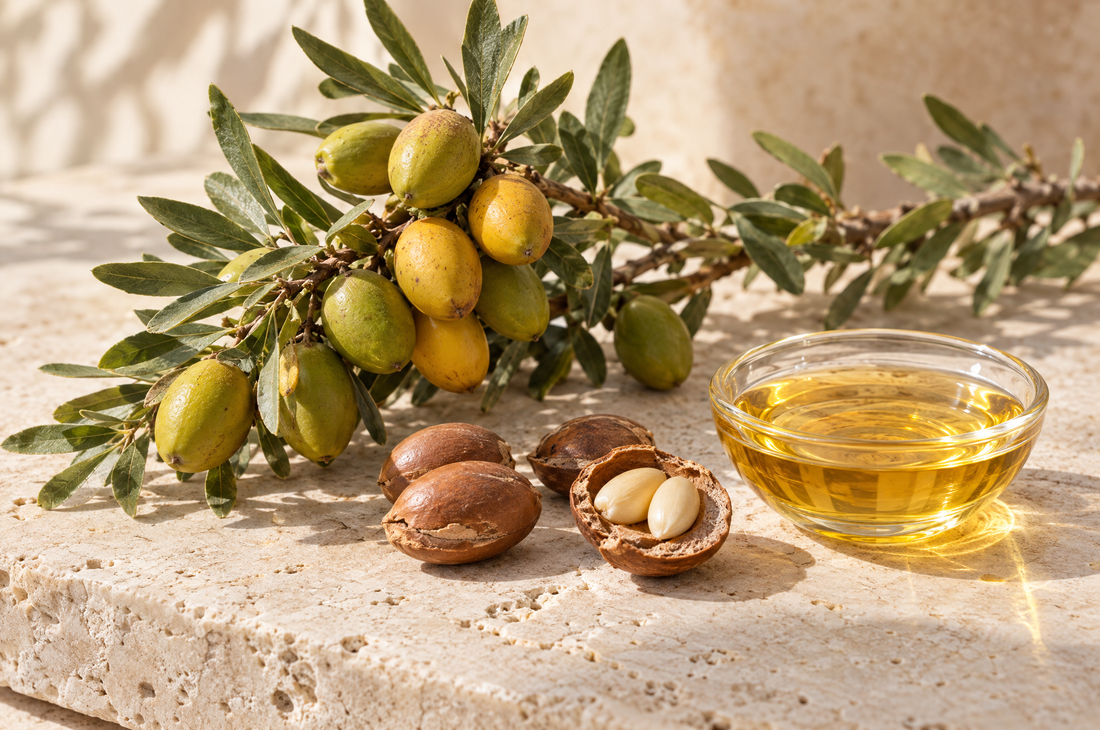
Argan oil is pressed from the kernels inside the fruit of the argan tree, Argania spinosa, which grows almost exclusively in southwestern Morocco. Authentic oil has a fairly consistent chemistry: roughly 43–49% oleic acid, 29–36% linoleic acid, around 60–90 mg of tocopherols (vitamin E compounds) per 100 g, and an unusual sterol profile dominated by schottenol and spinasterol.1 Quality differences come mostly from three things: what else is in the bottle, how the kernels were processed, and how fresh the oil is. Every point in the checklist below maps to one of those.
The 8-point checklist for the best argan oil
1. One ingredient on the label
In the US, cosmetic ingredients must be listed by their common or usual names, generally in descending order of predominance.2 For argan oil that name is usually written as Argania Spinosa Kernel Oil, sometimes alongside "argan oil." If anything else appears, such as cyclopentasiloxane, dimethicone, fragrance (parfum) or another plant oil, you are holding a blend. Blends can be pleasant products, but they are not what you are paying argan prices for. Our guide to what "100% pure argan oil" really means walks through how to read these labels line by line.
2. Cold-pressed from unroasted kernels
There are two kinds of argan oil. Culinary oil is pressed from roasted kernels, which gives it a copper color and a hazelnut flavor; cosmetic oil is cold-pressed from unroasted kernels and is a lighter gold.1 Roasting builds flavor but costs antioxidants: in one study, roasting at 175 °C for 10 minutes cut total tocopherols from about 978 to 305 mg/kg.3 For skin and hair you want the unroasted, cold-pressed cosmetic grade. More on that in our explainer on why the extraction method matters.
3. Unrefined, not deodorized
Some cosmetic suppliers refine argan oil to strip out its color and aroma. A 2024 study of that refining process found bleaching plus deodorization removed about a quarter of the oil's tocopherols immediately, and refined oil lost 92% of its tocopherols during accelerated storage, compared with 34% for unrefined oil.4 A completely odorless, water-clear "argan oil" is often refined. Virgin cosmetic oil should look golden and smell faintly of nuts or seeds.
4. A real organic certification, with a certifier named
Under USDA rules, a product labeled "100 percent organic" must contain only organically produced ingredients, and one labeled "organic" at least 95%.5 Products sold as organic must also state "Certified organic by" followed by the certifying agent's name.6 If a bottle says "organic" but names no certifier, treat the claim as unverified. Keep expectations realistic, though: the FDA notes that an ingredient's source does not determine its safety, and organic is not a safety or potency rating.7 We cover what the seal does and doesn't promise in Organic Argan Oil: What the Certification Actually Guarantees.
5. Origin you can trace to southwestern Morocco
Where does the best argan oil come from? The argan forest is concentrated in southwestern Morocco, and since 2010 Morocco has operated a protected geographical indication that reserves the label "Huile d'Argan" for oil from that region made to defined specifications.8 "Made in" a third country usually means the oil was blended or bottled elsewhere, which isn't automatically bad, but it adds a step where things can go wrong.
6. Dark or opaque packaging
Argan oil is rich in unsaturated fatty acids, which oxidize when exposed to light, heat and air. Research on argan oil storage found the best stability when the oil was kept sheltered from light at room temperature.1 Amber or other dark glass, or an opaque outer box, is a basic sign that the producer cares about freshness. Clear plastic on a sunny shelf is the opposite.
7. A fresh, faint scent
Your nose is a useful tool. Fresh cosmetic argan oil has a light nutty, slightly earthy smell that fades within minutes on the skin. A sharp, crayon-like or fishy smell suggests rancidity. A strong toasted aroma suggests culinary oil. A floral or perfume smell means added fragrance. Unroasted cosmetic oil keeps for less time than roasted food oil, about a year at 25 °C versus about two, according to one stability review,1 so check for a batch number and a best-before date. Our article on whether argan oil expires explains how to store it.
8. A price that makes sense
Argan oil is expensive to make. Estimates for fully traditional hand extraction range from about 10 to 24 hours of work per liter, and roughly 50 kg of fruit go into a single liter by hand.8,1 Because of that cost, argan oil is a known target for adulteration with cheaper oils such as sunflower, soybean, olive, corn and sweet almond.8 An unusually large bottle at a very low price is a warning sign, not a bargain. We break down the economics in why real argan oil costs what it does.
A quick comparison: what to look for and what to avoid
| Check | Good sign | Warning sign |
|---|---|---|
| Ingredient list | Argania Spinosa Kernel Oil only | Silicones, fragrance, other oils listed first |
| Processing | Cold-pressed, unroasted, virgin | "Refined," "deodorized," or no information |
| Color | Pale to medium gold | Water-clear, or deep copper (culinary) |
| Scent | Faint, nutty, fades quickly | Rancid, strongly toasted, or perfumed |
| Certification | Organic claim with certifier named | "Organic" with no certifier |
| Packaging | Dark glass, batch and date | Clear plastic, no date |
| Price | In line with a hand-harvested oil | Large volume at a very low price |
Best argan oil for hair vs. best argan oil for face
People often assume they need two different oils. They don't. The same pure, cold-pressed oil works for both; what changes is the amount.
For the face, the evidence is modest but real. In a 60-day trial in 60 postmenopausal women, nightly topical argan oil on the forearm was associated with improved skin elasticity measurements,9 and a companion analysis found improved skin hydration and lower water loss from the skin.10 Those are small, short studies on forearm skin, not faces, so they support "moisturizing and comfortable" rather than "anti-aging miracle." A few drops pressed in as the last step of your routine is plenty.
For hair, the honest picture is that controlled research is thin. A systematic review of oils for hair found no significant evidence that argan oil improves hair growth or quality,11 though a lab study found argan oil pretreatment reduced protein loss in hair samples exposed to oxidative damage.12 In practice, people use it as a light finishing oil to smooth ends and reduce the look of frizz. One drop through dry ends is a good start.
How to test a new bottle at home
- Read the label first. One ingredient, a certifier if organic is claimed, a batch number and a date.
- Look at it in daylight. Expect a clear golden oil. Some cloudiness in a cold room can happen with many plant oils, so don't treat it as proof either way.
- Smell it. Faint and nutty is right. Rancid, perfumed or strongly toasted is not.
- Rub a drop between your fingers. It should feel silky and absorb within a few minutes, not sit like a slick film.
- Patch test before using it on your face. The American Academy of Dermatology suggests applying a new product to a small area, such as the inner arm, twice daily for 7 to 10 days and stopping if redness, itching or swelling develops.13
None of these steps can prove purity. Only laboratory tests, such as measuring the sterol campesterol, which is present only in traces in genuine argan oil, can detect dilution reliably.8 For a deeper dive into which home tests are useful and which are myths, see Real vs. Fake Argan Oil: 7 Ways to Tell.
Where our oil fits
Since we make one, here is how our 100% organic argan oil lines up against the checklist: a single ingredient (organic Argania spinosa kernel oil), USDA-certified organic, cold-pressed and unroasted, hand-harvested in Morocco using traditional methods, with no fragrance, chemicals or dyes, in a 60 mL amber glass bottle with a dropper. It's also covered by a 30-day money-back guarantee, even if opened, which matters when you can't smell an oil before you buy it.
Frequently asked questions
What is the best brand of argan oil?
Rather than trusting a brand name, look for a single ingredient (Argania Spinosa Kernel Oil), cold-pressed unroasted oil, a named organic certifier, Moroccan origin, dark packaging and a fresh, faint scent. Any brand that meets those criteria is a good candidate.
Is Moroccan argan oil the best?
Argan trees grow almost entirely in southwestern Morocco, and Morocco protects the name "Huile d'Argan" for oil from that region. Moroccan origin is a baseline expectation rather than a mark of special quality, so check the other criteria too.
Should argan oil smell?
Fresh cosmetic argan oil has a light nutty or earthy scent that fades within minutes. No smell at all can mean the oil was refined, while a rancid, perfumed or strongly toasted smell is a red flag.
Is the same argan oil good for face and hair?
Yes. A pure, cold-pressed cosmetic argan oil works for both. Use 2 to 3 drops on the face and about one drop through dry hair ends, adjusting for hair length and thickness.
Is more expensive argan oil always better?
No. A high price doesn't guarantee purity, but a very low price for a large bottle is a common sign of dilution, refining or a blend. Judge by the label, certification, freshness and packaging first.
Sources
- Gharby S, Charrouf Z. Argan oil: chemical composition, extraction process, and quality control. Front Nutr. 2022;8:804587. Link
- U.S. Food and Drug Administration. Cosmetic ingredient names. Link
- Belcadi-Haloui R, Zekhnini A, El-Alem Y, Hatimi A. Effects of roasting temperature and time on the chemical composition of argan oil. Int J Food Sci. 2018;2018:7683041. Link
- Asbbane A, Bousaid Z, Guillaume D, et al. Effects of physical refining process on quality and stability of argan oil (Argania spinosa (L.) Skeels). Sci Rep. 2024;14:23045. Link
- Electronic Code of Federal Regulations. 7 CFR § 205.301 — Product composition (USDA National Organic Program). Link
- Electronic Code of Federal Regulations. 7 CFR § 205.303 — Packaged products labeled "100 percent organic" or "organic." Link
- U.S. Food and Drug Administration. "Organic" cosmetics. Link
- El Maouardi M, Kharbach M, Cherrah Y, De Braekeleer K, Bouklouze A, Vander Heyden Y. Quality control and authentication of argan oils: application of advanced analytical techniques. Molecules. 2023;28(4):1818. Link
- Boucetta KQ, Charrouf Z, Aguenaou H, Derouiche A, Bensouda Y. The effect of dietary and/or cosmetic argan oil on postmenopausal skin elasticity. Clin Interv Aging. 2015;10:339–349. Link
- Boucetta KQ, Charrouf Z, Derouiche A, Rahali Y, Bensouda Y. Skin hydration in postmenopausal women: argan oil benefit with oral and/or topical use. Prz Menopauzalny. 2014;13(5):280–288. Link
- Phong C, Lee V, Yale K, Sung C, Mesinkovska N. Coconut, castor, and argan oil for hair in skin of color patients: a systematic review. J Drugs Dermatol. 2022;21(7):751–757. Link
- Sharifi N, Hamedeyazdan S, Shokri J, Monajjemzadeh F. Argan oil as a pretreatment of human hair before exposure to oxidative damage: attenuated total reflectance and protein loss studies. J Cosmet Dermatol. 2022;21(10):5010–5017. Link
- American Academy of Dermatology. How to test skin care products. Link