Argan Oil Benefits and Side Effects: An Evidence-Based Guide
Argan oil has a reputation that runs well ahead of its research. Online, it's credited with everything from erasing wrinkles to regrowing hair. The real evidence is smaller and more interesting: a handful of human studies support some benefits, a lot of lab work hints at others, and a small number of case reports describe genuine side effects. This guide sorts the claims by how well they're supported, so you can decide what to expect.
The short answer
Small human trials suggest topical argan oil can improve skin hydration and elasticity, and dietary argan oil may improve blood lipids. Hair, acne, scar and anti-aging claims rest mostly on lab work or anecdote. Side effects are uncommon but include allergic contact dermatitis, rare anaphylaxis, and breakouts in some people.
What's in argan oil?
Argan oil is pressed from the kernels of the argan tree, Argania spinosa. It's about 80% unsaturated fatty acids, mainly oleic acid (43–49%) and linoleic acid (29–36%), with around 60–90 mg of tocopherols (vitamin E compounds) per 100 g, mostly gamma-tocopherol, plus unusual plant sterols such as schottenol and spinasterol.1 That composition explains why it feels light and absorbs reasonably well, and why researchers are curious about its antioxidant potential. For a deeper look, see What's in Argan Oil?
Argan oil benefits, graded by evidence
| Claimed benefit | Best evidence | Verdict |
|---|---|---|
| Skin hydration | Human trial, 60 women, 60 days | Supported (small study) |
| Skin elasticity | Human trial, 60 women, 60 days | Supported (small study) |
| Less oily skin | Uncontrolled study, 20 people, multi-ingredient cream | Weak |
| Stretch marks | Pilot study, 12 women, 7 days, multi-ingredient cream | Weak |
| Wound and burn healing | Animal studies | Lab only |
| Hair growth or quality | Systematic review found no significant evidence | Not supported |
| Hair protection from chemical damage | Lab study on hair samples | Lab only |
| Cholesterol (eaten, not applied) | Meta-analysis of 5 trials, 292 people | Promising |
Skin hydration: supported by a small human trial
In a Moroccan trial of 60 postmenopausal women, all participants applied cosmetic argan oil to one forearm each night for 60 days. On the treated forearm, the water content of the skin rose and transepidermal water loss (moisture escaping through the skin) fell.2 The authors noted limitations, including the short duration and an open-label design. Still, it's a reasonable basis for using argan oil as a moisturizing oil. See Argan Oil for Dry Skin for practical routines.
Skin elasticity: supported by the same trial
The same study measured skin elasticity and found significant improvements on the argan-treated forearm.3 Women who also consumed 25 mL of culinary argan oil a day improved elasticity on their untreated forearm too, while the comparison group consuming olive oil did not.3 It's encouraging, but forearm skin in postmenopausal women over two months isn't the same as "reverses wrinkles," and no large trials have tested argan oil on facial aging.
Oily skin and sebum: weak evidence
A frequently cited study tested a cream containing argan oil plus saw palmetto and sesame seed extracts in 20 people with oily or combination skin for four weeks. Sebum levels fell 20% and the area of oily spots fell 42%, but there was no control group and several active ingredients.4 It can't tell us what argan oil does on its own. More in Does Argan Oil Clog Pores?
Stretch marks: weak evidence
A 2016 pilot study tested a water-in-oil cream containing argan oil in 12 women for seven days. It found improved skin elasticity, measured as a shorter retraction time, but no significant change in hydration or skin thickness, and it had no control group.5 The authors suggested the formula might help with early, red stretch marks and called for longer studies. See Argan Oil for Stretch Marks.
Wound healing: animal studies only
Argan oil has been shown to enhance the healing of second-degree burns in rats.6 That's a long way from evidence in people, and argan oil shouldn't be used on burns or open wounds in place of medical care.
Hair: little human evidence
A 2022 systematic review of coconut, castor and argan oils for hair found no significant evidence that argan oil improves hair growth or quality.7 One lab study found argan oil pretreatment reduced protein loss in hair samples later exposed to oxidizing chemicals.8 Many people like it as a smoothing finishing oil, which is a cosmetic effect you can judge yourself. See Does Argan Oil Help Hair Grow?
Dietary benefits: promising
Eating culinary argan oil has the strongest controlled evidence of any argan use. A meta-analysis of five randomized trials with 292 participants found argan oil was associated with lower total cholesterol, LDL cholesterol and triglycerides and higher HDL cholesterol versus control treatments.9 The trials were small, and the authors called for larger studies. A broader review summed up the field: many effects are under investigation, but a lack of clinical data is a serious weakness.10
Argan oil side effects on skin
Allergic contact dermatitis
The most documented side effect is an allergic skin reaction: itching, redness, swelling or rash where the oil was applied. Case reports of allergic contact dermatitis caused by argan oil have been published in dermatology journals.11 A 2026 analysis of patch-test results from a dermatology referral center found reactions to argan oil in only 3 of 1,859 patients tested, and no significant cross-reactivity between fragrance allergy and argan oil.12 Learn more in Can Argan Oil Irritate Skin?
Anaphylaxis (rare)
Very rarely, argan oil has been linked to anaphylaxis, a severe whole-body allergic reaction, including a case reported after the oil was applied to the skin.13,14 These are isolated case reports, not a sign that argan oil is generally risky, but they're a reason for caution if you have a history of serious allergies.
Breakouts
Some people find that facial oils, argan included, congest their skin. This is largely anecdotal and individual. One relevant detail: argan oil is rich in oleic acid, and a review of plant oils notes that oleic acid can disrupt the skin barrier with continuous application, while linoleic acid supports barrier function.6 Argan oil contains substantial amounts of both.
Greasiness and rancidity
Using too much leaves skin and hair greasy; a few drops is usually enough. Old, oxidized oil smells sharp or stale and is best thrown away.
Who should be cautious
- People with nut or seed allergies. Argan oil is a kernel oil, and data on cross-reactivity are limited. Check with your doctor or allergist first.
- People with eczema, rosacea or very reactive skin. Patch test, and talk to a dermatologist if you have an active skin condition.
- Parents of infants. Allergic contact dermatitis from argan oil has been reported in an infant;15 ask your pediatrician before using any oil on a baby.
- Anyone with acne-prone skin. Introduce it slowly on a small area.
How to use argan oil safely
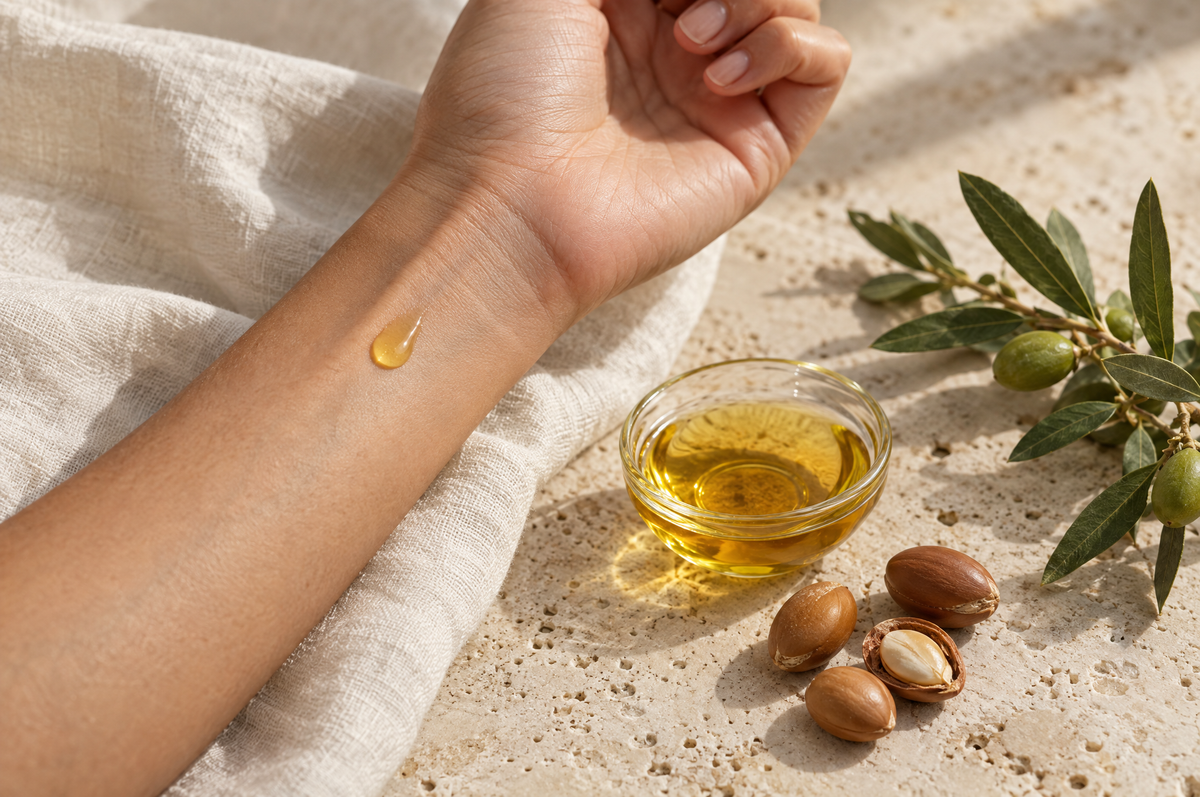
- Patch test first. The American Academy of Dermatology suggests applying a new product to a small spot, such as the inner arm, twice daily for 7 to 10 days, and washing it off and stopping if a reaction develops.16
- Start small. 2–3 drops for the face, 1 drop for hair ends, 1 drop for nails, 5–6 drops for the body after bathing.
- Use pure, fresh oil. Blends add fragrance and other ingredients that can cause their own reactions.
- Don't eat cosmetic oil. If you want the dietary benefits, buy culinary argan oil sold as food.
- Stop if anything feels wrong. Seek urgent care for swelling of the face or throat or difficulty breathing.
Argan oil earns its place as a gentle, moisturizing oil. It doesn't need to be a miracle to be worth using.
If you'd like to try it, look for a single-ingredient oil without added fragrance. Our argan oil is 100% organic Argania spinosa kernel oil, cold-pressed from unroasted kernels, with no fragrance, chemicals or dyes, and covered by a 30-day money-back guarantee even if opened.
Frequently asked questions
What are the proven benefits of argan oil?
Small human trials show topical argan oil can improve skin hydration and elasticity, and eating culinary argan oil was linked to better cholesterol levels in a meta-analysis. Most other claims, including for hair and acne, rely on lab studies or anecdote.
What are the side effects of argan oil?
Side effects are uncommon. Reported reactions include allergic contact dermatitis, rare anaphylaxis and, for some people, breakouts or a greasy feel. Patch test before regular use.
Can argan oil cause skin rashes?
Yes, occasionally. Allergic contact dermatitis to argan oil has been documented in case reports. If a rash, itching or swelling appears, wash it off, stop using it and see a doctor if it's severe.
Is argan oil safe if I have a nut allergy?
Data are limited. Argan oil is a kernel oil, and rare severe reactions have been reported, so check with your allergist before using it.
Is it safe to use argan oil every day?
For most people, yes. Use a few drops, patch test first, and stop if you notice irritation or breakouts.
Sources
- Gharby S, Charrouf Z. Argan oil: chemical composition, extraction process, and quality control. Front Nutr. 2022;8:804587. Link
- Boucetta KQ, Charrouf Z, Derouiche A, Rahali Y, Bensouda Y. Skin hydration in postmenopausal women: argan oil benefit with oral and/or topical use. Prz Menopauzalny. 2014;13(5):280–288. Link
- Boucetta KQ, Charrouf Z, Aguenaou H, Derouiche A, Bensouda Y. The effect of dietary and/or cosmetic argan oil on postmenopausal skin elasticity. Clin Interv Aging. 2015;10:339–349. Link
- Dobrev H. Clinical and instrumental study of the efficacy of a new sebum control cream. J Cosmet Dermatol. 2007;6(2):113–118. Link
- Bogdan C, Moldovan ML, Man IM, Crișan M. Preliminary study on the development of an antistretch marks water-in-oil cream: ultrasound assessment, texture analysis, and sensory analysis. Clin Cosmet Investig Dermatol. 2016;9:249–255. Link
- Lin TK, Zhong L, Santiago JL. Anti-inflammatory and skin barrier repair effects of topical application of some plant oils. Int J Mol Sci. 2017;19(1):70. Link
- Phong C, Lee V, Yale K, Sung C, Mesinkovska N. Coconut, castor, and argan oil for hair in skin of color patients: a systematic review. J Drugs Dermatol. 2022;21(7):751–757. Link
- Sharifi N, Hamedeyazdan S, Shokri J, Monajjemzadeh F. Argan oil as a pretreatment of human hair before exposure to oxidative damage: attenuated total reflectance and protein loss studies. J Cosmet Dermatol. 2022;21(10):5010–5017. Link
- Ursoniu S, Sahebkar A, Serban MC, Banach M; Lipid and Blood Pressure Meta-analysis Collaboration Group. The impact of argan oil on plasma lipids in humans: systematic review and meta-analysis of randomized controlled trials. Phytother Res. 2018;32(3):377–383. Link
- Monfalouti HE, Guillaume D, Denhez C, Charrouf Z. Therapeutic potential of argan oil: a review. J Pharm Pharmacol. 2010;62(12):1669–1675. Link
- Foti C, Romita P, Ranieri LD, Bonamonte D. Allergic contact dermatitis caused by argan oil. Contact Dermatitis. 2014;71(3):183–184. Link
- Karels S, Weber B, Hylwa S, Ophaug S, Lee K, Neeley A. To avoid or not to avoid: cross-reactivity between fragrance and common botanicals. Contact Dermatitis. 2026;94(5):488–493. Link
- Astier C, et al. Anaphylaxis to argan oil. Allergy. 2010;65(5):662–663. Link
- de las Marinas Alvarez MD, Martorell Calatayud C, Castillo Fernández M, et al. Anaphylaxis after cutaneous application of argan oil. J Investig Allergol Clin Immunol. 2021;31(4):332–334. Link
- Barrientos N, Moreno de Vega M, Dominguez J. Allergic contact dermatitis caused by argan oil in an infant. Contact Dermatitis. 2014;71(5):316–317. Link
- American Academy of Dermatology. How to test skin care products. Link
This article is for general information and isn't medical advice. If you have a skin condition or allergy, are pregnant, or are caring for an infant, check with your doctor, dermatologist or pediatrician before trying something new.