The Truth About Argan Trees and Goats
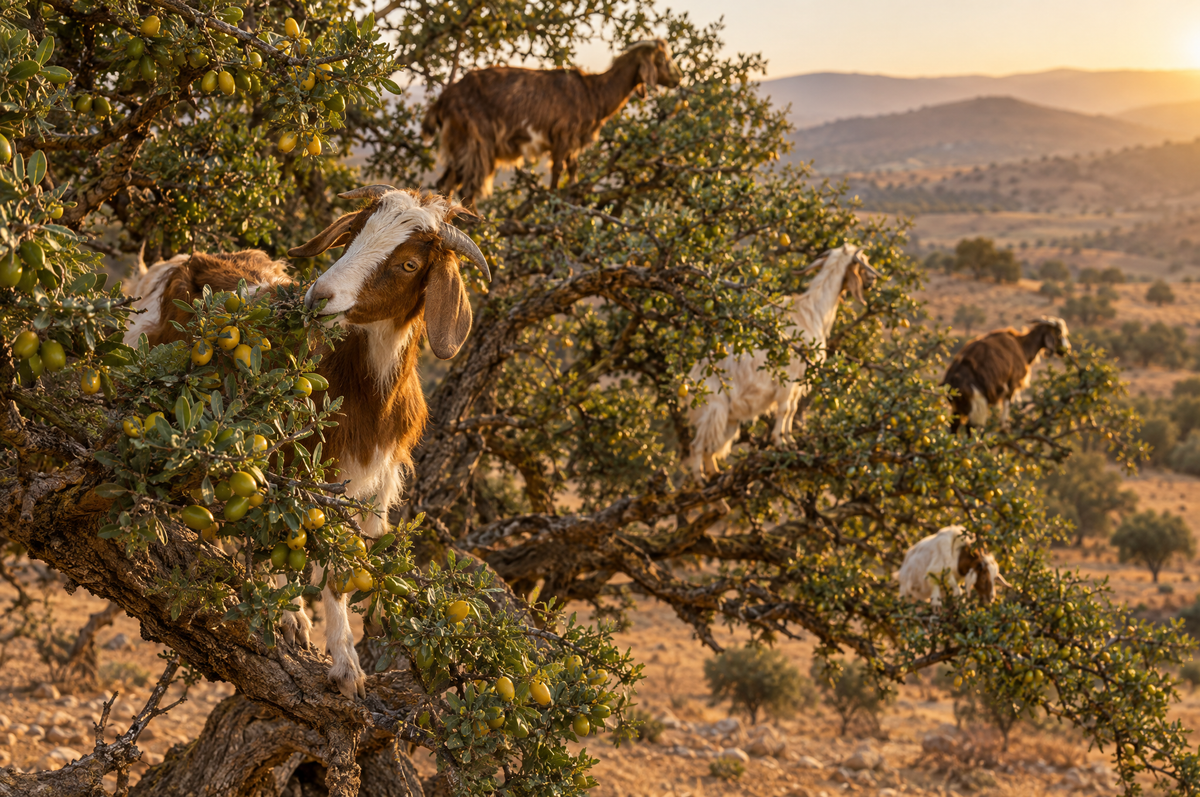
If you've seen one photo of Morocco's argan country, it's probably this one: a squat, thorny tree with a dozen goats balanced in its branches like oversized fruit. It's a real phenomenon, and it has spawned a whole folklore around argan oil, including the persistent claim that the oil is made from seeds the goats leave behind. The true story is more interesting, and a lot less unappetizing.
The short answer
Goats really do climb argan trees in southwestern Morocco to eat the fruit and leaves. Researchers found they spit out many argan nuts while chewing their cud, which helps spread seeds. Nuts collected after passing through goats were once used for some oil, but that oil is lower quality. Good argan oil comes from hand-harvested fruit.
Why do goats climb argan trees?
Food. The argan tree grows in the dry southwest of Morocco, where grazing on the ground can be thin, especially in late summer and autumn. Argan trees are short and their trunks are often low and branching, which lets goats clamber up into the canopy to reach the leaves and the olive-like fruit1. The United Nations notes that local goats scale the trees to eat the nuts, and that argan leaves serve as an important fodder reserve for herds in drought years2.
Herders help. A 2017 study summarized by the Ecological Society of America reported that herders prune argan trees to make climbing easier and help young goats learn to climb, and that in the autumn, when food is scarce, goats spend roughly three-quarters of their foraging time up in the trees, sometimes around 30 feet high3.
Goats are part of a much older system. Researchers describe argan country as a three-way relationship between tree, people and goats1, and FAO's recognition of the argan-based agro-sylvo-pastoral system at Ait Souab–Ait Mansour lists goats among the region's traditional livestock breeds4.
Goats in argan trees as seed planters
For a long time, people assumed goats spread argan seeds the usual way: by eating the fruit and excreting the seeds somewhere else. In 2017, ecologists Miguel Delibes, Irene Castañeda and José Fedriani of Spain's Doñana Biological Station published a short paper in Frontiers in Ecology and the Environment showing that something different is going on3.
Goats are ruminants. They swallow food, later bring it back up and chew it again as cud. While chewing their cud, the researchers observed, goats spit out many clean argan nuts, depositing them away from the parent tree. As the summary put it, goats do not usually poop large seeds. Spitting seeds during rumination, the authors suggested, could be a widespread and overlooked way that ruminants disperse plants3.
It isn't just goats, either. The researchers reported seeing sheep, captive red deer and fallow deer spit seeds while chewing their cud too3. Getting a seed some distance from its parent tree gives the seedling a better chance of survival, as the study's summary notes. For a slow-growing, drought-adapted species like argan, every advantage counts.
Argan nuts are famously hard, which is the same reason cracking them by hand is such skilled work. A seed that tough can survive being chewed, swallowed and brought back up again, then spat out intact on the ground. The pulp is what the goat is after; the nut is just along for the ride.
That doesn't make goats simply good for the forest. Fedriani has also pointed out that goats eat leaves and seedlings, which can prevent young argan trees from establishing during droughts5. And a study of argan-region households in PNAS found that rising argan oil prices let some families grow their goat herds, which the authors noted "bodes poorly" for the argan forest6. Goats are part of the landscape's story, for better and worse.
Is argan oil made from goat poop?
No, not the argan oil you should be buying. But the myth has a grain of truth behind it, which is why it won't go away.
Where the idea comes from
Historically, some argan nuts were gathered after goats had eaten the fruit around them, whether those nuts were spat out (as Delibes and colleagues showed) or otherwise left behind. These are sometimes described in the research literature as "goat-peeled" fruit, because the goat has done the work of removing the pulp.
Why quality oil isn't made this way
Researchers have studied oil made from goat-peeled fruit and found it isn't good. In a two-year study of edible argan oil, scientists noted that goat-peeled fruit was still sometimes introduced into artisanal production, even though the resulting oil is "notoriously of unsatisfactory quality," and found it held up worse in storage than mechanically pressed oil from properly harvested fruit7. Oil from goat-peeled fruit also carries additional volatile compounds that change its smell and taste8,9.
Modern production starts with ripe fruit collected by hand, sun-dried, mechanically or manually dehulled, cracked to free the kernels, and cold-pressed8. Goats aren't part of that chain. You can read the full process in how argan oil is made.
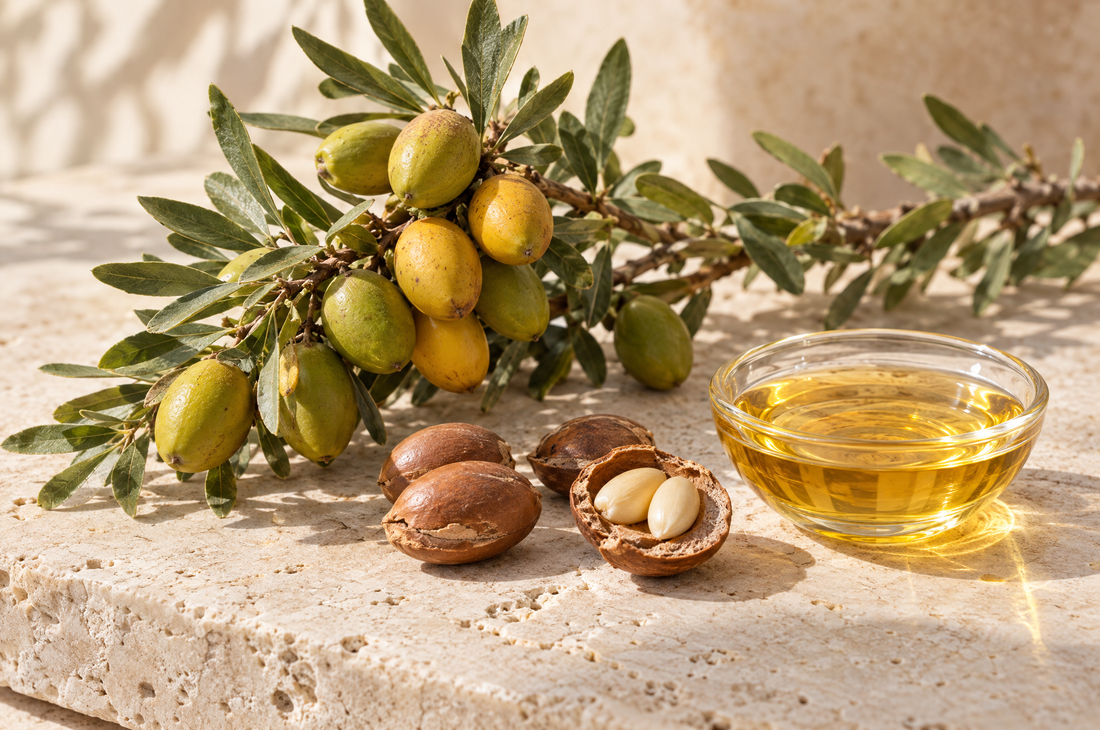
The goats eat the fruit. The oil comes from the kernel, collected and cracked by hand.
How is argan oil made, and where do goats fit?
| Step | Role of goats |
|---|---|
| Tree and fruit | Goats browse leaves and fruit, especially in lean seasons. |
| Seed dispersal | Goats spit out nuts while ruminating, helping spread seeds. |
| Seedlings | Goats also eat seedlings, which can hold back regeneration. |
| Fruit for quality oil | Hand-harvested from the tree or ground, not collected from goats. |
| Pulp and press cake | Used as animal feed after processing. |
That last point is a nice reversal: the fruit pulp and the residue left after pressing are used to feed livestock1, so goats still benefit from argan production, just at the other end of the process.
The roadside goat trees
If you've driven between Marrakech and Essaouira, you may have stopped at a tree full of goats and been asked for a tip. Many of these are staged. National Geographic reported in 2022 that some farmers began placing goats in argan trees around the early 2000s to earn money from tourists, training them with food or standing them on wooden platforms, and that animal welfare groups have raised concerns about the practice5.
Goats do climb argan trees on their own. But a tree packed with motionless goats beside a busy road, mid-afternoon, with a herder waiting for tips, is more likely a photo stop than a natural scene. If you want to see the real thing, a responsible local guide in the argan region is a better bet than a roadside stop.
Do goats threaten the argan forest?
Partly. The argan forest in southwestern Morocco declined substantially, from about 1.5 million hectares to an estimated 800,000 hectares by the year 2000, due to human pressures and drought8. UNESCO designated the region the Arganeraie Biosphere Reserve in 1998 to support conservation and sustainable use10. Grazing is part of that human pressure, as the research above suggests, but it isn't the whole story. Goats are woven into the local economy and culture, so the question is balance, not elimination.
What this means when you buy argan oil
- Look for cold-pressed oil from hand-harvested fruit. That signals the modern process, not goat-peeled nuts.
- Trust your nose. Cosmetic argan oil should smell faint and slightly nutty. A strong, off, barnyard or sour smell is a warning sign. See what argan oil should smell like.
- Be skeptical of very cheap oil. Shortcuts in sourcing and processing tend to show up in price. Our guide to real vs. fake argan oil covers what to check.
Our organic argan oil is sourced from Morocco, hand-harvested and cold-pressed from unroasted kernels using traditional methods. No goats involved, though we're fond of them.
Frequently asked questions
Do goats really climb argan trees?
Yes. Goats in southwestern Morocco climb argan trees to eat the leaves and fruit, especially when ground forage is scarce. Herders even prune trees to make climbing easier.
Is argan oil made from goat poop?
Quality argan oil is not. Nuts collected after goats ate the fruit were sometimes used in artisanal oil, but researchers describe that oil as poor quality. Good oil is pressed from kernels of hand-harvested fruit.
Do goats help argan trees?
In some ways. A 2017 study found goats spit out argan nuts while chewing their cud, which disperses seeds. But goats also eat leaves and seedlings, which can hold back regeneration.
Are the goats in trees in Morocco real?
Goats do climb argan trees naturally, but many roadside goat trees on tourist routes are staged, with goats placed on platforms to attract tips, a practice animal welfare groups have criticized.
Where can you see goats in argan trees?
In the argan region of southwestern Morocco, between areas such as Essaouira, Agadir and the Souss valley, mostly in late summer and autumn when goats browse the trees.
Sources
- Khallouki F, Eddouks M, Mourad A, Breuer A, Owen RW. Ethnobotanic, ethnopharmacologic aspects and new phytochemical insights into Moroccan argan fruits. Int J Mol Sci. 2017;18(11):2277. Link
- United Nations. International Day of Argania, 10 May (General Assembly resolution A/RES/75/262, 2021). Link
- Delibes M, Castañeda I, Fedriani JM. Tree-climbing goats disperse seeds during rumination. Front Ecol Environ. 2017;15(4):222–223. Summary published by the Ecological Society of America, May 24, 2017. Link
- Food and Agriculture Organization of the United Nations. Argan-based agro-sylvo-pastoral system within the area of Ait Souab – Ait Mansour, Morocco. Globally Important Agricultural Heritage Systems (designated 2018). Link
- Hobart E. The real story behind Morocco's tree-climbing goats. National Geographic. June 6, 2022. Link
- Lybbert TJ, Aboudrare A, Chaloud D, Magnan N, Nash M. Booming markets for Moroccan argan oil appear to benefit some rural households while threatening the endemic argan forest. Proc Natl Acad Sci U S A. 2011;108(34):13963–13968. Link
- Gharby S, Harhar H, Guillaume D, Haddad A, Matthäus B, Charrouf Z. Oxidative stability of edible argan oil: a two-year study. LWT – Food Sci Technol. 2011;44(1):1–8. Link
- Gharby S, Charrouf Z. Argan oil: chemical composition, extraction process, and quality control. Front Nutr. 2022;8:804587. Link
- Serrafi A, Chegdani F, Bennis F, Kepinska M. The importance of argan oil in medicine and cosmetology. Nutrients. 2024;16:3573. Link
- UNESCO Man and the Biosphere Programme. Arganeraie Biosphere Reserve, Morocco (designated 1998). Link