Where Does Argan Oil Come From? The Tree, the Region and the People
Most of the oils in your bathroom cabinet come from crops grown all over the world. Argan oil is different. It comes from a single tree species that grows naturally in one corner of one country, and the know-how for turning its fruit into oil has been handed down through generations of Moroccan women. Here is where argan oil really comes from, and why its origin matters when you buy it.
The short answer
Argan oil comes from the kernels inside the fruit of the argan tree, Argania spinosa, which is native to the arid southwest of Morocco. The region's argan forest is a UNESCO biosphere reserve, and the oil is traditionally produced by rural Amazigh (Berber) women, today often through cooperatives.
The argan tree: Argania spinosa
The argan tree is native to southwestern Morocco, where it grows in arid and semi-arid land1. It is endemic to the region, meaning it grows naturally almost nowhere else2,3.
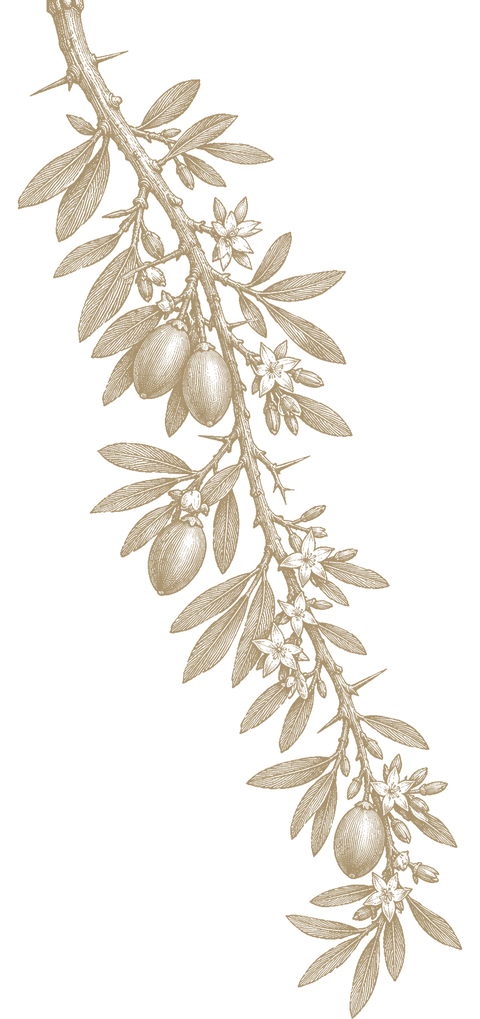
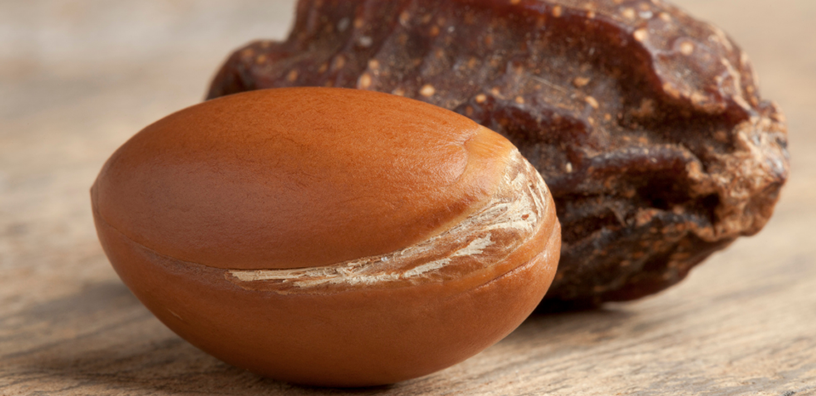
It is a remarkably tough tree. The United Nations describes it as resilient to water scarcity, erosion and poor soils, able to withstand temperatures of up to 50°C (122°F), and able to live for around 200 years1. Argan trees are short and thorny with gnarled trunks and small leaves, and their fruit looks a little like a large olive. Inside the fleshy fruit is a very hard nut, and inside that nut are the small kernels that are pressed for oil.
The tree matters for much more than oil. Its leaves and fruit are used as fodder, its wood as fuel, and the forest helps hold back desertification in a drought-prone region1,2.
Where in Morocco does argan grow?
The heart of argan country is the Souss plain and the surrounding hills, bordered by the High Atlas and Anti-Atlas mountains and open to the Atlantic in the west. The coastal cities of Essaouira and Agadir sit at its edge2.
The Arganeraie Biosphere Reserve
In 1998, UNESCO designated the Arganeraie Biosphere Reserve, covering roughly 2.5 million hectares of southwestern Morocco and home to more than three million people2. Biosphere reserves are meant to balance conservation with the livelihoods of the people who live there, which suits argan well: the forest is both a fragile ecosystem and a working landscape.
That protection came for good reason. According to one review, the argan forest shrank from about 1.5 million hectares to an estimated 800,000 hectares by the year 2000, which helped prompt the UNESCO designation3.
A globally important farming system
In 2018, the UN Food and Agriculture Organization (FAO) recognized the argan-based agro-sylvo-pastoral system of Ait Souab-Ait Mansour as a Globally Important Agricultural Heritage System4. The name describes how the land works: crops grown on dry-stone terraces among the trees, livestock grazing, and traditional underground water tanks, all adapted over centuries to a harsh, dry environment4.
Who makes argan oil?
Argan oil is, above all, a story about women. In 2014, UNESCO added "Argan, practices and know-how concerning the argan tree" to its Representative List of the Intangible Cultural Heritage of Humanity. The listing notes that the know-how is passed on mainly by rural women, who teach their daughters from a young age, and that the oil is used in cooking, medicine and cosmetics, and given as a wedding gift5.
The UN likewise notes that rural women lead the whole extraction process using knowledge handed down through generations, and that cooperatives play an important role in creating local jobs and fighting poverty1. Today, much of the oil is produced by women's cooperatives using a semi-industrial mechanical process3. In 2021 the UN General Assembly proclaimed 10 May the International Day of Argania, recognizing the tree's role in sustainable development1.
How argan is used in Morocco
Outside Morocco, argan oil is known almost entirely as a beauty oil. At home, it has always been much more. The roasted oil is a kitchen staple, drizzled over bread, couscous and salads, and blended with almonds and honey into amlou. The unroasted oil is used on skin and hair, and both have a place in traditional remedies and celebrations, including as a wedding gift5. The tree itself supplies fodder for animals and wood for cooking and heating1. When you buy a bottle of cosmetic argan oil, you are buying one small part of a much larger way of life.
Is argan oil sustainable?
It can be, but it is not automatic. The argan forest has shrunk considerably over the past century3, and international demand for the oil puts pressure on a slow-growing tree in a fragile, dry landscape. On the positive side, the forest's protected status, its recognition by UNESCO and FAO, and the growth of women's cooperatives have all given local communities more reason, and more means, to look after the trees1,2,4.
As a buyer, the most useful thing you can do is choose oil from sellers who are open about where and how it was sourced, and who sell it pure rather than as a token ingredient in a blend.
Every bottle of genuine argan oil starts with a tree that grows wild in one small corner of the world.
From fruit to bottle, briefly
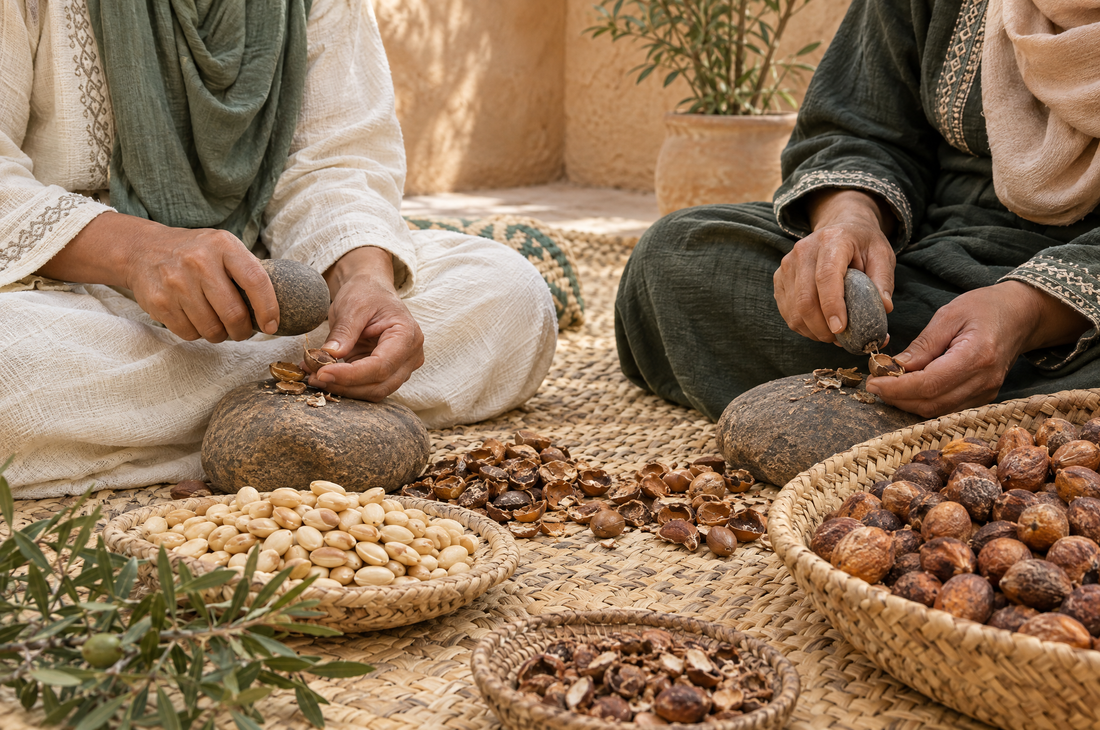
The process is simple to describe and slow to do. The fruit is harvested and dried, the pulp is removed, and the hard nuts are cracked, traditionally between two stones, to free the kernels5,6. For culinary oil, the kernels are roasted for a few minutes before pressing; cosmetic oil, like ours, is pressed from unroasted kernels3.
It takes a lot of fruit to make a little oil. FAO puts it at around 50 kilograms of fruit for half a liter of oil, while a scientific review describes about 24 hours of traditional hand work to get roughly 1 liter from 50 kilograms of fruit6,3. Either way, it is laborious, which is one reason genuine argan oil costs more than common plant oils. For the full step-by-step, read how argan oil is made.
| Cosmetic argan oil | Culinary argan oil | |
|---|---|---|
| Kernels | Unroasted | Roasted briefly before pressing |
| Color and scent | Pale gold, mild and slightly nutty | Deeper amber, toasted and nutty |
| Used for | Skin, hair and nails | Cooking, dressings, amlou (an almond and honey spread) |
More on the difference in culinary vs. cosmetic argan oil.
What about the goats in the trees?
Photos of goats balanced in argan branches are real: goats do climb the short trees to eat the leaves and fruit, and herding is part of the traditional system4,6. Stories that argan oil is made from nuts collected from goat droppings are a different matter, and they don't describe how quality cosmetic oil is made. We separate fact from folklore in the truth about argan trees and goats.
Why origin matters when you buy argan oil
Because the tree grows naturally almost only in Morocco, and because the oil takes so much work to make, argan oil is an obvious target for dilution and relabeling. A few things to look for:
- Morocco as the country of origin, ideally with information on how the oil was sourced.
- A single ingredient: Argania spinosa kernel oil, with nothing else on the list.
- A clear statement of type: cosmetic (unroasted) for skin and hair.
- Recognized certification if you want organic, such as USDA Organic.
Our guide to real vs. fake argan oil goes through the warning signs in detail.
Our own 100% organic argan oil is hand-harvested and cold-pressed in Morocco using traditional methods, USDA-certified organic, and made from unroasted kernels with nothing added.
Frequently asked questions
Does argan oil only come from Morocco?
The argan tree is native to southwestern Morocco and grows naturally almost nowhere else, so practically all genuine argan oil comes from there.
What part of the argan tree does the oil come from?
The oil is pressed from the small kernels inside the hard nut at the center of the argan fruit.
Who makes argan oil?
Traditionally, rural Amazigh (Berber) women in southwestern Morocco. Today much of the oil is produced by women's cooperatives, using a mix of traditional and mechanical methods.
Is the argan forest protected?
Yes. The Arganeraie in southwestern Morocco was designated a UNESCO biosphere reserve in 1998, and the know-how around the argan tree is on UNESCO's intangible heritage list.
Why is argan oil expensive?
It comes from one region, the trees produce slowly, and it takes tens of kilograms of fruit and many hours of work to make a small amount of oil.
Sources
- United Nations. International Day of Argania, 10 May. Link
- UNESCO Man and the Biosphere Programme. Arganeraie Biosphere Reserve, Morocco. Link
- Gharby S, Charrouf Z. Argan oil: chemical composition, extraction process, and quality control. Front Nutr. 2021;8:804587. Link
- Food and Agriculture Organization of the United Nations. Argan-based agro-sylvo-pastoral system within the area of Ait Souab - Ait Mansour (GIAHS). Link
- UNESCO Intangible Cultural Heritage. Argan, practices and know-how concerning the argan tree (inscribed 2014). Link
- Food and Agriculture Organization of the United Nations. The Moroccan landscape, traditions and communities behind argan and its oil. Link