How Argan Oil Is Made: From Fruit to Bottle
Every bottle of argan oil starts as a small, olive-like fruit on a thorny tree in southwestern Morocco, and it takes a surprising amount of fruit, time and skilled handwork to get from one to the other. Knowing how the oil is made explains why it costs what it does, why cosmetic and culinary argan oils smell so different, and why quality varies so much from one bottle to the next.
The short answer
Argan oil is made by harvesting ripe argan fruit, sun-drying it, removing the dried pulp, cracking the hard nuts to free the kernels, and cold-pressing those kernels. Cosmetic oil is pressed from raw kernels; culinary oil from lightly roasted ones. The oil is then decanted and filtered. Much of this work is done by women's cooperatives in Morocco.
Where argan oil comes from
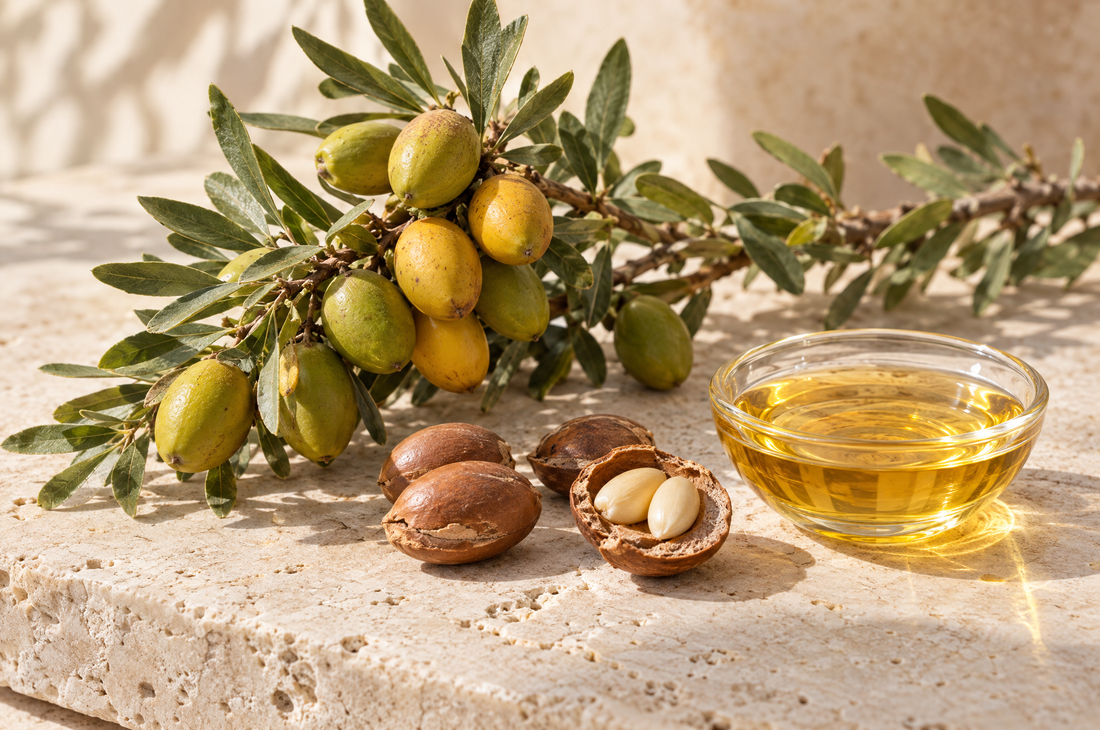
The argan tree (Argania spinosa) grows mainly in southwestern Morocco, where it is a slow-growing, thorny tree well adapted to dry land1. Its forest is protected within the Arganeraie Biosphere Reserve, designated by UNESCO in 1998 and covering roughly 2.5 million hectares between the High Atlas and Anti-Atlas mountains2. The United Nations notes the tree can reach about 10 meters, live for 200 years, and withstand temperatures up to 50°C3. Our article on where argan oil comes from covers the region in more depth.
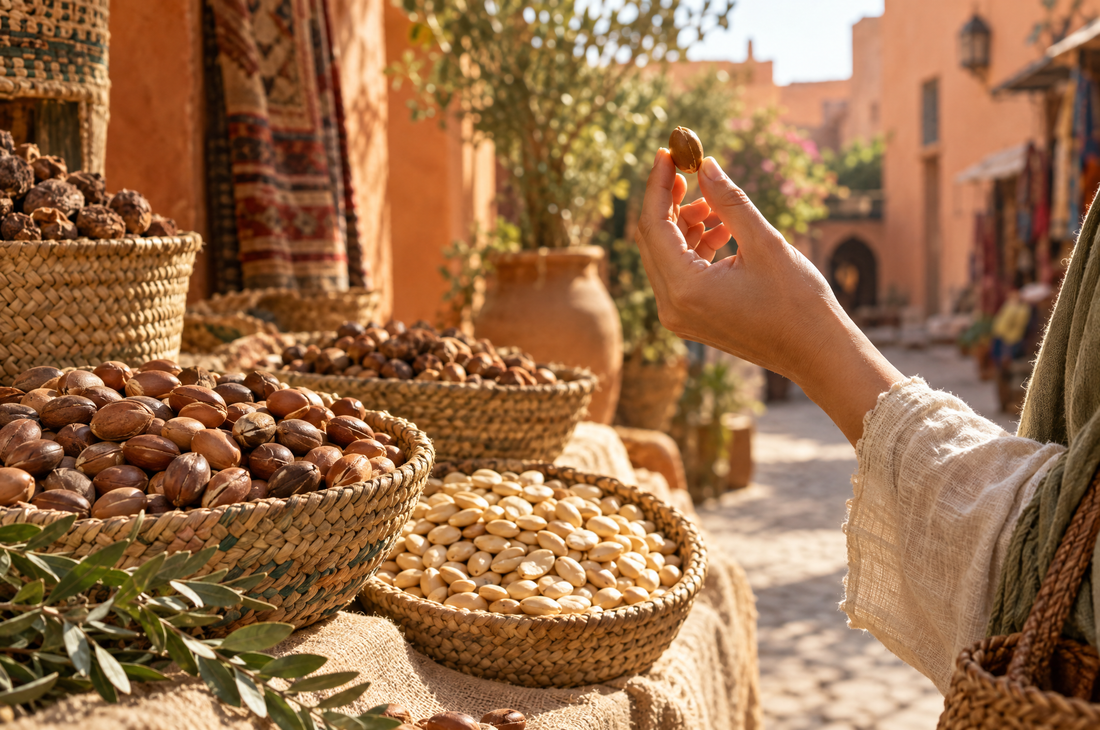
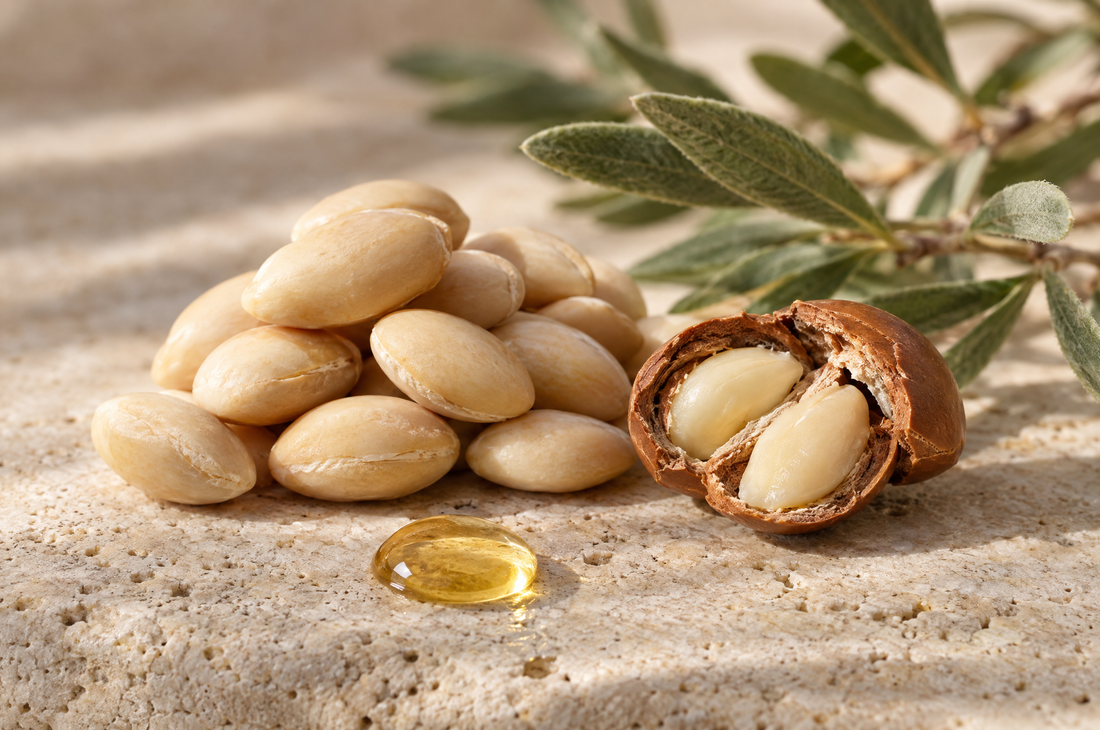
The fruit has a fleshy outer pulp around a very hard nut, and inside the nut sit one or more small, oil-rich kernels. Those kernels are what become argan oil.
How is argan oil made in Morocco? Step by step
A detailed review by Moroccan argan researchers Said Gharby and Zoubida Charrouf describes the process from tree to bottle1. Here is how it works.

1. Harvesting the fruit
Ripe fruit is collected by hand, traditionally from May to August1. Starting with ripe, sound fruit is the first quality decision in the whole chain.
2. Sun-drying
The fruit is spread out to dry in the sun for a few weeks. Research cited in the same review found that around two weeks of drying is optimal for producing high-quality oil1.
3. Removing the pulp (dehulling)
Once dry, the shriveled outer pulp is removed to leave the argan "nut." Traditionally this was done by hand; in modern production the fruit is often peeled mechanically1. The pulp isn't wasted: fruit, leaves and the press residue are used as animal feed4.
4. Cracking the nuts
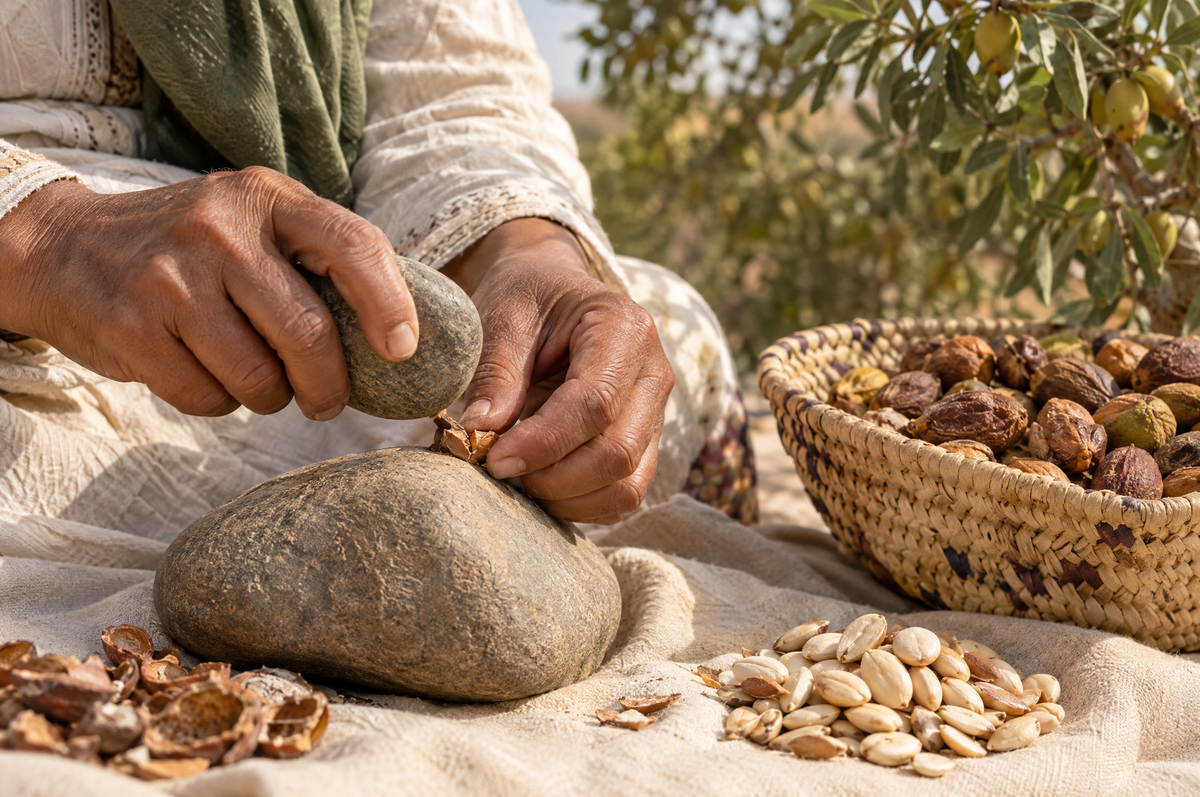
The argan nut is extremely hard. Traditionally, women crack each one between stones to free the kernels4, then sort them by hand. It's skilled, painstaking work, and it's a large part of why argan oil takes so long to make.
5. Roasting (culinary oil only)
This is where the two kinds of argan oil part ways. For culinary oil, kernels are lightly roasted, which develops the nutty, toasted flavor. Studies show roasting at around 110°C for 15 to 30 minutes is optimal for oil quality and stability5. For cosmetic oil, this step is skipped entirely, and the raw kernels go straight to the press1.
6. Pressing
Traditionally, kernels were ground on a stone hand mill and the resulting paste was kneaded by hand with small amounts of warm water until the oil separated out1,6. Today, cooperatives and producers typically use mechanical presses, which eliminate the added water and improve consistency and hygiene1. This mechanical, unheated pressing is what "cold-pressed" refers to; see why the extraction method matters.
7. Decanting and filtering
Freshly pressed oil is cloudy. It is left to settle and then filtered to remove fine solids, waxes and gums1, leaving a clear, golden oil ready for bottling.
Traditional vs. modern argan oil production
| Step | Traditional method | Modern cooperative or industrial method |
|---|---|---|
| Drying | Sun-dried | Sun-dried, with controlled drying times |
| Dehulling | By hand | Often mechanical |
| Cracking | By hand, between stones | Varies by producer |
| Grinding and extraction | Stone hand mill, paste kneaded with warm water | Mechanical press, no added water |
| Typical result | Variable quality and shelf life | More consistent quality, longer shelf life |
Hand-pressing was hugely labor-intensive: the review estimates it took a single person around 24 hours to extract about 1 liter of oil from 50 kg of fruit, and the leftover paste could still hold up to 25% oil1. The UN gives a similar ratio, about 150 kg of fruit for 3 liters of oil3. In a two-year storage study, mechanically pressed edible argan oil kept an excellent profile, while hand-extracted oil fared noticeably worse7.
How cosmetic and culinary argan oil differ
Both are virgin, cold-pressed oils. The single difference in production is roasting1:
- Cosmetic argan oil is pressed from unroasted kernels. It's light gold, with a mild, faint aroma.
- Culinary argan oil is pressed from roasted kernels. It's darker, copper-colored, and smells and tastes of toasted nuts. Roasting also generates aroma compounds and other substances that give the edible oil a longer shelf life7,1.
That's why a cosmetic oil that smells strongly roasted is worth questioning. More in culinary vs. cosmetic argan oil.
Women's argan cooperatives
Argan know-how has long been held largely by rural women. UNESCO's 2014 listing of argan practices and know-how as Intangible Cultural Heritage describes the skills being passed from mother to daughter and notes that the oil is also part of community life, given as a wedding gift and used in festive cooking6. The UN highlights that cooperatives create local jobs and help rural women gain economic independence3.
Many women now work in cooperatives that combine traditional hand skills with mechanical pressing4. The impact is real but not simple. A study of rural households published in PNAS found the argan boom helped some families increase consumption and send more girls to secondary school, but it also found no improvement in forest health and signs that higher prices may have contributed to degradation8. Buying argan oil can support these communities; it doesn't automatically protect the forest.
Every drop of argan oil is the end of a long chain of hands.
Protected heritage: UNESCO and FAO
The argan landscape carries several international designations:
- 1998: UNESCO designates the Arganeraie Biosphere Reserve2.
- 2014: UNESCO inscribes "Argan, practices and know-how concerning the argan tree" on the Representative List of the Intangible Cultural Heritage of Humanity6.
- 2018: FAO recognizes the argan-based agro-sylvo-pastoral system of Ait Souab–Ait Mansour as a Globally Important Agricultural Heritage System, noting its dry-stone terraces and traditional water management9.
- 2021: The UN General Assembly proclaims May 10 the International Day of Argania3.
What the process means when you're buying
Understanding production gives you a few practical checks:
- Check the ingredient list. It should read only Argania spinosa kernel oil. Anything else means a blend.
- Look for "cold-pressed." This signals mechanical pressing without added heat or solvents.
- Smell it. Cosmetic oil should smell faint and slightly nutty, not strongly toasted, perfumed or sour.
- Check the packaging. Dark glass protects the oil from light.
- Be wary of very low prices. Given the fruit, time and labor involved, real argan oil can't be cheap. Our guide to why argan oil costs what it does explains the economics.
Our own organic argan oil is sourced from Morocco, hand-harvested and cold-pressed from unroasted kernels using traditional methods, then bottled in amber glass with nothing added.
Frequently asked questions
How is argan oil extracted?
Argan fruit is dried, the pulp is removed, the hard nuts are cracked to free the kernels, and the kernels are cold-pressed. Traditionally this was done with a stone hand mill and warm water; today most oil is extracted with mechanical presses.
How much fruit does it take to make argan oil?
A lot. The UN cites about 150 kg of fruit for 3 liters of oil, and researchers estimate traditional hand extraction took about 24 hours of work to produce one liter.
Is argan oil made by hand?
Partly. Harvesting and sorting are hand work, and nut cracking has traditionally been done by hand with stones. Pressing is now usually mechanical, which improves consistency and shelf life.
What's the difference between cosmetic and culinary argan oil production?
Only the roasting step. Culinary oil is pressed from lightly roasted kernels, giving it a toasted, nutty taste; cosmetic oil is pressed from raw kernels and has a milder scent.
Who makes argan oil?
Much of it is produced in southwestern Morocco, often by women's cooperatives that combine traditional skills with modern pressing equipment.
Sources
- Gharby S, Charrouf Z. Argan oil: chemical composition, extraction process, and quality control. Front Nutr. 2022;8:804587. Link
- UNESCO Man and the Biosphere Programme. Arganeraie Biosphere Reserve, Morocco (designated 1998). Link
- United Nations. International Day of Argania, 10 May (General Assembly resolution A/RES/75/262, 2021). Link
- Khallouki F, Eddouks M, Mourad A, Breuer A, Owen RW. Ethnobotanic, ethnopharmacologic aspects and new phytochemical insights into Moroccan argan fruits. Int J Mol Sci. 2017;18(11):2277. Link
- Harhar H, Gharby S, Kartah B, El Monfalouti H, Guillaume D, Charrouf Z. Influence of argan kernel roasting-time on virgin argan oil composition and oxidative stability. Plant Foods Hum Nutr. 2011;66(2):163–168. Link
- UNESCO. Argan, practices and know-how concerning the argan tree. Representative List of the Intangible Cultural Heritage of Humanity, inscribed 2014. Link
- Gharby S, Harhar H, Guillaume D, Haddad A, Matthäus B, Charrouf Z. Oxidative stability of edible argan oil: a two-year study. LWT – Food Sci Technol. 2011;44(1):1–8. Link
- Lybbert TJ, Aboudrare A, Chaloud D, Magnan N, Nash M. Booming markets for Moroccan argan oil appear to benefit some rural households while threatening the endemic argan forest. Proc Natl Acad Sci U S A. 2011;108(34):13963–13968. Link
- Food and Agriculture Organization of the United Nations. Argan-based agro-sylvo-pastoral system within the area of Ait Souab – Ait Mansour, Morocco. Globally Important Agricultural Heritage Systems (designated 2018). Link