Argan Oil for Keratosis Pilaris (Strawberry Skin)
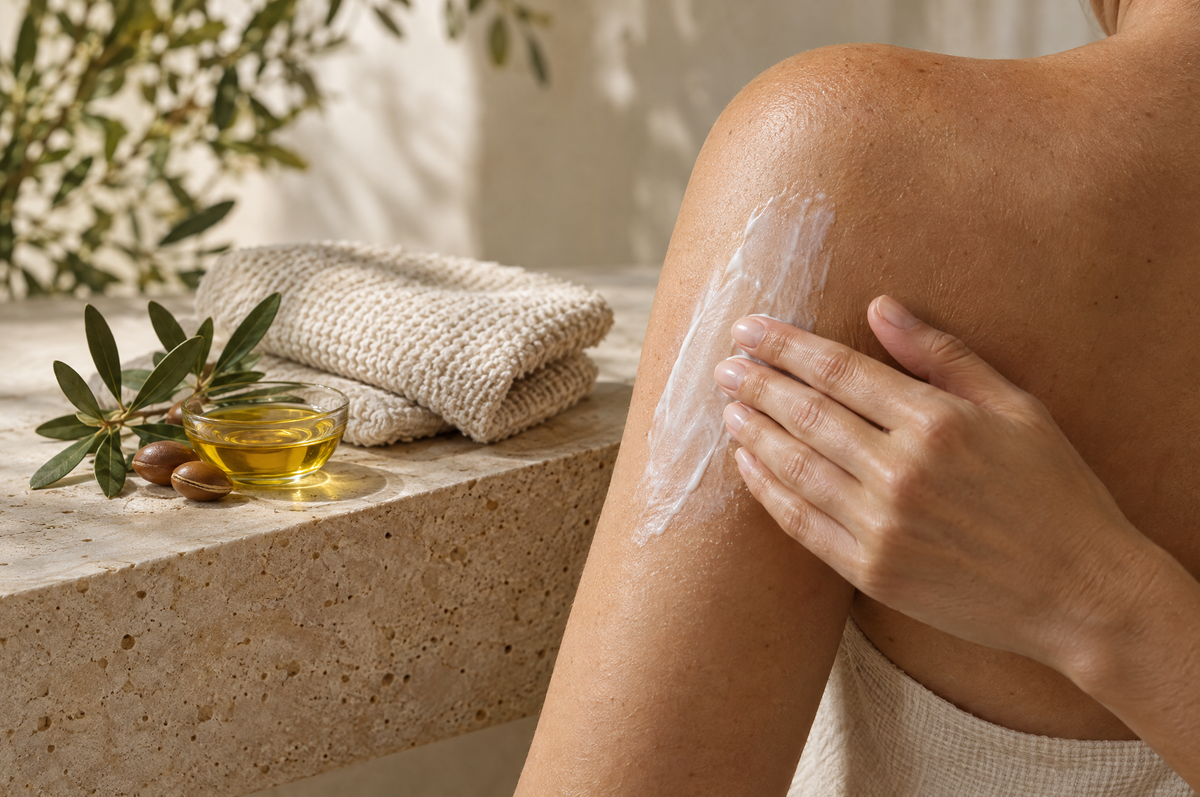
Argan oil won't clear keratosis pilaris, and it isn't what dermatologists reach for first. The rough bumps are plugs of dead skin in hair follicles, and the approach with the best support is gentle exfoliation plus a cream containing urea or lactic acid. Argan oil can play a small supporting role on dry skin around the bumps, but there is no research showing it improves keratosis pilaris itself.
The short answer
There's no evidence that argan oil improves keratosis pilaris. Dermatologists recommend gentle exfoliation, a product with urea, lactic acid, glycolic acid or salicylic acid, and a thick oil-free moisturizer. Argan oil can soften surrounding dry skin, but use it sparingly on the bumps, and see a dermatologist if they persist or bother you.
What keratosis pilaris actually is
Keratosis pilaris, often called KP, chicken skin or strawberry skin, causes small rough bumps, usually on the upper arms, thighs and buttocks.1 Each bump is a hair follicle clogged with dead skin cells. Because we have thousands of follicles, many plugged ones together make patches of skin feel like sandpaper.2
It is common, harmless and not contagious. It most often starts before age two or in the teenage years, and is more likely in people with dry skin, eczema, asthma, hay fever or a family history of it.2 Childhood KP often fades by late childhood or adolescence, and teen-onset KP often improves by the mid-20s, though it can continue into adulthood.2
One thing to know before you start: the American Academy of Dermatology (AAD) says keratosis pilaris can't be cured, so the goal is a maintenance routine that keeps skin smoother, often used a few times a week once it improves.3
Does argan oil help keratosis pilaris?
We couldn't find a single study testing argan oil on keratosis pilaris, and we'd be wary of any site that claims otherwise. Here is how the pieces fit together.
What argan oil can do
Argan oil is a good emollient for ordinary dry skin. Plant oils can form a light protective film that slows water loss from the skin, and linoleic acid, one of argan oil's two main fatty acids, helps keep the skin's water barrier intact.4 Since dry skin is a known risk factor for KP, keeping the surrounding skin comfortable is reasonable.2 Our guide to argan oil for dry skin covers that in more detail.
What it can't do
An oil doesn't dissolve the keratin plugs that make the bumps. That's the job of exfoliating ingredients. Argan oil's other main fatty acid is oleic acid, and the same review that praises linoleic acid notes that oleic acid applied continuously can disrupt the skin barrier in some studies.4 Argan oil is roughly 43–49% oleic acid.5 That doesn't make it harmful, but it's one more reason not to expect it to fix a follicle problem.
The oil-free advice
The AAD specifically recommends an ointment or oil-free cream for keratosis pilaris, noting that this helps avoid clogged pores, and suggests a thick, oil-free cream with urea or lactic acid.3 That's the clearest reason argan oil should be a minor extra here rather than your main moisturizer. Whether argan oil clogs pores is a fair question, and we look at the evidence in does argan oil clog pores, but with a condition that is literally plugged follicles, it makes sense to follow the oil-free guidance and see how your own skin responds.
For a balanced view of where the research on argan oil for skin is strong and where it's thin, see our evidence guide.
Chicken skin remedies that have evidence behind them
Keratosis pilaris has been studied less than you might expect, and a 2025 review notes that very few clinical studies exist.1 The ones we do have point in a consistent direction.
| Approach | What the evidence shows |
|---|---|
| 10% lactic acid cream | Twice daily for three months reduced lesions by an average of 66% in one randomized study.6 |
| 5% salicylic acid cream | Reduced lesions by an average of 52% in the same study; both creams also improved skin hydration.6 |
| 20% urea cream | Smoother skin texture after one and four weeks in an open study of 30 adults, with no comparison group.7 |
| Other topicals and lasers | A systematic review of 47 studies found lasers had the strongest support, with several topicals also improving appearance.8 |
| Argan oil | Not studied for keratosis pilaris. |
Interestingly, one of the topicals that improved KP in the systematic review was a mineral oil and hydrophilic petrolatum base.8 So rich, occlusive textures aren't automatically off-limits. But that was a specific product, not argan oil, and it doesn't override the AAD's oil-free advice.
The best moisturizer for keratosis pilaris
Based on the AAD's guidance, look for a thick cream or ointment rather than a lotion, without added oil, containing urea or lactic acid.3 Many people find a urea or lactic acid body cream does double duty as both exfoliant and moisturizer.
A keratosis pilaris routine, with or without oil
The AAD's self-care routine has three steps, done daily until skin improves, and then a few times a week to maintain it.3
- Bathe briefly in warm water. Keep baths and showers to 20 minutes or less, once a day, using warm rather than hot water and a mild cleanser instead of bar soap.3
- Exfoliate gently. Use a loofah, buff puff or rough washcloth with light pressure. Don't scrub; scrubbing irritates skin and tends to make KP worse.3
- Apply a keratolytic. Choose a product with glycolic acid, lactic acid, salicylic acid, urea or a retinoid, and follow its directions exactly. If skin becomes too dry or irritated, pause for a few days.3
- Moisturize within five minutes. Apply a thick, oil-free cream with urea or lactic acid to damp skin, and again whenever skin feels dry, at least two or three times a day.3
- Optional: a drop of argan oil on dry areas. If the skin around the bumps feels tight or flaky after acids, press one or two drops over your cream on those areas at night, rather than coating the bumps themselves.
Test it on one arm first
If you want to know whether argan oil helps or hinders your KP, use it on one arm only for three or four weeks while keeping everything else the same. If the oiled arm looks bumpier, stop. If you can't tell the difference, it's a matter of comfort. If you'd like a single-ingredient, fragrance-free oil for this, ours is 100% organic, cold-pressed argan oil with nothing else added.
Exfoliate, then moisturize. Oil, if you use it, comes last and goes light.
Habits that make the bumps more noticeable
- Shaving and waxing. Both can bring on more bumps. The AAD notes that laser hair removal can remove hair without triggering a flare-up.3 Our guide to argan oil after waxing or shaving covers aftercare for those areas.
- Self-tanner. The AAD says it tends to make the bumps more noticeable.3
- Dry indoor air. A humidifier can help when the air feels dry.3
- Harsh scrubs. Rough grains and vigorous scrubbing irritate skin and tend to make KP worse.3
When to see a dermatologist
The AAD recommends seeing a board-certified dermatologist if keratosis pilaris persists despite home care.3 It's also worth a visit if the bumps are itchy, inflamed or spreading. They can confirm it is keratosis pilaris rather than another condition with similar bumps, and discuss prescription options. Certain medicines, including some cancer drugs, can also cause KP-like bumps, which is worth mentioning if you've started a new medication.2
Frequently asked questions
Is argan oil good for keratosis pilaris?
There's no research showing it improves keratosis pilaris. It can soften surrounding dry skin, but dermatologists recommend urea or lactic acid creams and an oil-free moisturizer as the main routine.
What is the best oil for keratosis pilaris?
No oil has good evidence for KP. The AAD recommends a thick, oil-free cream or ointment with urea or lactic acid instead.
Can argan oil make keratosis pilaris worse?
It isn't known to, but KP involves plugged follicles and the AAD favors oil-free products. Try it on one arm for a few weeks and stop if the bumps look worse.
How do I get rid of chicken skin fast?
There's no quick fix and KP can't be cured. Daily gentle exfoliation, a lactic acid or urea product and regular moisturizing are the usual approach; studies measured improvement over one to three months, and a few times a week keeps it up.
This article is for general information and isn't medical advice. If your bumps are itchy, inflamed, spreading, or not improving, or if you're choosing products for a child, check with a doctor or board-certified dermatologist.
Sources
- Kaur K, Kaur A, Kalsi V, Kasav S. Keratosis pilaris unveiled: insights into its origin, management strategies and research frontiers. Indian J Dermatol. 2025;70(5):267–274. Link
- American Academy of Dermatology. Keratosis pilaris: who gets and causes. Link
- American Academy of Dermatology. Keratosis pilaris: self-care. Link
- Lin TK, Zhong L, Santiago JL. Anti-inflammatory and skin barrier repair effects of topical application of some plant oils. Int J Mol Sci. 2017;19(1):70. Link
- Gharby S, Charrouf Z. Argan oil: chemical composition, extraction process, and quality control. Front Nutr. 2021;8:804587. Link
- Kootiratrakarn T, Kampirapap K, Chunhasewee C. Epidermal permeability barrier in the treatment of keratosis pilaris. Dermatol Res Pract. 2015;2015:205012. Link
- McCormick E, Nussbaum D, Friedman A, Pham H, Meckfessel MH, Emesiani C. Evaluation of a moisturizing cream with 20% urea for keratosis pilaris. J Drugs Dermatol. 2024;23(1):1274–1277. Link
- Maghfour J, Ly S, Haidari W, Taylor SL, Feldman SR. Treatment of keratosis pilaris and its variants: a systematic review. J Dermatolog Treat. 2022;33(3):1231–1242. Link