What Does Argan Oil Smell Like?
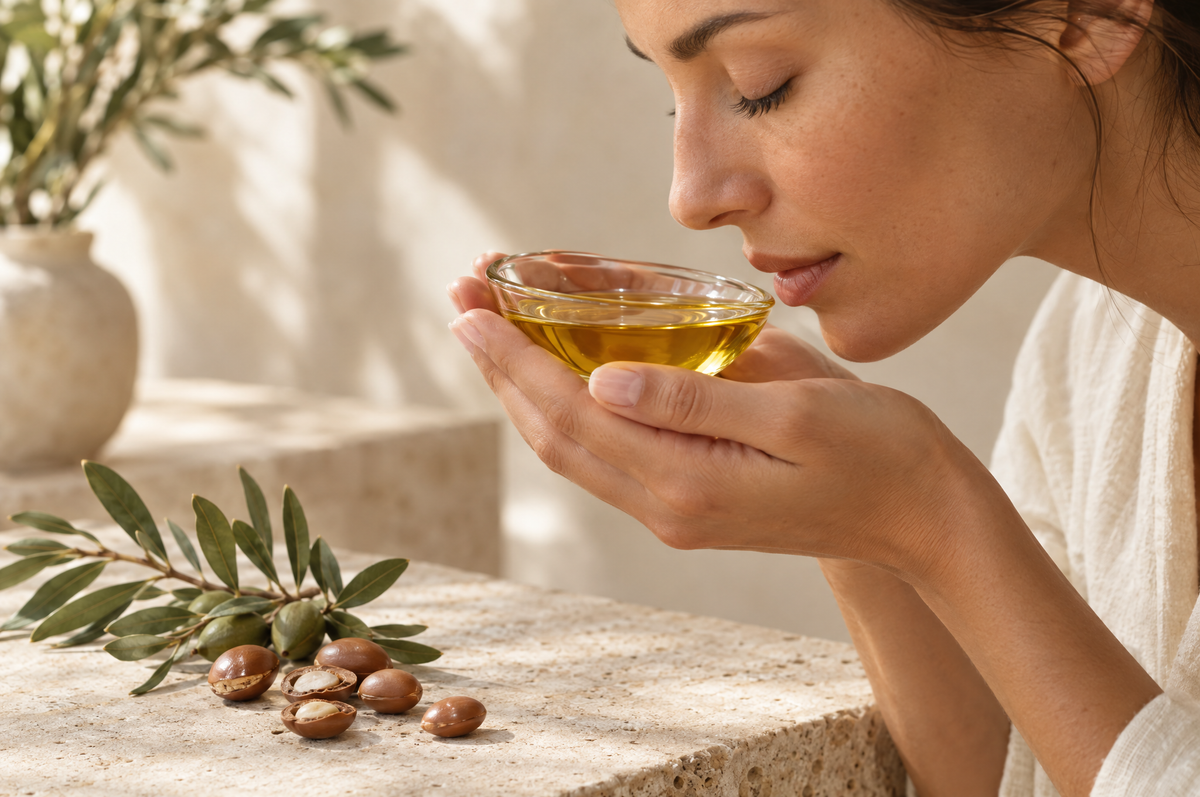
Open three bottles labeled "argan oil" and you might get three different smells: one barely there, one like toasted hazelnuts, one like a perfume counter. People reasonably wonder which one is right, or whether their bottle has gone off. Smell turns out to be one of the most useful clues you have about what's actually in the bottle and how it was made.
The short answer
Pure cosmetic argan oil has a mild, slightly nutty, earthy scent that fades within minutes on skin. Culinary argan oil smells strongly of toasted nuts because its kernels are roasted. A sour, stale or paint-like smell means rancid oil, while a floral or perfumed smell means fragrance has been added.
What does argan oil smell like?
It depends on which argan oil you mean. There are two kinds of virgin argan oil, and the only difference in how they're made is whether the kernels are roasted before pressing1.
Cosmetic argan oil: faint, nutty, a little earthy
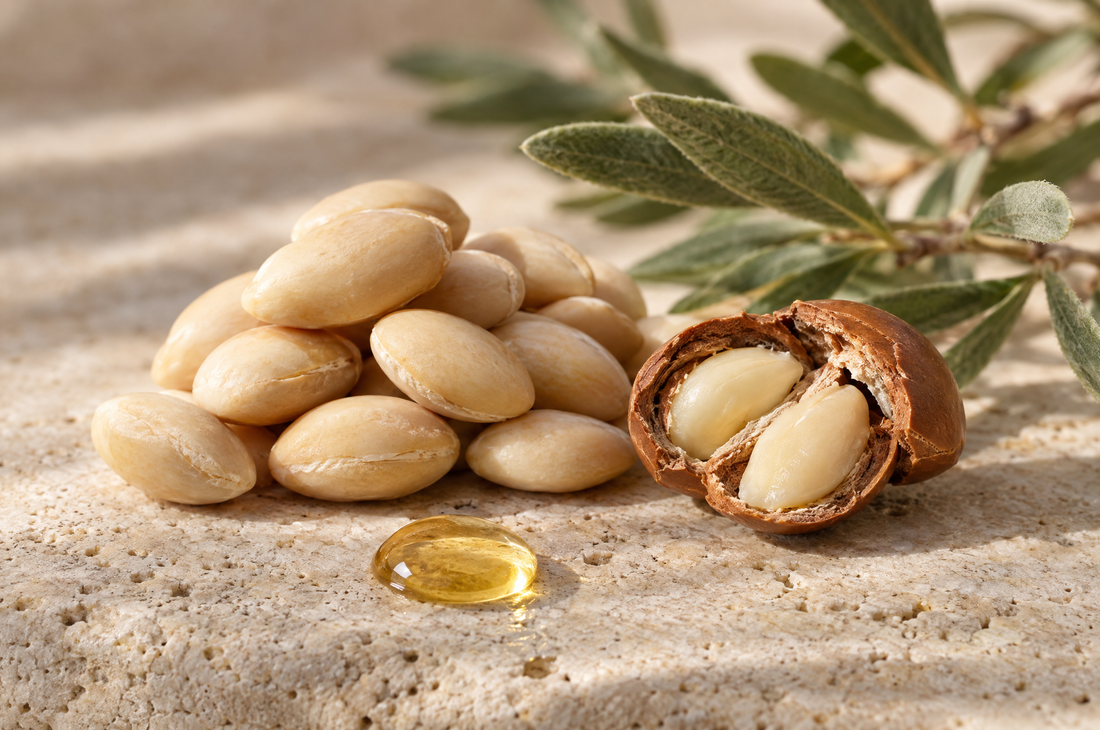
Cosmetic argan oil is cold-pressed from raw, unroasted kernels. Its aroma is gentle. Most people describe it as lightly nutty and slightly earthy. Chemists who analyzed the odor compounds in raw-kernel argan oil found its most prominent odorant was only weakly detectable, far less potent than the roasted aromas of culinary oil2. On skin or hair, the scent usually disappears within a few minutes.
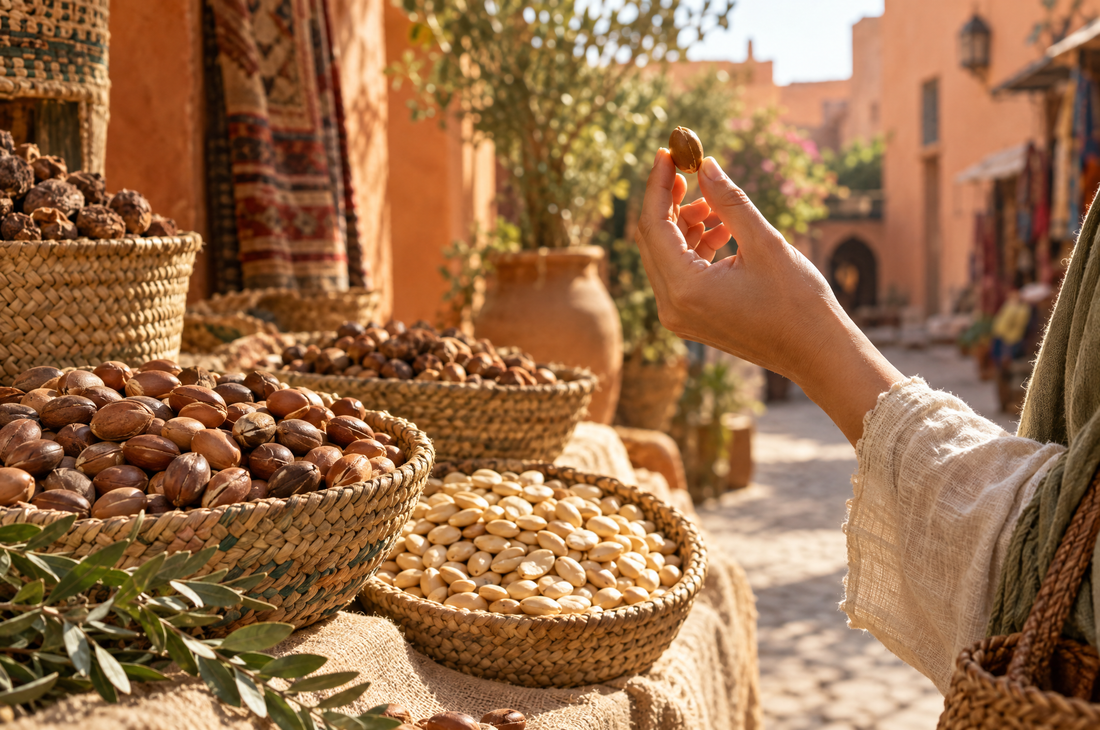
Culinary argan oil: toasted hazelnut
Culinary argan oil is pressed from kernels roasted for a few minutes. Roasting triggers Maillard reactions, the same browning chemistry behind toasted bread and roasted coffee, producing pyrazines and other compounds with a strong roasted, nutty aroma1. Food argan oil is described as having a hazelnut-like taste1, and in odor analysis its key aromas could still be detected at far greater dilutions than anything in raw-kernel oil2. Most of these roasting compounds start forming after about 15 to 25 minutes of roasting3.
| What you smell | What it likely means |
|---|---|
| Faint, nutty, earthy; fades fast | Fresh cosmetic (unroasted) argan oil |
| Strong toasted nuts, like sesame or hazelnut | Culinary (roasted) argan oil, or a blend containing it |
| Almost nothing at all | Possibly refined or deodorized oil |
| Floral, sweet, "salon" scent | Added fragrance; a blend or styling product |
| Sour, stale, crayon, putty or paint | Oxidized, rancid oil |
| Barnyard, musty or unusually strong and off | Poor-quality raw material or contamination |
Use your eyes as well as your nose
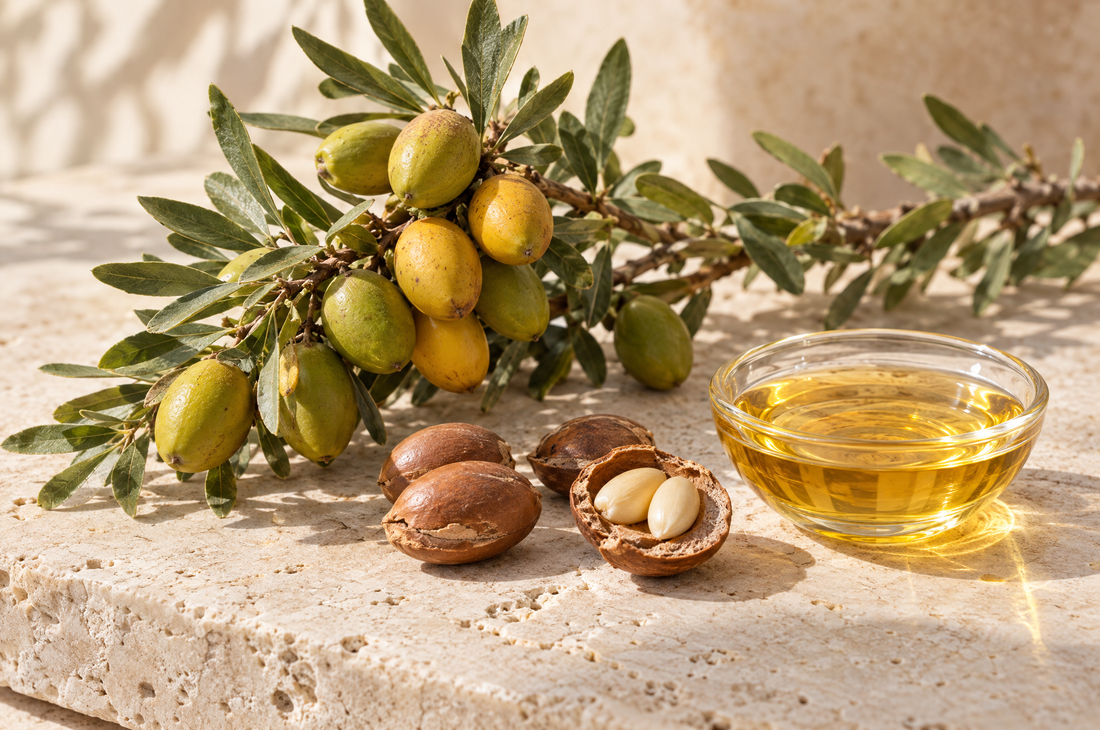
Color and smell usually travel together, because both come from the same roasting step. Cosmetic argan oil is a light gold, while culinary argan oil is a deeper copper color1, and longer roasting darkens the oil further4. So a dark, copper-toned oil with a strong toasted smell, sold for skin and hair, is a hint that roasted kernels were involved. A pale gold oil with a soft, nutty smell is what you'd expect from a cosmetic oil. Neither test is perfect on its own, but together they tell you a lot before you've even put a drop on your skin.
Does argan oil smell good?
"Good" is personal, but most people find fresh cosmetic argan oil neutral to pleasant: soft, natural, not perfumey. A recurring theme in skincare forums is people being surprised that their "argan oil" smells of almost nothing, or conversely that a new bottle smells "like peanuts." Both can be normal, within limits. What matters is that the smell is mild and clean, not sharp, sour or chemical.
If you're sensitive to scent, a mild natural smell is actually a plus. The American Academy of Dermatology recommends fragrance-free products for people with sensitive skin5, and pure argan oil, with no fragrance added, fits that bill even though it has its own faint natural aroma.
Why does my argan oil smell bad?
It's gone rancid
Argan oil, like every plant oil, slowly oxidizes as it's exposed to air, heat and light. The first sign is a change in smell and taste1. Aldehydes such as hexanal are recognized markers of argan oil oxidation1, and in accelerated storage tests, both raw- and roasted-kernel oils developed stronger oily and rancid odor notes1. Rancid oil smells sour, stale or waxy, often compared to old crayons, putty or oil paint. Oil from raw kernels is more prone to oxidation than oil from roasted kernels2, which is one reason cosmetic argan oil has a shorter shelf life. See does argan oil expire for storage advice.
It's culinary oil, or mixed with it
If a bottle sold for skin and hair smells strongly of roasted nuts, it may be made from roasted kernels. That's not dangerous, but it's not cosmetic-grade oil, and the scent can linger on your face and pillow. Our explainer on culinary vs. cosmetic argan oil goes deeper.
Poor-quality fruit
Oil made from fruit that goats have eaten and processed (so-called goat-peeled fruit) carries additional volatile compounds that change its smell1,6. Quality producers use hand-harvested fruit instead. The full story is in the truth about argan trees and goats.
Why some argan oil smells like nothing
Some argan oil used in cosmetics is physically refined: bleached and then deodorized with steam to remove color and odor so it doesn't affect a finished product's look or scent. A 2024 study found that this refining process also removed much of the oil's tocopherols (vitamin E compounds) and dramatically reduced its oxidative stability7.
So an oil with no smell at all and a very pale, almost colorless look may be refined. That doesn't make it fake, but it isn't the same as a virgin, cold-pressed oil. If the label says "deodorized" or "refined," you'll know why it's odorless.
What does added fragrance tell you?
Many hair products marketed with argan oil smell sweet, floral or "salon-fresh." That scent comes from added fragrance, not from argan. Check the ingredient list:
- If you see "fragrance" or "parfum," the product contains added scent.
- If argan oil (Argania spinosa kernel oil) appears near the end of a long list, the product likely contains only a little of it.
- If silicones such as cyclopentasiloxane or dimethicone come first, you're mostly buying silicone.
None of that makes those products bad, but they aren't pure argan oil. Our guide to real vs. fake argan oil walks through the checks, and argan oil vs. "Moroccan oil" explains a common naming confusion.
How to judge argan oil by smell
- Smell it straight from the bottle. Expect a light, nutty, earthy scent. You may need to get close to notice it.
- Put a drop on the back of your hand. Rub it in and smell after a minute. The aroma should fade noticeably.
- Check for sharp or sour notes. Anything that smells stale, waxy, like crayons or paint suggests oxidation.
- Check for perfume. Floral or sweet notes mean added fragrance.
- Check for a strong roast. A powerful toasted smell suggests roasted kernels.
- Compare over time. A bottle that smelled fine when you bought it and now smells sharper is aging.
A mild, natural smell is what we aim for. Our organic argan oil is cold-pressed from unroasted kernels with no fragrance added, so what you smell is simply the oil.
Does the smell of argan oil linger?
Fresh cosmetic argan oil shouldn't linger. Once absorbed, most people can't smell it on their skin or hair after a few minutes, which makes it easy to wear with perfume, cologne or other products. If you can still smell a strong nutty or sour scent hours later, something is off: you may be using a roasted oil, a rancid one, or simply too much.
Frequently asked questions
Is argan oil supposed to smell?
Yes, a little. Pure cosmetic argan oil has a faint, nutty, earthy scent that fades quickly on skin. It shouldn't smell strong, sour or perfumed.
Why does my argan oil smell like peanuts or popcorn?
A strong roasted smell usually means the oil was pressed from roasted kernels, which is how culinary argan oil is made. Cosmetic argan oil uses unroasted kernels and smells milder.
How do I know if my argan oil is rancid?
Rancid oil smells sour, stale, waxy or like old crayons or paint. It may also look darker or feel stickier. If it smells off, stop using it on your skin.
Why does my argan oil have no smell at all?
It may have been refined and deodorized, a process that removes odor but also strips out much of the oil's natural vitamin E. Virgin cold-pressed oil has a faint natural scent.
Does argan oil smell like perfume?
No. Pure argan oil has no floral or sweet perfume. If it smells like a salon product, fragrance has been added and it's likely a blend.
Sources
- Gharby S, Charrouf Z. Argan oil: chemical composition, extraction process, and quality control. Front Nutr. 2022;8:804587. Link
- Gracka A, Majcher M, Kludská E, Hradecký J, Hajšlová J, Jeleń HH. Storage-induced changes in volatile compounds in argan oils obtained from raw and roasted kernels. J Am Oil Chem Soc. 2018;95(12):1475–1485. Link
- El Monfalouti H, Charrouf Z, Giordano M, Guillaume D, Kartah B, Harhar H, Gharby S, Denhez C, Zeppa G. Volatile compound formation during argan kernel roasting. Nat Prod Commun. 2013;8(1):33–36. Link
- Harhar H, Gharby S, Kartah B, El Monfalouti H, Guillaume D, Charrouf Z. Influence of argan kernel roasting-time on virgin argan oil composition and oxidative stability. Plant Foods Hum Nutr. 2011;66(2):163–168. Link
- American Academy of Dermatology. Skin care tips for men. Link
- Serrafi A, Chegdani F, Bennis F, Kepinska M. The importance of argan oil in medicine and cosmetology. Nutrients. 2024;16:3573. Link
- Asbbane A, Bousaid Z, Guillaume D, et al. Effects of physical refining process on quality and stability of argan oil (Argania spinosa (L.) Skeels). Sci Rep. 2024;14:23045. Link