Does Argan Oil Clog Pores?
Few questions about argan oil come up more often than this one, and for good reason: if your skin breaks out easily, putting oil on your face feels like tempting fate. The honest answer is more interesting than a number on a chart, because the chart itself has a surprising history.
The short answer
For most people, pure argan oil is unlikely to clog pores. It is a light, fast-absorbing oil with a meaningful share of linoleic acid, and it is generally considered low on comedogenic scales. But those scales come from animal tests of raw ingredients, so the only reliable test is how your own skin responds.
Is argan oil comedogenic? Where the "comedogenic rating" comes from
"Comedogenic" simply means likely to form comedones, the blocked pores we call blackheads and whiteheads. The ratings you see online, usually a 0 to 5 scale, trace back to laboratory work from the 1970s and 1980s in which ingredients were applied to the inner ear of rabbits, a site that forms plugged follicles readily. A widely cited 1984 paper used exactly this rabbit-ear model to rank therapeutic products, cosmetics and individual ingredients, and flagged several common cosmetic ingredients as pore-clogging1.
That research was useful in its day, but it has real limits. Rabbit ear skin is not human facial skin, and raw ingredients were often tested on their own rather than in the finished products people actually use. In 2006, two dermatologists re-examined the concept using a human test on the backs of volunteers prone to comedones. Their conclusion was blunt: finished products made with "comedogenic" ingredients are not necessarily comedogenic2. The paper also points out that the original assumption, that a pore-clogging raw material always makes a pore-clogging product, was exactly that: an assumption2.
So what is argan oil's comedogenic rating?
You'll typically see argan oil listed at 0 or 1 on online charts. We looked for the published rabbit-ear or human testing behind those numbers and couldn't find it, so treat them as informed estimates rather than measured results. They are consistent with argan oil's chemistry, which we'll get to next, but they are not a guarantee for any individual face.
What's in argan oil, and why fatty acids matter for pores
Argan oil is mostly made of four fatty acids. A 2024 review in Nutrients puts oleic acid at roughly 43 to 49 percent, linoleic acid at 29 to 36 percent, palmitic acid at 11 to 15 percent and stearic acid at 4 to 7 percent3. It also carries a notable amount of vitamin E, around 600 to 700 mg per kilogram, most of it as gamma-tocopherol, plus plant sterols and squalene3. (For a closer look, see our guide to what's in argan oil.)
The balance between oleic and linoleic acid is the part worth paying attention to:
- Linoleic acid is an omega-6 fatty acid the skin uses to maintain its water barrier4.
- Oleic acid is an omega-9 fatty acid that, in concentrated form, can loosen the barrier and, with continuous use, has been linked to irritation in research settings4.
| Fatty acid | Share of argan oil | Why it matters for skin |
|---|---|---|
| Oleic acid (omega-9) | About 43–49% | Softening and emollient; very high-oleic oils can disrupt the barrier with continuous use |
| Linoleic acid (omega-6) | About 29–36% | Supports the skin's water barrier; studied in acne-prone skin |
| Palmitic acid (saturated) | About 11–15% | Contributes body and richness |
| Stearic acid (saturated) | About 4–7% | Contributes body and richness |
Figures from Serrafi et al., 20243.
Does argan oil cause acne? What linoleic acid research suggests
There is an intriguing thread of research connecting linoleic acid to acne. Back in 1986, researchers observed that people with acne tend to have low levels of linoleic acid in their skin surface lipids, and proposed that this local shortfall might contribute to the clogging of the follicle lining5. That was a hypothesis, not a proof.
A small follow-up study tested it directly. In a double-blind, placebo-controlled crossover trial in people with mild acne, applying linoleic acid to the skin for one month reduced the overall size of microcomedones, the tiny precursors to visible blemishes, by almost 25 percent, while placebo sites didn't change6. That trial used linoleic acid itself, not argan oil, and it was small. But it's one reason oils with a decent linoleic share are often considered friendlier to breakout-prone skin than very oleic-heavy oils.
The only human study that put argan oil on oily faces is also limited. A four-week study of 20 volunteers with oily skin used a cream that combined argan oil with saw palmetto and sesame seed extracts; casual sebum levels fell by about 20 percent and clinical oiliness scores improved7. Because the cream had several active ingredients and no placebo comparison is described in the abstract, it can't tell us what argan oil does on its own.
No oil is pore-safe for everyone, and very few are pore-clogging for everyone. Your skin is the test that counts.
What can actually make an "argan" product clog pores
When people say argan oil broke them out, the culprit is often something else in the bottle. Blends that dilute argan with cheaper oils, add fragrance, or include silicones and heavy waxes behave very differently from a single-ingredient oil. If you're comparing products, check that argan (Argania spinosa kernel oil) is the only ingredient. Our guide to real versus fake argan oil walks through what to look for. Our own 100% organic argan oil is exactly that: one cold-pressed, unroasted ingredient, with no fragrance or dyes.
Quantity and timing matter too. Several drops pressed over a heavy moisturizer and a full face of makeup is a lot of occlusion for skin that already produces plenty of oil. If you have oily skin, start lighter than you think you need.
How to introduce argan oil without risking breakouts
The American Academy of Dermatology recommends testing new skin care products before you use them freely, and gives a clear method9. Here's how we'd adapt it for a facial oil:
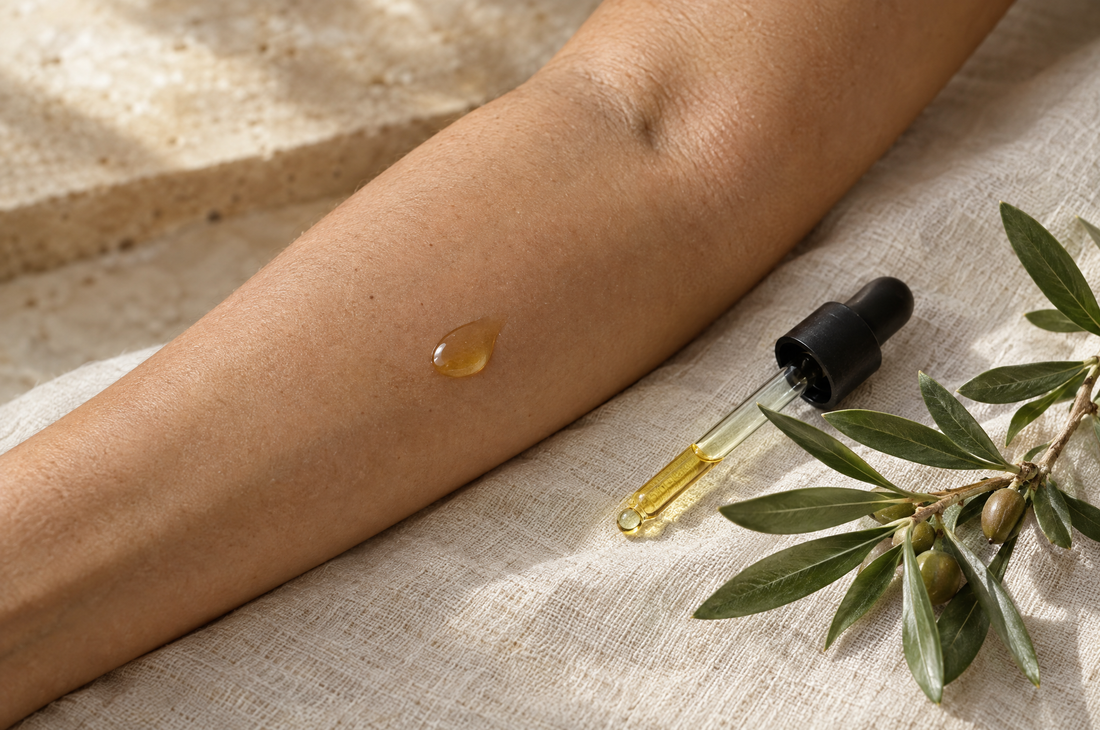
- Patch test first. Apply a small amount to a quarter-sized spot on the inside of your arm or the bend of your elbow, twice a day for seven to 10 days. If there's no redness, itching or swelling, it's reasonable to move on9.
- Then try one area of your face. Use one to two drops on your jawline or cheek, where you can watch for new bumps, for one to two weeks.
- Add only one new product at a time. If you change three things at once and break out, you won't know which one did it. The AAD also notes that switching acne products too often can irritate skin8.
- Use it on clean skin, last. Two to three drops warmed between your fingertips and pressed in, rather than rubbed, is plenty for the whole face.
- Keep sunscreen non-comedogenic. Dermatologists recommend sunscreens labeled "non-comedogenic" or "won't clog pores" for acne-prone skin8. Sunscreen and makeup can clog pores too, so check them before blaming the oil.
- Watch for at least a month. Breakouts can take a few weeks to show up, so a clear first week doesn't settle the question.
If you develop small, itchy bumps rather than blackheads, that may be irritation or an allergy rather than clogged pores. Our article on whether argan oil can irritate skin covers how to tell the difference.
Who should be more cautious
If you have active, inflamed acne, or acne that's leaving marks or scars, the AAD's advice is to see a board-certified dermatologist rather than experimenting on your own8. Argan oil can sit comfortably alongside proven acne treatments, especially drying ones, but it is not a substitute for them. We cover how it fits into an acne routine in argan oil for acne-prone skin.
If you've found that most facial oils break you out, it's sensible to stick with what works rather than forcing an oil into your routine. And if you have a known allergy to nuts or seeds, ask your doctor before trying a kernel oil.
Frequently asked questions
Is argan oil non-comedogenic?
Argan oil is generally considered low-risk for clogging pores and is commonly listed at 0 or 1 on comedogenic charts. Those charts are estimates based largely on animal testing, so patch testing is the only way to know how your skin reacts.
Why did argan oil make me break out?
The most common reasons are using too much, layering it over other heavy products, or using a blend that contains fragrance or other oils. True sensitivity to pure argan oil is possible but uncommon; if bumps are itchy, stop and consider irritation or allergy.
Is argan oil better than coconut oil for acne-prone skin?
Many people find argan oil easier to tolerate on the face because it is lighter and contains more linoleic acid. Neither oil is an acne treatment, and individual reactions vary.
How long does it take to know if argan oil clogs my pores?
Give it about four weeks of consistent use on a small area. Comedones develop slowly, so a reaction may not show up in the first few days.
Sources
- Fulton JE Jr, Pay SR, Fulton JE 3rd. Comedogenicity of current therapeutic products, cosmetics, and ingredients in the rabbit ear. J Am Acad Dermatol. 1984;10(1):96–105. Link
- Draelos ZD, DiNardo JC. A re-evaluation of the comedogenicity concept. J Am Acad Dermatol. 2006;54(3):507–512. Link
- Serrafi A, Chegdani F, Bennis F, Kepinska M. The importance of argan oil in medicine and cosmetology. Nutrients. 2024;16(20):3573. Link
- Lin TK, Zhong L, Santiago JL. Anti-inflammatory and skin barrier repair effects of topical application of some plant oils. Int J Mol Sci. 2017;19(1):70. Link
- Downing DT, Stewart ME, Wertz PW, Strauss JS. Essential fatty acids and acne. J Am Acad Dermatol. 1986;14(2 Pt 1):221–225. Link
- Letawe C, Boone M, Piérard GE. Digital image analysis of the effect of topically applied linoleic acid on acne microcomedones. Clin Exp Dermatol. 1998;23(2):56–58. Link
- Dobrev H. Clinical and instrumental study of the efficacy of a new sebum control cream. J Cosmet Dermatol. 2007;6(2):113–118. Link
- American Academy of Dermatology. Acne: Tips for managing. Link
- American Academy of Dermatology. How to test skin care products. Link
This article is for general information and isn't medical advice. If you have acne or another skin condition, check with your dermatologist before adding something new to your routine.