Does Argan Oil Expire? Shelf Life and Storage
A bottle of argan oil lasts a long time when you're using a few drops a day, which raises a fair question somewhere around month eight: is this still good? Argan oil doesn't grow mold the way a water-based cream can, but it does age. Its fats slowly react with oxygen, and eventually it turns rancid. The good news is that argan oil is unusually stable for a plant oil, and how you store it makes a measurable difference.
The short answer
Yes, argan oil expires, but slowly. Research shows cosmetic argan oil stored at room temperature away from light still met Morocco's official quality standard after 12 months, while heat speeds its decline. Culinary argan oil, made from roasted kernels, keeps longer. A sour, crayon-like or paint-like smell means it has gone rancid.
Does argan oil expire?
All plant oils eventually go off. The process is called oxidation: oxygen reacts with the unsaturated fats in the oil, first forming peroxides and then breaking down into smaller compounds, such as aldehydes and ketones, that smell and taste stale or rancid1. Argan oil is about 80% unsaturated fatty acids, mainly oleic and linoleic acid1, so it is susceptible like any other oil.
What slows it down is argan oil's natural antioxidant content, particularly its tocopherols (vitamin E compounds), along with other minor components1. That's why a good argan oil keeps better than you might expect for a delicate-looking golden oil.
Argan oil shelf life: what the studies show
Moroccan researchers have tracked argan oil's quality over long storage periods. Their findings give us actual numbers instead of guesses.
Cosmetic argan oil: about one year
In a one-year study of cosmetic argan oil (made from unroasted kernels), samples were stored at 25°C, either protected from or exposed to sunlight, and at 40°C. Oil kept at 40°C lost quality rapidly. Oil kept at 25°C and protected from sunlight was still satisfactory after 12 months by the official Moroccan standard, although the authors suggested no more than six months of storage to meet stricter industrial standards2.
Culinary argan oil: about two years
Edible argan oil, made from roasted kernels, is more stable. In a two-year study, mechanically pressed edible argan oil still had an excellent chemical profile at the end3. A review of the research sums it up: culinary argan oil can be kept for about two years at 25°C away from light, but cosmetic argan oil for only about one1. In a standard accelerated test, edible argan oil resisted oxidation for an average of 31 hours versus 13 hours for cosmetic oil1.
Why the difference?
Roasting changes the oil. It generates antioxidant compounds through the Maillard reaction and increases phospholipids, both of which appear to protect edible argan oil4. A separate study of stored oils found that oil from roasted kernels was significantly less prone to oxidation than oil from raw kernels5. Cosmetic oil skips roasting to keep its mild scent, and gives up some shelf life in the process. More on this in culinary vs. cosmetic argan oil.
Refined and deodorized oils are less stable
Some argan oil sold as a cosmetic ingredient is bleached and deodorized to remove color and smell. A 2024 study found this refining process stripped out much of the oil's tocopherols and dramatically reduced its oxidative stability6. An odorless, very pale "argan oil" may have been refined, and may age faster than a virgin oil. Our guide to telling real argan oil from fake covers other red flags.
| Type of argan oil | Approximate shelf life (cool, dark storage) | Why |
|---|---|---|
| Cosmetic (unroasted, cold-pressed) | About 12 months | Rich in tocopherols, but no roasting-derived protection |
| Culinary (roasted, cold-pressed) | About 24 months | Roasting adds protective compounds |
| Refined or deodorized | Likely shorter | Refining strips natural antioxidants |
| Any type stored warm or in sunlight | Much shorter | Heat and light speed oxidation |
Argan oil shelf life after opening
The studies above measured oil in storage, so think of them as the outer limit. Once a bottle is open, each use lets in fresh oxygen, and droppers can introduce traces of whatever is on your skin. In practice, plan to use an opened bottle of cosmetic argan oil within about a year, and sooner if it's kept somewhere warm or bright.
What about the "12M" symbol?
That little open-jar icon with a number, like 6M or 12M, is the period-after-opening (PAO) symbol. Under EU cosmetics law, products that last longer than 30 months don't need a printed expiry date, but must instead show how long they can be safely used after opening, using that symbol7. In the United States, there's no law requiring expiration dates on cosmetics; the FDA says determining shelf life is part of the manufacturer's responsibility8. So whether a bottle carries a PAO symbol, a best-by date or neither depends on where it was made and sold, and isn't by itself a sign of quality.
How to tell if argan oil has gone bad
Your nose is the best test. Oxidation shows up first as changes in smell and taste1, and in accelerated storage tests, both raw- and roasted-kernel argan oils developed increasingly oily and rancid odor notes1. Check for:
- Smell: fresh cosmetic argan oil smells faint and slightly nutty. Rancid oil smells sour, stale, like old crayons, putty or paint.
- Color: noticeable darkening compared with when you bought it.
- Texture: a thick, sticky or gummy feel instead of a silky one.
- Skin response: stinging or irritation from an oil that never bothered you before.
If you're unsure, compare it with a fresh bottle, or read what argan oil should smell like. If it smells off, retire it; don't put rancid oil on your face. It's not worth the risk of irritation, and it won't do your skin any favors.
How to store argan oil so it lasts
The research is consistent: heat and light are the enemies2,1. The FDA likewise notes that temperature changes and exposure to sunlight and air can change a cosmetic's color, texture and smell8.
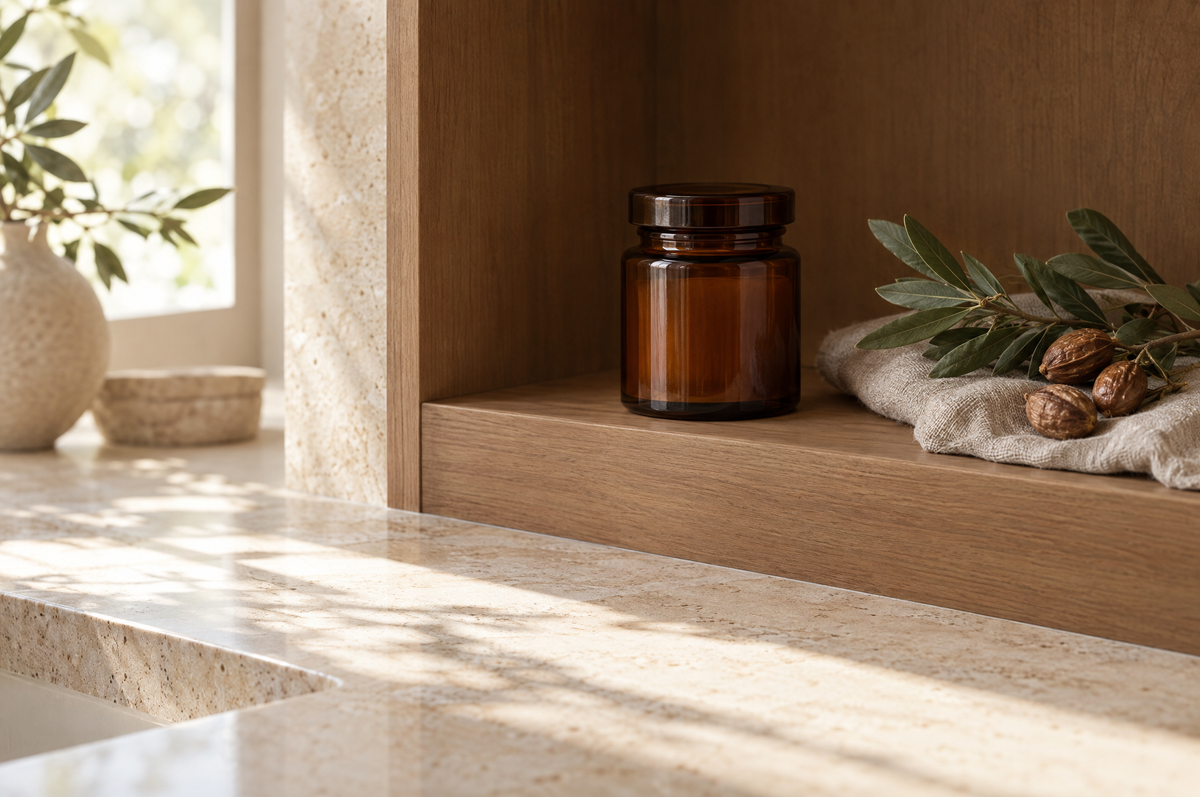
- Keep it in dark glass. Amber or other dark glass blocks much of the light that speeds oxidation. Avoid clear plastic.
- Keep it cool. Room temperature or below. Not on a sunny windowsill, near a radiator, or in a hot car.
- Keep it out of the shower. Steam and heat cycles aren't kind to oils. A bathroom cabinet or bedroom drawer is better.
- Close it tightly. Less air means slower oxidation.
- Keep the dropper clean. Don't touch it to your skin; let drops fall into your palm.
- Buy what you'll use. A smaller bottle you finish in a few months will be fresher at the end than a big one that lingers.
Should you refrigerate argan oil?
You can, but you don't have to. Cooler storage generally slows oxidation, and the long-term argan oil studies compared refrigerated storage at 5°C alongside room temperature and warm conditions3. The practical upside is modest if your home is already cool. If you live somewhere hot, the refrigerator is a reasonable place for a backup bottle. The oil may thicken or look slightly cloudy when cold; let it come back to room temperature before use.
Packaging and freshness matter as much as storage at home. Our organic argan oil is cold-pressed from unroasted kernels and bottled in amber glass with a dropper, which helps keep light and handling to a minimum.
What to do with old argan oil
- Slightly past its best but not rancid: use it up on your body, elbows, heels or hair ends, where small changes matter less. An after-shower body routine goes through a bottle quickly.
- Clearly rancid: don't use it on skin. Wipe it onto a paper towel and put it in the trash rather than pouring it down the drain.
- Culinary argan oil that has turned: don't eat it. Rancid oils taste bad and lose nutritional value.
Frequently asked questions
How long does argan oil last?
Cosmetic argan oil stored cool and away from light stays in good condition for about a year, according to stability research. Culinary argan oil, made from roasted kernels, lasts about two years.
How long is argan oil good for after opening?
Plan to use an opened bottle of cosmetic argan oil within about 12 months, and sooner if it's stored somewhere warm or bright. Each opening lets in fresh oxygen.
Can I use expired argan oil?
If it still smells fresh, it's likely fine on body or hair ends. If it smells sour, stale or like crayons or paint, it's rancid and shouldn't go on your skin.
Does argan oil need to be refrigerated?
No. A cool, dark cupboard is enough for most homes. Refrigeration can help in hot climates, but the oil may thicken or cloud when cold.
Why does my argan oil smell bad?
A sour or paint-like smell usually means the oil has oxidized and gone rancid. A strong roasted smell may mean it's culinary oil, and a perfume smell suggests added fragrance.
Sources
- Gharby S, Charrouf Z. Argan oil: chemical composition, extraction process, and quality control. Front Nutr. 2022;8:804587. Link
- Gharby S, Harhar H, Kartah B, Guillaume D, Chafchaouni-Moussaoui I, Bouzoubaa Z, Charrouf Z. Oxidative stability of cosmetic argan oil: a one-year study. J Cosmet Sci. 2014;65(2):81–87. Link
- Gharby S, Harhar H, Guillaume D, Haddad A, Matthäus B, Charrouf Z. Oxidative stability of edible argan oil: a two-year study. LWT – Food Sci Technol. 2011;44(1):1–8. Link
- Gharby S, Harhar H, Guillaume D, Haddad A, Charrouf Z. The origin of virgin argan oil's high oxidative stability unraveled. Nat Prod Commun. 2012;7(5):621–624. Link
- Gracka A, Majcher M, Kludská E, Hradecký J, Hajšlová J, Jeleń HH. Storage-induced changes in volatile compounds in argan oils obtained from raw and roasted kernels. J Am Oil Chem Soc. 2018;95(12):1475–1485. Link
- Asbbane A, Bousaid Z, Guillaume D, et al. Effects of physical refining process on quality and stability of argan oil (Argania spinosa (L.) Skeels). Sci Rep. 2024;14:23045. Link
- Regulation (EC) No 1223/2009 of the European Parliament and of the Council on cosmetic products, Article 19(1)(c). Link
- U.S. Food and Drug Administration. Shelf life and expiration dating of cosmetics. Link