Can Argan Oil Irritate Skin? Allergies, Nut Concerns and Patch Testing
Argan oil has a reputation as one of the gentlest oils you can put on your skin, and for most people it is. But "gentle for most people" is not the same as "safe for everyone," and if you have sensitive skin or a nut allergy, you deserve a straight answer rather than reassurance. Here is what the medical literature actually records, how to test it properly, and when to stop.
The short answer
Yes, argan oil can irritate skin or cause an allergic reaction, though this appears to be uncommon. Doctors have published cases of allergic contact dermatitis and, rarely, anaphylaxis. Argan is not one of the FDA's major tree nut allergens, but if you have a nut allergy, talk to your allergist first, and always patch test before regular use.
How common is an argan oil allergy?
No one has measured how often people react to argan oil, so nobody can give you a reliable percentage. What we do have is a small number of published case reports, which tells us two things at once: reactions are real, and they are unusual enough that individual cases are still being written up in medical journals.
Those reports include:
- Allergic contact dermatitis on the scalp in a woman using a hair product containing argan oil, confirmed with patch testing.1
- Allergic contact dermatitis in an infant, also confirmed with patch testing.2
- Protein contact dermatitis, a reaction to proteins in the oil rather than to a chemical additive.3
- Anaphylaxis, a severe whole-body allergic reaction, in two separate published cases: one in a man in 2010, investigated with skin tests and immunoblotting, and one after argan oil was applied to the skin, reported in 2021.4,5
A broad review of cosmetic plant oils lists the potential for allergic reactions among argan oil's drawbacks, as it does for jojoba and coconut oil.6 That is a useful reminder: "natural" ingredients are not automatically hypoallergenic, and plant proteins are a common reason people react to botanical products.
Irritation vs. allergy: what's the difference?
These are two different things, and it helps to know which you are dealing with.
| Irritation | Allergic reaction | |
|---|---|---|
| What causes it | The product stresses the skin directly (too much, too often, or on damaged skin) | The immune system reacts to a specific substance, often a protein or fragrance chemical |
| Who gets it | Can happen to anyone, especially with sensitive or broken skin | Only people who are sensitized to that substance |
| Typical signs | Stinging, burning, dryness, mild redness where applied | Itchy red rash, bumps or swelling, sometimes spreading beyond the area; rarely, hives or breathing problems |
| Timing | Usually soon after applying | Can be hours to a couple of days later (contact dermatitis) or within minutes (immediate allergy) |
| What to do | Use less, less often, or stop | Stop completely and see a doctor or dermatologist |
With a single-ingredient oil, irritation is less likely than with a product full of fragrance and preservatives, but it can still happen, particularly if you apply it to skin that is already inflamed, freshly exfoliated or broken.
Argan oil and nut allergy: is argan a tree nut?
This is the question we are asked most often, and the answer has a few layers.
Botanically, argan oil comes from the kernel inside the fruit of Argania spinosa, a tree in the Sapotaceae family.7 That puts it in a different plant family from almonds, walnuts, cashews and the other common tree nuts.
For food labeling, the FDA's 2025 guidance lists the tree nuts it considers major food allergens, including almond, Brazil nut, cashew, hazelnut, macadamia, pecan, pine nut, pistachio and walnuts. Argan does not appear in that guidance.8 Keep in mind that list governs food labels, not cosmetics, and it reflects which nuts have strong evidence as common allergens, not a guarantee that any other plant is safe for you.
Medically, we could not find any study that tested whether people with tree nut or peanut allergies are more likely to react to argan oil. The absence of evidence is not evidence of safety. Several of the reported reactions involved proteins in the oil,3,4 which suggests that traces of kernel protein in an oil can matter for someone who is sensitized.
So if you have a diagnosed nut allergy, particularly a severe one, the sensible step is to ask your allergist before using argan oil, the same as you would for any new plant-derived product. If you have a mild history of reacting to skincare in general, a careful patch test is usually a reasonable first step.
How to patch test argan oil properly
Dabbing a drop on your wrist and checking it an hour later is not a real patch test. The American Academy of Dermatology recommends a longer, repeated test that mimics how you would actually use a product.9
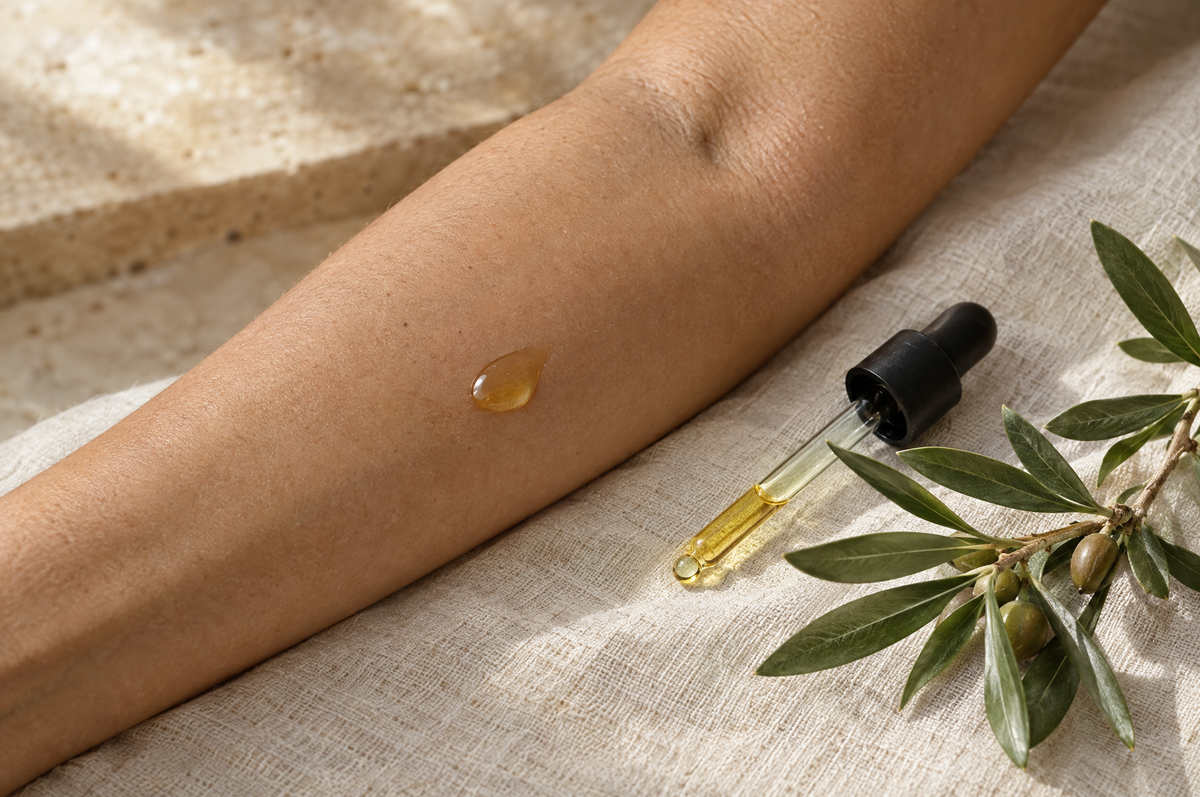
- Choose a quarter-sized spot where the oil won't be rubbed or washed away, such as the inside of your arm or the bend of your elbow.9
- Apply one drop of argan oil, about the amount you would normally use on that area.
- Repeat twice a day for seven to ten days, leaving it on as you normally would.9
- Check the spot each day for redness, itching or swelling.
- If you have no reaction after seven to ten days, you can start using it as intended. For the face, begin with one or two drops every other evening.
- If you do react, gently wash it off, stop using it, and soothe the area with a cool compress or petroleum jelly if needed.9
Test one new product at a time. If you introduce three products in the same week and your skin reacts, you won't know which to blame. And if you keep reacting to skincare and can't identify the cause, ask a dermatologist about formal patch testing, which can pinpoint the specific allergen.9
Choose an oil that's easy to test
Patch testing works best when you know exactly what is in the bottle. Many products sold as "argan oil" are blends with fragrance, silicones or other oils, which makes it impossible to tell what caused a reaction. A single-ingredient oil like our 100% organic argan oil, which contains only cold-pressed Argania spinosa kernel oil with no fragrance or dyes, gives you a clean test. Our guide to spotting real vs. fake argan oil explains how to check a label.
Argan oil side effects on skin: what else can go wrong?
Beyond allergy, the most common complaints are practical rather than medical:
- Breakouts or congestion. Some acne-prone skin doesn't tolerate added oils. See does argan oil clog pores?
- Greasiness. Usually a sign of using too much. Two or three drops cover the whole face.
- Stinging on broken skin. Avoid applying any oil to fresh cuts, open eczema or just-waxed skin.
- An old bottle. Oils oxidize over time, and an oil that smells sharp or crayon-like is past its best and worth replacing. Our article on whether argan oil expires covers storage.
For a wider look at what argan oil can and can't do, read our evidence-based guide to argan oil benefits and side effects.
When to see a doctor
Stop using argan oil and contact your doctor or dermatologist if a rash spreads, blisters, weeps, or doesn't settle within a few days of stopping.
Get emergency help immediately if you or someone else has signs of anaphylaxis after any exposure: trouble breathing, swelling of the lips, tongue or throat, a hoarse voice, widespread hives, dizziness or fainting. Anaphylaxis can progress quickly and should be treated immediately with epinephrine if it is available, followed by emergency care.10
Rare is not the same as never. A ten-day patch test is a small investment for peace of mind.
Frequently asked questions
Can you be allergic to argan oil?
Yes. Allergic contact dermatitis and, rarely, anaphylaxis from argan oil have been reported in medical journals. Reactions appear uncommon, but a proper patch test before regular use is sensible.
Is argan oil safe if I have a nut allergy?
Argan is not one of the FDA's major tree nut allergens and comes from a different plant family, but there is no research on cross-reactivity. If you have a nut allergy, ask your allergist before using it.
What does an argan oil allergy look like?
Most often it is an itchy red rash, bumps or swelling where the oil was applied, sometimes appearing a day or two later. Trouble breathing, throat swelling or widespread hives are an emergency.
How long should I patch test argan oil?
Dermatologists recommend applying it to a small spot twice a day for seven to ten days. If there is no redness, itching or swelling, you can begin using it normally.
Why is my skin red after using argan oil?
It may be irritation from using too much or applying it to sensitive or broken skin, or it may be an allergy. Wash it off and stop; if redness persists or spreads, see a dermatologist.
This article is for general information and isn't medical advice. If you have a known nut or food allergy, a history of skin reactions, or a skin condition, check with your doctor, allergist or dermatologist before trying something new.
Sources
- Foti C, Romita P, Ranieri LD, Bonamonte D. Allergic contact dermatitis caused by argan oil. Contact Dermatitis. 2014;71(3):183–184. Link
- Barrientos N, Moreno de Vega M, Dominguez J. Allergic contact dermatitis caused by argan oil in an infant. Contact Dermatitis. 2014;71(5):316–317. Link
- Lefebvre A, Cotten C, Bauvin O, et al. Protein contact dermatitis caused by argan oil. Dermatitis. 2023;34(4):347–348. Link
- Astier C, et al. Anaphylaxis to argan oil. Allergy. 2010;65(5):662–663. Link
- de las Marinas Alvarez MD, Martorell Calatayud C, Castillo Fernandez M, et al. Anaphylaxis after cutaneous application of argan oil. J Investig Allergol Clin Immunol. 2021;31(4):332–334. Link
- Abdalla S, Aroua MK, Gew LT. A comprehensive review of plant-based cosmetic oils (virgin coconut oil, olive oil, argan oil, and jojoba oil): chemical and biological properties and their cosmeceutical applications. ACS Omega. 2024;9(44):44019–44032. Link
- Gharby S, Charrouf Z. Argan oil: chemical composition, extraction process, and quality control. Front Nutr. 2022;8:804587. Link
- US Food and Drug Administration. Questions and answers regarding food allergens, including the food allergen labeling requirements of the Federal Food, Drug, and Cosmetic Act (Edition 5): guidance for industry. January 2025. Link
- American Academy of Dermatology. How to test skin care products. Link
- American College of Allergy, Asthma and Immunology. Anaphylaxis. Link