Argan Oil for Acne-Prone Skin: Help or Hindrance?
If you have acne-prone skin, you've probably been told two opposite things: that oil is the enemy, and that the right oil can "balance" your skin. Neither slogan is quite right. Here's what the research actually says about argan oil and breakouts, where it can earn a place in your routine, and where it can't.
The short answer
Argan oil is not an acne treatment, and no good study shows it clears breakouts. What it can be is a light, fragrance-free moisturizer for acne-prone skin, especially if your treatments leave you dry. Use a few drops of pure oil, patch test first, and keep your proven acne treatments as the main event.
Is argan oil good for acne? What the research actually shows
Let's grade the evidence honestly, because a lot of what's written online overstates it.
The sebum study
The study most often quoted is a 2007 trial of a "sebum control cream" in 20 volunteers with oily or combination facial skin. After four weeks of twice-daily use, casual sebum levels dropped by about 20 percent, clinical oiliness scores fell by about a third, and a visible sebum-regulating effect was reported in 95 percent of participants2. That sounds impressive, but the cream combined argan oil with saw palmetto and sesame seed extracts, the study was small and short, and it measured oiliness rather than acne. It tells us an argan-containing product didn't make oily skin oilier; it doesn't tell us argan oil alone reduces breakouts.
The linoleic acid connection
The more interesting science is about fatty acids. Researchers noticed decades ago that people with acne tend to have low levels of linoleic acid in their skin surface lipids, and proposed that this could encourage the blockage that starts a blemish3. A small double-blind, placebo-controlled trial later found that applying linoleic acid to mildly acne-prone skin for a month shrank microcomedones, the microscopic precursors of pimples, by almost 25 percent4.
Argan oil contains roughly 29 to 36 percent linoleic acid, alongside about 43 to 49 percent oleic acid5. So it's a reasonable middle ground: lighter and more linoleic-rich than many heavy oils, but not a linoleic-dominant oil, and nobody has tested whether it produces the same microcomedone effect. Promising theory, unproven in practice.
| Claim you'll see online | What the evidence shows | Strength |
|---|---|---|
| "Argan oil reduces oil production" | A multi-ingredient cream containing argan reduced sebum about 20% in 20 people over 4 weeks | Weak (small, combined ingredients) |
| "Linoleic acid helps acne" | Topical linoleic acid shrank microcomedones in one small controlled trial | Limited (tested pure linoleic acid, not argan) |
| "Argan oil clears acne" | No human trials show argan oil clears acne | None |
| "Argan oil won't clog pores" | Generally considered low-risk, but comedogenic ratings are estimates and individuals vary | Theoretical |
Can argan oil cause acne?
It can, for some people, as can almost any skin care product. The idea that ingredients can trigger breakouts on their own is well established, but so is the problem with judging them in isolation. A 2006 re-evaluation of the concept found that finished products containing supposedly comedogenic ingredients were not necessarily comedogenic when tested on human skin6. The reverse also holds: a "safe" ingredient can still disagree with your particular skin.
In practice, when people report that argan oil broke them out, it's often one of these:
- A blend, not pure argan. Many "argan" products are mostly other oils, silicones or fragrance with a little argan for the label.
- Too much product. Five or six drops on the face is a body dose. Two or three is enough.
- Too many layers. Oil over a rich cream under heavy makeup adds up.
- Coincidence. Acne naturally waxes and wanes, so a new product can get blamed for a flare it didn't cause.
We go deeper on this in does argan oil clog pores.
Where argan oil fits in an acne routine
The American Academy of Dermatology's 2024 acne guidelines give strong recommendations for benzoyl peroxide, topical retinoids and topical antibiotics, with options such as salicylic acid and azelaic acid, and prescription medicines for more stubborn or severe acne1. Those are the treatments with evidence behind them. Argan oil isn't on that list, and it shouldn't replace anything on it.
Where it can help is with the side effects. Retinoids in particular commonly cause dryness, redness and peeling, and in clinical trials that irritation typically peaks in the first one to two weeks7. A review on retinoid use in acne recommends a gentle, non-comedogenic moisturizer and notes that moisturizers may matter more for tolerability than the retinoid's strength or formula7. Benzoyl peroxide can be drying as well. For many people with acne-prone skin, a few drops of a light, single-ingredient oil can be that moisturizer, or can sit on top of one in drier months. Our guide to using argan oil with retinol covers the order of application.
Morning, night or both?
Night is the easiest place to start. Many acne treatments are applied in the evening, skin has hours to settle, and you don't have to think about how oil sits under sunscreen or makeup. If your skin still feels tight in the morning, a single drop pressed over dry patches before sunscreen is usually enough. If you're oily by midday, keep it to the evening only.
If you go this route, the bottle matters. A pure, fragrance-free oil gives you one variable to watch instead of ten. Our organic argan oil is a single ingredient, cold-pressed from unroasted kernels, with nothing added.
How to use argan oil on acne-prone skin
- Patch test. Apply a small amount twice a day for seven to 10 days to the inside of your arm or bend of your elbow, as the AAD recommends for any new product9.
- Start at night, two or three times a week. Cleanse gently with your fingertips rather than a washcloth or scrub, which can irritate acne-prone skin8.
- Apply treatment first, then wait. Put on your acne medication as directed and let it absorb.
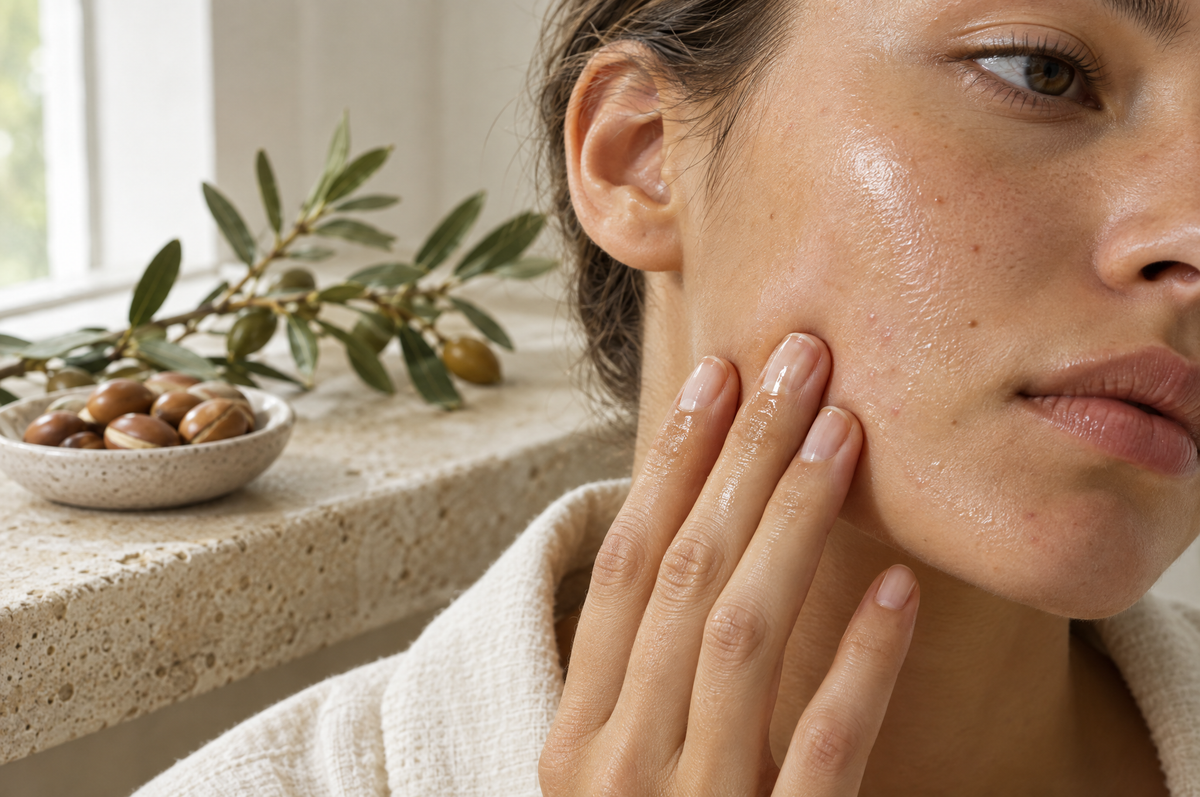
- Press in two drops. Warm them between your fingertips and press over dry areas, or the whole face if it feels comfortable. Avoid rubbing over active spots.
- Use non-comedogenic sunscreen by day. Dermatologists recommend sunscreen labeled "non-comedogenic" or "won't clog pores"8.
- Give it four to six weeks before deciding, and change only one thing at a time. The AAD notes that trying new products too often can itself irritate skin8.
If you have very oily skin, you might find you only need it in winter, or only on drier zones. Our article on argan oil for oily skin has more on that.
Argan oil and acne on Reddit: the recurring themes
Read enough skincare forum threads and a pattern emerges. One camp says a few drops of pure argan oil calmed the tight, flaky feeling from tretinoin or benzoyl peroxide. Another says it broke them out, and on closer reading, many in that camp were using a blend, using a lot, or layering it over other heavy products. A third group simply found it made no difference either way. That spread is about what you'd expect from a moisturizer: helpful for some, neutral for many, wrong for a few. We round up more of these questions in argan oil on Reddit.
When to skip argan oil and see a dermatologist
Skip the oil, at least for now, if you notice new clogged pores or small bumps in the area where you apply it, or if it itches or stings. If your acne is painful, cystic, leaving dark marks or scars, or not improving with over-the-counter care, the AAD recommends seeing a board-certified dermatologist, who can help prevent new breakouts and reduce the chance of scarring8. Picking at blemishes also raises the risk of scars and dark spots8; if marks are your main concern, see our article on argan oil and dark spots.
Frequently asked questions
Is argan oil good for acne-prone skin?
It can be a reasonable light moisturizer for acne-prone skin, especially when acne treatments cause dryness. It is not an acne treatment, and it should be patch tested first.
Can argan oil cause acne?
Some people do break out from it, though pure argan oil is generally considered low-risk. Blends, fragrance, using too much and heavy layering are common culprits.
Can I use argan oil with benzoyl peroxide or tretinoin?
Many people do, applying the treatment first and a couple of drops of oil afterward to offset dryness. Check with your dermatologist, especially for prescription treatments.
Does argan oil help acne scars?
There is no good evidence that argan oil fades acne scars or dark marks. Sun protection and proven treatments from a dermatologist are the reliable options.
Sources
- Reynolds RV, Yeung H, Cheng CE, et al. Guidelines of care for the management of acne vulgaris. J Am Acad Dermatol. 2024;90(5):1006.e1–1006.e30. Link
- Dobrev H. Clinical and instrumental study of the efficacy of a new sebum control cream. J Cosmet Dermatol. 2007;6(2):113–118. Link
- Downing DT, Stewart ME, Wertz PW, Strauss JS. Essential fatty acids and acne. J Am Acad Dermatol. 1986;14(2 Pt 1):221–225. Link
- Letawe C, Boone M, Piérard GE. Digital image analysis of the effect of topically applied linoleic acid on acne microcomedones. Clin Exp Dermatol. 1998;23(2):56–58. Link
- Serrafi A, Chegdani F, Bennis F, Kepinska M. The importance of argan oil in medicine and cosmetology. Nutrients. 2024;16(20):3573. Link
- Draelos ZD, DiNardo JC. A re-evaluation of the comedogenicity concept. J Am Acad Dermatol. 2006;54(3):507–512. Link
- Leyden J, Stein-Gold L, Weiss J. Why topical retinoids are mainstay of therapy for acne. Dermatol Ther (Heidelb). 2017;7(3):293–304. Link
- American Academy of Dermatology. Acne: Tips for managing. Link
- American Academy of Dermatology. How to test skin care products. Link
This article is for general information and isn't medical advice. If you have acne, especially painful, persistent or scarring acne, see a dermatologist before changing your routine.