Where to Buy Argan Oil (and What to Check Before You Do)
You can buy argan oil almost anywhere now: drugstores, beauty chains, grocery stores, online marketplaces, brand websites and, of course, markets in Morocco. That's convenient, but it also means the same words, "pure," "organic," "Moroccan," appear on very different products. Where you buy matters less than knowing what to check before you pay.
The short answer
Buy pure argan oil from a seller that shows the full ingredient list, names the organic certifier if one is claimed, states that the oil is cold-pressed from unroasted kernels, ships in dark packaging with a batch and date, and offers a clear return policy. Brand websites and specialist retailers make this easiest to verify.
What to check before you buy, wherever you shop
Every buying option below comes back to the same five checks:
- Ingredients. Pure argan oil has one: Argania Spinosa Kernel Oil. US cosmetic labels list ingredients by common or usual name, generally in descending order of predominance, so if argan isn't the only, or at least the first, ingredient, you're looking at a blend.1
- Processing. Look for cold-pressed oil from unroasted kernels. Culinary oil is pressed from roasted kernels and is copper-colored with a toasted aroma; cosmetic oil is gold.2
- Certification. An "organic" claim should come with "Certified organic by" and the certifier's name.3
- Freshness. Unroasted cosmetic oil keeps about a year at 25 °C when protected from light.2 Look for dark glass, a batch number and a best-before date.
- Returns. You can't smell oil through a screen. A guarantee that covers opened bottles takes the risk off you.
Why be this careful? Because argan oil's limited supply and high price make it a target: researchers describe it as highly prone to partial or total substitution with cheaper oils,4 including sunflower, olive, soybean, corn and sweet almond.5 For the full list of home checks, see Real vs. Fake Argan Oil: 7 Ways to Tell.
Where to buy pure argan oil: the main options compared
| Where | Pros | Watch out for |
|---|---|---|
| Brand's own website | Full product information, batch details, direct guarantee, fresher stock | Shipping time; check the return terms |
| Online marketplaces | Huge choice, fast delivery | Copycat listings, third-party sellers, reviews that can't be verified, stock of unknown age |
| Pharmacies and drugstores | Convenient, easy returns | Many "argan" products are blends or silicone serums; read the ingredients |
| Beauty and natural-food stores | You can see and sometimes smell the product | Bottles on bright shelves; check dates |
| Markets in Morocco | Direct from the source, possible cooperative purchase | Wide quality range, unlabeled bottles, culinary oil sold as cosmetic |
Buying direct from a brand
Buying from the producer's own website usually gives you the most information: full ingredients, processing details, certification, sizes and a guarantee that comes straight from the people who made the product. Stock also tends to move faster than on a store shelf. The downside is that you need to trust the brand, so look for specifics rather than adjectives.
Good questions to ask any seller, by email or chat, before you order:
- Is the oil cold-pressed from unroasted kernels, and is it refined or deodorized?
- Who certifies it as organic, if that's claimed?
- Where in Morocco is it pressed, and when was this batch bottled?
- What happens if I open it and don't like it?
A producer who knows its oil can answer all four quickly. Vague replies, or none at all, are useful information too.
Online marketplaces
Marketplaces are convenient, but listings can be confusing. Different sellers may share a product page, and you often can't tell how long a bottle has been in a warehouse. If you buy this way, check that the seller is the brand itself or an authorized retailer, compare the photographed ingredient list with the description, and check the bottle's date as soon as it arrives.
Pharmacies, drugstores and beauty stores
The upside of shopping in person is that you can read the actual label. The catch is that many products with "argan" in the name are hair serums or lotions where argan oil is one ingredient among many. That doesn't make them bad, but it does make them different. Our guide to what "100% pure argan oil" really means shows how to decode the label in seconds.
Argan oil near me: buying locally
If you'd rather pick up a bottle today, natural-food stores, pharmacies and beauty retailers are the usual places to look. The in-store checklist is short:
- Turn the box over and read the ingredients before anything else.
- Prefer bottles from the back of the shelf, away from bright lights, and check the date.
- Avoid clear bottles that have been sitting in a sunny window.
- If there's a tester, smell it: faint and nutty is right; perfumed, toasted or stale is not.
- Ask about the return policy before opening it.
Where to buy argan oil in Morocco
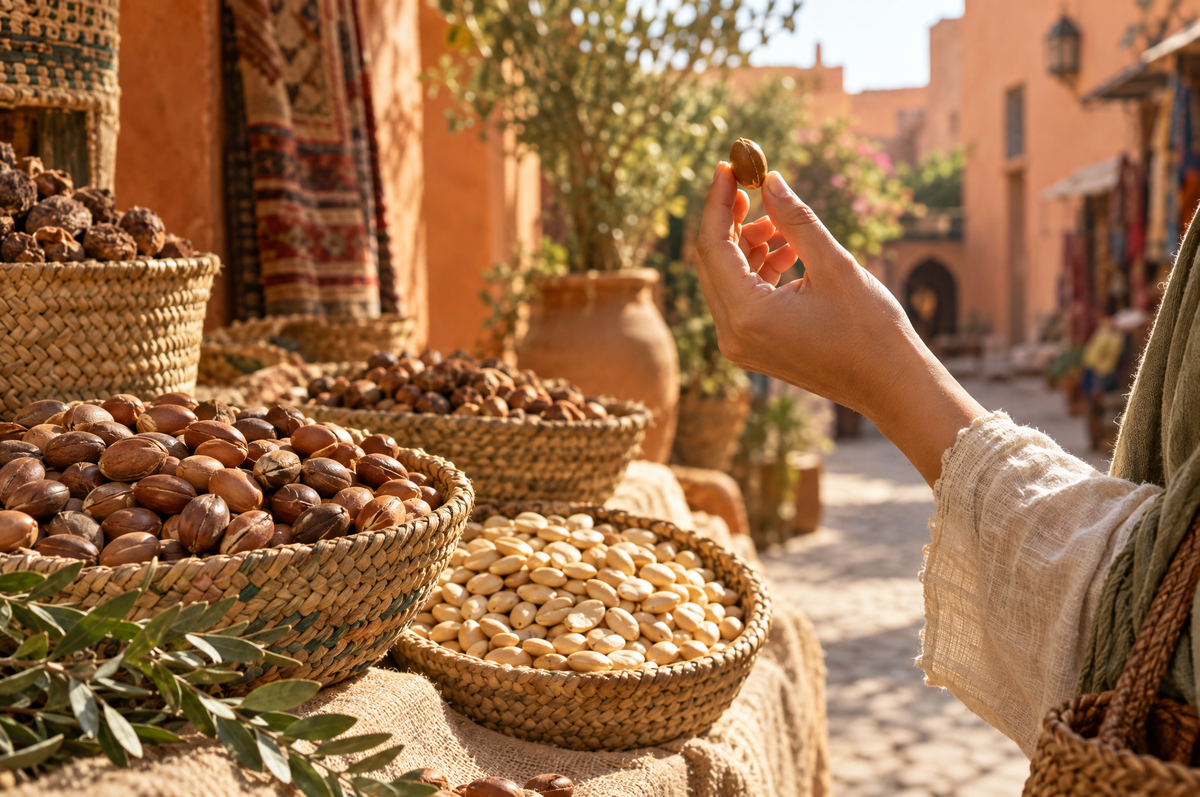
Buying in Morocco can be a lovely experience and a chance to see where the oil comes from. The argan tree grows in southwestern Morocco, in the region UNESCO designated the Arganeraie Biosphere Reserve in 1998,6 and the practices and know-how around it, carried mainly by rural women, are recognized as intangible cultural heritage.7 Visitors can often buy from cooperatives in the region, which can be a good way to see how the oil is made and to buy closer to the source.
That said, markets and roadside stalls sell a wide range of quality. Some practical advice:
- Know which oil you want. Ask specifically for cosmetic oil from unroasted kernels. Roasted culinary oil is darker and smells toasted.2 Both are sold, and it's easy to come home with the wrong one. See Culinary vs. Cosmetic Argan Oil.
- Look for labeling. Since 2010, Morocco has run a protected geographical indication that reserves the label "Huile d'Argan" for oil from the southwest made to set specifications.5 Sealed, labeled bottles with a producer named are easier to trust than unlabeled ones.
- Use your senses. Cosmetic oil should be golden, smell faint and feel silky. A strong perfume suggests added fragrance; a very pale, odorless oil may be refined, a process that removes aroma and a meaningful share of vitamin E.8
- Be wary of demonstrations. Quick "purity tests" performed by sellers can't prove anything; only lab analysis can.
- Pack it well. Keep it out of the heat and sun on the way home.
After you buy: storage and a patch test
Store argan oil tightly closed, away from heat and light, and aim to finish an opened bottle of cosmetic oil within about a year. Our article on whether argan oil expires covers the signs it has turned. Before using any new oil on your face, the American Academy of Dermatology suggests testing it twice daily for 7 to 10 days on a small patch of skin, such as the inner arm, and stopping if redness, itching or swelling develops.9
Buying direct from us
If you'd like to skip the guesswork, you can buy our organic argan oil directly from us. It's a single ingredient, USDA-certified organic, hand-harvested and cold-pressed in Morocco from unroasted kernels, with no fragrance, chemicals or dyes, in a 60 mL amber glass dropper bottle. It comes as a Single, a Duo (two bottles) or a Ritual Set (four bottles), and every order is covered by a 30-day money-back guarantee, even if the bottle has been opened.
Still comparing brands? Our guide to choosing the best argan oil has a full checklist, and Why Real Argan Oil Costs What It Does explains what a fair price looks like.
Frequently asked questions
Where is the best place to buy argan oil?
Wherever you can verify the essentials: a single ingredient, cold-pressed unroasted oil, a named organic certifier, a batch and date, and a clear return policy. Brand websites and specialist retailers usually make this easiest.
Is argan oil from Amazon real?
Some is and some isn't. Buy from the brand's own storefront or an authorized seller, check that the listing shows the full ingredient list, and inspect the color, smell and date when it arrives.
Is it better to buy argan oil in Morocco?
It can be, especially from a cooperative, but quality in tourist markets varies widely. Ask for cosmetic oil from unroasted kernels, prefer sealed and labeled bottles, and use the same checks you would at home.
Can I buy pure argan oil at a drugstore?
Sometimes, but many drugstore "argan" products are blends or silicone hair serums. Read the ingredient list: pure argan oil lists only Argania Spinosa Kernel Oil.
Sources
- U.S. Food and Drug Administration. Cosmetic ingredient names. Link
- Gharby S, Charrouf Z. Argan oil: chemical composition, extraction process, and quality control. Front Nutr. 2022;8:804587. Link
- Electronic Code of Federal Regulations. 7 CFR § 205.303 — Packaged products labeled "100 percent organic" or "organic." Link
- Amaral JS, Raja FZ, Costa J, et al. Authentication of argan (Argania spinosa L.) oil using novel DNA-based approaches: detection of olive and soybean oils as potential adulterants. Foods. 2022;11(16):2498. Link
- El Maouardi M, Kharbach M, Cherrah Y, De Braekeleer K, Bouklouze A, Vander Heyden Y. Quality control and authentication of argan oils: application of advanced analytical techniques. Molecules. 2023;28(4):1818. Link
- UNESCO Man and the Biosphere Programme. Arganeraie Biosphere Reserve, Morocco (designated 1998). Link
- UNESCO Intangible Cultural Heritage. Argan, practices and know-how concerning the argan tree. Inscribed 2014 (9.COM) on the Representative List. Link
- Asbbane A, Bousaid Z, Guillaume D, et al. Effects of physical refining process on quality and stability of argan oil (Argania spinosa (L.) Skeels). Sci Rep. 2024;14:23045. Link
- American Academy of Dermatology. How to test skin care products. Link