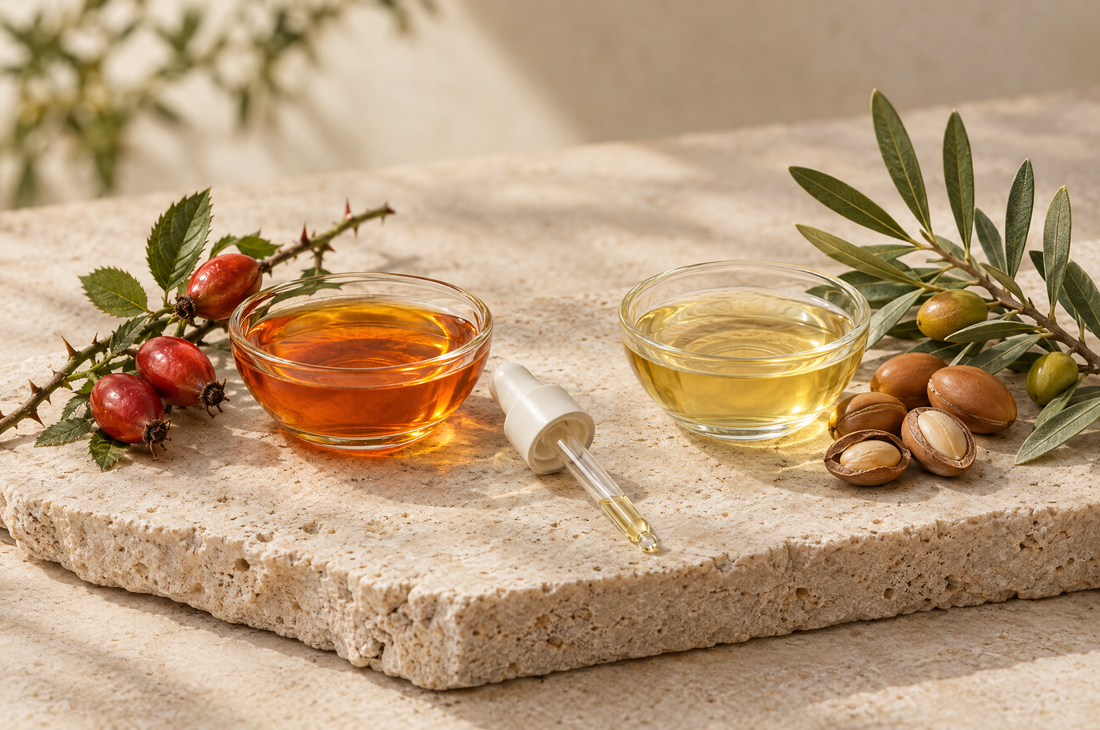
Argan Body Oil: How to Choose and Use It From Neck to Feet

The best argan body oil for most people is simply pure argan oil: a single ingredient, cold-pressed and unscented, used a few drops at a time on damp skin. Many products sold as "argan body oil" are blends in which argan is a minor ingredient alongside cheaper oils and fragrance. Below is how to tell the difference, how much to use on each part of the body, and when an oil alone isn't enough.
The short answer
Choose a body oil that lists Argania spinosa kernel oil as its first or only ingredient and contains no added fragrance. Apply three to six drops per area to slightly damp skin, with an extra drop on elbows, knees, shins and heels. Layer it over a cream if your skin is very dry.
What is an argan body oil? Pure vs. blended
There is no legal definition of "argan body oil," so the label is where you find out what you are buying. In the United States, the FDA requires cosmetic ingredients to be listed in descending order of predominance, although ingredients present at 1 percent or less can appear in any order after the rest.1 Fragrance can be listed simply as "fragrance," without naming its components.1
That gives you two quick tests. First, look for Argania spinosa kernel oil, the standard name for argan oil. If it appears near the end of a long list, the product is mostly something else. Second, check for "fragrance" or "parfum." The American Academy of Dermatology recommends fragrance-free products for dry skin and warns that "unscented" products may still contain chemicals that can irritate it.2
| Pure argan oil | Blended "argan" body oil | Body lotion | |
|---|---|---|---|
| Typical ingredients | One: argan kernel oil | Several oils, often fragrance; argan may be minor | Water, humectants, emulsifiers, oils, preservatives |
| Scent | Faint, nutty, fades quickly | Usually perfumed | Varies |
| Main job | Softens and helps slow water loss | Depends on the blend | Adds water and humectants |
| Best for | Most skin types, sensitive and fragrance-averse skin | People who want a scented product | Very dry skin, as the first layer |
If you want to dig further into labels, our guide to telling real from fake argan oil covers color, scent and texture, and our piece on organic argan oil certification explains what an organic seal actually guarantees.
Argan oil body oil benefits: what the evidence says
Argan oil is made up mostly of oleic acid (roughly 43 to 49 percent) and linoleic acid (roughly 29 to 37 percent), with natural vitamin E compounds called tocopherols.3 On the skin, plant oils like this act as emollients and form a light protective layer; a review of topical plant oils describes how that layer helps the skin retain moisture and lowers transepidermal water loss.4
The direct human evidence for argan oil on the body comes from a pair of small studies by the same Moroccan research group. In 60 postmenopausal women who applied argan oil to one forearm every night for 60 days, that skin showed lower water loss and higher water content.5 A companion analysis reported improved skin elasticity measures over the same period.6 Both come with real caveats: all participants were also eating argan or olive oil daily, the untreated forearm improved too, and the authors themselves described the elasticity results as preliminary.6
So the honest summary is this: argan oil is a pleasant, well-tolerated emollient that helps skin feel softer and hold moisture. It is not a firming product, and any body oil claiming dramatic changes is overselling. For the bigger picture, see our evidence review of argan oil for skin.
How much argan oil for your body: a head-to-toe map
These amounts are starting points for slightly damp skin, not rules. Our own usage guide suggests five to six drops after bathing; adjust up or down depending on how your skin feels an hour later.
| Area | Starting amount | Notes |
|---|---|---|
| Neck and chest | 2–3 drops | Press in with upward strokes. Go lighter on a breakout-prone chest. |
| Each arm | 3–4 drops | Damp skin spreads oil further. |
| Elbows | 1 drop each | Massage in last, after the arms. |
| Each leg | 4–6 drops | Shins are often the driest spot; add a drop there. |
| Knees | 1 drop each | Work it into creases. |
| Back and shoulders | 3–4 drops | Skip if you are prone to body breakouts. |
| Feet and heels | 1–2 drops each | Best at night, under socks. |
A full body usually takes somewhere between 10 and 25 drops, depending on your size and how dry your skin is. If you feel greasy after ten minutes, use less next time.
Cracked heels deserve a special note. The AAD recommends a moisturizer with 10 to 25 percent urea, an alpha hydroxy acid or salicylic acid applied after bathing, plus plain petroleum jelly under socks at night.7 Argan oil is a nice maintenance step once heels are smooth again, but it isn't strong enough on its own for deep cracks. Heels that stay cracked can sometimes signal a condition such as diabetes, so see a dermatologist if they don't improve.7
Body oil vs. lotion: which do you need?
They do different jobs. A lotion or cream adds water and humectants such as glycerin; an oil softens the surface and helps slow evaporation. The AAD suggests creams or ointments over thin lotions for dry skin and lists ingredients such as glycerin, hyaluronic acid and shea butter as helpful.2
- Normal skin: argan oil alone on damp skin is usually enough.
- Dry skin: apply a cream first, then seal with a few drops of oil. Our guide to using argan oil as a moisturizer covers the layering order in detail.
- Very dry or flaky skin: mix two or three drops of argan oil into a palmful of a rich cream, and see our full routine for argan oil for dry skin.
How to use argan body oil
The single most useful habit is applying it within a few minutes of bathing, while your skin is still damp; the AAD recommends moisturizing right after a shower for exactly this reason.2 We cover that bathroom routine step by step in our after-shower body oil ritual, so here are the extras that make a body oil easier to live with:
- Keep the bottle where you dry off. If it lives in a cupboard, you won't use it.
- Dispense into your palm, then warm it. Rubbing your hands together for a few seconds spreads the oil more evenly.
- Work one area at a time. Use the map above, finishing with elbows, knees and heels.
- Give it a few minutes. Let the oil absorb before you dress so it doesn't mark fabric.
- Use it between showers too. A drop on dry shins or elbows mid-afternoon is fine on dry skin; it just spreads less easily.
Choosing a pure argan oil for body: a short checklist
- One ingredient. Argania spinosa kernel oil, nothing else.
- Cosmetic, not culinary. Culinary argan oil is pressed from roasted kernels and smells strongly toasted. For skin, look for oil from unroasted kernels.
- Cold-pressed. No heat or chemical solvents in extraction.
- No added fragrance. Pure argan oil smells faintly nutty, and the scent fades as it absorbs.
- Protective packaging. Glass and a dropper or pump, stored out of direct sun.
Our 100% organic argan oil checks each of those boxes: USDA-certified organic, cold-pressed from unroasted kernels, and sold in a 60 mL glass dropper bottle with no fragrance or dyes. Because the dropper makes it easy to count drops, it works as well for a full body as it does for a face.
Who should be careful with body oil
- Breakout-prone chest or back: some people find any oil on the torso contributes to bumps. Start on your limbs.
- Nut allergy or very reactive skin: argan comes from a kernel, and allergic reactions to it have been reported in the medical literature, though they appear uncommon.8 Patch test on your inner arm for a week first.
- Eczema or broken skin: ask your dermatologist which moisturizers suit you, and don't apply oil to weeping or infected areas.
A good body oil is mostly about the label and the habit: one ingredient, a few drops, damp skin.
Frequently asked questions
Is argan oil good for the whole body?
Yes, most people can use it anywhere from neck to feet. Use a few drops per area on damp skin and go lighter on breakout-prone areas such as the chest and back.
How many drops of argan oil should I use on my body?
Start with three to six drops per area, such as one arm or one leg, and an extra drop on elbows, knees and heels. A full body usually takes 10 to 25 drops.
Is a blended argan body oil as good as pure argan oil?
It depends on the label. If argan oil is near the end of the ingredient list or the product contains fragrance, you are mostly paying for other oils and scent.
Can I use argan oil instead of body lotion?
On normal skin, often yes. On very dry skin, use a cream with humectants first and seal it with a few drops of argan oil.
Sources
- U.S. Food and Drug Administration. Cosmetics labeling guide. Link
- American Academy of Dermatology. Dermatologists' top tips for relieving dry skin. Link
- Abdalla S, Aroua MK, Gew LT. A comprehensive review of plant-based cosmetic oils (virgin coconut oil, olive oil, argan oil, and jojoba oil): chemical and biological properties and their cosmeceutical applications. ACS Omega. 2024;9(44):44019–44032. Link
- Lin TK, Zhong L, Santiago JL. Anti-inflammatory and skin barrier repair effects of topical application of some plant oils. Int J Mol Sci. 2017;19(1):70. Link
- Boucetta KQ, Charrouf Z, Derouiche A, Rahali Y, Bensouda Y. Skin hydration in postmenopausal women: argan oil benefit with oral and/or topical use. Prz Menopauzalny. 2014;13(5):280–288. Link
- Boucetta KQ, Charrouf Z, Aguenaou H, Derouiche A, Bensouda Y. The effect of dietary and/or cosmetic argan oil on postmenopausal skin elasticity. Clin Interv Aging. 2015;10:339–349. Link
- American Academy of Dermatology. How to care for dry, cracked heels. Link
- Lefebvre A, Cotten C, Bauvin O, et al. Protein contact dermatitis caused by argan oil. Dermatitis. 2023;34(4):347–348. Link