Is Argan Oil Sustainable? Forests, Goats and Fair Pay
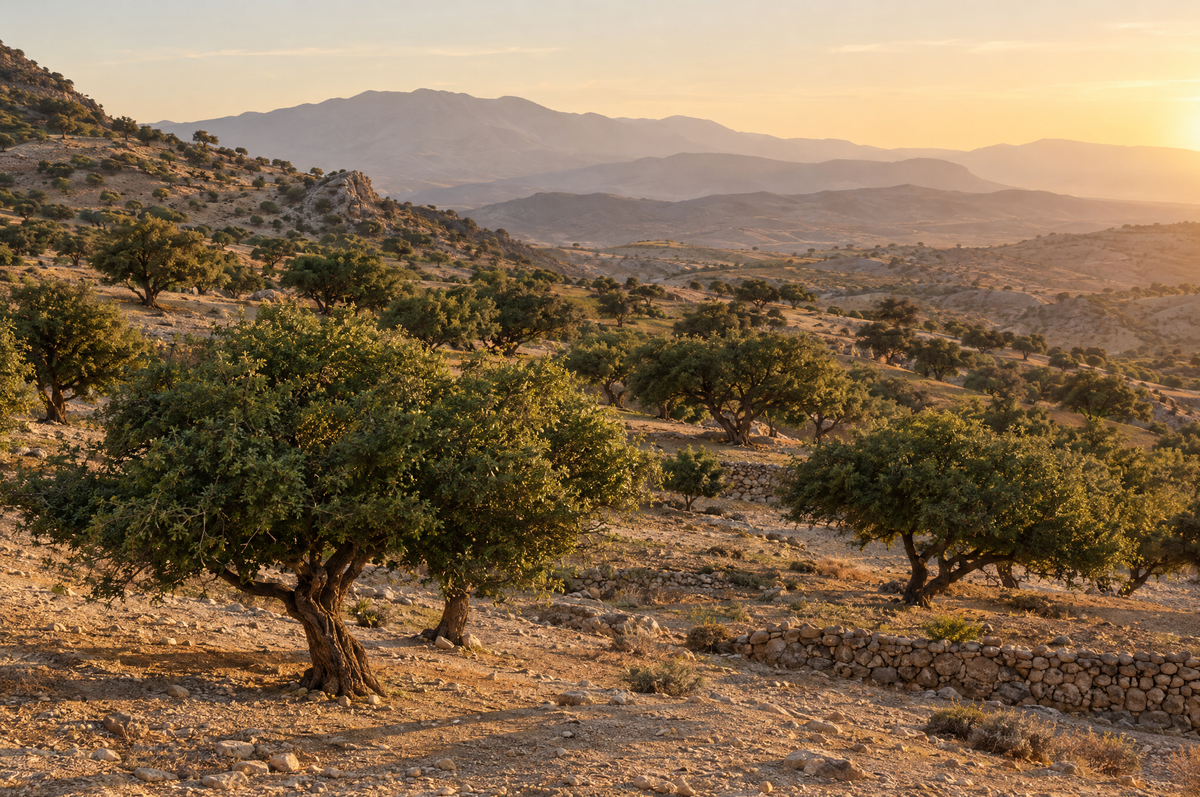
Argan oil can be sustainable, but it is not automatically so. The oil comes from fruit collected from a wild, slow-growing forest that has shrunk substantially, mostly because of overgrazing, woodcutting, land clearing and drought rather than fruit harvesting itself. Research also shows the export boom has helped some families without, on its own, protecting the trees.
The short answer
Partly. Fruit collection is not among the main causes researchers give for forest loss, and the oil supports rural incomes, especially for women. But the argan forest has declined sharply, mainly from overgrazing, woodcutting, land clearing and drought, and studies find the oil boom has not by itself improved forest health. Traceable, certified, fairly paid oil is the better bet.
Why sustainability is a real question for argan oil
Argan oil comes almost entirely from one ecosystem: the argan woodlands of southwestern Morocco. In 1998 UNESCO designated the Arganeraie Biosphere Reserve, covering about 2.5 million hectares between the High Atlas and Anti-Atlas mountains, and describes the argan as an endemic species important for conservation and for local livelihoods5. Most residents live from herding, agriculture and argan oil, and the trees are also used for fuelwood5.
Unlike most plant oils, argan does not come from orchards that can simply be expanded. Our guide to how argan oil is made shows how much fruit and labor go into each liter. When global demand rises, the pressure falls on a forest that regenerates very slowly.
Argan forest deforestation: how much has been lost?
The losses are real, though estimates vary with the method. A review by Moroccan argan scientists reports that the argan forest shrank from about 1.5 million hectares to an estimated 800,000 hectares by the year 2000, attributing the decline to human activity and to drought1. A 2022 remote-sensing study cites a figure of about 950,000 hectares in 20152.
Area alone understates the problem, because a forest can keep its outline while losing trees inside it. The same study cites earlier research that found a 44.5 percent decline in tree density at one site between 1970 and 20072. Its own detailed survey of about 2,500 trees across 30 one-hectare plots, comparing aerial images from 1972 with 2018, found no clear overall trend toward either recovery or further loss, but many small trees that had survived in a stunted, heavily browsed state2.
What is driving the decline?
Researchers consistently name the same pressures2,4:
- Overgrazing and browsing by goats, sheep and dromedaries, which eat leaves, seedlings and young regrowth.
- Woodcutting for fuel and charcoal, some of it illegal.
- Land clearing for crops.
- Climate. An arid climate with scarce, irregular rainfall, and, according to UNESCO, long droughts followed by heavy rain and floods4,5.
The result is a forest that struggles to replace itself. One 2024 study describes natural regeneration as practically absent across the tree's main range4, and the 2022 study says natural regeneration is very rarely possible2. Goats have a complicated role here; our article on argan trees and goats explains both sides.
Did the argan oil boom help or hurt the forest?
The hope, promoted for years by development agencies and cooperatives, was a win-win: if the oil became valuable, people would protect the trees. The most-cited test of that idea, a 2011 study in PNAS, found something more mixed3.
| What the boom did | Finding |
|---|---|
| Household income | Some households increased their spending3 |
| Education | More girls attended secondary school3 |
| Fruit | Households became vigilant guardians of fruit on the tree3 |
| Long-term tree care | No new investment in tree and forest health3 |
| Goats | Some households used the income to expand goat herds3 |
| Forest cover | Satellite vegetation data from 1981 to 2009 showed no improvement and possibly some degradation3 |
In other words, a high oil price made people value the fruit, not necessarily the forest. Nothing in the market price pays for planting a tree that will take years to bear and decades to reach full production.
A valuable fruit does not automatically make a protected forest.
Argan oil environmental impact: what is being done?
There is a lot of effort, with uneven results. Morocco has run a program to save the argan tree in a sustainable way since around 20001, and reforestation with grazing exclusion began in the late 1990s2. The 2022 study found grazing exclusion had only a slight positive effect on tree shape, possibly because exclusion periods were short, and warned that fencing land local people depend on can lead to herds breaking in2. Sustainable management, in other words, has to work with herders and households, not around them.
Traditional systems offer some models. In 2018 FAO recognized an argan-based agro-sylvo-pastoral system in the Ait Souab–Ait Mansour area as a Globally Important Agricultural Heritage System, highlighting dry-stone terraces, underground water cisterns and community-managed water rules that have kept the landscape productive for generations7. The UN also stresses that wild-harvested argan needs its sustainability monitored, pointing to FAO guidance on responsible sourcing of wild plants6.
Ethical argan oil: the people side
Sustainability is social as well as environmental. Argan oil is largely made by rural women, many in cooperatives, and the UN credits the sector with local jobs and greater economic independence for women6. But a 2023 study of cooperatives in the Souss Massa region found that control of the trade has shifted toward intermediaries supplying larger companies, threatening both cooperatives and women's income, and argued for benefit-sharing arrangements to protect women's livelihoods and the argan ecosystem8. Cheap oil tends to come out of someone's share.
How to buy argan oil more sustainably
No single label proves an oil is sustainable. These checks tilt the odds:
- Buy pure oil. A bottle that is mostly another oil wastes the argan it does contain and misleads you. Make sure the label reads like 100% pure argan oil, with argan kernel oil as the only ingredient. Our guide to real vs. fake argan oil covers the warning signs.
- Look for third-party certification. USDA organic argan oil is audited for how it is produced and handled; fair trade labels address pay and working conditions. Neither measures forest health directly, but both mean someone independent has checked something.
- Ask about origin. A seller should be able to say where the oil was pressed and how the fruit was collected.
- Be wary of very low prices. Fair pay and careful harvesting cost money, and a bargain bottle has to be cheap somewhere.
- Use it well. The most sustainable bottle is one you finish. A few drops are enough for most uses, and there are plenty of ways to use argan oil so none goes stale in a drawer.
Our organic argan oil is USDA-certified organic, sourced from Morocco, hand-harvested and cold-pressed from unroasted kernels, with nothing added. We think the honest position for any argan brand, including us, is that the forest's future depends on far more than any one bottle, and that buyers are right to ask questions.
Frequently asked questions
Is argan oil bad for the environment?
Collecting argan fruit is not what researchers blame for the forest's decline. Studies point mainly to overgrazing, woodcutting, land clearing and drought. The concern is that the oil boom has not, on its own, paid for protecting or regrowing trees.
Is the argan forest disappearing?
It has shrunk substantially. A scientific review estimates the forest fell from about 1.5 million hectares to roughly 800,000 by 2000. Recent satellite and field work finds no clear trend either way at many sites, but many trees are degraded.
Do goats harm argan trees?
They can. Researchers name overgrazing and browsing by goats, sheep and camels as major causes of degradation, partly because animals eat seedlings and young regrowth. Rising argan income has let some households keep more goats.
Is fair trade argan oil more sustainable?
Fair trade certification addresses pay and working conditions, which is one part of sustainability. It does not directly measure forest health, so it is a useful signal rather than a complete answer.
What is the Arganeraie Biosphere Reserve?
It is a UNESCO biosphere reserve designated in 1998, covering about 2.5 million hectares of southwestern Morocco, meant to balance conservation of the argan ecosystem with the livelihoods of the people who live there.
Sources
- Gharby S, Charrouf Z. Argan oil: chemical composition, extraction process, and quality control. Front Nutr. 2022;8:804587. Link
- Kirchhoff M, Marzolff I, Stephan R, Seeger M, Aït Hssaine A, Ries JB. Monitoring dryland trees with remote sensing. Part B: combining tree cover and plant architecture data to assess degradation and recovery of Argania spinosa woodlands of South Morocco. Front Environ Sci. 2022;10. Link
- Lybbert TJ, Aboudrare A, Chaloud D, Magnan N, Nash M. Booming markets for Moroccan argan oil appear to benefit some rural households while threatening the endemic argan forest. Proc Natl Acad Sci U S A. 2011;108(34):13963–13968. Link
- Chabbi N, Chafiki S, Telmoudi M, et al. Plant-growth-promoting rhizobacteria improve seeds germination and growth of Argania spinosa. Plants (Basel). 2024;13(15):2025. Link
- UNESCO Man and the Biosphere Programme. Arganeraie Biosphere Reserve, Morocco (designated 1998). Link
- United Nations. International Day of Argania, 10 May (General Assembly resolution A/RES/75/262, 2021). Link
- Food and Agriculture Organization of the United Nations. Argan-based agro-sylvo-pastoral system within the area of Ait Souab – Ait Mansour, Morocco. Globally Important Agricultural Heritage Systems (designated 2018). Link
- Montanari B, Handaine M, Id Bourrous J. Argan oil trade and access to benefit sharing: a matter of economic survival for rural women of the Souss Massa, Morocco. Human Ecology. 2023;51:995–1007. Link