Argan Oil as a Pre-Shampoo Treatment (Pre-Poo)
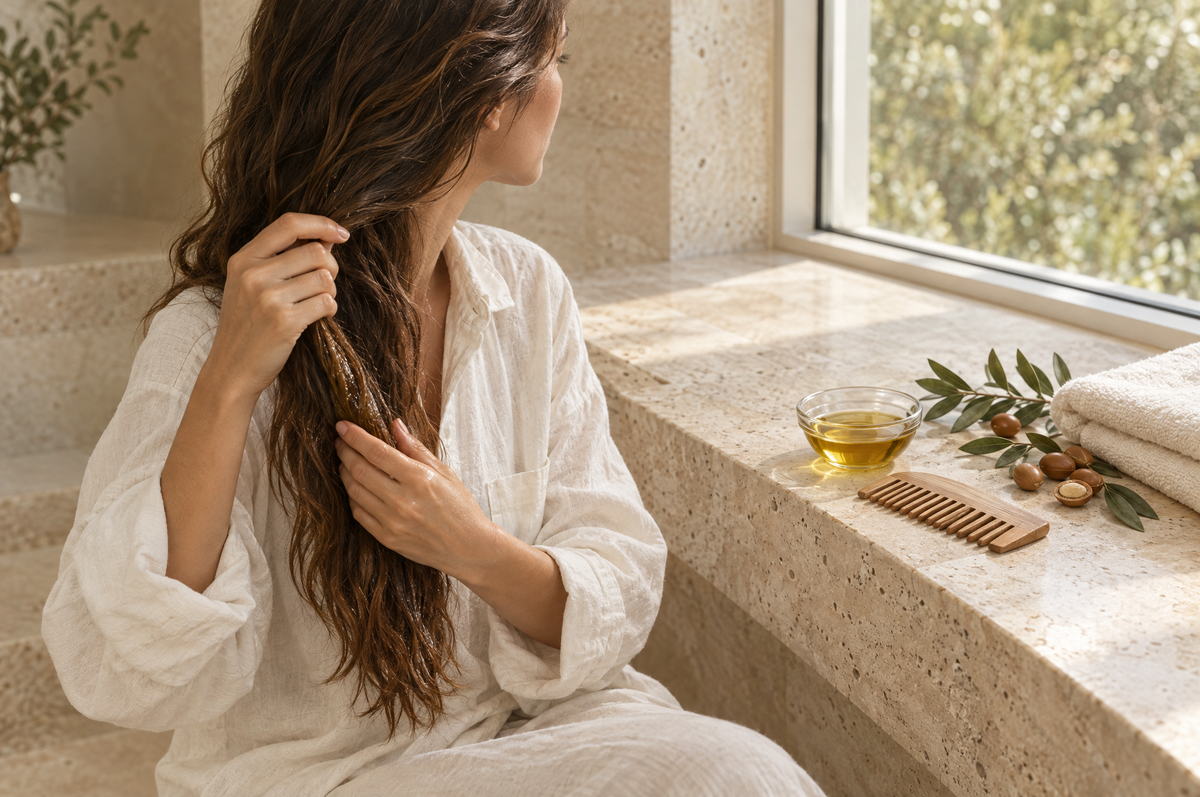
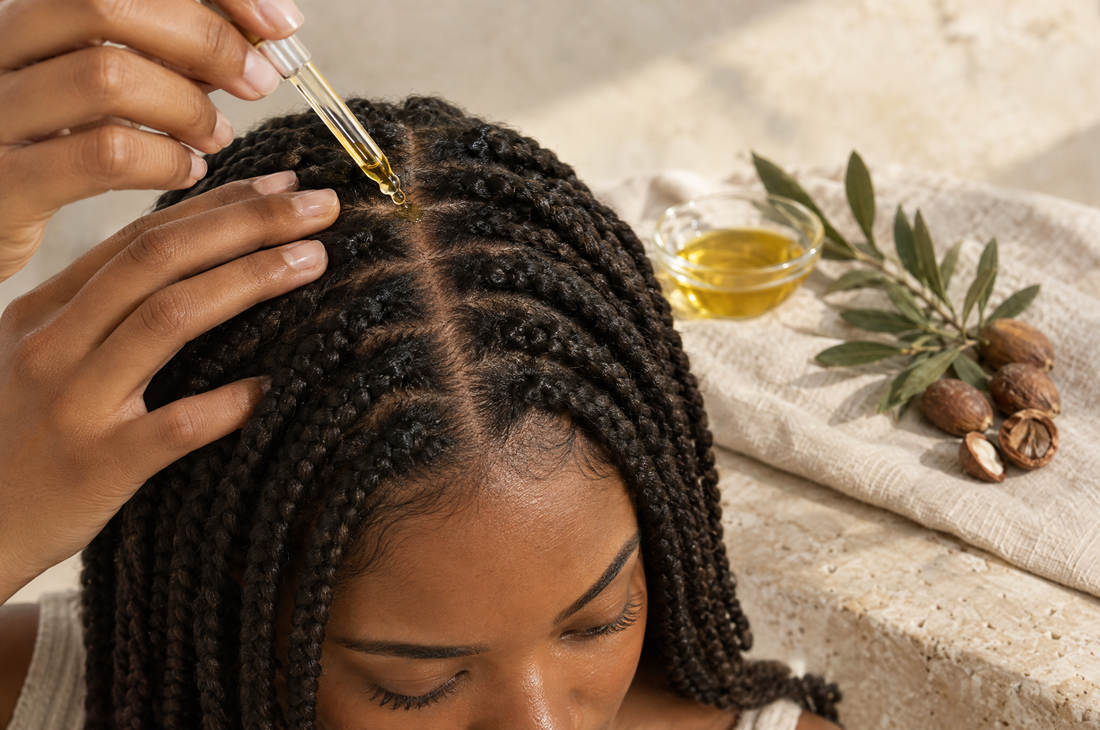
An argan oil pre-poo simply means coating your hair with argan oil for 20 minutes to overnight before you shampoo. The idea is that oil already on the strands limits how much water and detergent they take on during washing, so hair may come out softer, less tangled and less stripped. The strongest lab evidence for pre-wash oiling involves coconut oil; argan-specific data is limited but encouraging.
The short answer
For an argan oil pre-poo, work enough oil to lightly coat dry or slightly damp mid-lengths and ends, leave it for 20 to 30 minutes or overnight, then shampoo the scalp and condition as usual. It may reduce washing stress on dry, curly or color-treated hair, though argan-specific research is still limited.
What is a pre-poo?
"Pre-poo" is short for pre-shampoo: anything you put on your hair before washing it. Oils are the most common choice, though some people use conditioner or a mix of both. The habit has deep roots: hair oiling is culturally rooted in Indian and African traditions,1 and some of the best-known lab research on pre-wash oiling studied oils widely used in Indian hair care.2
A pre-poo is not the same as a hair mask or a leave-in. A mask is usually a longer, conditioning session aimed at softening the hair; a leave-in stays on after washing. The pre-poo's job is narrower: to shield the hair from the wash itself.
Why oil before shampoo may help
Washing is harder on hair than it looks. Two things happen every time you shampoo.
Hair swells, then shrinks
Hair absorbs water and swells, then contracts as it dries. Repeated over and over, that cycle is known as hygral fatigue, and it is considered one of the causes of hair damage. In an imaging study, researchers found that coconut oil penetrated the hair shaft and limited swelling, which they suggested may help protect against hygral fatigue.3 A dermatology review of hair cosmetics summarizes the point: some oils can penetrate hair and reduce how much water it absorbs, lowering swelling and hygral fatigue.4
Detergent gets inside the fiber
Shampoo surfactants don't only clean the surface. A 2022 lab study showed that surfactants diffuse into hair during routine washing and dissolve some of its protein, increasing the fiber's porosity; hair oiled with a coconut-based hair oil was largely spared that increase.5 The same review notes that oil can fill the gaps between cuticle cells and help keep aggressive substances such as surfactants out.4
The best-known evidence comes from a 2003 study comparing coconut, sunflower and mineral oils. Coconut oil was the only one of the three that remarkably reduced protein loss in both undamaged and damaged hair when used as a pre-wash and post-wash product; sunflower and mineral oils did not reduce protein loss at all.2 The authors linked the difference to structure: coconut oil's straight-chained lauric acid can enter the fiber, while sunflower oil's bulky, linoleic-rich molecules do not penetrate.2
What about argan oil specifically?
This is where honesty matters. Argan oil has not been tested in a head-to-head pre-wash study like the coconut research. Its chemistry sits in between: about 80% of its fatty acids are unsaturated, mainly oleic acid (roughly 43–49%) and linoleic acid (roughly 29–37%).6 Given what happened with linoleic-rich sunflower oil, it is reasonable to expect argan oil to work more as a surface film than as a deep penetrant.
There is one directly relevant lab study. Researchers pretreated hair tresses with argan oil before exposing them to an oxidizing agent. The argan-treated hair lost significantly less protein than untreated hair, and the oil was still detectable on the fiber even after a washing procedure.7 That is a chemical stress test, not a shampoo test, but it supports the idea that an argan oil coat can buffer hair against damage during processing.
On the clinical side, a 2022 systematic review found no significant evidence that argan oil improves hair growth or overall hair quality in people.1 So the fair summary is: pre-wash oiling has a sound rationale, coconut oil has the best data, and argan oil is a lighter option with some supportive lab work. If you are weighing the two, our comparison of argan oil vs. coconut oil for hair goes into more detail.
| Pre-poo oil | Penetrates the hair shaft? | Evidence on protein loss | Feel and rinse-out |
|---|---|---|---|
| Coconut oil | Yes, in lab imaging3 | Reduced protein loss as a pre- and post-wash product2 | Solid when cool; can feel stiff on some hair |
| Argan oil | Not well studied | Reduced protein loss under oxidative stress in the lab7 | Light and liquid; usually rinses out with one or two shampoos |
| Mineral oil | No, in lab imaging3 | Did not reduce protein loss2 | Slippery surface film |
How to do an argan oil pre-poo
- Start with dry or barely damp hair. Finger-detangle first so you are not combing through knots once the hair is wet.
- Section your hair. Four sections for most people, more for thick or very long hair, so oil reaches every part evenly.
- Use enough to coat, not drench. As a starting point, try 5 to 8 drops for short hair, 10 to 15 for shoulder length, and more for long or thick hair. The lengths should look lightly glossy, not dripping.
- Focus on mid-lengths and ends. These are the oldest and most porous parts. Add a little to the scalp only if it feels dry; skip it if your scalp is oily or prone to flaking.
- Leave it on. Twenty to thirty minutes is practical. Overnight works too; cover your pillow or wear a cotton scarf. No study shows that longer is better, so choose what suits your routine.
- Shampoo the scalp, not the lengths. Massage shampoo into your scalp and let the rinse run through the lengths. The AAD recommends concentrating shampoo on the scalp rather than the full length of the hair.8 If hair still feels coated, shampoo a second time.
- Condition as usual. Use conditioner after washing, through the lengths for dry or curly hair.8 Then finish damp ends with a drop of oil if you like.
Because a pre-poo is going to be washed off, the oil you use matters less for scent and more for purity: you want the oil, not fillers or fragrance. Our organic argan oil is a single ingredient, cold-pressed from unroasted kernels, in a dropper bottle that makes counting drops easy.
Who benefits from a pre-poo, and who can skip it
A pre-poo for dry hair makes the most sense. It is worth trying if your hair:
- feels rough, squeaky or tangled straight after shampooing
- is curly, coily or long, so the ends are old and weathered
- is bleached, colored or heat-styled often
- frizzes easily; our guide to argan oil for frizzy hair covers the finishing side of the routine
You can probably skip it if your hair is very fine and gets flat or greasy quickly, or if it is low porosity and tends to hold product on the surface. In that case, a drop of oil on the ends after washing will give you most of the softness with less residue. Our guide to argan oil for low porosity hair explains why.
Pre-poo, hair mask or leave-in?
They overlap, and the same bottle can do all three.
- Pre-poo: a shorter oil coat before every wash or most washes, aimed at reducing washing stress.
- Mask: a richer, occasional session for very dry lengths. Our guide to the argan oil hair mask covers timing, heat and how to rinse it out.
- Leave-in: one to three drops through damp or dry ends after washing for shine and smoothness. For amounts by hair type, see our guide on how to use argan oil for hair.
A dermatology review offers a useful rule for all three: thick oil films can mask lifted cuticle scales but leave hair looking oily and heavy, so thin layers are preferred.4 If your hair feels coated after washing, the fix is fewer drops, not a harsher shampoo.
Frequently asked questions
Should you put argan oil in your hair before or after washing?
Both work, for different reasons. Before washing, a pre-poo coat may reduce how much water and detergent your hair takes on. After washing, a few drops on damp ends add shine and smoothness. Many people with dry hair do both.
How long should I leave argan oil in my hair before washing?
Twenty to thirty minutes is enough for most people, and overnight is fine if it suits your routine. There is no evidence that a longer pre-poo gives better results.
Do you pre-poo on wet or dry hair?
Dry or barely damp hair is easiest, because the oil spreads into the lengths before water fills the fiber. Finger-detangle first.
Is a pre-poo good for dry hair?
Yes, it is most useful for dry, curly, long or color-treated hair that feels rough or tangled after shampooing. Very fine or oily hair may do better with a drop of oil on the ends after washing.
Will an oil pre-poo make my hair greasy?
Not if you use a modest amount and shampoo the scalp well. If hair still feels coated, shampoo a second time and use fewer drops next time.
Sources
- Phong C, Lee V, Yale K, Sung C, Mesinkovska N. Coconut, castor, and argan oil for hair in skin of color patients: a systematic review. J Drugs Dermatol. 2022;21(7):751–757. Link
- Rele AS, Mohile RB. Effect of mineral oil, sunflower oil, and coconut oil on prevention of hair damage. J Cosmet Sci. 2003;54(2):175–192. Link
- Ruetsch SB, Kamath YK, Rele AS, Mohile RB. Secondary ion mass spectrometric investigation of penetration of coconut and mineral oils into human hair fibers: relevance to hair damage. J Cosmet Sci. 2001;52(3):169–184. Link
- Gavazzoni Dias MF. Hair cosmetics: an overview. Int J Trichology. 2015;7(1):2–15. Link
- Kaushik V, Kumar A, Gosvami NN, Gode V, Mhaskar S, Kamath Y. Benefit of coconut-based hair oil via hair porosity quantification. Int J Cosmet Sci. 2022;44(3):289–298. Link
- Gharby S, Charrouf Z. Argan oil: chemical composition, extraction process, and quality control. Front Nutr. 2021;8:804587. Link
- Sharifi N, Hamedeyazdan S, Shokri J, Monajjemzadeh F. Argan oil as a pretreatment of human hair before exposure to oxidative damage: attenuated total reflectance and protein loss studies. J Cosmet Dermatol. 2022;21(10):5010–5017. Link
- American Academy of Dermatology. Tips for healthy hair. Link