Does Argan Oil Have SPF? Argan Oil and Sunscreen
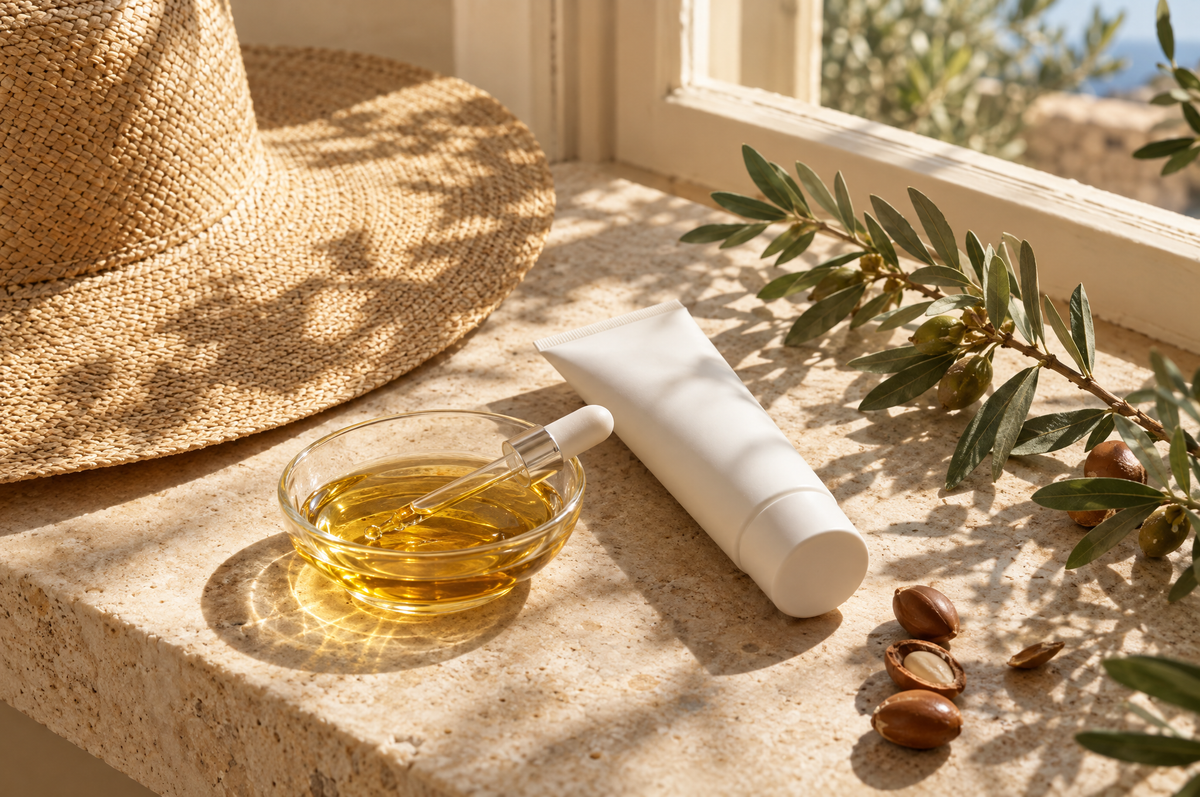
No, argan oil does not have a meaningful SPF, and it should never be used in place of sunscreen. No published study we could find has measured a reliable SPF for argan oil, and careful testing of other popular plant oils found their sun protection was negligible. Argan oil can sit comfortably under your sunscreen, but it can't do sunscreen's job.
The short answer
Argan oil does not have SPF in any useful sense. Plant oils tested under proper conditions offer negligible sun protection, and argan oil isn't regulated or tested as a sunscreen. Use it as a moisturizing step, then apply a broad-spectrum sunscreen of SPF 30 or higher on top every morning.
Does argan oil have SPF?
Online, you may see claims that argan oil has a low natural SPF or that it "naturally protects from the sun." We looked for the evidence behind those numbers and couldn't find a study that tested argan oil's SPF.
What we did find is research on other plant oils, and it points firmly in one direction:
- A widely shared 2010 lab study measured the UV absorbance of diluted herbal oils and reported in vitro SPF values of roughly 2 to 8 for oils such as olive, coconut, castor and almond1. Argan oil was not among the oils tested. The authors themselves describe the method as a screening tool that supplements, rather than replaces, testing on people1.
- A 2021 study in Photochemical & Photobiological Sciences set out to check claims like these. It tested 14 virgin vegetable oils both in the lab and on human skin using the standard ISO method. The five most-promoted oils (carrot seed, coconut, raspberry seed, rosehip seed and wheat germ) had lab SPF values between 0 and 0.4 and values on skin of only about 1.2 to 2.8, and the other oils tested provided no or negligible SPF, with tamanu oil the only notable exception2. The researchers concluded that earlier, higher figures came from not following the measurement method strictly2.
The abstract of that 2021 study doesn't name argan oil among the results, so we can't quote a number for it. But there's no reason to expect argan oil to behave differently from the oils that were tested, and a 2024 review of argan oil's composition, while noting interest in it for after-sun products, gives no SPF value for it3.
Why "natural SPF" claims don't hold up
There's a gap between an oil absorbing a little UV in a test tube and an oil protecting your skin outdoors. SPF is a measure of protection against sunburn, mainly from UVB rays4, and real sunscreens must meet specific testing standards. In the United States, the FDA regulates sunscreens as over-the-counter drugs so that they meet safety and effectiveness standards4. A bottle of cosmetic oil goes through none of that.
Even an SPF of 2, if an oil managed it, would be a fraction of what dermatologists recommend. The AAD advises a broad-spectrum sunscreen with an SPF of 30 or higher5, which it says blocks about 97 percent of the sun's UVB rays6.
| Argan oil | Broad-spectrum sunscreen | |
|---|---|---|
| Tested SPF | None established; similar oils negligible2 | Labeled and tested; AAD advises SPF 30+5 |
| Regulated as | A cosmetic | An over-the-counter drug in the US4 |
| UVA and UVB coverage | Not established | Broad-spectrum products cover both4 |
| Role in a routine | Moisturizing step | Final morning step |
Antioxidants are not sunscreen
Part of the confusion comes from argan oil's antioxidants. It's rich in tocopherols, a family of vitamin E compounds, at about 600 to 700 mg per kilogram3, and antioxidants do play a role in how skin copes with sun exposure. You can read more in our guide to vitamin E and what's in argan oil.
But antioxidants work differently from sunscreen. Sunscreen filters UV before it reaches the skin; antioxidants help neutralize some of the damaging molecules UV creates afterward. A major review of topical antioxidants concluded that they may supplement sunscreen protection, not replace it7. That conclusion came from research on carefully formulated vitamin C and E serums, which have far more evidence behind them than a plain oil does.
Antioxidants can back sunscreen up. They can't stand in for it.
Can you use argan oil under sunscreen?
Yes, and it's a common morning routine. Argan oil is a moisturizing step, and moisturizer belongs before sunscreen. A few practical points:
- Apply serums first, then any moisturizer.
- Use one or two drops of argan oil, pressed in rather than rubbed. More oil makes it harder for sunscreen to spread evenly.
- Give it a few minutes to absorb so your skin feels smooth rather than slick.
- Apply a full amount of sunscreen as the final step. The AAD notes that most adults need about one ounce to cover exposed body skin and recommends applying sunscreen to dry skin 15 minutes before going outdoors6.
- Reapply about every two hours outdoors, and after swimming or sweating4,6.
An honest caveat: we couldn't find a study testing whether a face oil worn underneath changes how well a sunscreen performs. Sunscreens are tested as a single product, so a light, well-absorbed layer of oil and a generous layer of sunscreen is the cautious approach. Our guide to using argan oil as a moisturizer covers the rest of the layering order, and our guide to argan oil for face care has a simple morning and evening routine.
If you'd like a pure oil for that moisturizing step, our 100% organic argan oil is a single, cold-pressed ingredient with no added fragrance, which keeps your morning routine simple under sunscreen.
Argan oil sun protection: what it can and can't do
What it can do: support skin comfort and hydration. In a 60-day study, argan oil applied to the forearm reduced water loss through the skin and increased its water content8. That makes it a reasonable moisturizing layer under sunscreen, or a soothing step for dry skin after a day outdoors. For the broader picture of what the research does and doesn't support, see our honest review of argan oil for skin.
What it can't do: stand in for sunscreen, shade or clothing. Don't use argan oil, or any plant oil, as a tanning oil without sunscreen, and don't rely on it on hair or scalp as sun protection either.
Sun habits that actually work
- Broad-spectrum sunscreen, SPF 30 or higher, on all exposed skin, every day5.
- Water-resistant formulas for swimming or sweating; their protection lasts either 40 or 80 minutes5.
- Shade and timing. The FDA recommends limiting time in the sun between 10 a.m. and 2 p.m.4.
- Clothing, hats and sunglasses alongside sunscreen4.
- SPF isn't a timer. The FDA notes that SPF doesn't mean you can safely stay in the sun that many times longer4.
Frequently asked questions
Can argan oil protect you from the sun?
No. Argan oil has no established SPF, and properly tested plant oils offer negligible sun protection. Use a broad-spectrum sunscreen of SPF 30 or higher.
Should I put argan oil before or after sunscreen?
Before. Press in one or two drops of argan oil, let it absorb for a few minutes, then apply a full amount of sunscreen as the last step.
Can I use argan oil as a tanning oil?
It's not a good idea. Argan oil offers no meaningful protection from UV, so using it to tan without sunscreen leaves skin unprotected.
Is there any plant oil with a real SPF?
In a 2021 study of 14 vegetable oils, only tamanu oil showed a notable SPF in lab testing; the rest offered little or none. No plant oil on its own has been shown to replace a tested, broad-spectrum sunscreen.
Is argan oil good after sun exposure?
It can help dry skin feel more comfortable after a day outdoors. For sunburn that blisters, is painful or covers a large area, see a doctor.
Sources
- Kaur CD, Saraf S. In vitro sun protection factor determination of herbal oils used in cosmetics. Pharmacognosy Res. 2010;2(1):22–25. Link
- Ácsová A, Hojerová J, Janotková L, et al. The real UVB photoprotective efficacy of vegetable oils: in vitro and in vivo studies. Photochem Photobiol Sci. 2021;20(1):139–151. Link
- Serrafi A, Chegdani F, Bennis F, Kepinska M. The importance of argan oil in medicine and cosmetology. Nutrients. 2024;16(20):3573. Link
- U.S. Food and Drug Administration. Sunscreen: how to help protect your skin from the sun. Link
- American Academy of Dermatology. How to select a sunscreen. Link
- American Academy of Dermatology. Sunscreen FAQs. Link
- Pinnell SR. Cutaneous photodamage, oxidative stress, and topical antioxidant protection. J Am Acad Dermatol. 2003;48(1):1–19. Link
- Boucetta KQ, Charrouf Z, Derouiche A, Rahali Y, Bensouda Y. Skin hydration in postmenopausal women: argan oil benefit with oral and/or topical use. Prz Menopauzalny. 2014;13(5):280–288. Link