Argan Oil vs. Jojoba Oil: Which One Is Right for You?
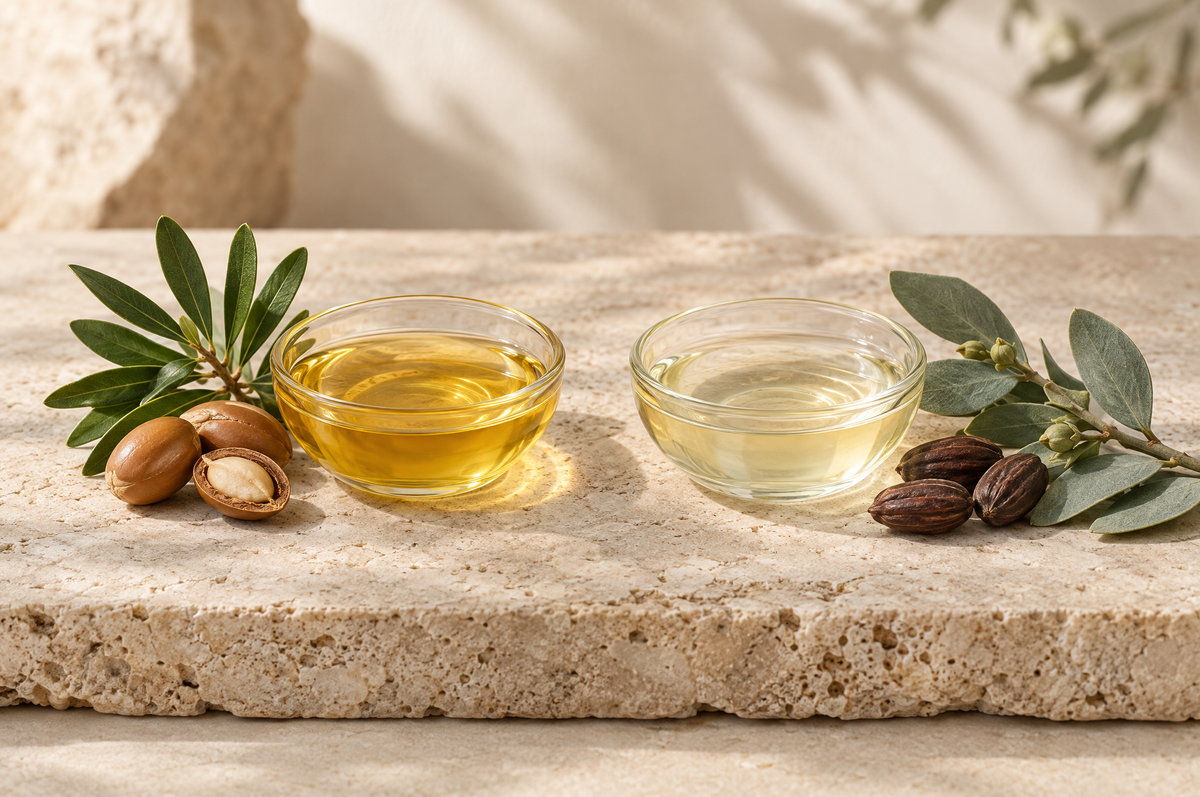
Argan and jojoba are the two oils most often recommended to people who are nervous about putting oil on their face. Both are light, both come from hardy desert plants, and both have loyal followings. They are also chemically very different, and that difference is the most useful thing to understand when you are choosing between them. We sell argan oil, but jojoba is a genuinely good ingredient, and this comparison tries to be fair to both.
The short answer
Jojoba is technically a liquid wax that some find lighter and very stable; argan is a true oil, richer in linoleic acid and vitamin E, with a slightly more cushioned, nourishing feel. Jojoba often suits very oily skin; argan often suits normal to dry skin and dry hair ends. Neither has strong head-to-head evidence.
The key difference: an oil vs. a liquid wax
Argan oil, pressed from the kernels of the Moroccan argan tree, is a true plant oil. Like olive or sunflower oil, it is made mainly of triglycerides: fatty acids attached to a glycerol backbone. About 80 percent of its fatty acids are unsaturated, chiefly oleic acid (around 43 to 49 percent) and linoleic acid (around 29 to 36 percent).1
Jojoba "oil" comes from the seeds of a desert shrub and is not really an oil at all. Reviews describe it as roughly 98 percent waxes, mostly long-chain wax esters built from fatty acids and fatty alcohols with 20 and 22 carbons.2,3 That structure is why it stays liquid at room temperature yet feels a little silkier and drier than most oils, and why it is often described as structurally similar to the skin's own sebum.2
Why the chemistry matters for you
- Stability. Jojoba's wax structure, plus natural tocopherols, gives it high resistance to rancidity.2 Cosmetic argan oil is also relatively stable for a plant oil, with an estimated shelf life of around a year at room temperature for unroasted oil.1
- Nutrients. Argan oil is notably rich in vitamin E, with total tocopherols of roughly 60 to 90 mg per 100 g, most of it gamma-tocopherol, plus distinctive plant sterols.1 See our breakdown of what's in argan oil.
- Feel. Jojoba tends to feel lighter and less "oily." Argan absorbs quickly but leaves a slightly more cushioned, satin finish.
Argan oil vs. jojoba oil: which is lighter?
Most people experience jojoba as the lighter of the two, especially on oily skin, because a wax ester feels drier than a triglyceride oil. But argan oil is itself one of the lighter plant oils, and both absorb well when you use the right amount. In practice, the amount you use matters more than which bottle you choose: two drops of either on the face will feel light, while six drops of either will feel heavy.
Argan vs. jojoba for face: what the research says
Here is where honesty matters. Neither oil has large, high-quality clinical trials for everyday facial skin care, and nobody has compared the two directly in people. What exists is a handful of small studies and a lot of tradition.
The evidence for argan oil
In two related studies of 60 postmenopausal women, nightly argan oil on the forearm for 60 days reduced transepidermal water loss and increased skin water content,4 and improved measures of skin elasticity.5 These are among the better human data for any cosmetic oil, though still small, in one population, and partly combined with dietary argan oil.
The evidence for jojoba oil
Jojoba is one of the ingredients the American Academy of Dermatology lists as helpful in moisturizers for dry skin.6 A review of plant oils notes its high wax ester content makes it a good repair option for conditions with a disrupted skin barrier.7 On acne, a 2012 observational pilot study of 194 people (133 with complete lesion counts) using a clay and jojoba oil facial mask two to three times a week reported a 54 percent drop in total lesions after six weeks.8 That sounds impressive, but there was no control group and the mask also contained clay, so it cannot isolate jojoba's effect.
The fair summary: both are reasonable, gentle options with modest evidence. Choose based on your skin and how each feels, not on marketing claims.
Jojoba or argan oil for hair?
For hair, the evidence is even thinner for both. Laboratory work on hair shows that whether an oil penetrates the hair shaft depends on its molecular structure: in one classic study, coconut oil reduced protein loss from hair while sunflower oil, a triglyceride rich in unsaturated fatty acids, did not penetrate well.9 Argan oil was not part of that study, though a separate lab study on hair samples found that pretreating with argan oil reduced protein loss after oxidative damage.10 Jojoba hasn't been tested as a simple pre-wash oil, though adding it to hair-straightening formulas has been reported to limit protein loss.2
What both oils clearly do is coat the surface of the hair, which smooths the cuticle, reduces friction and tames frizz. Many people find argan the more satisfying choice for dry, coarse, curly or color-treated ends because it feels richer, while jojoba suits fine hair and the scalp because it is lighter. Our guide to what argan oil can and can't do for hair goes into more detail.
Side-by-side comparison
| Argan oil | Jojoba oil | |
|---|---|---|
| What it is | Plant oil (triglycerides) from argan kernels | Liquid wax (about 98% wax esters) from jojoba seeds |
| Main components | Oleic ~43–49%, linoleic ~29–36%, palmitic, stearic1 | Long-chain C20–C22 wax esters (e.g. eicosenoic-based)2 |
| Vitamin E | High (about 60–90 mg/100 g), mostly gamma-tocopherol1 | Contains tocopherols that aid stability2 |
| Feel | Light, satin, slightly cushioned | Very light, silky, drier |
| Often preferred for | Normal, dry and mature skin; dry or frizzy hair ends; nails and cuticles | Oily and combination skin; fine hair; scalp |
| Best human evidence | Small trials on hydration and elasticity in postmenopausal women | Uncontrolled pilot study of a clay–jojoba mask for mild acne |
| Shelf stability | Good for a plant oil; about a year at room temperature (cosmetic)1 | Very high |
| Scent | Faint, slightly nutty when unroasted | Nearly odorless |
Which one should you choose?
Choose jojoba if
- Your skin is very oily and you want the lightest possible finish.
- You want an oil mainly for your scalp or fine, easily weighed-down hair.
- You want a carrier that will sit in a warm bathroom for a long time.
Choose argan if
- Your skin is normal, dry or mature and you want a nourishing finish without heaviness.
- You want one bottle that works on face, dry hair ends, cuticles and body.
- You value the small but real human research on skin hydration and elasticity.
If you go with argan, look for a single-ingredient, unroasted, cold-pressed cosmetic oil. Our 100% organic argan oil is exactly that, and it is covered by a 30-day money-back guarantee even if opened, which makes it easy to find out how your skin feels about it. If you are deciding by skin type, our guides to argan oil for oily skin and argan oil for dry skin may help.
Can you use argan and jojoba together?
Yes. They mix easily, and a 50/50 blend is a sensible middle ground for combination skin: lighter than argan alone, more nourishing than jojoba alone. As with any new product, patch test first and introduce one change at a time.
Jojoba is the lighter touch; argan is the richer one. Both are honest, simple ingredients when they're pure.
Frequently asked questions
Is jojoba oil or argan oil better for the face?
It depends on your skin. Jojoba tends to suit oily and combination skin because it feels lighter, while argan tends to suit normal, dry and mature skin. There is no direct comparison study, so trying each is the best guide.
Is argan oil lighter than jojoba oil?
Usually not. Most people find jojoba feels lighter because it is a liquid wax rather than an oil, though both absorb well in small amounts.
Is jojoba or argan oil better for hair growth?
Neither has good evidence for making hair grow. Both can help hair look smoother and reduce friction-related breakage by coating the hair surface.
Can I mix argan oil and jojoba oil?
Yes. They blend easily, and a half-and-half mix can work well for combination skin or for hair that is dry at the ends but fine at the roots.
Sources
- Gharby S, Charrouf Z. Argan oil: chemical composition, extraction process, and quality control. Front Nutr. 2022;8:804587. Link
- Gad HA, Roberts A, Hamzi SH, et al. Jojoba oil: an updated comprehensive review on chemistry, pharmaceutical uses, and toxicity. Polymers (Basel). 2021;13(11):1711. Link
- Abdalla S, Aroua MK, Gew LT. A comprehensive review of plant-based cosmetic oils (virgin coconut oil, olive oil, argan oil, and jojoba oil): chemical and biological properties and their cosmeceutical applications. ACS Omega. 2024;9(44):44019–44032. Link
- Boucetta KQ, Charrouf Z, Derouiche A, Rahali Y, Bensouda Y. Skin hydration in postmenopausal women: argan oil benefit with oral and/or topical use. Prz Menopauzalny. 2014;13(5):280–288. Link
- Boucetta KQ, Charrouf Z, Aguenaou H, Derouiche A, Bensouda Y. The effect of dietary and/or cosmetic argan oil on postmenopausal skin elasticity. Clin Interv Aging. 2015;10:339–349. Link
- American Academy of Dermatology. Dermatologists' top tips for relieving dry skin. Link
- Lin TK, Zhong L, Santiago JL. Anti-inflammatory and skin barrier repair effects of topical application of some plant oils. Int J Mol Sci. 2017;19(1):70. Link
- Meier L, Stange R, Michalsen A, Uehleke B. Clay jojoba oil facial mask for lesioned skin and mild acne: results of a prospective, observational pilot study. Forsch Komplementmed. 2012;19(2):75–79. Link
- Rele AS, Mohile RB. Effect of mineral oil, sunflower oil, and coconut oil on prevention of hair damage. J Cosmet Sci. 2003;54(2):175–192. Link
- Sharifi N, Hamedeyazdan S, Shokri J, Monajjemzadeh F. Argan oil as a pretreatment of human hair before exposure to oxidative damage: attenuated total reflectance and protein loss studies. J Cosmet Dermatol. 2022;21(10):5010–5017. Link