Argan Oil vs. Coconut Oil for Hair
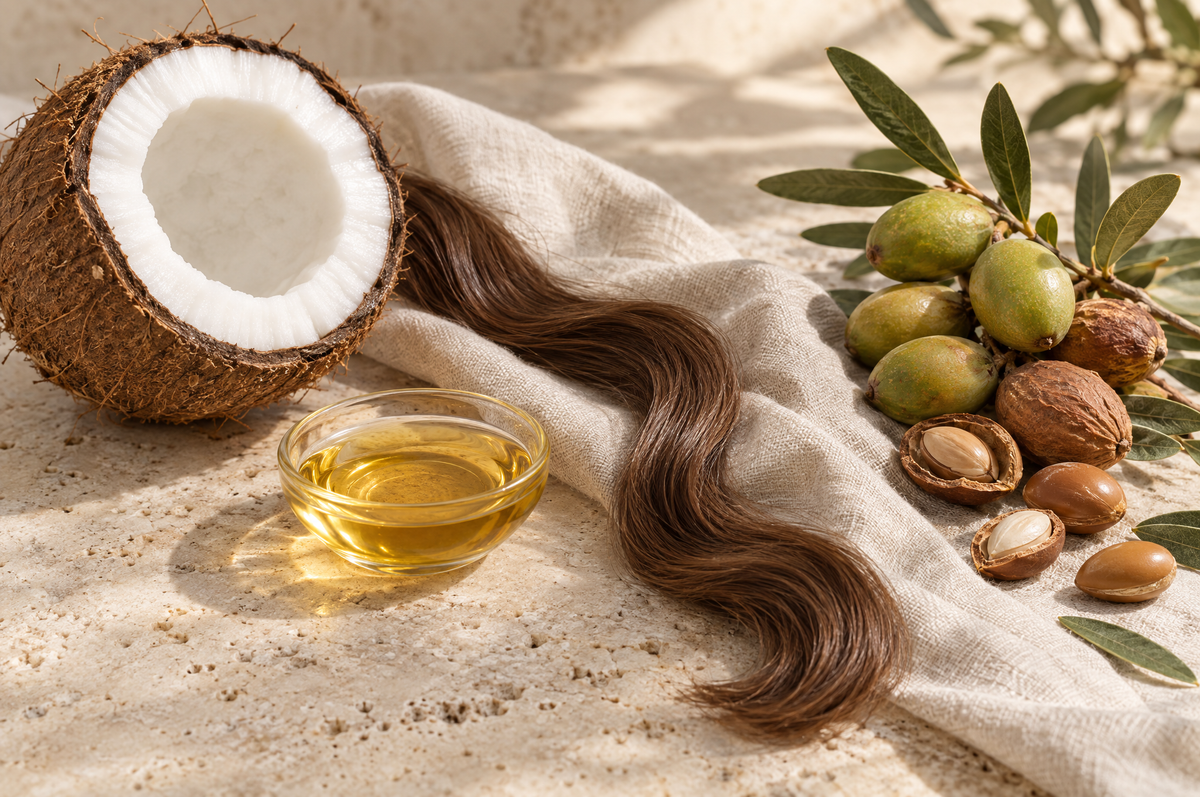
Coconut oil and argan oil are the two oils most people already have within reach, and online advice tends to crown one of them the winner. The truth is less dramatic and more useful: they behave differently on the hair fiber, and the research supports using each one for a different job.
The short answer
Coconut oil is better studied as a pre-wash treatment: lab research shows it penetrates the hair shaft and reduces protein loss. Argan oil is lighter, stays liquid and works best as a leave-in finisher that smooths frizz and adds shine. Many people get the best results using coconut before washing and argan after.
Argan oil vs. coconut oil for hair: what is actually different?
Both are plant oils made mostly of triglycerides, but the fatty acids inside those triglycerides are not the same, and that shapes how each oil interacts with hair.
Coconut oil is dominated by lauric acid, a saturated fatty acid with a short, straight chain. Researchers studying hair have pointed to that small, linear shape as the reason coconut oil has a high affinity for hair proteins and can travel into the fiber.1
Argan oil is a different kind of oil. Around 80% of its fatty acids are unsaturated, mainly oleic acid (roughly 43–49%) and linoleic acid (roughly 29–37%), and it carries tocopherols (vitamin E compounds) and plant sterols.5 Those unsaturated chains have kinks in them. In the classic comparison study, sunflower oil, which is rich in linoleic acid, did not penetrate hair well because of that bulkier structure.1 Argan oil has not been tested head-to-head in the same experiment, so it is fair to say we do not know exactly how deeply it goes, but its chemistry suggests it behaves more like a surface oil than coconut does.
| Coconut oil | Argan oil | |
|---|---|---|
| Main fatty acids | Lauric acid (saturated) | Oleic and linoleic acids (unsaturated)5 |
| Texture at room temperature | Solid below about 76°F (24°C), melts on contact | Liquid, light, spreads thinly |
| Penetrates the hair shaft? | Yes, shown in lab studies2 | Not well studied; some oil remains on hair after washing8 |
| Strongest evidence for | Reducing protein loss when used before and after washing1 | Reducing protein loss from chemical treatments in lab tests8 |
| Best used as | Pre-wash treatment or overnight mask | Leave-in finisher on damp or dry lengths |
| Scent | Coconut, unless refined | Mild and nutty when unroasted |
What the research says about coconut oil and hair
Most of what we know comes from a small group of laboratory studies on hair tresses, not from trials on people's heads. They are still useful because they measure things you cannot judge in the mirror.
In the best-known study, researchers compared coconut, sunflower and mineral oils. Coconut oil was the only one of the three that reduced protein loss remarkably, for both undamaged and damaged hair, when used as a pre-wash and post-wash treatment. Sunflower and mineral oils did not help with protein loss at all.1 An earlier imaging study from the same research group found that coconut oil penetrates the hair shaft while mineral oil does not.2 A 2022 lab study added that a coconut-based hair oil helped prevent damage-related increases in hair porosity and offered some protection for hair color.6
The reason a pre-wash matters is something called hygral fatigue. Hair swells when it absorbs water and shrinks as it dries, and repeating that cycle stresses the fiber. Oils that penetrate can reduce how much water the hair absorbs and how much it swells.4
One caveat worth keeping in view: a 2022 systematic review of coconut, castor and argan oils found that coconut oil had clinical evidence for helping brittle hair, but limited evidence for hair growth.7 So coconut oil earns its reputation for protecting the fiber, not for growing more of it.
What argan oil does well for hair
Argan oil's evidence base for hair is thinner, and the same systematic review concluded that it does not yet have significant clinical evidence for improving hair growth or hair quality.7 That is an honest starting point. What does exist is lab work showing argan oil can protect hair under chemical stress, plus solid general evidence about how oil films behave on hair.
It reduced protein loss from oxidative damage in the lab
In a 2022 study, hair tresses pretreated with argan oil before an oxidizing treatment lost significantly less protein than untreated tresses, and spectroscopy showed argan oil was still deposited on the hair even after washing.8 That is relevant to anyone who colors or lightens their hair, and we cover it in more detail in our guide to argan oil for dry, damaged and frizzy hair.
It seals in moisture and tames frizz
Frizz happens when hair pulls moisture from humid air unevenly. A study of oil-treated hair found that oil films lowered how much moisture vapor the hair picked up and markedly slowed the rate at which water moved in and out of the fiber, an effect the authors compared to moisturizing the hair.3 Notably, the oil film on the surface was the main barrier. That is exactly the role a light, liquid oil like argan plays when you smooth a drop over your lengths.
It is easy to use lightly
Because argan oil stays liquid and spreads thinly, a single drop can cover the ends of shoulder-length hair. Coconut oil is easier to overdo, and many people find it leaves a waxy residue when used as a styler.
Coconut oil is a treatment you wash out. Argan oil is a finish you leave in.
Which is better, argan or coconut oil, for your hair type?
The better question is which oil fits your hair and how you plan to use it.
Fine or straight hair
Fine hair is easily weighed down. Use coconut oil only as a pre-wash treatment that gets shampooed out, and keep argan oil to a single drop on dry ends.
Thick, coarse, curly or coily hair
Textured hair tends to be drier along its length and usually welcomes both. A coconut oil pre-wash before shampoo, followed by argan oil to seal a water-based leave-in conditioner, is a common and sensible routine. Our routine for curly hair walks through the steps.
Low porosity hair
If water beads on your hair and products seem to sit on top, go light. Many people with low porosity hair report that coconut oil leaves their hair stiff, though this is an observation rather than a well-studied effect. A few drops of argan oil over damp, conditioned hair is the gentler place to start. See argan oil for low porosity hair for the full method.
Bleached, colored or chemically treated hair
Both oils have lab evidence for reducing protein loss: coconut oil in general damage studies1 and argan oil specifically before oxidative treatment.8 Using one as a pre-wash and the other as a finisher covers both bases.
How to use argan oil and coconut oil together
You do not have to choose. This routine uses each oil where the evidence and the texture make sense.
- Pre-wash with coconut oil. Warm a teaspoon or two between your palms until it melts and work it through dry mid-lengths and ends 30 minutes to overnight before washing. Keep it off the scalp if you are prone to breakouts along the hairline.
- Shampoo the scalp, condition the lengths. Concentrate shampoo at the roots and let the rinse run through the lengths. Follow with conditioner.
- Towel blot, do not rub. Press water out gently so hair is damp, not dripping.
- Seal with argan oil. Rub a drop or two between your palms and smooth over damp lengths and ends. Thick or curly hair may need a few more drops.
- Finish dry hair with one drop. On second-day hair, a single drop pressed over the ends tames flyaways without the heaviness of a balm.
If you want a single-ingredient argan oil for step four, our 100% organic argan oil is cold-pressed from unroasted kernels in Morocco, USDA-certified organic and contains nothing else, so it will not add fragrance or silicones to your routine. For a deeper look at application, see how to apply argan oil for hair treatment.
Coconut oil vs. argan oil: common mistakes
- Using too much. Either oil will make hair look limp and greasy if overapplied. Start smaller than you think.
- Applying oil to the scalp and hairline if you break out easily. The American Academy of Dermatology notes that oil in hair products can reach the skin, clog pores and cause small breakouts along the hairline and forehead.9
- Expecting either oil to grow hair. Neither has good clinical evidence for growth.7 Their value is in protecting the hair you already have.
- Buying a blend labeled "argan." Many argan products are mostly other oils or silicones with a little argan added. Check that the ingredient list is a single line.
The verdict
If you only want one oil and your goal is protecting hair from washing damage, coconut oil has the stronger laboratory record as a pre-wash. If you want something to smooth frizz, add shine and finish your style without stiffness or residue, argan oil is the more pleasant tool. For most people with dry or textured hair, the answer to "argan oil or coconut oil for hair" is both, at different moments in the routine. Curious about what else is in argan oil? Read what's in argan oil.
Frequently asked questions
Which is better for hair, argan oil or coconut oil?
Neither is better for everyone. Coconut oil has the stronger lab evidence as a pre-wash treatment that reduces protein loss, while argan oil is lighter and better suited to finishing and smoothing dry lengths without stiffness or heavy residue.
Can I mix argan oil and coconut oil?
Yes. Many people use coconut oil as a pre-wash treatment and argan oil as a leave-in finisher, which uses each oil where it performs best. Blending them in one bottle works too, but the coconut oil will solidify in a cool room.
Does coconut oil make hair stiff or dry?
Some people, often those with coarse or low porosity hair, report that coconut oil leaves their hair feeling stiff or brittle. This is a common observation rather than a well-studied effect, so treat your own results as the best guide.
Is argan oil or coconut oil better for frizz?
For day-to-day frizz on dry hair, argan oil is usually the easier choice because it is liquid, spreads thinly and leaves less residue. Lab work shows oil films in general slow how quickly hair absorbs moisture from humid air, which is what drives frizz.
Sources
- Rele AS, Mohile RB. Effect of mineral oil, sunflower oil, and coconut oil on prevention of hair damage. J Cosmet Sci. 2003;54(2):175–192. Link
- Ruetsch SB, Kamath YK, Rele AS, Mohile RB. Secondary ion mass spectrometric investigation of penetration of coconut and mineral oils into human hair fibers: relevance to hair damage. J Cosmet Sci. 2001;52(3):169–184. Link
- Keis K, Huemmer CL, Kamath YK. Effect of oil films on moisture vapor absorption on human hair. J Cosmet Sci. 2007;58(2):135–145. Link
- Gavazzoni Dias MFR. Hair cosmetics: an overview. Int J Trichology. 2015;7(1):2–15. Link
- Gharby S, Charrouf Z. Argan oil: chemical composition, extraction process, and quality control. Front Nutr. 2021;8:804587. Link
- Kaushik V, Kumar A, Gosvami NN, Gode V, Mhaskar S, Kamath Y. Benefit of coconut-based hair oil via hair porosity quantification. Int J Cosmet Sci. 2022;44(3):289–298. Link
- Phong C, Lee V, Yale K, Sung C, Mesinkovska N. Coconut, castor, and argan oil for hair in skin of color patients: a systematic review. J Drugs Dermatol. 2022;21(7):751–757. Link
- Sharifi N, Hamedeyazdan S, Shokri J, Monajjemzadeh F. Argan oil as a pretreatment of human hair before exposure to oxidative damage: attenuated total reflectance and protein loss studies. J Cosmet Dermatol. 2022;21(10):5010–5017. Link
- American Academy of Dermatology. Are your hair care products causing breakouts? Link