Argan Oil for Dry Skin: How to Use It for Lasting Comfort
Dry skin is easy to describe and surprisingly hard to fix: it feels tight after washing, looks dull or flaky by afternoon, and drinks up moisturizer only to feel dry again an hour later. Argan oil is one of the most popular natural answers, and for once the research is reasonably encouraging. The trick is knowing what it can do on its own, and what it needs help with.
The short answer
Argan oil is a good choice for dry skin. In a 60-day study of postmenopausal women, nightly argan oil on the forearm reduced water loss from the skin and raised its water content. It works best as a seal: apply two or three drops to damp skin or over a hydrating moisturizer, rather than relying on oil alone to add moisture.
Is argan oil good for dry skin? What the research shows
The most relevant study followed 60 postmenopausal women, a group prone to dry skin, for 60 days. Every participant applied argan oil to one forearm each night. By the end of the study, the oil-treated skin showed significantly lower transepidermal water loss (TEWL), meaning less water escaping through the skin, and significantly higher water content in the outer layer. The authors concluded that argan oil improved hydration by restoring barrier function and helping the skin hold on to water.1 A companion study in the same population found that topical argan oil also improved measures of skin elasticity.2
Those are useful results, but they come with honest caveats. The studies were small, short, run in one group of women, and focused on forearm skin. They also tested dietary argan oil alongside the topical oil. So they support argan oil as a helpful moisturizing oil; they don't prove it outperforms other good moisturizers.
Why argan oil suits dry skin
Argan oil is mostly made of oleic and linoleic acids, with a notable amount of vitamin E (mostly gamma-tocopherol) and plant sterols.3 Linoleic acid has a direct role in keeping the skin's water barrier intact.4 Plant oils in general form a light protective layer on the skin that slows water loss.4 For dry skin, that combination of softening and sealing is exactly what you want.
The humectant and occlusive logic: why oil alone isn't enough
Dermatologists group moisturizing ingredients by how they work. Humectants such as glycerin, urea and hyaluronic acid draw water into the outer skin. Emollients, including fatty acids like those in argan oil, fill gaps between skin cells and make skin feel smooth and soft. Occlusives form a layer that blocks water from escaping.5
Here's the catch: oil adds very little water of its own. A dermatology review notes that humectants work best combined with an occlusive, and that occlusives are most effective on damp skin, where there is water to lock in.5 Argan oil does a good job as an emollient and a light seal, but for very dry skin it is a partner to a humectant moisturizer, not a replacement. The same review is also candid that petrolatum is a far stronger occlusive than plant oils such as olive oil.5
In practice, this means two simple rules: put argan oil on damp skin, and if your skin is very dry, put it over a hydrating cream.
Argan oil as a moisturizer: a routine for dry faces
The American Academy of Dermatology recommends that people with dry skin choose creams or ointments over lotions, look for ingredients such as ceramides and hyaluronic acid when skin is very dry, avoid fragrance and alcohol, and moisturize right after washing.6
- Cleanse gently. Use a mild, fragrance-free cleanser and lukewarm water. Don't scrub.
- Leave skin damp. Pat your face lightly with a towel, leaving it slightly moist.
- Hydrate. Apply a cream containing a humectant such as glycerin or hyaluronic acid.
- Seal. Warm two or three drops of argan oil between your palms and press them over your face and neck.
- Repeat at night. In the evening, you can use an extra drop on the driest areas.
- Protect by day. Finish your morning routine with a broad-spectrum sunscreen.
For more on placing oil in a routine, see our guide to argan oil before or after moisturizer.
Argan oil for dry, flaky skin
Flakes are clumps of dead skin cells that haven't shed smoothly. Picking or scrubbing them off tends to make skin more irritated. Instead, soften them: argan oil on damp skin after cleansing helps flakes lie flatter and makes them less visible. If flaking is persistent, red, itchy or scaly, it may not simply be dry skin. Conditions such as eczema, seborrheic dermatitis or psoriasis need a dermatologist's diagnosis; our guide to argan oil and eczema explains what to watch for.
Argan oil for very dry skin on the body
Body skin, especially on the shins, arms and feet, is often drier than the face. The AAD's core advice for dry skin is to keep showers to five to ten minutes in warm water, use a gentle fragrance-free cleanser, and apply moisturizer immediately while skin is still damp. It also lists humidifiers, gloves for chores and cotton clothing as helpful habits.7
After the shower, five or six drops of argan oil per area smoothed over damp skin is usually enough. If your skin is very dry, apply a rich body cream first and then the oil, or mix two or three drops of oil into a palmful of cream. Our after-shower body oil guide walks through the full ritual.
A winter routine for dry skin
Cold air outdoors and heated air indoors both pull moisture from the skin, so many people find their skin is at its driest in winter. A few adjustments help:
- Run a humidifier in your bedroom to add moisture to dry indoor air.7
- Turn the water temperature down. Hot showers feel good in winter but strip more oil from the skin.
- Switch to a richer cream and use argan oil on top, morning and night.
- Add an evening step for rough patches: one drop of argan oil massaged into elbows, knees or the backs of hands before bed.
- Keep wearing sunscreen. Winter sun still causes damage, and the AAD includes sunscreen in its dry-skin advice.7
Argan oil for dry hands and cuticles
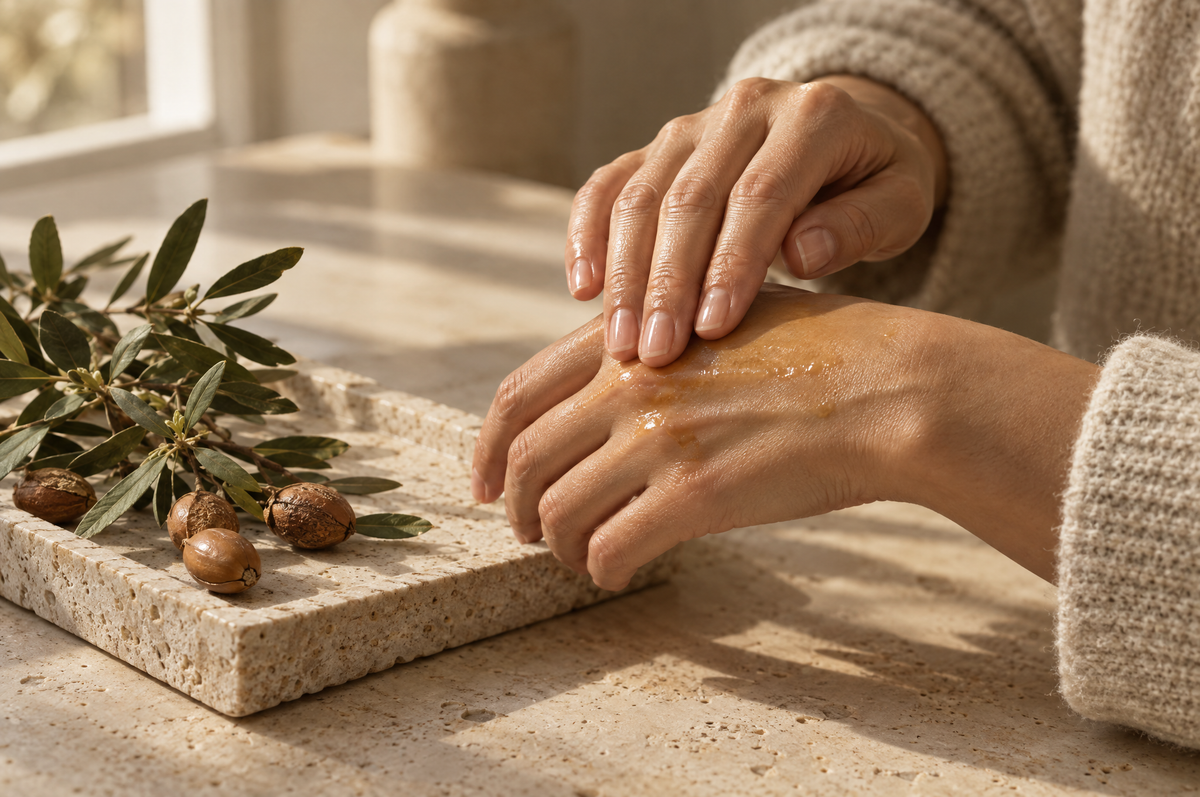
Hands get washed many times a day, which is why they are often the first place dryness shows. The AAD recommends washing with lukewarm water, drying hands while leaving them slightly damp, and then applying a hand cream or ointment, working it into the fingertips and nails. For chapped hands, it suggests products with mineral oil or petrolatum, in a tube rather than a pump, labeled fragrance-free and dye-free.8
Argan oil works well alongside that routine rather than instead of it. Use a thick hand cream during the day, and at night massage one drop of argan oil into your cuticles and the backs of your hands. Our guide to argan oil for nails and cuticles has a dedicated routine.
For a single bottle that covers face, body, hands and cuticles, our 100% organic argan oil is cold-pressed with nothing added, so there is no fragrance to irritate dry, reactive skin.
Dry skin needs water first and a seal second. Argan oil is a very good seal.
Frequently asked questions
Can I use argan oil instead of moisturizer for dry skin?
For mildly dry skin, argan oil on damp skin may be enough. For very dry skin, use it over a moisturizer with humectants such as glycerin or hyaluronic acid, because oil alone adds little water.
How often should I use argan oil for dry skin?
Once or twice a day works for most people, after cleansing or showering. In winter you can add an extra drop to rough patches at night.
Is argan oil good for dry skin on the face?
It can be. Small studies on the forearms of postmenopausal women found topical argan oil reduced water loss and increased skin hydration; the face hasn't been studied directly. Two or three drops pressed in after moisturizer is a good starting point.
Why is my skin still dry after using argan oil?
You may be applying it to dry skin or skipping a hydrating step. Apply it to damp skin over a humectant moisturizer; if dryness persists, see a dermatologist to rule out a skin condition.
This article is for general information and isn't medical advice. If your dry skin is itchy, cracked, scaly or not improving, check with a dermatologist, as it may be a condition that needs treatment.
Sources
- Boucetta KQ, Charrouf Z, Derouiche A, Rahali Y, Bensouda Y. Skin hydration in postmenopausal women: argan oil benefit with oral and/or topical use. Prz Menopauzalny. 2014;13(5):280–288. Link
- Boucetta KQ, Charrouf Z, Aguenaou H, Derouiche A, Bensouda Y. The effect of dietary and/or cosmetic argan oil on postmenopausal skin elasticity. Clin Interv Aging. 2015;10:339–349. Link
- Gharby S, Charrouf Z. Argan oil: chemical composition, extraction process, and quality control. Front Nutr. 2021;8:804587. Link
- Lin TK, Zhong L, Santiago JL. Anti-inflammatory and skin barrier repair effects of topical application of some plant oils. Int J Mol Sci. 2017;19(1):70. Link
- Purnamawati S, Indrastuti N, Danarti R, Saefudin T. The role of moisturizers in addressing various kinds of dermatitis: a review. Clin Med Res. 2017;15(3-4):75–87. Link
- American Academy of Dermatology. How to pick the right moisturizer for your skin. Link
- American Academy of Dermatology. Dermatologists' top tips for relieving dry skin. Link
- American Academy of Dermatology. Dry skin relief from handwashing. Link