Argan Oil for Nails and Cuticles
Ragged cuticles, nails that peel in thin layers, a tip that snaps the moment you open a soda can: most nail complaints come down to dryness and wear rather than anything exotic. That is why so many people reach for a cuticle oil, and why argan oil keeps coming up as the one to try. Here is what it can realistically do for nails and cuticles, what the evidence does and doesn't say, and how to build a routine that takes thirty seconds a night.
The short answer
Yes, argan oil works well as a cuticle and nail oil. It softens dry cuticles and may help limit the moisture loss behind peeling and brittleness, which is what dermatologists recommend moisturizing for. There are no clinical trials on argan oil for nails specifically, so expect better-looking, more flexible nails, not faster growth.
Is argan oil good for nails?
For everyday nail care, yes, with one honest caveat. Nobody has run a clinical trial of argan oil on fingernails. What we do have is two pieces of indirect evidence that point the same way.
The first is dermatology advice. The American Academy of Dermatology (AAD) repeatedly tells people to moisturize their nails and cuticles to keep brittleness in check: apply a moisturizing product to nails and cuticles several times a day between manicures1, moisturize after using nail polish remover because removers dry the nail2, and use a moisturizer on hands, nails and cuticles after washing to help prevent dryness and brittle nails3. The AAD's go-to examples are petroleum jelly and ointment-style products, but the principle is simple: keep the nail and the skin around it from drying out.
The second is what we know about argan oil on skin. It is made mostly of oleic and linoleic acids, with a notable amount of vitamin E compounds (tocopherols) and plant sterols4. In a 60-day study of postmenopausal women, applying argan oil to the forearm reduced transepidermal water loss and increased the water content of the outer skin compared with baseline5. A 2017 review of topical plant oils lists argan oil among those with evidence for skin barrier repair, although that evidence rests on a small number of studies6. Your cuticles and the folds around your nails are skin, so it is reasonable to expect the same kind of softening and moisture retention there.
Put together: argan oil is a pleasant, lightweight way to follow the moisturizing advice dermatologists already give. It isn't a treatment, and it won't change the nail your body is growing.
What argan oil can and can't do for your nails
What it can help with
- Dry, rough or ragged cuticles. This is where you'll notice the difference fastest, often within a few nights.
- Peeling and splitting from dryness. Nails that flake at the free edge after frequent hand-washing, cleaning or polish removal tend to benefit from regular oiling.
- Dullness. A drop buffed into the nail plate gives a soft, natural sheen.
- Hangnails. Softer skin around the nail is less likely to catch and tear.
What it can't do
- Make nails grow faster. Growth happens at the nail matrix under the skin. No study shows argan oil speeds it up.
- Treat nail fungus, psoriasis or infection. Thickening, lifting, yellowing or pain need a proper diagnosis. The AAD advises seeing a dermatologist when you notice nail changes3.
- Undo damage that's already grown out. A split or weakened section only goes away as it grows out and is trimmed off. Oil helps the new growth stay in better shape.
Argan oil for nails: before and after expectations
People searching for "argan oil nails before and after" usually want to know how long it takes. A realistic timeline:
- First few days: cuticles look smoother and less white or flaky. Hangnails become less frequent.
- Two to four weeks: the edges of your nails may peel less, especially if you're also cutting back on harsh removers and wearing gloves for wet work.
- Two to three months: fingernails grow slowly, so this is roughly when nail that grew under a consistent routine starts reaching the tip. If your nails are going to look stronger overall, this is when you'll see it.
Be wary of dramatic before-and-after photos. Lighting, a fresh manicure and a coat of oil can transform how nails look in a single shot. Consistency over weeks matters more than any single application. For a broader look at timelines, see our guide to realistic argan oil results.
Can you use argan oil as cuticle oil?
Yes. Most cuticle oils are simply blends of plant oils, sometimes with vitamin E and a fragrance. A pure argan oil gives you the plant oil without the perfume, which is useful if you have sensitive skin or simply dislike a scented hand.
Argan oil also has a practical texture advantage: it's light enough to sink in within a minute or two, so you're not leaving greasy prints on your phone. If you're looking for a single-ingredient option, our 100% organic argan oil comes in a dropper bottle that makes one-drop-per-nail application easy, and the same bottle covers your face, hair and body.
How to use argan oil on nails and cuticles
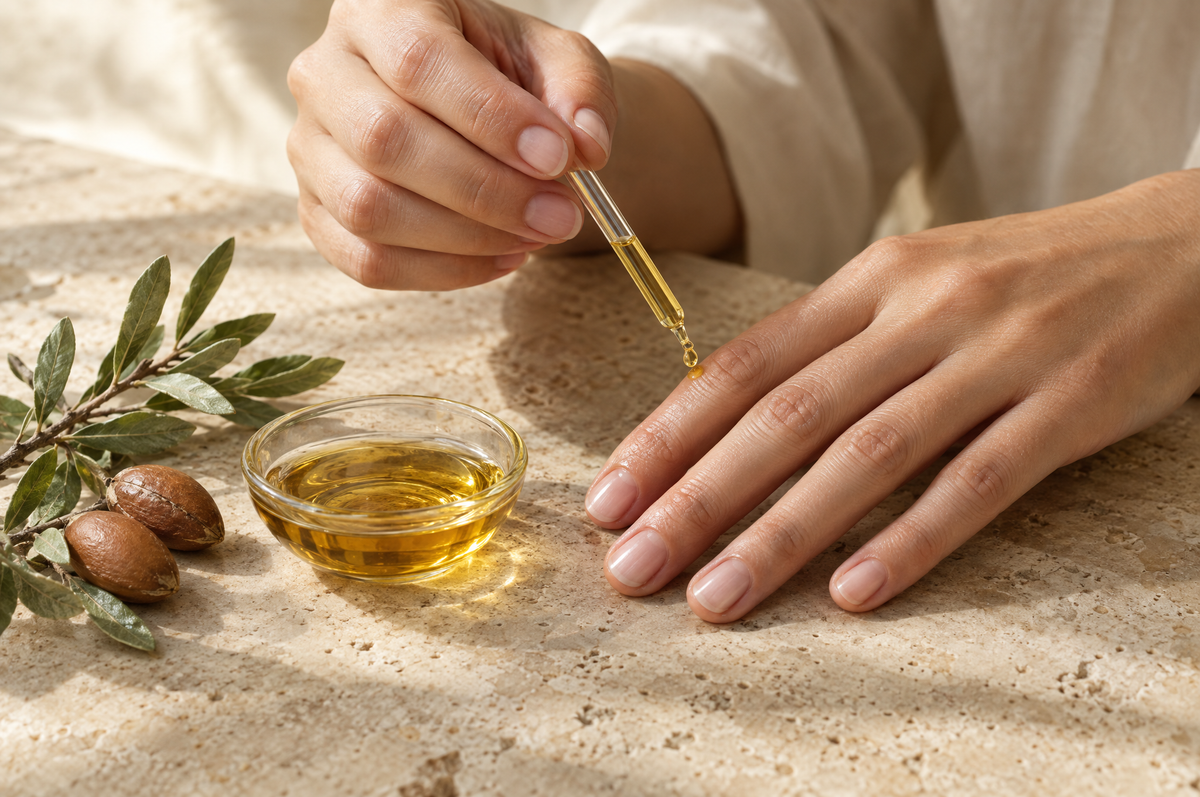
A drop per hand is often enough. Our own usage guide suggests one drop on the nail beds. Here's a simple nightly routine:

- Start with clean, dry hands. If you've just removed polish, wash your hands first to clear away remover residue.
- Apply one small drop to each nail bed, or one drop per hand if your nails are short.
- Massage it in for 20 to 30 seconds, working around the cuticle and along the sides of the nail, then over the nail plate and the underside of the tip.
- Leave your cuticles alone. The AAD advises against cutting or forcefully pushing back cuticles, because they help protect against infection. If you must push them back, do it gently after a shower2.
- Finish with hand cream if your hands are dry, or simply let the oil absorb.
- Repeat during the day if you wash your hands often or work with water. A quick drop after washing is a good habit.
Bedtime is the best single moment because nothing disturbs the oil for hours. For an intensive weekend treatment, oil your nails and cuticles generously and wear thin cotton gloves overnight.
Argan oil with gel, acrylic and dip manicures
Enhancements are where cuticle care matters most, and where the most questions come up.
Gel polish
The AAD recommends moisturizing nails and cuticles several times a day between gel manicures, giving your nails a break of a week or two between sets, and avoiding peeling gel off yourself1. Argan oil fits neatly into this: apply it to the cuticle area daily while you're wearing gel, and more generously during your break weeks. Avoid oiling the nail plate right before a salon appointment, because oil can interfere with how polish bonds. Wash your hands or let your technician prep the nail first.
Acrylics and dip powder
Oil around the cuticles and along the sidewalls keeps the surrounding skin from cracking where the product meets the nail. The AAD notes that artificial nails aren't a good idea if you're prone to brittle nails or fungal infections, and that they shouldn't be used to hide a nail problem2.
Removal recovery
Acetone is very drying. The AAD suggests soaking only your fingertips rather than your whole hands1. Afterward, wash your hands, then massage in a drop of argan oil per nail and repeat nightly for the first couple of weeks.
Argan oil nails on Reddit: common questions
A recurring thread in nail-care and skincare forums asks whether argan oil is "as good as" branded cuticle oils, whether jojoba is better, and whether cheap supermarket oils will do. A few honest answers:
- Branded oil vs. argan: many cuticle oils are plant-oil blends, so a pure oil can do the same basic job. Consistency matters more than the label.
- Argan vs. jojoba: both work. Jojoba is technically a liquid wax and feels slightly drier; argan feels a touch richer. Our argan vs. jojoba comparison goes into the details.
- "Argan" blends: check the ingredient list. If argan oil appears after silicones or fragrance, you're mostly paying for something else. Our guide to spotting real argan oil walks through the checks.
Argan oil vs. other nail care options
| Option | Texture | Best for | Trade-off |
|---|---|---|---|
| Argan oil | Light, absorbs in a minute or two | Daily cuticle care, daytime use, people who dislike fragrance | Needs regular reapplication |
| Petroleum jelly | Heavy, occlusive | Very dry or cracked cuticles overnight (an AAD favorite) | Greasy; not practical during the day |
| Scented cuticle oil blend | Varies | People who enjoy a fragrance | Fragrance can irritate sensitive skin |
| Hand cream | Light to rich | Hands overall | Often doesn't get worked into the cuticle |
Many people combine them: argan oil during the day, and a layer of petroleum jelly over it on nights when cuticles are cracked.
Is argan oil safe for nails? A few cautions
Argan oil is generally well tolerated, but allergic reactions have been reported in medical journals, so they're possible7. Because it's pressed from a kernel, anyone with a nut or seed allergy should check with their doctor first. If you're trying it for the first time, the AAD's patch-test method is a good precaution: apply a little to a small spot on your inner arm twice a day for 7 to 10 days and watch for redness, itching or swelling8. For more on this, see whether argan oil can irritate skin.
See a dermatologist rather than reaching for any oil if a nail is painful, swollen, discolored, lifting from the bed, or changing shape.
Frequently asked questions
How often should I put argan oil on my nails?
Once a day at bedtime is enough for most people. If you wash your hands often or wear gel polish, a quick drop on each cuticle after washing helps too.
Does argan oil make nails grow faster?
There's no evidence that it does. Nail growth happens under the skin at the nail matrix. Argan oil helps the nail and cuticle stay flexible and moisturized, which can mean less breakage as nails grow.
Can I use argan oil on my nails before painting them?
Use it after, not before. Oil on the nail plate can stop polish from adhering, so wash your hands first and save the oil for the cuticles once the polish is dry.
Is argan oil better than cuticle oil?
Many cuticle oils are plant-oil blends, so pure argan oil does the same core job without added fragrance. The best oil is the one you'll use every day.
Can I use argan oil on toenails?
Yes, for dry cuticles and rough skin around the toenails. Keep feet clean and dry afterward, and see a dermatologist if a toenail thickens, discolors or lifts.
Sources
- American Academy of Dermatology. Gel manicures: Tips for healthy nails. Link
- American Academy of Dermatology. Manicure and pedicure safety. Link
- American Academy of Dermatology. National Healthy Skin Month: dermatologists provide tips on caring for your skin, hair, and nails. Link
- Gharby S, Charrouf Z. Argan oil: chemical composition, extraction process, and quality control. Front Nutr. 2022;8:804587. Link
- Boucetta KQ, Charrouf Z, Derouiche A, Rahali Y, Bensouda Y. Skin hydration in postmenopausal women: argan oil benefit with oral and/or topical use. Prz Menopauzalny. 2014;13(5):280–288. Link
- Lin TK, Zhong L, Santiago JL. Anti-inflammatory and skin barrier repair effects of topical application of some plant oils. Int J Mol Sci. 2017;19(1):70. Link
- Foti C, Romita P, Ranieri LD, Bonamonte D. Allergic contact dermatitis caused by argan oil. Contact Dermatitis. 2014;71(3):183–184. Link
- American Academy of Dermatology. How to test skin care products. Link