Argan Oil for Men: One Bottle for Face, Hair and Beard
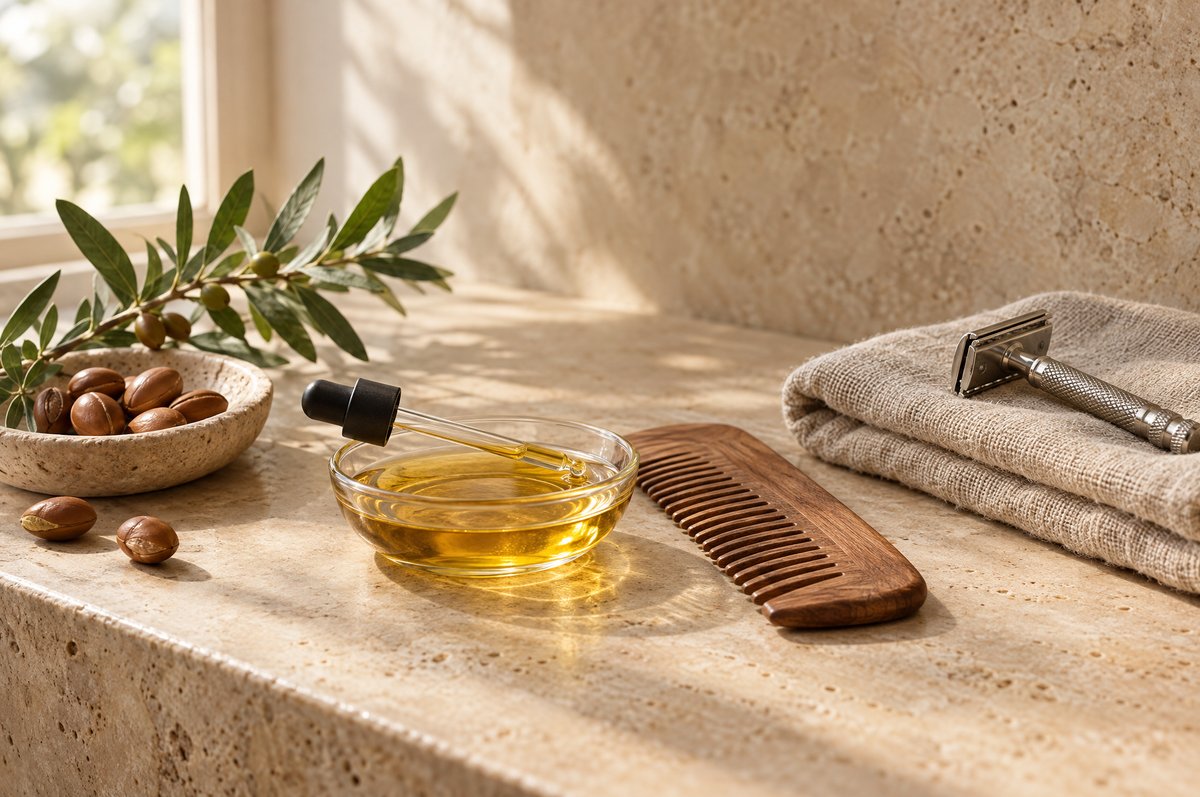
Walk down a grooming aisle and you'd think skin and hair came in two models: one with florals and pastel bottles, one with charcoal packaging and names like "Glacier." Argan oil doesn't fit either box. It's a single plant oil that does the same thing on any face, scalp or beard, which is exactly why a lot of men end up using it as the one product that replaces three or four others.
The short answer
Argan oil is for everyone. It's a single-ingredient plant oil, and skin and hair don't care what gender is on the label. Men use it as a lightweight face moisturizer, a post-shave soother, a beard oil and a finishing oil for dry or frizzy hair. Marketing splits it by gender; the oil itself is identical.
Is argan oil for men or women?
Both. Pure cosmetic argan oil is pressed from the unroasted kernels of the argan tree, and its makeup, mostly oleic and linoleic acids plus vitamin E compounds called tocopherols and plant sterols, is the same no matter who buys it1. There's no "men's" version of the oil. When a product is marketed to men, the differences are usually fragrance, packaging, or other ingredients blended in.
There are some real differences in men's skin care needs, and they're worth knowing because they shape how you use the oil. The American Academy of Dermatology (AAD) notes that shaving is a major source of irritation, recommends moisturizing right after bathing or shaving while skin is still damp, and suggests men with sensitive skin choose fragrance-free products2. A plain, fragrance-free oil fits all three points.
Why a one-bottle routine appeals to men
The case for argan oil in a men's routine is mostly about simplicity. One small bottle can stand in for:
- a face moisturizer (for normal to dry skin)
- a post-shave balm
- a beard oil
- a leave-in hair serum or finishing oil
- a hand and cuticle treatment
That doesn't mean it's the best possible product for each job. A dedicated sunscreen moisturizer is still the better daytime choice, and people with acne-prone skin may prefer an oil-free formula. But for a man who wants a short, honest routine, it covers a lot of ground.
Argan oil for men's skin
What it does
The best human evidence for argan oil on skin comes from small trials. In one, 60 postmenopausal women applied argan oil to the forearm for 60 days, and the treated skin lost less water and held more moisture3. In a companion study, skin elasticity measurements improved4. Those participants were women, so the results don't automatically transfer, but the underlying effect, helping the skin barrier hold on to water, isn't specific to one sex.
In practical terms: argan oil helps dry, tight skin feel comfortable, and it absorbs more quickly than heavy creams, which suits men who dislike a greasy finish.
How to use it on your face
- Wash with a gentle facial cleanser and lukewarm water; the AAD notes that regular bar soap can be drying2.
- Pat your face so it's still slightly damp.
- Warm 2 to 3 drops between your fingertips and press them into your face and neck.
- In the morning, finish with a broad-spectrum SPF 30 or higher sunscreen; the AAD recommends it whenever you're outdoors2.
Our guide to using argan oil on your face has more detail on layering.
If your skin is oily
Oil on oily skin sounds backwards, but it isn't automatically a problem. A small study of a cream combining argan oil with saw palmetto and sesame extracts found reduced facial greasiness after four weeks5, though with several active ingredients it's impossible to credit argan oil alone. If you break out easily, start with one or two drops at night only, and read argan oil for oily skin before going further.
Argan oil as an aftershave
Shaving is hard on skin, which is why it can feel tight or sting afterward. The AAD advises shaving after a shower when hair is softer, shaving in the direction of hair growth, changing blades every 5 to 7 shaves, and moisturizing immediately afterward2.
A couple of drops of argan oil after you rinse and pat dry is an easy way to handle that last step. Unlike alcohol-based aftershaves, it doesn't sting. It won't prevent razor bumps on its own, though; technique matters most.
Argan oil for men's hair
Men's hair ranges from buzzed to shoulder-length and from straight to tightly coiled, so "men's hair" isn't one thing. Argan oil is most useful when hair is long enough, or dry enough, to frizz, tangle or look dull.
What the evidence says
Lab work on hair fibers is encouraging but limited. In one study, hair pre-treated with argan oil before exposure to an oxidizing agent (the kind of chemical used in bleaching and dyeing) lost significantly less protein than untreated hair6. That's a lab study on cut hair, not a clinical trial. On the other hand, a 2022 systematic review found no significant clinical evidence that argan oil improves hair growth or hair quality7. So: a good cosmetic conditioner, not a hair-loss solution.
If thinning is your concern, see a dermatologist, and read our honest take on argan oil and hair loss.
How to use it
- Short hair: one drop rubbed between your palms and run through towel-dried hair adds a little control and a natural finish, without the stiffness of gel.
- Medium to long hair: one or two drops through the lengths and ends of damp hair, then style as usual.
- Dry or curly hair: a little more, concentrated on the ends. The AAD recommends conditioner after every wash and conditioning throughout if hair is dry or curly8; argan oil can be the leave-in step after that.
Our full guide on how to use argan oil for hair goes further.
Argan oil for beards
This is where many men start. The AAD recommends beard oil for men with normal to dry skin, applied sparingly, to prevent dry, flaky, itchy skin underneath9. Argan oil does that job without added fragrance. Use 2 to 5 drops depending on length, massaged into the skin first and then smoothed through the hair. We cover it in depth in argan oil for beards.
A simple men's routine with one bottle
| When | Step | Argan oil |
|---|---|---|
| Morning | Wash face, shave if needed | 2–3 drops on damp face and neck, then sunscreen |
| Morning | Beard | 2–5 drops into skin and beard, comb through |
| Morning | Hair | 1–2 drops through damp or dry ends |
| Night | Wash face | 2–3 drops pressed in as the last step |
| After showering | Body (optional) | 5–6 drops on dry areas like elbows and shins |
If you'd like to try it, our 100% organic argan oil is a single ingredient, USDA-certified organic and cold-pressed from unroasted kernels, with no fragrance or dyes. The 60 mL dropper bottle is small enough for a dopp kit.
What to watch for
- Breakouts. If you get new spots, especially under a beard, stop and reassess. The AAD suggests a non-comedogenic conditioner rather than beard oil for beard acne10.
- Allergy. Reactions are uncommon but possible. Patch test first: the AAD recommends applying a product to a small spot on your inner arm twice a day for 7 to 10 days11.
- Too much. If your face or hair looks shiny an hour later, cut back a drop.
- Fake or blended oils. "Argan" products often contain only a trace of the oil. Check that the ingredient list says Argania spinosa kernel oil and nothing else. See how to tell real argan oil from fake.
Frequently asked questions
Is argan oil good for men's skin?
Yes, especially for normal to dry skin. A few drops on damp skin after washing or shaving help skin hold on to moisture. Men with acne-prone skin should start slowly or choose an oil-free moisturizer.
Can men use argan oil on their hair every day?
Yes, in small amounts. One or two drops through the lengths and ends is enough for most men. If hair starts to look limp or greasy, use less or skip a day.
Can I use argan oil as an aftershave?
Yes. After shaving, rinse, pat dry and press in two or three drops. It moisturizes without the sting of alcohol-based aftershaves, though it won't prevent razor bumps on its own.
Is men's argan oil different from women's argan oil?
No. Pure argan oil is the same single ingredient regardless of packaging. Products marketed to men usually differ only in fragrance, packaging or added ingredients.
Does argan oil help with hair loss in men?
There's no good evidence that it does. A 2022 systematic review found no significant evidence that argan oil improves hair growth. If you're noticing thinning, see a dermatologist.
Sources
- Gharby S, Charrouf Z. Argan oil: chemical composition, extraction process, and quality control. Front Nutr. 2022;8:804587. Link
- American Academy of Dermatology. Skin care tips for men. Link
- Boucetta KQ, Charrouf Z, Derouiche A, Rahali Y, Bensouda Y. Skin hydration in postmenopausal women: argan oil benefit with oral and/or topical use. Prz Menopauzalny. 2014;13(5):280–288. Link
- Boucetta KQ, Charrouf Z, Aguenaou H, Derouiche A, Bensouda Y. The effect of dietary and/or cosmetic argan oil on postmenopausal skin elasticity. Clin Interv Aging. 2015;10:339–349. Link
- Dobrev H. Clinical and instrumental study of the efficacy of a new sebum control cream. J Cosmet Dermatol. 2007;6(2):113–118. Link
- Sharifi N, Hamedeyazdan S, Shokri J, Monajjemzadeh F. Argan oil as a pretreatment of human hair before exposure to oxidative damage: attenuated total reflectance and protein loss studies. J Cosmet Dermatol. 2022;21(10):5010–5017. Link
- Phong C, Lee V, Yale K, Sung C, Mesinkovska N. Coconut, castor, and argan oil for hair in skin of color patients: a systematic review. J Drugs Dermatol. 2022;21(7):751–757. Link
- American Academy of Dermatology. Tips for healthy hair. Link
- American Academy of Dermatology. A dermatologist's top tips for a healthy beard. Link
- American Academy of Dermatology. DIY treatment for 5 common beard problems. Link
- American Academy of Dermatology. How to test skin care products. Link