Argan Oil Before or After Moisturizer? How to Layer It
Face oil has a reputation for being fussy: put it on in the wrong order and it supposedly "blocks" everything else or slides around on top. The reality is simpler. Where argan oil goes in your routine depends on what you want it to do, and once you understand the logic you can place it with confidence on any skin type.
The short answer
For most people, apply argan oil after moisturizer, as the last skincare step at night and before sunscreen in the morning. Oil helps seal in the water-based layers underneath. If your skin is oily or you dislike layering, mix one or two drops into your moisturizer instead. Medicated treatments always go on first.
Why order matters: how oils and moisturizers actually work
Dermatologists describe moisturizers by what their ingredients do. Humectants such as glycerin and hyaluronic acid attract water into the outer layer of skin. Emollients, which include fatty acids like oleic and linoleic acid, fill the small gaps between skin cells so the surface feels softer and smoother. Occlusives, which are mostly oil-based, form a water-repelling layer that slows the evaporation of water from the skin, known as transepidermal water loss or TEWL.1
That last point is the key to layering. A review of moisturizers notes that humectants can actually increase water loss on their own, because they pull water into the upper skin where it evaporates easily, so they are usually paired with an occlusive.1 Plant oils act partly as a light occlusive: a review of topical plant oils describes how they form a protective film that helps skin retain moisture and lowers TEWL.2 In a 60-day study of postmenopausal women, nightly argan oil on the forearm significantly reduced TEWL and increased the water content of the skin over the study period.3
So the logic of "water first, oil last" holds: put the hydrating, water-based layers down, then use oil to slow how quickly that water escapes. It is worth being honest about scale, though. The same moisturizer review notes that petrolatum, the benchmark occlusive, reduces water loss far more than a plant oil such as olive oil.1 Argan oil is a gentle seal and a softener, not a heavy barrier.
Does oil stop moisturizer from absorbing?
This is the most common worry, and it comes from the idea that oil applied first creates a barrier that nothing else can get through. Argan oil is a light, fast-absorbing oil, so it does not create an impenetrable film, but water-based products do spread less evenly over an oily surface. That is the practical reason to put it after your moisturizer: everything goes on smoothly, and the oil does its sealing job at the end.
How to layer face oil: the thinnest-to-thickest rule
The rule of thumb many dermatologists and estheticians use is to apply products from the thinnest, most watery texture to the thickest. The American Academy of Dermatology's recommended order is to cleanse, apply any medication or treatment, then moisturizer and/or sunscreen, then makeup.4 Oils are not on that list, but they slot in naturally after moisturizer at night and before sunscreen in the morning.
| Step | Morning | Evening |
|---|---|---|
| 1 | Gentle cleanser or water rinse | Gentle cleanser |
| 2 | Water-based serum (e.g. vitamin C or hyaluronic acid), if you use one | Prescription or active treatment (e.g. retinoid), if you use one |
| 3 | Light moisturizer | Moisturizer |
| 4 | 1–2 drops of argan oil, or skip | 2–3 drops of argan oil, pressed in |
| 5 | Broad-spectrum sunscreen, SPF 30+ | Done |
| 6 | Makeup, if desired | — |
Where medicated products go
The AAD advises applying medication or treatment right after cleansing, before moisturizer or sunscreen.4 That includes acne treatments, prescription creams and retinoids. If you use a retinoid, our guide to using argan oil with retinol covers timing in more detail. If a dermatologist has given you specific instructions for a prescription, follow those over any general rule.
Argan oil with moisturizer in the morning: the sunscreen question
Sunscreen should go on after your other skincare products and beneath makeup.5 So if you use argan oil in the morning, it sits between moisturizer and sunscreen, and less is more. One or two drops, warmed between your fingertips and pressed into the skin, is enough. Give it a few minutes to absorb before you apply sunscreen so the sunscreen goes on in an even layer.
Two cautions. First, do not mix oil into your sunscreen. Sunscreens are tested as formulated, and diluting one with anything else may leave you with patchier coverage than the label promises. Second, argan oil is not a sunscreen. Use a broad-spectrum SPF 30 or higher, apply it about 15 minutes before going outside and reapply every two hours outdoors.6
If your morning routine already feels heavy, simply save argan oil for the evening. Many people find that is where it makes the biggest difference.
Argan oil in your skincare routine order: evening routines by skin type
At night there is no sunscreen to worry about, and oil can be the final step. Our own usage guide suggests two to three drops pressed in as the last step, morning and evening, and that is a sensible starting amount for most skin. Here is how to adapt it.
Dry or mature skin
Apply a richer cream to slightly damp skin, then press two to three drops of argan oil over the top. Dermatologists recommend applying moisturizer right after washing, while the skin is still damp, to trap water in.7 For very dry patches, a drop of oil worked into the area again before bed can help. See our guide to argan oil for dry skin for a fuller routine.
Normal or combination skin
Use a lightweight lotion, then one or two drops of oil, concentrating on drier areas like the cheeks and leaving the T-zone lighter.
Oily or acne-prone skin
Try mixing one drop of argan oil into a gel moisturizer in your palm rather than layering it separately, and use it at night only to begin with. Introduce it slowly and watch how your skin responds over a few weeks. Our article on argan oil for oily skin explains why some oily skin types tolerate it well and others do not.
Sensitive skin
Keep your routine short. The AAD warns that using too many products can irritate the skin.4 A gentle cleanser, a simple fragrance-free moisturizer and a drop or two of pure oil may be all you need. Patch test anything new first; our guide on whether argan oil can irritate skin shows how.
How to apply argan oil after moisturizer, step by step
- Cleanse and gently pat your face dry, leaving it very slightly damp.
- Apply any treatment or serum, then your moisturizer, and give it a minute to settle.
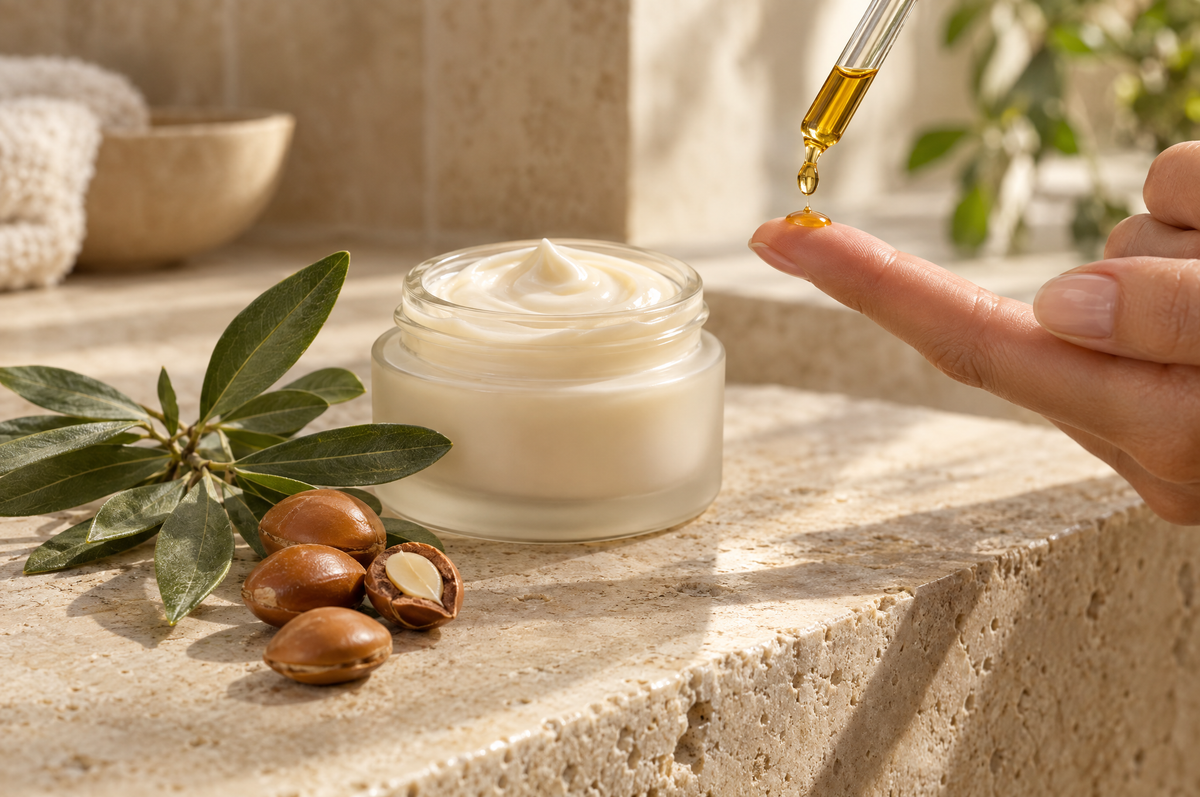
- Dispense two to three drops of argan oil into your palm.
- Rub your palms together briefly to warm and spread the oil.
- Press your palms gently onto your cheeks, forehead, chin and neck rather than rubbing, which helps avoid tugging and keeps the moisturizer underneath in place.
- In the morning, wait a few minutes before sunscreen. At night, you are done.
The "mix it in" method
If layering is not your style, put a pea-sized amount of moisturizer in your palm, add one or two drops of argan oil, mix with a fingertip and apply as usual. You get the softness of the oil in a single step, and it is the easiest way to adjust the amount: more drops in winter, fewer in summer.

Whichever method you choose, the quality of the oil matters more than the order. A single-ingredient, cold-pressed oil like our 100% organic argan oil has nothing added, so it will not introduce fragrance or other potential irritants into an otherwise simple routine.
Frequently asked questions
Do you put argan oil on before or after moisturizer?
After, for most people. Oil helps seal in the water-based moisturizer beneath it. If you prefer one step, mix a drop or two into your moisturizer instead.
Can I use argan oil instead of moisturizer?
Some people with normal or dry skin do, applying it to damp skin. But oil supplies little water of its own, so most skin does better with a moisturizer containing humectants underneath.
Does argan oil go before or after sunscreen?
Before. Sunscreen should be the last skincare step in the morning, under makeup. Use only one or two drops of oil and let it absorb first.
Should I use argan oil in the morning or at night?
Either works, but night is easiest because there is no sunscreen or makeup to layer over it. Many people use a lighter amount in the morning or skip it.
How many drops of argan oil should I use on my face?
Two to three drops for the face is a good starting point. Use one drop if your skin is oily or you are mixing it into moisturizer.
Sources
- Purnamawati S, Indrastuti N, Danarti R, Saefudin T. The role of moisturizers in addressing various kinds of dermatitis: a review. Clin Med Res. 2017;15(3-4):75–87. Link
- Lin TK, Zhong L, Santiago JL. Anti-inflammatory and skin barrier repair effects of topical application of some plant oils. Int J Mol Sci. 2017;19(1):70. Link
- Boucetta KQ, Charrouf Z, Derouiche A, Rahali Y, Bensouda Y. Skin hydration in postmenopausal women: argan oil benefit with oral and/or topical use. Prz Menopauzalny. 2014;13(5):280–288. Link
- American Academy of Dermatology. Should I apply my skin care products in a certain order? Link
- American Academy of Dermatology. Dermatologist-recommended skin care for your 20s. Link
- American Academy of Dermatology. How to apply sunscreen. Link
- American Academy of Dermatology. Dermatologists' top tips for relieving dry skin. Link