Argan Oil for Stretch Marks: What the Research Says
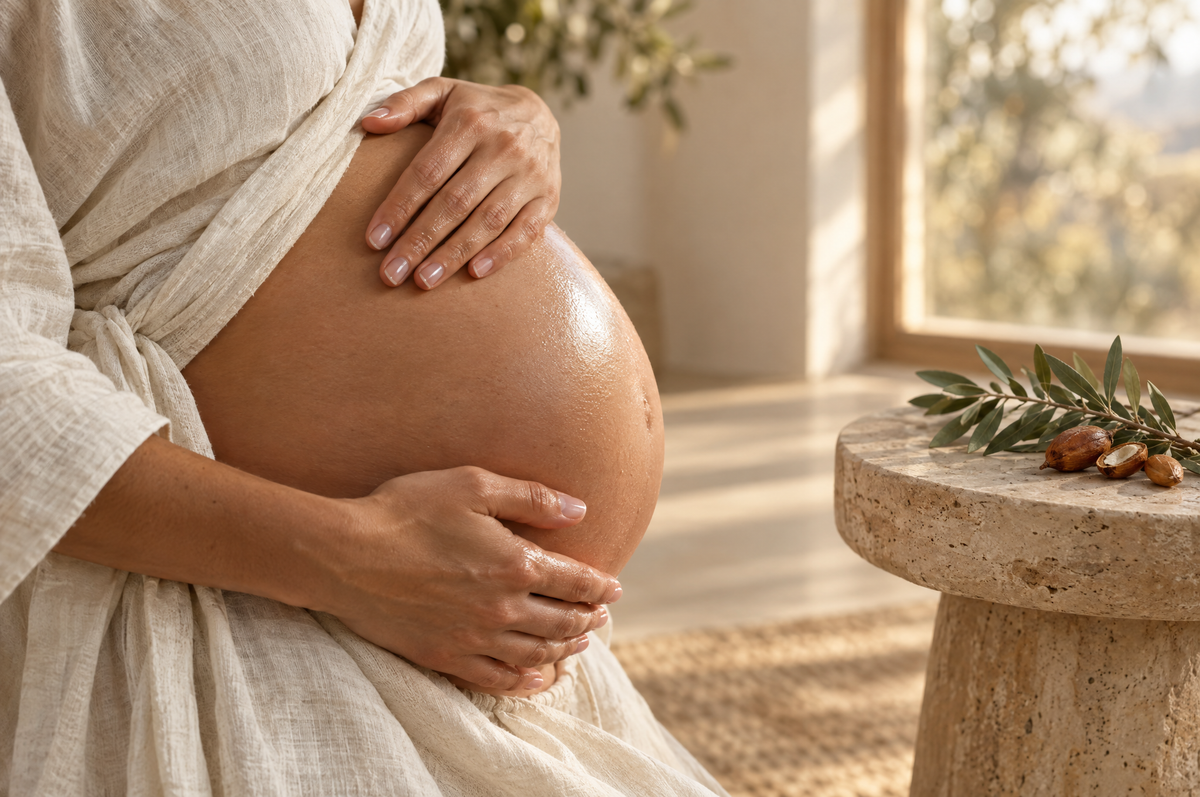
Few skin concerns attract as many hopeful products as stretch marks, and argan oil is often near the top of the list. It's easy to see why: rubbing a rich oil into a growing belly feels like doing something. The research, though, is clear-eyed, and knowing what it says can save you money and disappointment while still leaving a real role for a good oil.
The short answer
No cream or oil, argan included, has been shown to reliably prevent or remove stretch marks. A Cochrane review found no high-quality evidence that any topical product prevents them in pregnancy. Argan oil can keep stretching skin soft and comfortable and ease dryness and itch, which is worthwhile, but it won't change whether marks appear.
Is argan oil good for stretch marks? What the research says
There are no clinical trials of argan oil for stretch marks, so we have to look at the broader evidence on topical products.
- The Cochrane review. Looking at six trials involving 800 pregnant women, reviewers found no statistically significant difference in whether stretch marks developed between women using topical preparations with active ingredients and those using a placebo or nothing. They concluded there is no high-quality evidence to support any topical preparation for preventing stretch marks in pregnancy1.
- The American Academy of Dermatology. The AAD notes that popular home remedies haven't worked in studies: none of the stretch marks faded when people massaged almond oil, cocoa butter, olive oil or vitamin E into them2.
- The NHS. Despite the many products claiming to prevent or remove stretch marks, the NHS says there's very little evidence they work3.
- Oil-specific trials. A 2022 review of clinical studies on plant oils found three trials of olive oil in pregnancy, none showing a significant difference in stretch marks compared with controls. One study of a blend rich in safflower oil reported improved skin condition, though the reviewers note that blend differed considerably from plain olive oil4.
Put together, the honest grade for argan oil and stretch marks is: no direct evidence, and the indirect evidence for oils in general isn't encouraging.
What about the argan oil elasticity study?
You may see a 2015 study cited as proof. In it, 60 postmenopausal women applied argan oil to one forearm nightly for 60 days, and measures of skin elasticity improved5. It's a genuine finding, but it measured elasticity on the forearm of older women, not stretch marks, and not pregnant skin. It can't tell us whether argan oil affects stretch marks.
Why stretch marks form
A stretch mark is a type of scar. According to the AAD, it forms when the skin stretches or shrinks quickly and the collagen and elastin that support it rupture2. Fluctuating hormones seem to play a role, and you're more likely to get them if family members do. They commonly appear during growth spurts in puberty, pregnancy, rapid weight gain or loss, and rapid muscle growth from weight training; long-term corticosteroid use and some medical conditions increase the risk too2.
That explains why surface products struggle: the change happens in the deeper layers of the skin, driven by stretch, hormones and genetics. The NHS notes that it isn't always possible to prevent stretch marks, and that maintaining a healthy weight is the best way to reduce your chances3.
An oil can't decide whether you get stretch marks. It can decide how your skin feels while it stretches.
Argan oil and pregnancy stretch marks: what it can genuinely do
If you're pregnant, you're far from alone in wanting to do something. In a survey of more than 750 women late in pregnancy, 78 percent said they'd used a product to prevent or reduce stretch marks, and over a third had used two or more6. The researchers' conclusion was that high-quality evidence on these products is still needed6.
Here's where argan oil can earn its place:
- Comfort for itchy, stretching skin. Itching in pregnancy is common as hormones change and skin stretches, and the NHS suggests using an unperfumed moisturizer regularly7. A pure, fragrance-free oil fits that description.
- Softness and dryness relief on the belly, hips, breasts and thighs. Our guide to argan oil for dry skin has more on lasting comfort.
- A calming routine. A few minutes of massage is a pleasant ritual, even if it doesn't change the outcome.
If you choose an oil for this, simpler is better during pregnancy. The AAD lists ingredients to avoid in pregnancy, including retinoids and some essential oils8, so a single-ingredient, unscented oil keeps things straightforward. Our organic argan oil contains only cold-pressed argan kernel oil, with no fragrance or essential oils. For a broader look at safety, see is argan oil safe during pregnancy.
An important itch warning
Not all pregnancy itching is just dry skin. The NHS advises contacting your maternity unit urgently if you have very itchy skin that keeps you awake at night, itching on the palms of your hands or soles of your feet, or itching that's worse at night, because these can be signs of intrahepatic cholestasis of pregnancy, a liver condition that needs treatment7. Don't try to moisturize that away.
How to use argan oil on stretching skin
- Patch test first. Apply a little to your inner arm twice a day for seven to 10 days9. Sensitive skin is a common change in pregnancy8.
- Apply after a warm (not hot) shower or bath, while skin is still slightly damp.
- Use five to six drops per area, such as the belly or thighs, warmed between your palms.
- Massage gently in slow circles until absorbed. There's no need for pressure.
- Repeat once or twice a day, whenever skin feels tight or itchy.
- Check with your midwife, doctor or OB-GYN about anything you use in pregnancy, especially if you have allergies.
For more on body routines, see argan oil as an after-shower body oil.
Argan oil stretch marks before and after: realistic expectations
Online before-and-after photos are rarely controlled: lighting differs, and stretch marks naturally fade from red or purple to paler over time. Here's what actually has evidence, according to the AAD and NHS:
| Option | What the evidence says | Notes |
|---|---|---|
| Argan oil and other plant oils | Not shown to prevent or fade stretch marks2,1 | Good for comfort and dryness |
| Tretinoin (prescription retinoid) | May make early stretch marks less noticeable2 | Not for use during pregnancy3 |
| Hyaluronic acid | Made early stretch marks less noticeable in studies2 | Works best on new marks |
| In-office procedures | Lasers, peels, microdermabrasion, radiofrequency and ultrasound can make marks less noticeable2 | See a dermatologist |
| Self-tanner | Can camouflage early and mature marks2 | Cosmetic, temporary |
Timing matters: treatments tend to work on early marks and have little effect on mature ones2. If you're interested in retinoids after pregnancy and breastfeeding, check with your doctor first and see our guide to argan oil and retinol. And for honest timelines across other uses, see argan oil before and after.
When to see a doctor
Stretch marks are a normal part of life for most people. But the NHS recommends seeing a GP if you develop large stretch marks along with other symptoms such as fat building up on the chest, face and neck, as this can occasionally be a sign of a hormonal condition3. A dermatologist can advise on procedures if stretch marks bother you after pregnancy.
Frequently asked questions
Does argan oil prevent stretch marks?
There's no evidence that it does. A Cochrane review found no high-quality evidence that any topical product prevents stretch marks in pregnancy, though argan oil can keep stretching skin soft and comfortable.
Can argan oil fade old stretch marks?
No study shows that it does. Mature, white stretch marks respond poorly even to medical treatments; a dermatologist can advise on procedures that may make them less noticeable.
Is argan oil safe to use on my belly during pregnancy?
Pure argan oil used on the skin is generally considered a low-risk cosmetic, but there are no formal pregnancy safety studies. Patch test, avoid scented blends, and check with your midwife or doctor, especially if you have nut or seed allergies.
When should I start using oil on my belly in pregnancy?
Whenever your skin feels dry, tight or itchy. Since oils don't prevent stretch marks, there's no ideal start date; use it for comfort.
Sources
- Brennan M, Young G, Devane D. Topical preparations for preventing stretch marks in pregnancy. Cochrane Database Syst Rev. 2012;11:CD000066. Link
- American Academy of Dermatology. Stretch marks: Why they appear and how to get rid of them. Link
- NHS. Stretch marks. Link
- Poljšak N, Kočevar Glavač N. Vegetable butters and oils as therapeutically and cosmetically active ingredients for dermal use: a review of clinical studies. Front Pharmacol. 2022;13:868461. Link
- Qiraouani Boucetta K, Charrouf Z, Aguenaou H, Derouiche A, Bensouda Y. The effect of dietary and/or cosmetic argan oil on postmenopausal skin elasticity. Clin Interv Aging. 2015;10:339–349. Link
- Brennan M, Clarke M, Devane D. The use of anti stretch marks' products by women in pregnancy: a descriptive, cross-sectional survey. BMC Pregnancy Childbirth. 2016;16(1):276. Link
- NHS. Itching and intrahepatic cholestasis of pregnancy. Link
- American Academy of Dermatology. Dermatologist-approved pregnancy skin care. Link
- American Academy of Dermatology. How to test skin care products. Link
This article is for general information and isn't medical advice. If you're pregnant or breastfeeding, check with your doctor, midwife or dermatologist before trying something new, and seek urgent advice for severe itching.