Can You Use Argan Oil With Retinol?
Retinoids are some of the best-studied ingredients in skin care, and some of the hardest to live with in the first few weeks. Dryness, flaking and stinging are common, and they're the main reason people give up. A simple oil can help, as long as you know what it is, what it isn't, and where it goes in your routine.
The short answer
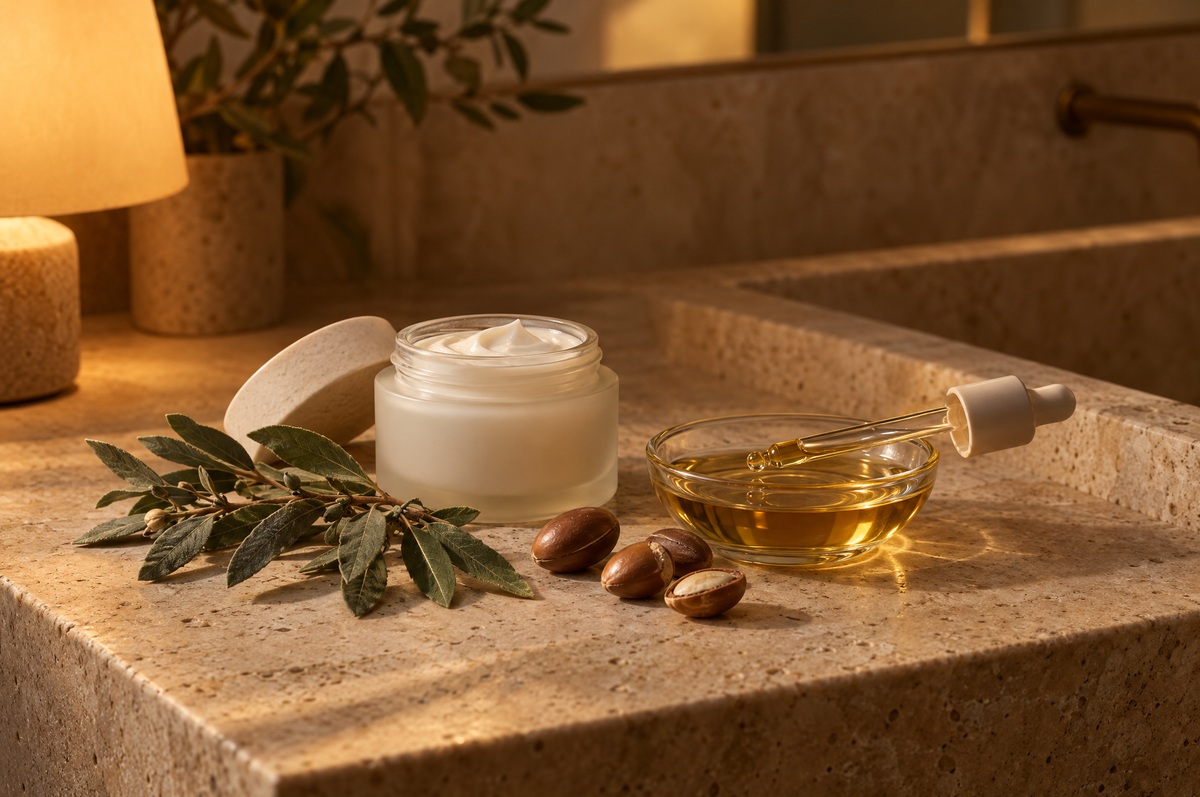
Yes, you can use argan oil with retinol. Argan oil contains no retinol, and nothing in it is known to clash with retinoids. Apply your retinoid to clean, dry skin, let it absorb, then press in two or three drops of argan oil. If your skin is sensitive, a "sandwich" with oil before and after can soften irritation.
Does argan oil have retinol?
No. This is a common mix-up, partly because argan oil is often marketed as "anti-aging" and partly because it's rich in vitamin E, which people sometimes confuse with vitamin A. A 2024 review of argan oil's composition describes it as mostly fatty acids (roughly 43 to 49 percent oleic and 29 to 36 percent linoleic), with tocopherols (vitamin E compounds) at around 600 to 700 mg per kilogram, plant sterols such as schottenol and spinasterol, about 0.3 percent squalene, and small amounts of polyphenols1. Retinol and other vitamin A compounds aren't among its reported components. You can read more in our guide to vitamin E and what's in argan oil.
| Argan oil | Retinol and other retinoids | |
|---|---|---|
| What it is | A plant oil: fatty acids, vitamin E, sterols, squalene1 | Vitamin A derivatives, from over-the-counter retinol to prescription tretinoin2 |
| Main job | Moisturizing; supports the skin barrier and hydration5 | Speeds cell turnover and boosts collagen; used for lines, tone and acne2 |
| Best evidence for | Hydration and elasticity in small trials | Fine wrinkles in randomized trials4 |
| Common side effects | Uncommon; occasional breakouts or sensitivity | Redness, dryness, peeling, irritation2 |
| Pregnancy | Ask your provider; no retinoid content | Avoid7 |
Why argan oil and retinol work well together
The AAD notes that retinoids commonly cause redness, dryness, peeling and irritation, especially at the start, and recommends beginning with a low strength every other night and following with moisturizer2. A review on topical retinoids found that irritation in clinical trials typically peaks in the first one to two weeks and then subsides, and that moisturizers may matter more for tolerability than the retinoid's concentration or vehicle3.
Argan oil is a reasonable candidate for that moisturizing role. In a 60-day study, applying it to the forearm reduced water loss through the skin and increased the skin's water content5, and a review of plant oils notes linoleic acid's role in maintaining the skin's water barrier6. In short, the retinoid does the renewing, and the oil helps keep the skin comfortable while it does.
A practical note: if you use argan oil this way, choose a pure, fragrance-free oil. Retinoid-treated skin is more reactive than usual, and fragrance is an unnecessary variable. Our 100% organic argan oil is a single, cold-pressed ingredient with nothing added.
Argan oil and retinol together: the order of application
The standard approach is "thinnest to thickest," with the active ingredient going on first so nothing stands between it and your skin.
- Cleanse gently and pat your face dry.
- Wait until skin is fully dry. Many people find retinoids sting more on damp skin; 10 to 20 minutes after washing is a common rule of thumb.
- Apply a pea-sized amount of your retinoid to the whole face, avoiding the corners of the nose, mouth and eyes. Follow your product's or doctor's directions.
- Let it absorb for a few minutes.
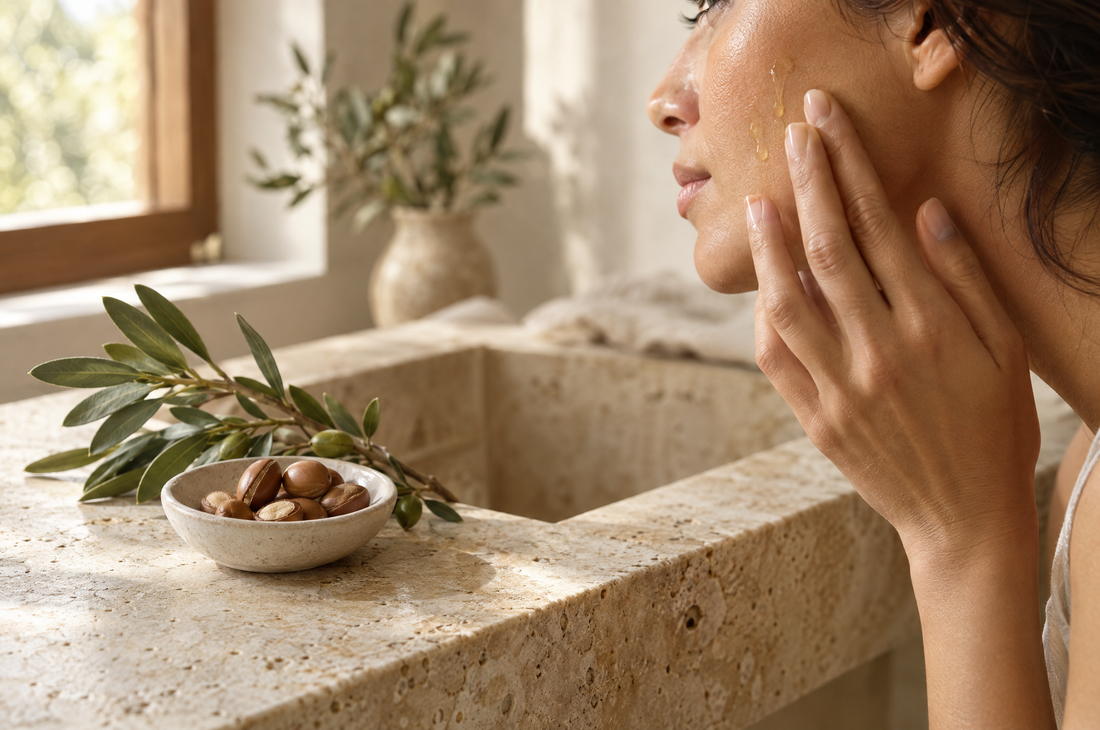
- Press in two to three drops of argan oil. Warm them between your fingertips and press, rather than rub, over the face. If you also use a water-based moisturizer, put that on before the oil; see argan oil before or after moisturizer.
- Wear sunscreen the next morning. Retinoids increase sun sensitivity, and the AAD recommends daily sunscreen while you use them2.
The retinol sandwich with argan oil
If your skin is easily irritated, the "sandwich" method is a popular way to soften the blow:
- Apply a thin layer of moisturizer or one to two drops of argan oil to clean, dry skin, especially around the nose, mouth and eyes.
- Apply your retinoid.
- Finish with another layer of moisturizer or argan oil.
To be clear about the evidence: we couldn't find a clinical trial testing the sandwich technique specifically. The logic is that a buffer layer slows how quickly the retinoid reaches the skin, which may reduce irritation and may also reduce how much of it gets in. That trade-off is often worth it while you're getting used to a retinoid. Once your skin adjusts, many people move to applying the retinoid directly and the oil afterward.
Other evidence-based ways to reduce irritation
- Every other night at first. A retinoid review suggests applying it every other day for the first two to four weeks, when irritation is most likely3.
- Short contact. The same review describes applying the retinoid for 30 to 60 minutes and then washing it off during the first two to four weeks3.
- Start low. The AAD recommends the lowest-strength formula to begin with2.
Let the retinoid do the renewing and the oil do the comforting.
Will argan oil make retinol less effective?
There's no research directly on this question, so any answer is partly informed reasoning. Applied after a retinoid has absorbed, a few drops of oil are unlikely to interfere much. Applied underneath, as in the sandwich, it may blunt both the irritation and, to some degree, the effect. Since retinoid results build slowly anyway (studies of retinol for wrinkles run for months; one well-known trial lasted 24 weeks4), consistency matters more than squeezing out every bit of potency. A routine you can stick with beats a stronger one you abandon in week two.
What to expect in the first months
Expect the first two to four weeks to be the bumpiest. That's when retinoid irritation is most likely, and when a buffer of oil, an every-other-night schedule or both tend to help most3. After that, most people find their skin settles and they can use the retinoid more often. Visible changes in fine lines and texture take longer: the retinol trial mentioned above measured results at 24 weeks4. Through all of it, the oil's job stays the same, keeping skin soft and comfortable, not speeding results. If fine lines are your main goal, our article on argan oil for wrinkles explains what the oil itself can and can't do.
Who should be careful
- Pregnancy and breastfeeding. The AAD advises avoiding retinoids during pregnancy, including prescription tretinoin, tazarotene and isotretinoin and over-the-counter retinol and adapalene7. Argan oil itself contains no retinoids; see is argan oil safe during pregnancy for more.
- Rosacea or very reactive skin. The AAD notes retinoids may not suit people with significant redness, inflammation or rosacea, so talk to a dermatologist first2.
- Darker skin tones. Irritation can leave dark marks, so ease in slowly2.
- Acne-prone skin. Argan oil is generally considered low-risk for pores, but watch for new bumps; see argan oil for acne-prone skin.
- Anyone trying argan oil for the first time. Patch test it on your inner arm for seven to 10 days before using it on retinoid-treated skin8.
Frequently asked questions
Should I put argan oil before or after retinol?
Usually after. Apply your retinoid to clean, dry skin, let it absorb, then press in a few drops of argan oil. If your skin is sensitive, you can also apply a thin layer before the retinoid as a buffer.
Does argan oil contain retinol or vitamin A?
No. Argan oil is made up mainly of fatty acids, vitamin E (tocopherols), plant sterols and squalene. It contains no retinoids.
Can I use argan oil with tretinoin?
Many people use a pure oil to offset tretinoin dryness, applying it after the tretinoin has absorbed. Since tretinoin is a prescription medicine, check with your dermatologist about how to layer it.
Can I use argan oil and retinol in the morning?
Retinoids are usually applied at night. In the morning, you can use a drop of argan oil under sunscreen, which is essential while using a retinoid.
Sources
- Serrafi A, Chegdani F, Bennis F, Kepinska M. The importance of argan oil in medicine and cosmetology. Nutrients. 2024;16(20):3573. Link
- American Academy of Dermatology. Retinoid or retinol? Link
- Leyden J, Stein-Gold L, Weiss J. Why topical retinoids are mainstay of therapy for acne. Dermatol Ther (Heidelb). 2017;7(3):293–304. Link
- Kafi R, Kwak HS, Schumacher WE, et al. Improvement of naturally aged skin with vitamin A (retinol). Arch Dermatol. 2007;143(5):606–612. Link
- Boucetta KQ, Charrouf Z, Derouiche A, Rahali Y, Bensouda Y. Skin hydration in postmenopausal women: argan oil benefit with oral and/or topical use. Prz Menopauzalny. 2014;13(5):280–288. Link
- Lin TK, Zhong L, Santiago JL. Anti-inflammatory and skin barrier repair effects of topical application of some plant oils. Int J Mol Sci. 2017;19(1):70. Link
- American Academy of Dermatology. Dermatologist-approved pregnancy skin care. Link
- American Academy of Dermatology. How to test skin care products. Link
This article is for general information and isn't medical advice. Retinoids should be avoided during pregnancy. If you are pregnant, breastfeeding, using prescription treatments, or have a skin condition, check with your doctor or dermatologist first.