Mixing Argan Oil With Essential Oils: Ratios and Safety
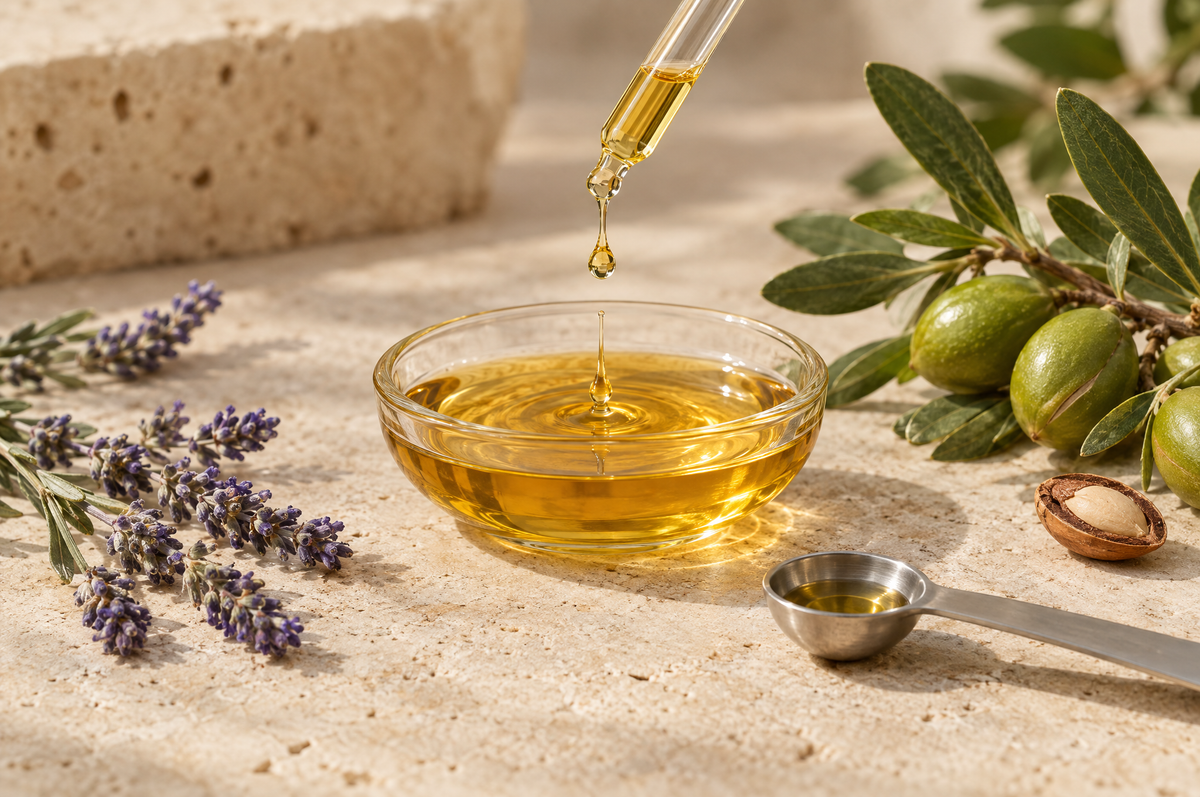
Yes, argan oil makes an excellent carrier for essential oils, as long as you keep the blend weak. For everyday skin use, about 1 percent (roughly one drop of essential oil per teaspoon of argan oil) is a sensible starting point, and well-established safety guidance considers 1 to 5 percent the normal range for adults.1 The argan does the moisturizing; the essential oil is there mostly for scent.
The short answer
Argan oil works well as a carrier oil. Mix essential oils at 1 to 5 percent: 1 drop per teaspoon (5 mL) of argan oil is about 1 percent, a good level for the face. Never apply essential oils undiluted, skip phototoxic citrus oils before sun exposure, patch test first, and mix small batches.
Why use argan oil as a carrier oil?
Essential oils are concentrated, volatile plant extracts, and applying them straight to skin can cause irritation and reactions to UV light. Mayo Clinic's patient guidance says to dilute them in a carrier oil before they touch skin, and names almond and jojoba as common choices.1 Argan oil fills the same role well for a few reasons:
- It's a skin oil in its own right. Argan oil is about 80 percent unsaturated fatty acids, mainly oleic and linoleic acid, with natural tocopherols (vitamin E compounds).6 The case for argan oil for skin doesn't depend on anything you add to it.
- It has very little scent. Cosmetic argan oil, pressed from unroasted kernels, smells faintly nutty, so it doesn't compete with lavender or rose the way a strongly scented carrier might.
- It absorbs comfortably. A few drops spread easily over the face or body without a heavy film.
The one caveat: if you're blending, start with a plain, single-ingredient oil so you know exactly what's in the bottle. A 100% pure argan oil with nothing added gives you a clean base; a pre-scented "argan blend" already contains fragrance, which makes it hard to control the final strength.
Essential oil dilution ratio: how much to add
Dilution is described as a percentage of the total blend. Mayo Clinic's handout gives a simple drop conversion: 1 drop of essential oil in 1 teaspoon of carrier oil is about 1 percent, and 5 drops in 1 teaspoon is about 5 percent. It adds that dilutions between 1 and 5 percent don't typically represent a safety concern, but that the potential for skin reactions increases as the percentage goes up.1
| Dilution | Per 1 teaspoon (5 mL) argan oil | Per 1 tablespoon (15 mL) | Good for |
|---|---|---|---|
| About 0.5% | 1 drop per 2 teaspoons | 1–2 drops | A trial blend, or sensitive skin if your doctor has said essential oils are fine |
| About 1% | 1 drop | 3 drops | Face, daily use, first-time blends |
| About 2% | 2 drops | 6 drops | Body oil, hands, feet |
| About 3–5% | 3–5 drops | 9–15 drops | Short-term, small areas only; the upper end of the usual range |
Drop sizes vary between bottles and with the thickness of the oil, so these numbers are approximate. When in doubt, go lower. More essential oil doesn't make the blend more effective at moisturizing; that's the argan's job.
How to mix argan oil with essential oils
- Use a separate small bottle. Don't add essential oils to your whole bottle of argan oil. A small amber or cobalt glass dropper bottle lets you mix only what you'll use in a week or two.
- Measure the argan oil first. A teaspoon is 5 mL; a tablespoon is 15 mL.
- Add the essential oil drop by drop according to the table above.
- Cap and roll the bottle between your palms to mix. Label it with the oils and the date.
- Patch test. Apply a small amount to the inner forearm and wait 24 to 48 hours before using it more widely. Our guide to patch testing and skin reactions walks through it.
- Apply sparingly. Two or three drops of the blend for the face, five or six for the body after bathing.
Argan oil and lavender oil: the most popular pairing
Lavender is the oil most people reach for first, and it pairs easily with argan's mild scent. A 1 percent blend (one drop of lavender per teaspoon of argan oil) is plenty for the face or as a scented evening body oil.
There is one thing worth knowing about lavender: its main scent compounds, linalool and linalyl acetate, react with air over time and form hydroperoxides, which can sensitize skin. In a Swedish patch-test study, 2.8 percent of patients reacted to oxidized lavender oil.5 The practical takeaway is to keep lavender oil tightly capped, buy small bottles, and not keep using one that's been open for a long time.
As for what lavender does beyond smelling pleasant: the evidence is thin. The U.S. National Center for Complementary and Integrative Health notes that little rigorous research has been done on aromatherapy for uses such as sleep.7 Enjoy it for the scent, not as a remedy.
Which essential oils need extra caution?
Phototoxic citrus oils
Some citrus oils can harm skin that is then exposed to sunlight, which the FDA points out in its consumer guidance.2 Bergamot is the best-documented example. Its furocoumarins, mainly bergapten, make skin react to UV light, and dermatologists have reported blistering reactions developing 48 to 72 hours after people used bergamot aromatherapy oil and were then exposed to UV, including from a tanning bed.3 Keep citrus blends off skin that will see sun or UV lamps, or ask your supplier whether a specific citrus oil is phototoxic before using it on exposed skin.
Common sensitizers
Any essential oil can cause an allergic reaction, but some do so more often. In German clinic data covering 10,930 patients with dermatitis who were patch tested with 12 essential oils, 8.3 percent reacted to at least one. The most frequent culprits were ylang ylang (3.9 percent), lemongrass (2.6 percent), jasmine, sandalwood, clove and neroli.4 The authors concluded that sensitization is uncommon in most people but higher among massage therapists and cosmeticians, who handle these oils every day.4 Mayo Clinic also flags oils rich in aldehydes such as citral (found in lemongrass) and phenols such as eugenol (found in clove) as more likely to cause skin reactions.1
Broken or inflamed skin
Damaged, inflamed or irritated skin is more likely to react to essential oils and absorbs them more readily, so leave them out of anything you apply there.1 Plain argan oil is the gentler choice for skin that's already unhappy.
The argan does the moisturizing. The essential oil is there for the scent, so a little goes a long way.
Children, pregnancy and pets
Infants and young children are more sensitive to essential oils. Mayo Clinic advises using less and lists birch, wintergreen and peppermint among oils that should not be used on young children, and suggests checking with your child's health care provider first.1 For little ones, plain argan oil without any essential oil is the simpler option; see our guide to argan oil for babies.
If you're pregnant or breastfeeding, ask your doctor or midwife before using essential oils on your skin. Unscented argan oil on its own is the more conservative choice during that time.
Don't swallow it, and watch the claims
Essential oils shouldn't be taken internally unless a health care provider has advised it, because the safety of internal use is still being investigated.1 It's also worth knowing how the FDA sees claims: a scented oil sold to moisturize or smell nice is a cosmetic, but one claiming to help you sleep, ease pain or relieve anxiety is making drug claims.2 Be wary of blends that promise those things.
How to store an argan and essential oil blend
Both parts of the blend change with time. Argan oil oxidizes faster with heat and oxygen, and it stays most stable kept out of the light at around room temperature (25 °C).6 Some essential oils, lavender among them, form more irritating compounds as they oxidize.5 So:
- Mix small batches and use them within a few weeks.
- Store in dark glass with a tight cap, away from heat and sunlight.
- Throw out a blend that smells sharp, stale or "off."
If you're not sure whether your base oil is still fresh, see can argan oil go bad for the signs of rancid oil. Our organic cold-pressed argan oil is a single ingredient with no added fragrance, which makes it a straightforward base for your own blends, and it's just as good used on its own.
Frequently asked questions
Can I mix essential oils with argan oil?
Yes. Argan oil is a good carrier oil. Add about 1 drop of essential oil per teaspoon of argan oil for the face, and stay within the usual 1 to 5 percent range for adults.
How many drops of essential oil per ounce of argan oil?
An ounce is about 6 teaspoons, so a 1 percent blend is roughly 6 drops of essential oil per ounce and a 2 percent blend about 12 drops. Drop sizes vary, so take these as approximate.
Can I put tea tree or lavender oil in argan oil for my face?
You can, at a low dilution of about 1 percent, after a patch test. Keep the essential oil tightly capped, because oxidized oils such as old lavender are more likely to irritate skin.
Is argan oil itself an essential oil?
No. Argan oil is a pressed fixed oil from the kernels of the argan tree, used undiluted. Essential oils are concentrated aromatic extracts that need diluting before they touch skin.
This article is for general information and isn't medical advice. If you have a skin condition or allergies, are pregnant or breastfeeding, or are using essential oils on a child, check with your doctor, pediatrician or dermatologist first.
Sources
- Mayo Clinic. Essential oils: aromatherapy safety. Patient education handout MC5574-120rev0918. Mayo Foundation for Medical Education and Research; 2018. Link
- U.S. Food and Drug Administration. Aromatherapy. FDA Cosmetics. Link
- Kaddu S, Kerl H, Wolf P. Accidental bullous phototoxic reactions to bergamot aromatherapy oil. J Am Acad Dermatol. 2001;45(3):458–461. Link
- Geier J, Schubert S, Reich K, et al. Contact sensitization to essential oils: IVDK data of the years 2010–2019. Contact Dermatitis. 2022;87(1):71–80. Link
- Hagvall L, Bråred Christensson J. Patch testing with main sensitizers does not detect all cases of contact allergy to oxidized lavender oil. Acta Derm Venereol. 2016;96(5):679–683. Link
- Gharby S, Charrouf Z. Argan oil: chemical composition, extraction process, and quality control. Front Nutr. 2022;8:804587. Link
- National Center for Complementary and Integrative Health. Aromatherapy. NIH. Link