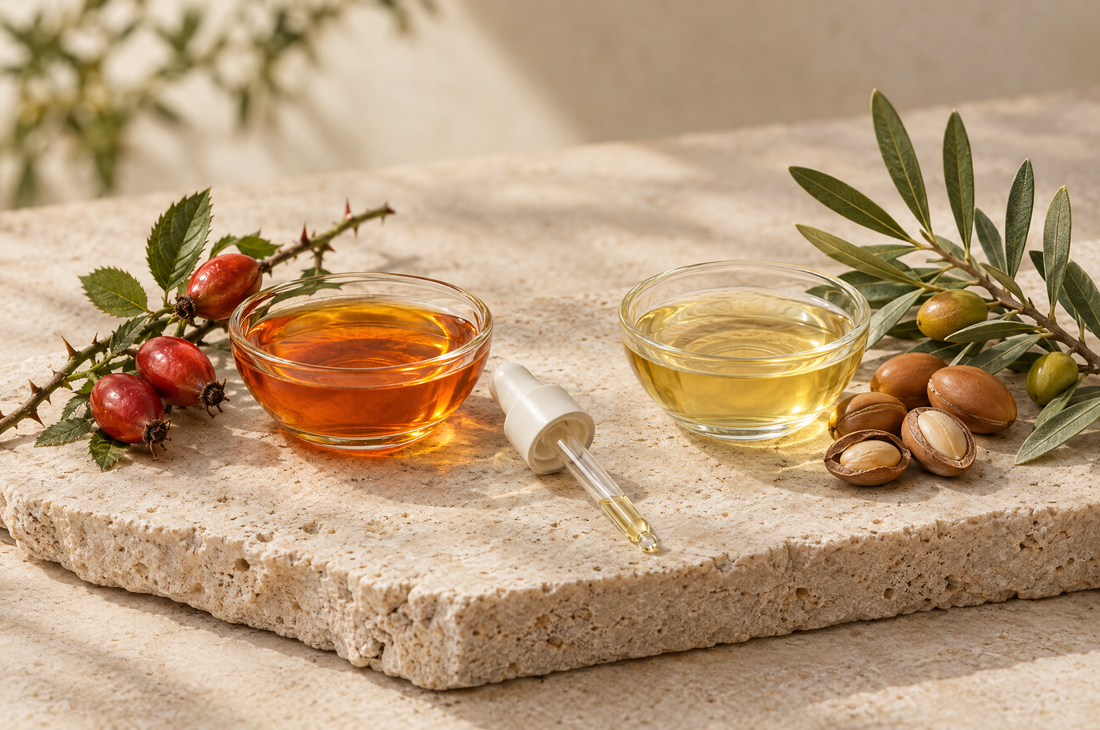
Argan Oil vs. Marula Oil

Marula oil and argan oil are both pressed from the hard-shelled kernels of African trees, and both are sold as premium face and hair oils. The main difference is balance: marula is dominated by oleic acid and feels a little richer, while argan pairs oleic acid with a large share of linoleic acid and much more vitamin E. Each has a small amount of human skin research, and neither has been tested head to head with the other.
The short answer
Marula oil is roughly 70 percent oleic acid, which gives it a rich, cushiony feel and good stability, but it has relatively little vitamin E. Argan oil is more balanced, with about a third linoleic acid and high vitamin E. Dry skin often enjoys either; normal or combination skin may prefer argan.
Two trees, two regions
Argan oil comes from the argan tree, a species that grows wild only in south-west Morocco, in what is now the Arganeraie Biosphere Reserve. The know-how around it, from harvesting to hand-milling, is mainly held by rural women and was added to UNESCO's list of intangible cultural heritage in 2014.1 The oil has traditionally been used for cooking, medicine and cosmetics.1 You can read more about the region and its people in where argan oil comes from.
Marula oil comes from Sclerocarya birrea, a tree widely distributed across sub-Saharan Africa, whose fruit is also used for food and drink.2,3 The oil is pressed from the kernels inside the stone. Ethnobotanical records note that the Zulu people of South Africa, among others, applied marula oil to keep skin in good condition.4 Both oils, in other words, have long traditional use before they became beauty-aisle ingredients.
How marula and argan oil compare chemically
Marula oil
In a detailed analysis of a cosmetic marula oil, oleic acid made up 69 percent of the fatty acids, followed by palmitic acid (15 percent), linoleic acid (9 percent), palmitoleic acid (4 percent) and stearic acid (1.5 percent).4 A separate analysis of kernel oil from Zimbabwe found a similar pattern, with oleic acid at about 73 percent and linoleic acid at about 8 percent.2 A 2025 review notes an earlier finding that marula oil has a low vitamin E content compared with other nut oils.3
Argan oil
Argan oil is about 80 percent unsaturated, split between oleic acid (roughly 43 to 49 percent) and linoleic acid (roughly 29 to 36 percent).5 It is rich in vitamin E, around 60 to 90 mg per 100 g, mostly gamma-tocopherol, and contains plant sterols such as schottenol and spinasterol that are rare in other oils.5 Our article on what's in argan oil explains these compounds in plain language.
What that means on your skin
- Feel. Marula's high oleic content gives a slightly richer, more cushioned glide. Argan feels lighter and more satin.
- Stability. Oils with fewer polyunsaturated fats generally resist oxidation longer, so marula's low linoleic acid suggests it should keep well, though we found no published shelf-life data for it. Cosmetic argan oil has been estimated to keep for about a year at room temperature.5
- Barrier. A review of plant oils notes that linoleic acid supports the skin's water barrier, while oleic acid applied continuously at high concentrations can disrupt it.6 That does not make marula harmful, but people with very oily or breakout-prone skin may find a more linoleic-rich oil like argan easier to wear.
Marula or argan oil for face: what the research shows
Both oils have a small amount of human evidence, and neither has been tested on facial skin in a large trial.
Marula. In a 2015 study, healthy adult women (20 per test) had marula oil applied in a series of skin tests. It caused no irritation in patch testing, improved moisture and hydration when applied to dry skin, and showed occlusive effects on normal skin, meaning it slowed water loss by forming a light seal.4 The authors concluded its use in cosmetics may be justified. More broadly, a 2025 review of marula products found that most research is in lab and animal models and that clear clinical evidence is still lacking.3
Argan. In a study of 60 postmenopausal women, daily argan oil on the forearm for 60 days reduced water loss through the skin and increased skin water content.7 This was a small study in one population, but its results are among the better human data for a cosmetic oil. See our honest round-up on argan oil for skin for the full picture.
The fair conclusion is that both are reasonable, gentle moisturizing oils. Choose based on your skin type and the feel you like.
Marula oil vs. argan oil for hair
We could not find any published study testing marula oil on hair, so any claims about it for hair are based on its texture and tradition. Argan oil's hair research is also limited, but there is at least laboratory work: hair samples pretreated with argan oil lost significantly less protein after oxidative damage, and some oil stayed on the fiber even after washing.8
In practice, both oils smooth the hair surface, add shine and help tame frizz. Marula's richer feel may suit thick, coarse or very dry hair; argan's lighter finish is easier on fine or wavy hair that collapses under heavier oils. For techniques, see how to use argan oil for hair.
Side-by-side comparison
| Argan oil | Marula oil | |
|---|---|---|
| Source | Kernels of Argania spinosa, south-west Morocco1 | Kernels of Sclerocarya birrea, sub-Saharan Africa2 |
| Oleic acid | ~43–49%5 | ~69–73%4,2 |
| Linoleic acid | ~29–36%5 | ~8–9%4,2 |
| Vitamin E | High, about 60–90 mg/100 g5 | Reported as low compared with other nut oils3 |
| Feel | Light, satin finish | Richer, more cushioned |
| Best human skin evidence | Hydration in a 60-day trial7 | Non-irritating, moisturizing and occlusive in small tests4 |
| Hair evidence | Lab study on reduced protein loss8 | None found |
| Often preferred for | Normal, combination, dry and mature skin; most hair types | Dry skin; thick or coarse hair |
Which one should you choose?
Choose marula if
- Your skin is dry and you like a richer oil that leaves a soft, cushioned finish.
- Your hair is thick, coarse and very dry at the ends.
Choose argan if
- Your skin is normal, combination or mature, or you want a lighter feel.
- You value a high natural vitamin E content and a more balanced fatty acid profile.
- You want one bottle for face, hair, nails and body.
Whichever you pick, look for a single-ingredient, cold-pressed oil. Our organic argan oil is pressed from unroasted kernels in Morocco, USDA-certified organic, and comes with a 30-day money-back guarantee, even if opened.
How to use either oil on your face
- Cleanse, then apply any water-based serum while skin is still slightly damp.
- Warm two or three drops of oil between your fingertips.
- Press the oil over your cheeks, forehead, jaw and neck rather than rubbing.
- Use it as the last step at night, or under sunscreen in the morning.
- Patch test a new oil on your inner arm or jawline for a few days first.
Our step-by-step guide to argan oil for face covers amounts, timing and layering in more detail.
Two desert-tough trees, two honest oils: marula is the richer one, argan the more balanced.
Frequently asked questions
Is marula or argan oil better for the face?
Neither has been shown to be better in a direct comparison. Marula is richer and suits dry skin; argan is lighter and more balanced, with more vitamin E, and suits a wider range of skin types.
Is marula oil lighter than argan oil?
Usually not. Marula is about 70 percent oleic acid and tends to feel slightly richer, while argan oil leaves a lighter, satin finish.
Is marula or argan oil better for hair?
There are no published hair studies on marula oil. Argan oil has lab evidence for reducing protein loss from damaged hair, and its lighter texture suits more hair types, while marula may suit very thick, coarse hair.
Can you mix marula and argan oil?
Yes. A drop of each warmed together in your palm gives a finish between the two, which can work well for dry but not very dry skin.
Sources
- UNESCO Intangible Cultural Heritage. Argan, practices and know-how concerning the argan tree (inscribed 2014, Representative List). Link
- Bvenura C, Kambizi L. Chemical profile and potential applications of Sclerocarya birrea (A.Rich.) Hochst. subsp. caffra (Sond.) Kokwaro kernel oils: analysis of volatile compounds and fatty acids. Molecules. 2024;29(16):3815. Link
- Olas B. Marula [Sclerocarya birrea (A. Rich.) Hochst.] products as a food and medicine. Front Pharmacol. 2025;16:1552355. Link
- Komane B, Vermaak I, Summers B, Viljoen A. Safety and efficacy of Sclerocarya birrea (A.Rich.) Hochst (marula) oil: a clinical perspective. J Ethnopharmacol. 2015;176:327–335. Link
- Gharby S, Charrouf Z. Argan oil: chemical composition, extraction process, and quality control. Front Nutr. 2022;8:804587. Link
- Lin TK, Zhong L, Santiago JL. Anti-inflammatory and skin barrier repair effects of topical application of some plant oils. Int J Mol Sci. 2017;19(1):70. Link
- Boucetta KQ, Charrouf Z, Derouiche A, Rahali Y, Bensouda Y. Skin hydration in postmenopausal women: argan oil benefit with oral and/or topical use. Prz Menopauzalny. 2014;13(5):280–288. Link
- Sharifi N, Hamedeyazdan S, Shokri J, Monajjemzadeh F. Argan oil as a pretreatment of human hair before exposure to oxidative damage: attenuated total reflectance and protein loss studies. J Cosmet Dermatol. 2022;21(10):5010–5017. Link