Argan Oil vs. Sweet Almond Oil for Skin and Hair
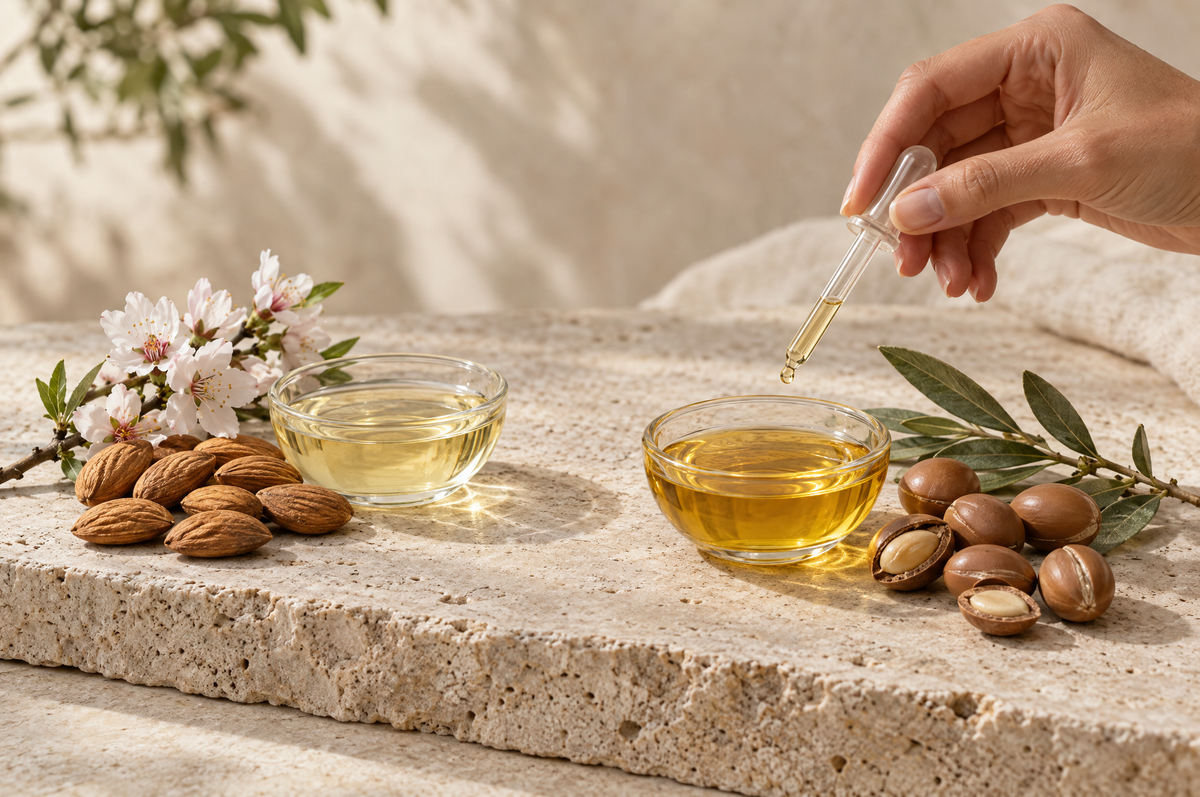
Sweet almond oil and argan oil are both gentle, versatile oils for skin and hair, and both are mostly oleic and linoleic acid. Almond oil is a little heavier, very affordable to produce at scale and comes from a recognized major food allergen; argan oil is lighter-feeling, richer in vitamin E, and has a few more human skin studies behind it. For most people the choice comes down to texture, budget and any nut allergy in the household.
The short answer
Almond oil is a mild, slightly heavier emollient that suits body massage and dry skin. Argan oil is lighter, richer in vitamin E and better studied for skin hydration, which makes it the more versatile face oil. Almond is a major tree nut allergen; argan is not on that list, but check with an allergist first.
Where the two oils come from
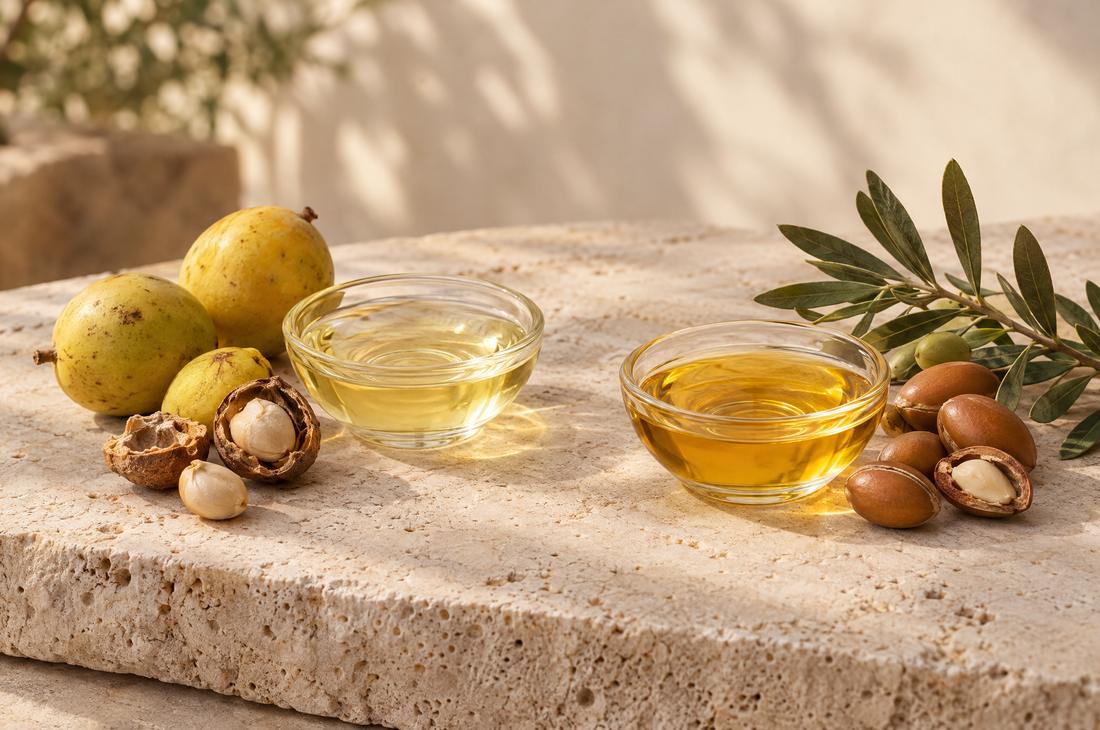
Sweet almond oil is pressed from the nuts of the almond tree, Prunus dulcis,1 a widely farmed nut crop. Argan oil comes from the kernels of the argan tree, which grows wild only in south-west Morocco, in the Arganeraie Biosphere Reserve.2 Turning argan fruit into oil involves many hand steps, from harvesting through cracking and milling, and this know-how is mainly held by rural women, a tradition UNESCO recognized as intangible cultural heritage in 2014.2
That difference explains most of the gap in what each oil costs to make: almonds are grown and pressed at industrial scale, while argan comes from a single region and relies on slow, skilled handwork to crack very hard nuts. We explain the economics in why real argan oil costs what it does.
How their composition compares
Argan oil is about 80 percent unsaturated, mainly oleic acid (roughly 43 to 49 percent) and linoleic acid (roughly 29 to 36 percent), with palmitic and stearic acids making up most of the rest.3 It is notably rich in vitamin E, around 60 to 90 mg per 100 g, mostly in the gamma-tocopherol form, and contains plant sterols that are rare in other oils.3
Almond oil leans further toward oleic acid. One 2025 analysis of a commercial, pharmaceutical-grade refined almond oil measured about 61 percent oleic acid, 28 percent linoleic acid and 5 percent palmitic acid; the same study found that the extraction method changed both the fatty acid balance and how well the oil resisted oxidation.4 Cold-pressed and refined almond oils can therefore behave somewhat differently.
What that means in practice
- Feel. Both are light-to-medium oils. Almond oil has a smooth, slightly slower glide that many people like for massage; argan sinks in a little faster with a satin finish.
- Scent. Refined almond oil is nearly odorless; unroasted argan oil has a faint, nutty scent.
- Stability. Cosmetic argan oil has been estimated to keep about a year at room temperature.3 Almond oil's stability depends heavily on how it was extracted and stored.4
Almond oil or argan oil for face?
Argan has more direct evidence here. In a study of 60 postmenopausal women, applying argan oil to the forearm daily for 60 days reduced water loss through the skin and increased skin water content.5 It is a small study in one population, and the forearm is not the face, but it is more than almond oil has for facial hydration. Our overview of argan oil for skin covers the rest of the research.
Almond oil is a long-standing emollient, and it is perfectly reasonable on dry skin, but its best-known research topic, stretch marks in pregnancy, has been disappointing. A 2026 systematic review of four randomized trials with 671 pregnant participants found that sweet almond oil was not effective at reducing the development of stretch marks, alongside rose and sesame oils.6
On the face specifically, argan's lighter finish and higher linoleic acid share make it the more comfortable choice for most normal and combination skin. Almond oil may feel heavy on oilier skin, and we found no good-quality evidence on how either oil affects breakouts. For a face routine, see our guide to argan oil for face.
Argan vs. almond oil for hair
Neither oil has strong hair research. For argan, there is laboratory work on cut hair: tresses pretreated with argan oil lost significantly less protein after oxidative damage, and some oil remained on the hair even after washing.7 We could not find comparable published studies on sweet almond oil for hair.
In practice, both oils coat the hair surface, smooth the cuticle and reduce frizz and friction. Almond oil is a sensible, economical choice for a pre-wash scalp or lengths oiling that you will shampoo out. Argan's lighter finish makes it the better leave-in for dry ends because it is less likely to look greasy. Our guide on how to use argan oil for hair covers five methods.
Nut allergies: what to know about each oil
This is the most important practical difference. Under US food labeling rules, almond is one of the tree nuts the FDA considers a major food allergen.1 Argan is not on that list.1 The list covers foods, not cosmetics, and it does not mean argan can never cause a reaction: allergic reactions to argan oil are rare but have been published, including a case report of anaphylaxis after argan oil was applied to the skin.8
- If you or your child has a tree nut allergy, ask an allergist before using either oil.
- Whatever your history, patch test a new oil on your inner arm for a few days first. Our guide to whether argan oil can irritate skin explains how.
Side-by-side comparison
| Argan oil | Sweet almond oil | |
|---|---|---|
| Source | Argan kernels, south-west Morocco2 | Almonds (Prunus dulcis), widely farmed1 |
| Main fatty acids | Oleic ~43–49%, linoleic ~29–36%3 | Oleic ~61%, linoleic ~28% in one refined sample4 |
| Vitamin E | High, about 60–90 mg/100 g, mostly gamma3 | Not reported in the analysis we reviewed |
| Feel | Light, satin finish | Smooth, slightly heavier glide |
| Best human skin evidence | Improved hydration in a 60-day trial5 | Not effective for stretch marks in pregnancy trials6 |
| Hair evidence | Lab study on reduced protein loss7 | None found |
| Allergen status (US food labeling) | Not a listed major allergen; rare reactions reported1,8 | Major tree nut allergen1 |
| Typical best use | Face, leave-in for hair ends, cuticles | Body massage, pre-wash hair oiling |
Which one should you choose?
Choose almond oil if
- You want an economical body or massage oil and nobody in your home has a tree nut allergy.
- You like a slightly slower glide for longer massage.
Choose argan oil if
- You want one oil that works well on the face as well as hair and body.
- You prefer a lighter finish and a higher natural vitamin E content.
- You want an oil with some human research on skin hydration.
Plenty of people keep both: almond for the body, argan for the face and hair. If you choose argan, look for a single-ingredient, cold-pressed oil from unroasted kernels; our organic argan oil is exactly that, and it comes with a 30-day money-back guarantee, even if opened.
How to use argan oil where it shines
- Face: press two or three drops over clean, slightly damp skin as the last step of your routine.
- Hair: smooth one drop through dry ends, or a little more through damp hair before styling.
- Nails: massage one drop into the nail beds and cuticles.
- Body: warm five or six drops in your palms and apply after bathing, while skin is still damp.
Almond is the everyday body oil; argan is the one you reach for when it's your face.
Frequently asked questions
Is almond oil or argan oil better for the face?
Argan oil is usually the better face oil. It feels lighter, is richer in vitamin E and has small human studies showing improved skin hydration, while almond oil may feel heavier on oilier skin.
Is argan oil a tree nut?
Argan oil comes from the kernel of the argan fruit, and argan is not on the FDA's list of tree nuts considered major food allergens, while almond is. Rare allergic reactions to argan oil have been reported, so anyone with a tree nut allergy should ask an allergist first.
Is almond or argan oil better for hair?
Both smooth the hair surface and reduce frizz. Argan is the better leave-in because it is lighter, while almond oil is a good economical choice for a pre-wash oiling.
Why is argan oil more expensive to make than almond oil?
Argan trees grow wild only in south-west Morocco, and the oil relies on slow handwork to crack very hard nuts, while almonds are farmed and pressed at industrial scale.
This article is for general information and isn't medical advice. If you have a nut allergy, a skin condition, or are choosing an oil for a baby, check with your doctor, allergist or pediatrician before trying something new.
Sources
- US Food and Drug Administration. Guidance for industry: questions and answers regarding food allergen labeling (Edition 5). January 2025. Link
- UNESCO Intangible Cultural Heritage. Argan, practices and know-how concerning the argan tree (inscribed 2014, Representative List). Link
- Gharby S, Charrouf Z. Argan oil: chemical composition, extraction process, and quality control. Front Nutr. 2022;8:804587. Link
- Kozłowska M, Mańko-Jurkowska D, Zieniuk B, Rudzińska M. Influence of extraction techniques on almond oil quality: a comparative study of solvent-extracted and commercial products. Molecules. 2025;30(17):3519. Link
- Boucetta KQ, Charrouf Z, Derouiche A, Rahali Y, Bensouda Y. Skin hydration in postmenopausal women: argan oil benefit with oral and/or topical use. Prz Menopauzalny. 2014;13(5):280–288. Link
- Güner Emül T, Kaplan Serin E. Effect of aromatherapy oil applications on striae gravidarum: a systematic review. Skin Res Technol. 2026;32(4):e70354. Link
- Sharifi N, Hamedeyazdan S, Shokri J, Monajjemzadeh F. Argan oil as a pretreatment of human hair before exposure to oxidative damage: attenuated total reflectance and protein loss studies. J Cosmet Dermatol. 2022;21(10):5010–5017. Link
- de las Marinas Alvarez MD, Martorell Calatayud C, Castillo Fernandez M, et al. Anaphylaxis after cutaneous application of argan oil. J Investig Allergol Clin Immunol. 2021;31(4):332–334. Link