Argan Oil for Natural and 4C Hair: Sealing, Shine and Scalp
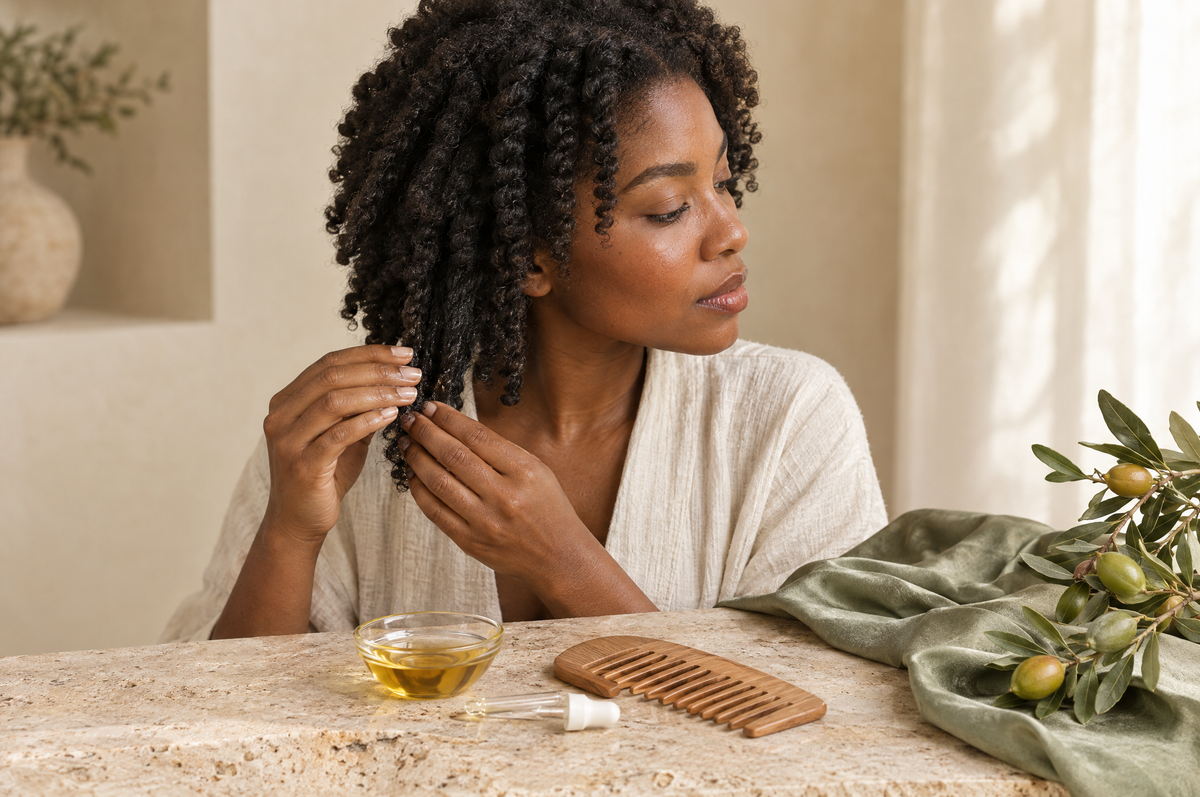
Argan oil works well on natural hair, including 4C, as a sealing oil: a few drops pressed over a water-based leave-in to help hold softness in and add shine. It is lighter and easier to spread than castor oil or most butters, which many people with tightly coiled hair like for daily use. It will not moisturize on its own, though, and the evidence for argan oil on hair is still thin. Here is how to use it well.
The short answer
Yes, argan oil is a good sealing oil for natural and 4C hair. Apply a water-based leave-in to damp sections first, then press in two to four drops of argan oil per section, then your cream if you use one. Use it on dry ends between washes, and keep scalp oiling light to avoid buildup.
Why natural and 4C hair gets dry so easily
Dryness and breakage are the most common hair concerns among people with Afro-textured hair, according to a 2026 review written for dermatologists.1 The reasons are mostly structural.
The shape of the strand
Afro-textured hair has an elliptical, flattened cross-section and twists along its length, and its diameter varies along the strand, with narrower points at each twist.2 Tightly curled fibers intertwine, which makes them more prone to tangles and knots.1 Each bend and narrow point is a spot where the hair can break under combing or tension.
The cuticle and water content
A dermatology review notes that African hair tends to have fewer cuticle layers than Asian or Caucasian hair and a lower water content.2 The cuticle is the hair's protective outer layer, so a thinner one leaves the inner hair less shielded from everyday wear.
Scalp oil doesn't travel down coils
Sebum, your scalp's natural oil, spreads poorly along curly fibers, and the same review notes that sebaceous glands in people of African descent often produce relatively low amounts.2 On straight hair, scalp oil slides down to the ends. On coily hair, it barely leaves the root, so the lengths and ends rarely get any.
One important nuance: Afro-textured hair is often described as inherently fragile, but research cited in the 2026 review attributes much of its apparent fragility to mechanical trauma, such as combing, tension and styling, rather than to the hair itself.1 That is good news, because handling is something you can change.
What argan oil can do for natural hair
Argan oil mainly coats the outside of the hair. For coily hair, that film helps in three ways:
- Sealing. In a lab study, oil-coated hair absorbed less water vapor than uncoated hair, because the oil film slowed moisture moving in and out of the strand.3 That is the logic behind using oil after a water-based leave-in: the water softens, the oil slows its exchange with the air.
- Slip. A little oil helps fingers and combs move through coils, which means less pulling during detangling.
- Shine and softness. Coily hair scatters light, so it can look matte. A light film of oil gives it more sheen and a softer feel.
Being honest about the evidence
A 2022 systematic review of coconut, castor and argan oil for hair in skin of color patients found the strongest clinical support for coconut oil, weaker evidence for castor oil, and no significant supporting evidence for argan oil.4 That does not mean argan oil does nothing. It means its benefits for hair are cosmetic and have not been tested in good clinical studies. Choose it because you like how it feels and performs on your hair, not because of promises about growth or repair.
LOC method with argan oil
The LOC method (liquid, oil, cream) and its variation LCO (liquid, cream, oil) are popular routines in the natural hair community for layering moisture and sealing it in. They have not been studied in clinical research, so there is no evidence that one order is better. Many people find that one simply works better for their hair than the other.
- Start with clean, damp hair. Work in sections, four to eight depending on density.
- Liquid. Apply a water-based leave-in conditioner to each section, from root to tip.
- Oil. Warm two to four drops of argan oil in your palms and smooth them over the section, focusing on the ends.
- Cream. Finish with your curl cream, butter or styler and twist, braid or style as usual.
- LCO variation. If your hair feels greasy or your styles lose definition, put the cream on before the oil and use the oil as the final seal.
Our routine for argan oil for curly hair covers LOC and LCO for looser curl patterns, and our guide on how to use argan oil for hair covers masks and other methods.
How much argan oil for type 4 hair?
| Use | Amount | When |
|---|---|---|
| Sealing on wash day (LOC/LCO) | 2–4 drops per section | After a water-based leave-in |
| Refreshing dry ends | 1–2 drops per side | Between washes, on lightly misted ends |
| Pre-wash oil treatment | Enough to coat lengths and ends | About twice a month, 30 minutes or more before washing |
| Scalp | 3–5 drops total | Before wash day, massaged in with fingertips |
The pre-wash suggestion follows the American Academy of Dermatology (AAD), which recommends a hot oil treatment about twice a month for Black hair to add moisture and flexibility.5
Argan oil for the scalp: what to know
Scalp oiling is a long tradition in many families, and plenty of people with natural hair love it. A few things are worth keeping in mind.
- Wash often enough. The 2026 review notes that washing only every month or two is common, partly from the belief that frequent shampooing causes dryness, but that infrequent washing is linked with a higher risk of seborrheic dermatitis. Recent studies suggest weekly washing with suitable products helps reduce buildup.1 The AAD suggests shampooing once a week or every other week and conditioning every time, focusing on the ends.5
- Keep it light between washes. Heavy daily oiling on an unwashed scalp adds to buildup. A small amount massaged in before wash day, then shampooed out, is easier on the scalp.
- Mind your hairline. Oils and pomades can seep onto the skin and cause small bumps and whiteheads along the hairline, forehead or back of the neck, a type of acne the AAD calls acne cosmetica.6 Keep oil off the edges if you are prone to it, and wash pillowcases and scarves regularly.6
For a closer look at flaking and itch, see our guide to argan oil for scalp dryness and dandruff, including when oil helps and when it is better to see a dermatologist.
Shrinkage, frizz and breakage: small habits that help
- Detangle on damp, conditioned hair. Use your fingers or a wide-tooth comb, starting at the ends. A drop of argan oil on a stubborn section adds slip.
- Protect at night. The 2026 review describes sleeping on silk scarves or pillowcases as beneficial.1
- Use protective styles, loosely. Twists, braids and similar styles reduce friction between strands and help hold moisture, but styles that pull too tightly are linked to traction hair loss.1 The AAD advises asking a stylist to redo braids or cornrows that hurt.5
- Go easy on heat. Heat temporarily disrupts the hair's hydrogen bonds and, over time, can loosen the curl pattern.1 If you press or blow out your hair, use a heat protectant on damp hair and the lowest effective temperature.5 Argan oil is a finisher afterward, not a heat protectant.
If frizz and rough, puffy ends are your main concern, our guide to argan oil for frizzy hair and dry, damaged ends has more ideas.
Choosing an argan oil for natural hair
Natural hair routines already involve several products, so it helps when each one is simple. Look for an oil whose only ingredient is Argania spinosa kernel oil, without added fragrance or silicones, so you know exactly what you are layering. Our argan oil is a single ingredient: USDA-certified organic, cold-pressed argan kernel oil from Morocco, with no fragrance, chemicals or dyes, in a glass bottle with a dropper so you can measure drops per section.
Water softens coils. Oil helps them keep it.
Frequently asked questions
Is argan oil good for 4C hair?
It can be a good sealing oil for 4C hair. It is fluid, spreads easily and adds softness and shine on top of a water-based leave-in. It does not add moisture on its own, so use it after a leave-in or water, not instead of one.
Should I put argan oil on my scalp if I have natural hair?
A few drops massaged into a dry scalp before wash day is fine for many people. Avoid heavy daily oiling between washes, which can build up, and keep oil away from your hairline if you are prone to breakouts. See a dermatologist for flaking, itching or redness that does not settle.
How do I use argan oil in the LOC method?
Apply a water-based leave-in (liquid) to damp sections, then a few drops of argan oil (oil), then your curl cream or butter (cream). In the LCO order, the oil goes last. Neither order has been studied directly, so try both and see which keeps your hair softer longer.
How often should I use argan oil on type 4 hair?
Most people use it on wash day as part of their sealing routine and then a drop or two on dry ends between washes. A pre-wash oil treatment about twice a month suits many people with very dry hair.
Is argan oil better than castor or coconut oil for natural hair?
Not better, just different. A 2022 review found the most clinical support for coconut oil, weaker evidence for castor oil and no significant evidence for argan oil. Argan's advantage is feel: it is lighter and easier to spread, which many people prefer for sealing.
This article is for general information and isn't medical advice. If you have persistent scalp itching, flaking, redness, bumps along the hairline or noticeable hair thinning, see a board-certified dermatologist.
Sources
- Humphrey JG, Harding MJ, Cartwright KM, Thomas LE, Luke J. Afro-textured hair care: a narrative review and recommendations for dermatologists. Int J Womens Dermatol. 2026;12(1):e246. Link
- Gavazzoni Dias MFR. Hair cosmetics: an overview. Int J Trichology. 2015;7(1):2–15. Link
- Keis K, Huemmer CL, Kamath YK. Effect of oil films on moisture vapor absorption on human hair. J Cosmet Sci. 2007;58(2):135–145. Link
- Phong C, Lee V, Yale K, Sung C, Mesinkovska N. Coconut, castor, and argan oil for hair in skin of color patients: a systematic review. J Drugs Dermatol. 2022;21(7):751–757. Link
- American Academy of Dermatology. Black hair: tips for everyday care. Link
- American Academy of Dermatology. Your hair products may be triggering breakouts. Link