What Is Amlou? Morocco's Argan, Almond and Honey Spread
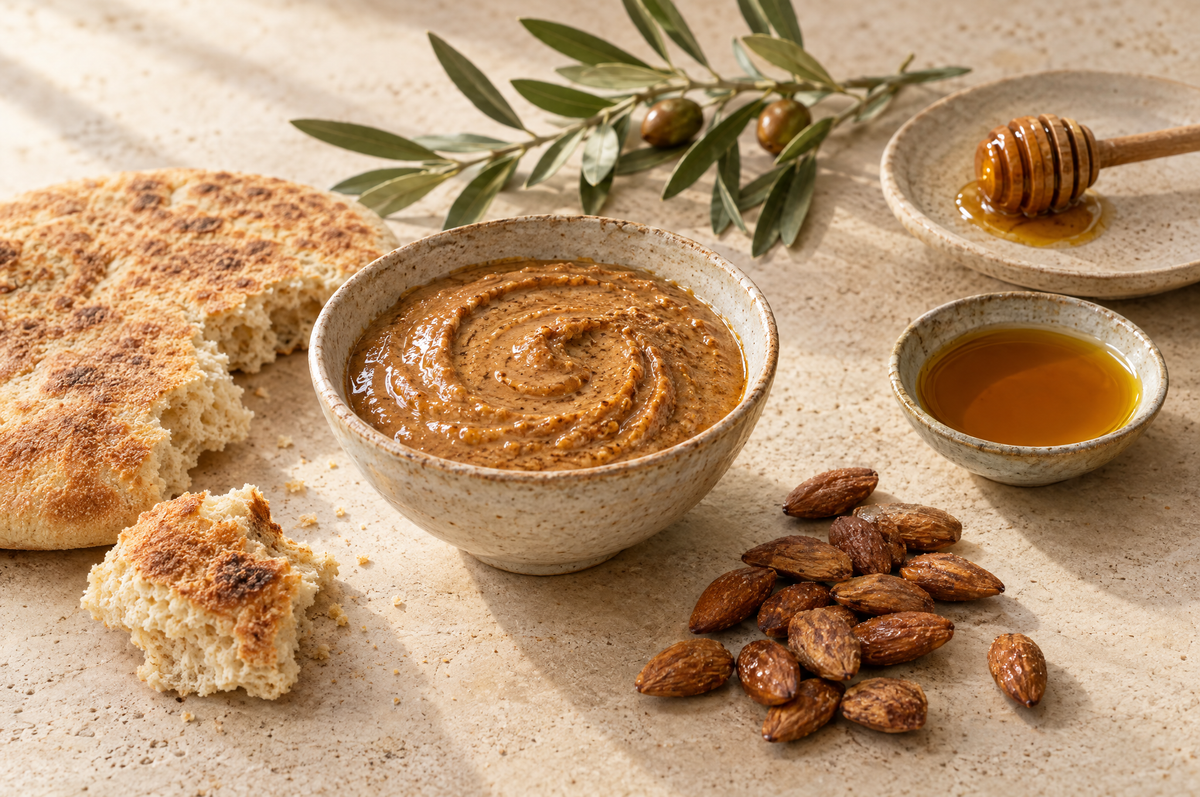
Amlou is a Moroccan spread made from three ingredients: roasted almonds, roasted (culinary) argan oil and honey, ground together into a loose, nutty paste. It comes from the Souss region in southwestern Morocco, where it's eaten with warm bread at breakfast and set out for guests. Think of a runny almond butter with a deep, toasted flavor and a gentle sweetness.
The short answer
Amlou is a traditional Moroccan spread from the Souss region made by grinding roasted almonds with culinary argan oil and honey. It has a pourable, nut-butter texture and a toasty, hazelnut-like flavor, and is usually eaten with warm bread or pancakes at breakfast. It needs roasted, food-grade argan oil, not cosmetic oil.
What is amlou?
Researchers describe amlou as a traditional culinary specialty of the Souss region and one of Morocco's most prized local products, made from argan oil, roasted sweet almonds and honey.1 A 2024 survey of 450 people in the Western Anti-Atlas found that every one of them used argan in food, and identified amlou as the main dish made with argan oil.2
Amlou belongs to a much older food culture around the argan tree. UNESCO's listing of argan know-how as intangible cultural heritage notes that the oil is used for cooking as well as medicine and cosmetics, that the skills are passed down largely from women to their daughters, and that argan oil is given as a wedding gift and used in festive dishes.4 For the bigger picture of where the oil comes from, see the tree, the region and the people behind it.
How amlou is traditionally made and eaten
The traditional method is simple. The almonds are roasted, then crushed with a stone hand mill and blended with argan oil and honey until smooth.2 The argan oil itself is the roasted, culinary kind: its kernels are briefly toasted before pressing, which gives the oil a copper color and the hazelnut-like flavor that defines amlou.3 Roasting the kernels at around 125 to 150 °C develops that flavor; above roughly 100 °C, browning reactions start to darken the oil.5
In the Anti-Atlas survey, people described eating amlou daily with warm bread, spreading it on baghrir (spongy Moroccan pancakes), and serving it at gatherings and celebrations.2 Argan oil on its own is also eaten raw there, almost daily, at breakfast or as a snack.2
Ratios vary from home to home
There's no single official recipe. The ethnobotanical survey recorded a typical serving made with equal weights of argan oil and almonds and a smaller amount of honey (45 g, 45 g and 10 g).2 Food scientists who prepared amlou for a 2024 study used more almonds and less oil: about 76 to 80 percent almonds, 16 to 20 percent argan oil and 4 percent honey.1 More oil gives a pourable spread; less gives something closer to nut butter.
Amlou recipe
This is a straightforward home version in the traditional style, using a food processor in place of a stone mill. It sits between the two ratios above and makes about 1 cup.
Ingredients
- 1 cup (about 150 g) whole almonds, skin on or blanched
- 1/3 to 1/2 cup (80 to 120 mL) culinary roasted argan oil, sold as food
- 2 to 3 tablespoons mild honey, to taste
- A small pinch of fine salt (optional)
Method
- Roast the almonds. Spread them on a baking sheet and roast at 325 °F (160 °C) for 10 to 15 minutes, stirring once, until fragrant and lightly golden inside. Let them cool completely.
- Grind. Process the almonds in a food processor, scraping down the sides, until they form a fine, damp meal and then start to turn pasty. This can take several minutes.
- Add the oil. With the motor running, drizzle in the argan oil slowly until the mixture loosens into a thick, glossy paste.
- Sweeten. Add the honey and salt and process briefly. Taste and adjust: more oil for a pourable spread, more honey for sweetness.
- Rest. Spoon into a clean glass jar. The flavor rounds out after a few hours.
Store the jar sealed in a cool, dark place or the fridge, and stir before serving, since the oil naturally separates. Because it's made without preservatives, make small batches and eat them within a few weeks.
How to serve it
- Spread on warm flatbread, toast or baghrir.
- Drizzle over yogurt, oatmeal or sliced fruit.
- Serve in a small bowl alongside olive oil and honey as part of a Moroccan-style breakfast.
Two cautions: amlou is made from tree nuts, so it's not suitable for anyone with a nut allergy, and because it contains honey, don't give it to babies under 1 year old.6
Three ingredients, ground together slowly, and nothing else. That is the whole idea of amlou.
Amlou and argan oil: which oil to use
This is the most important practical point. Amlou is made with culinary argan oil, pressed from roasted kernels. Cosmetic argan oil is pressed from unroasted kernels and is made for skin and hair.3 The two look similar in the bottle but they aren't interchangeable; our guide to culinary vs. cosmetic argan oil explains the differences in color, flavor and labeling.
Our oil is a cosmetic oil. It's cold-pressed from unroasted kernels and packaged and labeled for skin, hair and nails, not as a food, so please don't use it in amlou or any other recipe. When you shop for argan oil for the kitchen, look for:
- Food labeling. It should be sold as a food, with a best-before date.
- A roasted, nutty aroma and a copper or amber color.3
- A single ingredient. The same principle that applies to 100% pure argan oil for skin applies here: argan oil should be the only thing in the bottle.
Certifications help too. A USDA organic argan oil label tells you how the oil was produced, though not whether it was roasted for food, so check that it's sold as a culinary oil.
Watch for altered amlou
If you buy amlou ready-made, read the label. Researchers note that altered versions are sold in Moroccan markets, including amlou made with peanuts instead of almonds, and versions made with sunflower or soybean oil in place of argan oil.1 Real amlou lists almonds, argan oil and honey, and little else.
Is amlou healthy?
Amlou is a rich food. A figure cited in the 2024 study puts it at about 690 calories per 100 grams, most of it from fat,1 and the survey's analysis came out at a similar 703 calories per 100 grams.2 Its fat comes from almonds and argan oil, which are largely unsaturated, and it's traditionally eaten in small amounts with bread. There are no clinical studies on amlou itself, so think of it as what it is: a delicious, traditional spread to enjoy in modest portions, not a health food with proven benefits.
More ways to enjoy argan
Amlou is the best-known food made from argan oil, but culinary argan oil is also drizzled over couscous, salads and tagines. For cosmetic oil, there are dozens of ways to use argan oil on skin, hair and nails, and our organic cosmetic argan oil is made for exactly those.
Frequently asked questions
What does amlou taste like?
Amlou tastes toasty and nutty, a little like a runny almond butter with a hazelnut note from the roasted argan oil, and gently sweet from the honey.
What is amlou made of?
Traditional amlou has three ingredients: roasted almonds, culinary argan oil pressed from roasted kernels, and honey. Some recipes add a pinch of salt.
Can I make amlou with cosmetic argan oil?
No. Use culinary argan oil sold as food. Cosmetic argan oil is pressed from unroasted kernels and labeled for skin and hair, not for eating.
How do you eat amlou?
In Morocco it is usually spread on warm bread or baghrir pancakes at breakfast or served to guests. It also works drizzled over yogurt, oatmeal or fruit.
Sources
- Ait Bouzid H, Ait Nouisse A, Hallouch O, et al. Amlou inspired spread: formulation and characterization of new spread based on Ziziphus lotus L. fruit, argan oil, and honey. Heliyon. 2024;10(14):e34002. Link
- Barkaoui M, Msanda F, Boubaker H, et al. Ethnobotany, traditional knowledge, and nutritional value of argan (Argania spinosa (L.) Skeels) in Western Anti-Atlas of Morocco. Braz J Biol. 2024;84:e260477. Link
- Gharby S, Charrouf Z. Argan oil: chemical composition, extraction process, and quality control. Front Nutr. 2022;8:804587. Link
- UNESCO Intangible Cultural Heritage. Argan, practices and know-how concerning the argan tree. Inscribed 2014 on the Representative List. Link
- Belcadi-Haloui R, Zekhnini A, El-Alem Y, Hatimi A. Effects of roasting temperature and time on the chemical composition of argan oil. Int J Food Sci. 2018;2018:7683041. Link
- Centers for Disease Control and Prevention. Botulism: prevention. Link