Should You Use Argan Oil in the Morning or at Night?
You can use argan oil morning or night, and many people use it at both. If you only use it once a day, night is the better fit: you can apply a slightly richer layer, it won't interfere with makeup or sunscreen, and your skin tends to lose more water in the evening. In the morning, keep it to a drop or two, let it absorb, and finish with sunscreen.
The short answer
Argan oil works morning or night. At night, use 2–3 drops as the last step for a richer layer while you sleep. In the morning, use 1–2 drops, let it absorb for a few minutes, then apply sunscreen on top, because argan oil is not a sunscreen. For hair, use it before styling or overnight.
When to use argan oil: the case for night
There are a few practical and biological reasons why evening suits a facial oil well.
Your skin loses more water later in the day
Skin follows daily rhythms. A review of skin biology notes that transepidermal water loss (the water that evaporates through your skin) is significantly higher in the afternoon and evening than in the morning, suggesting the barrier is less efficient late in the day.1 Plant oils help mainly by forming a light occlusive layer that slows that water loss.2 Applying oil in the evening puts it in place when it has the most to do.
Nobody sees the shine
At night you can use a little more without worrying about a glossy finish, makeup slipping or hair looking flat by lunchtime.
It's how the research was done
The best-known clinical study of topical argan oil had postmenopausal women apply it to the forearm every night for 60 days, and found improvements in skin elasticity measurements.3 That doesn't prove nighttime is better than morning, since the trial didn't compare the two, but nightly use is the routine with some evidence behind it.
Argan oil in the morning: yes, with sunscreen on top
There's no reason to skip argan oil in the morning if your skin likes it, particularly in dry or cold weather. A few rules keep it working with the rest of your routine:
- Use less. One or two drops, pressed in, rather than the two or three you might use at night.
- Give it a few minutes. Let the oil settle while you do something else, so the next layer doesn't slide.
- Finish with sunscreen. Argan oil is not a sunscreen. The American Academy of Dermatology recommends a broad-spectrum SPF 30 or higher, at least a teaspoon for the face, applied about 15 minutes before going outside and reapplied every two hours outdoors.4
Does a facial oil under sunscreen weaken it? Specific research on oils is lacking. The closest study we found tested moisturizing creams applied shortly before or after sunscreen in 25 volunteers and found no significant change in sunscreen effectiveness.5 Oils weren't tested, so the cautious approach is the one above: a thin layer, absorbed first, with a full amount of sunscreen on top.
Oily skin? Mornings are optional
Facial sebum output tends to be lowest at night and to peak in the early afternoon.1 If your skin gets shiny by midday, skip argan oil in the morning and use one or two drops at night instead. Our guide to argan oil for oily skin goes further.
Argan oil AM vs PM at a glance
| Morning (AM) | Night (PM) | |
|---|---|---|
| Amount for face | 1–2 drops | 2–3 drops |
| Where in the routine | After moisturizer, before sunscreen | Last step, over moisturizer or serum |
| Wait before next step | A few minutes before sunscreen and makeup | None needed |
| Best for | Dry skin, cold or windy weather, flyaways | All skin types, especially dry or mature skin |
| Hair | 1 drop on dry ends to smooth frizz | A light overnight coat on ends, or a pre-wash mask |
Argan oil night routine, step by step
- Cleanse and pat skin almost dry.
- Apply any active serum or prescription product as directed. If you use retinoids, see argan oil with retinol for how to layer the two.
- Moisturize if you use a cream. On slightly damp skin, products spread more easily, and the AAD recommends moisturizing while skin is still damp.7
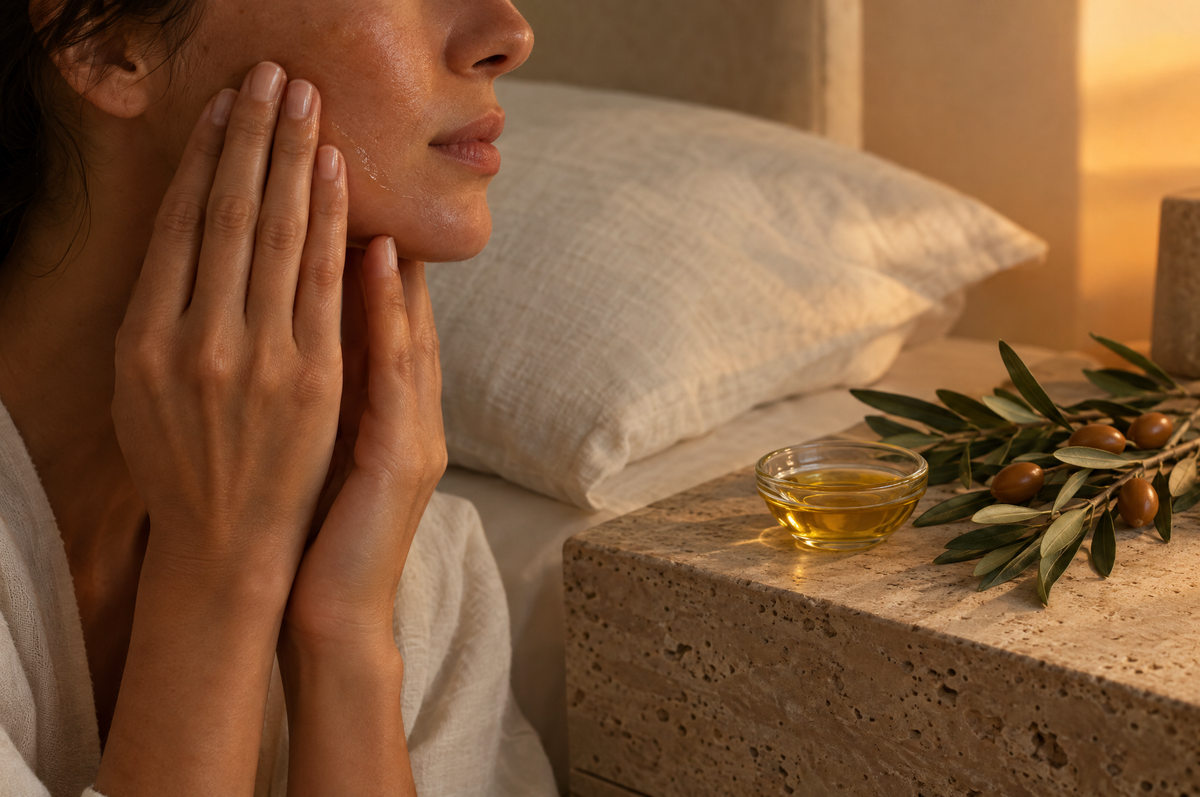
- Finish with argan oil. Warm 2 to 3 drops between your palms and press them over your face and neck.
- Use the leftovers on cuticles or the ends of your hair.
Whether you use argan oil as a moisturizer on its own or layer it over a cream depends on how dry your skin is; that guide explains both approaches. For the full daily routine, see our guide to argan oil for face care.
When to use argan oil on hair
Timing matters more for hair than for skin, because it depends on what you're trying to do. Oils smooth hair by lubricating the shaft and reducing friction, and some oils can reduce how much water hair takes up, which limits repeated swelling and drying.6 The same review notes that a thick film of oil leaves hair looking oily and heavy,6 which is the main reason to think about when you apply it.
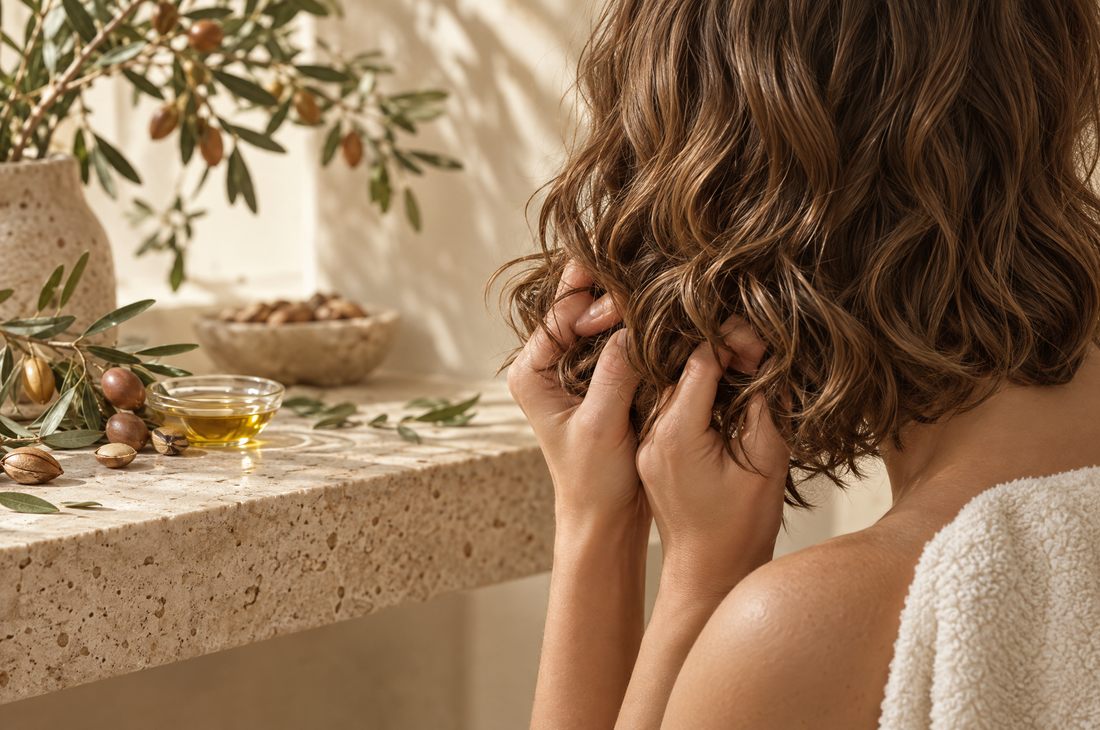
- Morning, before styling: 1 drop on dry ends to tame frizz and flyaways, or a little into damp hair before blow-drying.
- Night, as an overnight mask: coat the lengths lightly, braid or loosely tie hair, protect your pillowcase, and shampoo in the morning.
- Before washing: apply to lengths 30 minutes or more before shampoo for a softer finish without leaving residue.
For step-by-step methods, see how to use argan oil for hair.
Can you use argan oil twice a day?
Yes. There's nothing about argan oil that makes once a day the limit, and many people with dry skin use it morning and night. The point to watch isn't frequency but amount: two thin layers a day feel better than one heavy one. If your skin starts to feel congested or looks shiny for hours, cut back to nights only, or drop to a single drop in the morning. Our article on whether it's okay to use argan oil every day covers long-term daily use in more detail, including when to take a break and what to watch for if you're new to facial oils.
Routines by skin type
Dry or mature skin
Use it twice a day: 2 to 3 drops at night over moisturizer, and 1 to 2 drops in the morning before sunscreen.
Normal or combination skin
Night is usually enough. Add a morning drop on dry patches in winter.
Oily or acne-prone skin
Try 1 to 2 drops at night only, and watch how your skin responds over a few weeks before adding more.
Sensitive skin
Start at night, a few times a week, after a patch test. Plain, fragrance-free oil is a gentler choice than scented blends.
If you only use it once a day, make it at night. If you use it in the morning, sunscreen goes on last.
Our organic cold-pressed argan oil is a single ingredient with no fragrance, so the same bottle works for both routines and for hair.
Frequently asked questions
Is it better to use argan oil in the morning or at night?
Both work. If you only use it once a day, night is easier: you can use a little more, it won't affect makeup or sunscreen, and skin tends to lose more water in the evening.
Can I use argan oil in the morning under makeup?
Yes. Use just 1 to 2 drops, let it absorb for a few minutes, then apply sunscreen and makeup. Too much oil can make makeup slide.
Does argan oil have SPF?
Argan oil is not a sunscreen and has no tested SPF, so don't rely on it for sun protection. Use a broad-spectrum SPF 30 or higher as the last step of your morning routine.
Can I leave argan oil on my face overnight?
Yes. Leaving 2 to 3 drops on overnight as the last step of your routine is the most common way to use it, and nightly application is how it was used in clinical research.
Sources
- Matsui MS, Pelle E, Dong K, Pernodet N. Biological rhythms in the skin. Int J Mol Sci. 2016;17(6):801. Link
- Lin TK, Zhong L, Santiago JL. Anti-inflammatory and skin barrier repair effects of topical application of some plant oils. Int J Mol Sci. 2017;19(1):70. Link
- Boucetta KQ, Charrouf Z, Aguenaou H, Derouiche A, Bensouda Y. The effect of dietary and/or cosmetic argan oil on postmenopausal skin elasticity. Clin Interv Aging. 2015;10:339–349. Link
- American Academy of Dermatology. How to apply sunscreen. Link
- Gálvez MVD, Aguilera J, Leal M, Sánchez-Roldán C, Herrera-Ceballos E. Sunscreens effectiveness are not altered by concomitant use of moisturizing creams: an ultraviolet reflectance photography study. Photodermatol Photoimmunol Photomed. 2021. doi:10.1111/phpp.12745. Link
- Gavazzoni Dias MF. Hair cosmetics: an overview. Int J Trichology. 2015;7(1):2–15. Link
- American Academy of Dermatology. Dermatologists' top tips for relieving dry skin. Link