Can You Use Argan Oil With Niacinamide?
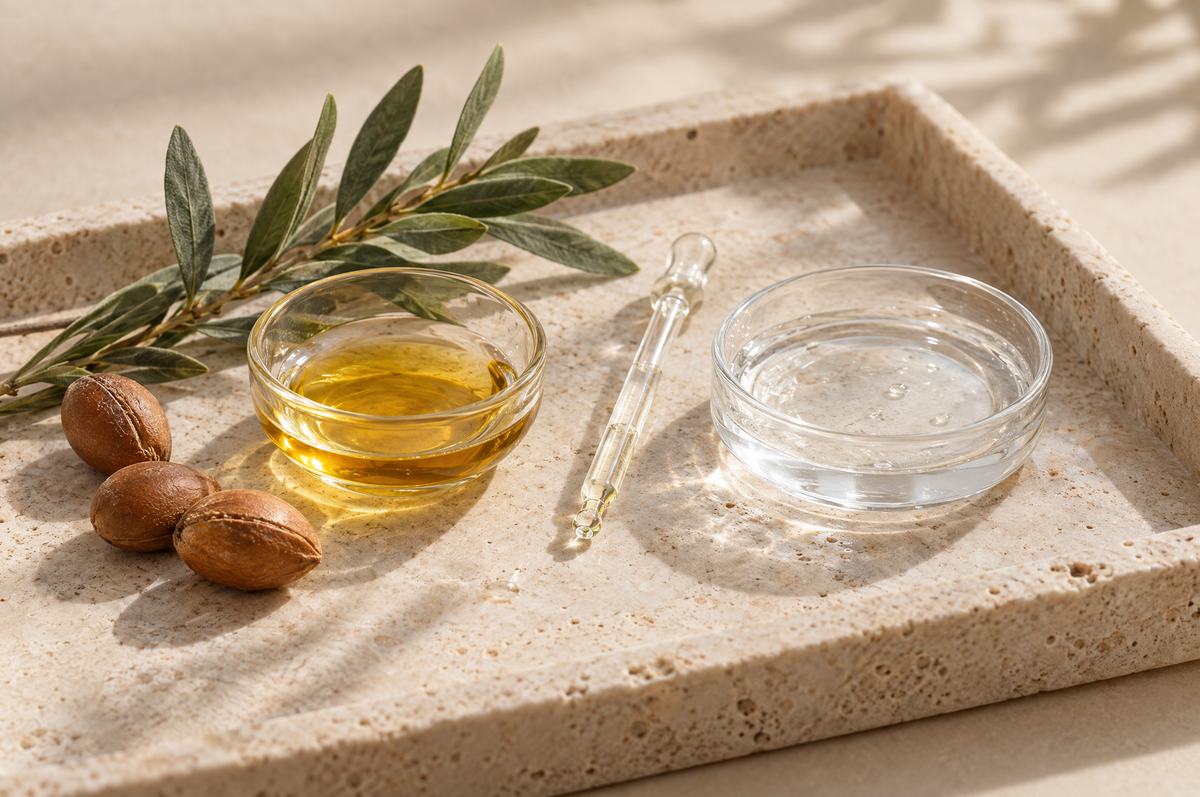
Yes, you can use argan oil and niacinamide together, and they make a sensible pair. Niacinamide is a water-based serum ingredient, so it goes on first; argan oil goes on last to soften skin and hold moisture in. There's no known clash between them, and the order is the same morning and night.
The short answer
Yes, argan oil and niacinamide can be used together. Apply your niacinamide serum to clean skin first, let it absorb for a minute, then press in one to three drops of argan oil. Niacinamide supports the skin barrier and may reduce oiliness; argan oil adds softness and helps limit water loss.
What niacinamide actually does
Niacinamide (also called nicotinamide) is a form of vitamin B3. It's popular because it's gentle and does several useful things at once, and some of those claims have reasonable evidence behind them.
Barrier support
In a study published in the British Journal of Dermatology, nicotinamide increased the production of ceramides and other barrier lipids in cultured skin cells, and when applied to dry skin it raised ceramide and free fatty acid levels in the outer layer and reduced water loss through the skin1. Ceramides are part of the "mortar" that keeps the skin barrier intact, which is why niacinamide is often described as barrier-supporting.
Oil control
A placebo-controlled study of 2 percent niacinamide in 100 Japanese participants found a significantly lower sebum excretion rate after two and four weeks. In a separate six-week study of 30 Caucasian participants, casual sebum levels fell, but the sebum excretion rate did not change significantly2. In other words, there's a signal for oil control, but results weren't consistent across groups.
Uneven tone
A 2021 review of niacinamide summarizes several small clinical trials in which 4 to 5 percent niacinamide reduced the appearance of hyperpigmented spots over eight weeks, with effects that faded after people stopped using it3. The same review describes niacinamide as well tolerated at the concentrations normally used, under 5 percent3.
| Niacinamide serum | Argan oil | |
|---|---|---|
| What it is | Vitamin B3, usually in a water-based serum | A plant oil: fatty acids, vitamin E, sterols, squalene4 |
| Main job | Barrier lipids, oil control, tone1,2,3 | Softening; helps skin hold water5 |
| Where it goes | Early, on clean skin | Last (before sunscreen in the morning) |
| Best for | Most skin types, including oily | Dry, normal and combination skin; sparingly on oily skin |
Can you use argan oil with niacinamide?
Yes. They don't compete for the same job. Niacinamide helps the skin make more of its own barrier lipids1, while argan oil adds lipids to the surface. In a 60-day study, argan oil applied to the forearm reduced transepidermal water loss and increased the skin's water content5, and a review of plant oils describes how the linoleic acid in oils like argan has a direct role in maintaining the skin's water barrier6. Used together, you get a water-light active underneath and a thin, comfortable seal on top.
Niacinamide then argan oil: the right order
Follow the usual layering rule: water-based products first, oils last. Niacinamide is almost always sold as a water-based serum, so it goes before the oil.
- Cleanse and pat skin dry, or leave it very slightly damp if your serum's directions allow.
- Apply niacinamide. A few drops or one pump over the face.
- Wait a minute until it has absorbed and no longer feels wet.
- Moisturizer, if you use one. Cream goes on before the oil.
- Press in one to three drops of argan oil. Warm them between your fingertips and press gently over your face.
- Morning only: finish with a broad-spectrum sunscreen.
If you're unsure whether you need a cream at all, our guide to using argan oil as a moisturizer walks through when oil alone is enough and when to layer. For a single, fragrance-free oil to finish this routine, our 100% organic argan oil is cold-pressed with nothing added.
Niacinamide and face oil by skin type
Oily skin
Niacinamide is a good fit here, given the sebum research2. Use one drop of argan oil, or keep the oil for the evening only. Oily skin can still be dehydrated, and a little oil often feels better than a heavy cream. Our article on argan oil for oily skin explains why.
Dry skin
Use two or three drops of argan oil after niacinamide, morning and night. If your skin still feels tight, add a simple moisturizer between the two.
Combination skin
Apply niacinamide all over, then press oil mainly onto the drier areas, such as the cheeks, and go lighter on the T-zone.
Breakout-prone skin
Start with one drop every other evening and watch for new bumps over two to four weeks. If you've been wondering does argan oil clog pores, our separate article looks at that question in detail.
Serum underneath to do the work, a few drops of oil on top to keep it comfortable.
Myths about niacinamide worth clearing up
"Niacinamide will make my face flush"
Facial flushing is a well-known effect of nicotinic acid (niacin), a different form of vitamin B3. The 2021 review notes that, unlike nicotinic acid, nicotinamide does not cause flushing, and that in one study a 10 percent topical application caused no stinging or flushing3. If your skin does turn red or sting after a new serum, stop using it and patch test before trying again.
"You can't use niacinamide with vitamin C"
This advice is everywhere, but we couldn't find a clinical study showing that using the two in the same routine causes a problem. The 2021 review even describes clinical formulas that combine niacinamide with a vitamin C derivative3. If you use both, the simplest approach is still the layering rule: apply them as separate serums, thinnest first, and finish with argan oil.
"Oil blocks niacinamide from working"
There's no direct research on this. If oil goes on after the serum has absorbed, it's unlikely to get in the way. Putting oil underneath a water-based serum is the arrangement to avoid.
How long before you notice a difference?
Give any new routine a few weeks before judging it. In the sebum study, oiliness was already lower at the two-week check in one group, while the other group was followed for six weeks2. The pigmentation trials summarized in the 2021 review measured results at four and eight weeks, and the improvements faded after people stopped using niacinamide3, which suggests consistency matters more than strength. Argan oil works on a more immediate level: skin should feel softer and less tight straight away, while the hydration changes in the argan oil study were measured over 30 and 60 days of daily use5.
A sensible plan is to introduce niacinamide first, use it on its own for a week or two, then add argan oil. If something doesn't agree with your skin, you'll know which product to blame.
A note on patch testing
Whether it's a new serum or a new oil, try one thing at a time. The AAD suggests applying a new product to a small area, such as the inside of the elbow, twice a day for seven to 10 days and stopping if redness, itching or swelling appears7. For daily routines built around a single oil, see our guide to argan oil for face care.
Frequently asked questions
Do I apply niacinamide or argan oil first?
Niacinamide first. It's usually a water-based serum, so it goes on clean skin before any oil. Let it absorb for a minute, then press in a few drops of argan oil.
Can I use niacinamide and argan oil every day?
Most people can use both daily, morning and night. If you notice irritation or new breakouts, cut back and patch test each product separately.
Is argan oil good for oily skin with niacinamide?
It can be, in small amounts. Niacinamide may help with oiliness, and one drop of argan oil, or oil only at night, can keep skin comfortable without feeling heavy.
Does niacinamide cause flushing?
Niacinamide is not known to cause the flushing linked to nicotinic acid (niacin), a different form of vitamin B3. Any persistent redness or stinging is a reason to stop and check with a dermatologist.
Sources
- Tanno O, Ota Y, Kitamura N, Katsube T, Inoue S. Nicotinamide increases biosynthesis of ceramides as well as other stratum corneum lipids to improve the epidermal permeability barrier. Br J Dermatol. 2000;143(3):524–531. Link
- Draelos ZD, Matsubara A, Smiles K. The effect of 2% niacinamide on facial sebum production. J Cosmet Laser Ther. 2006;8(2):96–101. Link
- Boo YC. Mechanistic basis and clinical evidence for the applications of nicotinamide (niacinamide) to control skin aging and pigmentation. Antioxidants (Basel). 2021;10(8):1315. Link
- Serrafi A, Chegdani F, Bennis F, Kepinska M. The importance of argan oil in medicine and cosmetology. Nutrients. 2024;16(20):3573. Link
- Boucetta KQ, Charrouf Z, Derouiche A, Rahali Y, Bensouda Y. Skin hydration in postmenopausal women: argan oil benefit with oral and/or topical use. Prz Menopauzalny. 2014;13(5):280–288. Link
- Lin TK, Zhong L, Santiago JL. Anti-inflammatory and skin barrier repair effects of topical application of some plant oils. Int J Mol Sci. 2017;19(1):70. Link
- American Academy of Dermatology. How to test skin care products. Link