Argan Oil and Hyaluronic Acid: The Humectant-Plus-Oil Routine
Argan oil and hyaluronic acid are one of the simplest, most logical pairings in skin care. Hyaluronic acid goes on first, onto damp skin, to draw water into the surface; argan oil goes on last to soften and help hold that water in. One attracts moisture, the other slows its escape, and each covers a gap the other leaves.
The short answer
Yes, use them together, in this order: apply hyaluronic acid serum to damp skin, then press two or three drops of argan oil on top once the serum has settled. Hyaluronic acid is a humectant that draws water in; argan oil is an emollient that softens skin and helps slow water loss.
Humectant, emollient, occlusive: the three jobs of a moisturizer
Most moisturizers combine three kinds of ingredients, and understanding them explains why this pairing works.
- Humectants attract water. A review of moisturizers in the Indian Journal of Dermatology describes them as hygroscopic compounds that pull water into the outer skin, from the deeper layers and, in humid conditions, from the air1.
- Emollients are mainly lipids and oils that make skin softer, smoother and more flexible1.
- Occlusives form a water-repellent film over the skin that slows water loss1.
Hyaluronic acid is a humectant. Argan oil is an emollient with some occlusive effect: a review of plant oils notes that oils can form a protective layer that helps skin retain moisture and lowers transepidermal water loss2.
| Hyaluronic acid serum | Argan oil | |
|---|---|---|
| Type | Humectant (water-attracting) | Emollient with some occlusive effect2 |
| Texture | Watery gel or serum | Light, dry-finishing oil |
| Main job | Draws water into the skin's surface | Softens and helps slow water loss |
| Where it goes | Early, on damp skin | Last (before sunscreen in the morning) |
| Weak spot alone | Water it draws in can evaporate1 | Adds no water of its own |
Why hyaluronic acid needs a partner
Hyaluronic acid is the skin's own key moisture molecule, with what a review in Dermato-Endocrinology calls a unique capacity to bind and retain water3. In a 60-day study of 76 women, creams containing 0.1 percent hyaluronic acid in several molecular weights all improved skin hydration and elasticity compared with a placebo, and the lower-weight versions also reduced wrinkle depth around the eyes4. So topical hyaluronic acid has some reasonable evidence behind it, though the effects are modest, and the same review notes that hyaluronic acid introduced from outside is cleared and broken down quickly in the deeper skin3.
The catch is that humectants can work against you on their own. The moisturizer review describes them as "a double-edged weapon": water drawn into the surface can still be lost to the air, increasing water loss, which is why humectants are usually combined with an occlusive1. That's the role argan oil plays here.
The dry-climate caveat
Because humectants only pull water from the air in humid conditions1, a hyaluronic acid serum in a dry, heated or air-conditioned room has less to draw on and relies more on water from inside your skin. This is a well-reasoned concern rather than something that has been measured in a head-to-head study, but it points to a simple fix: apply the serum to damp skin and seal it promptly with oil or cream. The AAD's advice for dry skin also includes running a humidifier, particularly in the bedroom overnight5.
Hyaluronic acid then argan oil: the routine
- Cleanse with a gentle, fragrance-free cleanser.
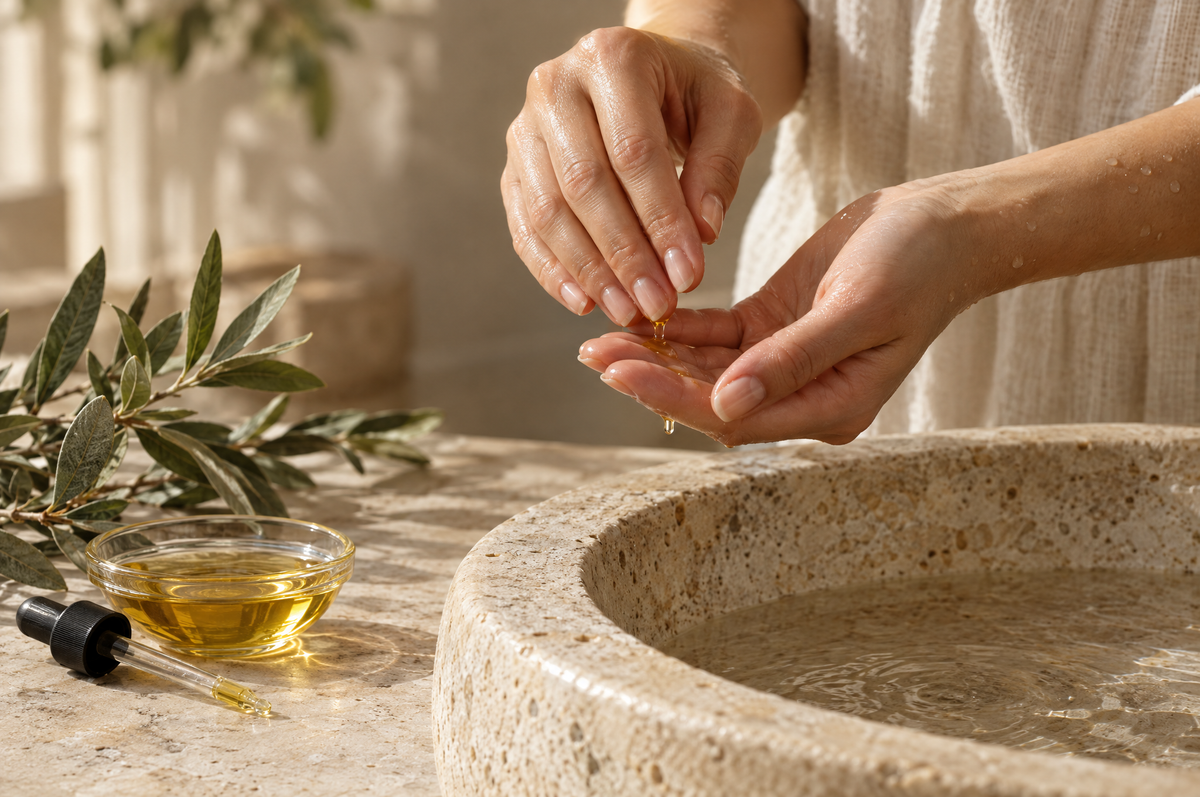
- Leave your skin damp. Pat lightly so it's moist but not dripping. The AAD recommends applying moisturizer while skin is still damp after washing5.
- Apply hyaluronic acid. A few drops or a pump spread over the face and neck.
- Wait 30 to 60 seconds until it feels settled but still slightly dewy.
- Moisturizer, if you use one. For very dry skin, a cream between serum and oil adds another layer.
- Press in two or three drops of argan oil. Warm them in your fingertips and press gently over the face. The moisturizer review notes that occlusive oils work best on moist skin1.
- Morning: follow with sunscreen once the oil has settled.
For the full layering logic, including when to skip the cream, see our guide to using argan oil as a moisturizer. If you want a single-ingredient oil for the final step, our 100% organic argan oil is cold-pressed, unscented and has nothing added.
Water first, then something to keep it there.
What argan oil adds
Argan oil's own evidence fits this job well. In a 60-day study of postmenopausal women, argan oil applied to the forearm reduced transepidermal water loss and increased the skin's water content6. Not every plant oil behaves the same way: the plant-oil review points out that olive oil was found to increase water loss when applied to adult forearms, and that linoleic acid has a direct role in maintaining the skin's water barrier2. Linoleic acid makes up roughly 29 to 36 percent of argan oil7. For more on using it when tightness and flaking are the main problem, see our guide to argan oil for dry skin.
Can I mix hyaluronic acid with argan oil?
You can, but layering usually works better. Hyaluronic acid serums are water-based and argan oil is, of course, oil, so mixing them in your palm gives a temporary blend at best. Nothing in either ingredient is known to clash, so if mixing a drop of oil into your serum suits your routine, it's unlikely to cause harm. What you lose is the sequence: serum on damp skin first, oil sealed on top. We couldn't find any study comparing mixing with layering, so this comes down to the general logic of humectants and occlusives described above.
Morning or night?
Both. In the morning, the pairing gives skin a comfortable base for sunscreen and makeup; keep the oil to one or two drops so the sunscreen goes on smoothly, and give it a few minutes to settle first. At night you can be more generous, since there's nothing going on top. If you use a retinoid or an exfoliating acid in the evening, hyaluronic acid and argan oil are gentle partners for those routines too, applied after the active ingredient has absorbed.
How quickly you'll notice a difference depends on what you're looking for. Skin usually feels softer and less tight straight away, but the measurable changes in the studies above were tracked over weeks: 30 and 60 days in the argan oil study6, and 30 and 60 days in the hyaluronic acid cream study4.
Adapting the routine
Dry or mature skin
Use the full sequence morning and night, with a cream between serum and oil if your skin still feels tight by midday.
Oily or combination skin
Hyaluronic acid on its own is light enough for most oily skin. Use one drop of argan oil, or press it only onto drier areas.
Body
The same principle works below the neck: apply oil to damp skin straight after bathing. Our guide to argan oil as an after-shower body oil explains how.
Tips and cautions
- Don't overdo the serum. A few drops is plenty. More humectant without a seal on top can leave skin feeling tight.
- Keep showers short and warm, not hot. The AAD recommends five to 10 minutes and patting skin dry5.
- Patch test anything new. The AAD suggests applying a new product to a small area twice a day for seven to 10 days before using it on your face8.
- Persistent dryness that doesn't improve with a good routine is worth showing to a dermatologist.
For a simple daily routine built around oil, our guide to argan oil for face care is a good place to start.
Frequently asked questions
Do I put hyaluronic acid or argan oil on first?
Hyaluronic acid first, on damp skin. Let it settle for under a minute, then press in a few drops of argan oil to help hold the water in.
Can hyaluronic acid dry out your skin?
On its own, a humectant can let water evaporate from the skin's surface, especially in dry air. Applying it to damp skin and sealing it with an oil or cream reduces that risk.
Is argan oil a humectant or an occlusive?
Neither, strictly. Argan oil is an emollient that softens skin, with some occlusive effect that helps slow water loss. It does not attract water the way hyaluronic acid does.
Can I use hyaluronic acid and argan oil twice a day?
Yes. Both are generally gentle enough for morning and evening use. In the morning, finish with sunscreen.
Sources
- Sethi A, Kaur T, Malhotra SK, Gambhir ML. Moisturizers: the slippery road. Indian J Dermatol. 2016;61(3):279–287. Link
- Lin TK, Zhong L, Santiago JL. Anti-inflammatory and skin barrier repair effects of topical application of some plant oils. Int J Mol Sci. 2017;19(1):70. Link
- Papakonstantinou E, Roth M, Karakiulakis G. Hyaluronic acid: a key molecule in skin aging. Dermatoendocrinol. 2012;4(3):253–258. Link
- Pavicic T, Gauglitz GG, Lersch P, et al. Efficacy of cream-based novel formulations of hyaluronic acid of different molecular weights in anti-wrinkle treatment. J Drugs Dermatol. 2011;10(9):990–1000. Link
- American Academy of Dermatology. Dermatologists' top tips for relieving dry skin. Link
- Boucetta KQ, Charrouf Z, Derouiche A, Rahali Y, Bensouda Y. Skin hydration in postmenopausal women: argan oil benefit with oral and/or topical use. Prz Menopauzalny. 2014;13(5):280–288. Link
- Serrafi A, Chegdani F, Bennis F, Kepinska M. The importance of argan oil in medicine and cosmetology. Nutrients. 2024;16(20):3573. Link
- American Academy of Dermatology. How to test skin care products. Link