Argan Oil for Thick and Coarse Hair: How Much and When
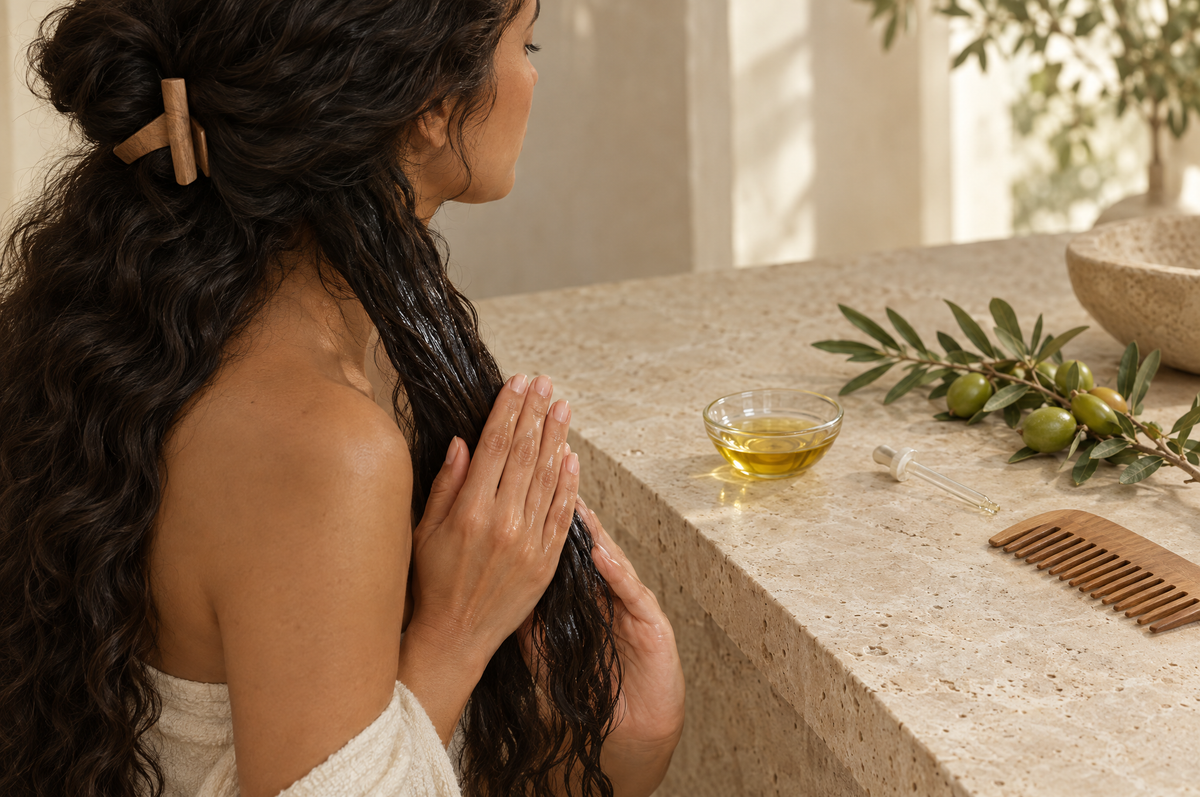
Argan oil is a good match for thick and coarse hair, and this is the one hair type where you can be a little more generous with it. Most thick hair needs three to eight drops, applied to damp hair in sections so the oil reaches the middle layers instead of sitting on top. Used that way, it softens coarse texture, tames frizz and adds shine without the heaviness many people expect.
The short answer
Yes, argan oil works well on thick and coarse hair. Use three to four drops for shoulder-length hair and five to eight for long or very coarse hair. Apply to damp hair in sections, from mid-lengths to ends, then add one or two drops to dry hair for frizz and shine.
Thick vs. coarse hair: why the difference matters
The two words get used interchangeably, but they describe different things:
- Thick hair usually means density: lots of strands on your head. The challenge is coverage, getting product to the hair underneath, not just the outer layer.
- Coarse hair means each strand has a wide diameter. Coarse strands feel firmer and often drier, and they can carry more product before looking weighed down.
Plenty of people have both. Either way, the general rule from dermatologists is the same: thick hair needs more product, and fine hair needs less.1 Product makers work this way too. A review of silicones in hair care notes that hair with larger strand diameters is formulated with considerably higher silicone concentrations, around 3–5% versus 0.5% for finer hair.2 The same logic applies to oil: wider strands, and more of them, simply have more surface to cover.
A dermatology review of hair cosmetics also notes that coarser hair tends to be less prone to clumping and limpness than fine straight hair.3 That is why the one-drop advice you will read for fine hair does not apply here.
What argan oil does for thick, coarse hair
Argan oil works mainly by forming a thin film on the outside of the hair. For thick and coarse hair, that film helps in a few ways:
- Softness. Coarse hair often feels rough. A light coat of oil makes it feel smoother and more pliable.
- Frizz control. In a lab study, oil-coated hair absorbed less water vapor from humid air than uncoated hair, because the oil film slowed moisture moving into the strand.4 Thick hair has a lot of surface for humidity to work on, so this is often the most noticeable benefit.
- Shine. Coarse hair can look matte. A film of oil gives a more even surface to reflect light.
- Easier detangling. Oil adds slip, which helps a comb move through dense hair.
It is worth being clear about the evidence. A 2022 systematic review of coconut, castor and argan oil for hair found no significant clinical evidence supporting argan oil.5 In the lab, a conditioner containing 1% argan oil, applied after an oxidative blonde dye, reduced protein loss compared with dyed hair left untreated or given the base conditioner alone.6 That is encouraging, but it is a single lab study on one hair type, not proof of what will happen on your head. The benefits above are cosmetic, and you will see them quickly or not at all.
How to use argan oil on thick hair, step by step
This is a wash-day routine built for thick, coarse hair. For the full range of methods, see our guide on how to use argan oil for hair.

- Shampoo the scalp, condition the lengths. The American Academy of Dermatology (AAD) suggests concentrating shampoo on the scalp and letting suds rinse through the ends, and using conditioner after every wash.7
- Blot, don't rub. Wrap your hair in a towel to absorb water instead of rubbing it.7 You want it damp, not dripping.
- Section your hair. Divide it into four to six sections with clips. This is the step most people skip, and it is the difference between oil on the outer layer and oil throughout.
- Oil each section. Put one drop per section in your palm, rub your hands together, and smooth it from mid-length to the ends. Keep it off the scalp.
- Detangle. Work through each section with a wide-tooth comb or your fingers, starting at the ends. The AAD notes that textured or curly hair can be combed while damp with a wide-tooth comb, while straighter hair is better left to dry partly first.7
- Style and dry. Air-dry or diffuse as usual, using a heat protectant if you use heat.
- Finish dry. Once dry, warm one or two drops and press them over the surface and ends to calm frizz.
How many drops for thick hair?
| Hair | On damp hair | On dry hair |
|---|---|---|
| Thick, shoulder-length | 3–4 drops | 1–2 drops |
| Thick, long | 5–6 drops | 2 drops |
| Very coarse or very dense, long | 6–8 drops | 2–3 drops |
These are starting points, not rules. If your hair looks greasy the next day, cut back by a drop or two. If your ends still feel rough once dry, add one.
Sealing the ends
The ends are the oldest, most weathered part of any long hair, and on coarse hair they are usually the driest. Sealing means finishing with a little oil concentrated on the last few inches, after any water-based leave-in, so the oil film sits on top. Think of it as a final layer rather than the main moisturizer: oil does not add water to hair, but it can slow the exchange of moisture with the air.4
LOC and LCO, briefly
If your thick hair is also curly or very dry, you may come across the LOC method (liquid, oil, cream) or its cousin LCO (liquid, cream, oil). Both layer a water-based leave-in, an oil and a cream in a set order. These methods come from natural hair communities and have not been studied directly, so there is no research saying one order is better. Argan oil works well as the oil step in either, and our routine for argan oil for curly hair covers both methods in more depth. Try both orders for a week or two each and see which keeps your hair softer for longer.
Argan oil for thick, frizzy hair
Thick hair that frizzes needs coverage more than quantity. Frizz often starts in the underneath layers and at the hairline, where people rarely apply product. Section, apply to damp hair, and then smooth a final drop across the surface once dry. On very humid days, a drop worked into the outer layer before you go out helps. Our dedicated guide to argan oil for frizzy hair and dry, damaged ends goes further.
The pre-wash option: an argan oil hair mask
Coarse hair often responds well to a weekly oil treatment before washing. Work 8 to 15 drops through dry lengths, focusing on the ends, cover with a shower cap and leave it for 30 minutes or longer, then shampoo and condition. Our guide to the argan oil hair mask covers timing, add-ins and how to wash it out cleanly.
What is the best oil for coarse hair?
There is no single winner. Different oils suit different jobs:
- Coconut oil has the strongest lab evidence for use before washing. In an often-cited study, it was the only oil tested that reduced protein loss from both undamaged and damaged hair, which a later review attributes to its small, straight-chain molecules penetrating the hair shaft.3 Some people find it stiff or heavy as a leave-in.
- Argan oil is a fluid oil that spreads easily, which makes it a good leave-in and finishing oil for shine, softness and frizz.
- Castor oil is very thick. In one case report, sudden matting of a patient's whole head of long hair after an oil wash was attributed to castor oil's high viscosity.8 That is rare, but it is a reason to dilute it and use it with care on long, dense hair.
Many people with coarse hair use two oils: one as a pre-wash treatment and argan oil as the daily finisher.
If you go with argan oil, look for a pure one, so you know exactly what you are putting on your hair. Our argan oil is a single ingredient: USDA-certified organic, cold-pressed argan kernel oil from Morocco, with no added fragrance, chemicals or dyes, in a 60 mL glass bottle with a dropper.
For thick hair, where the oil goes matters more than how much you use.
Frequently asked questions
How much argan oil should I use on thick hair?
Start with three to four drops for shoulder-length thick hair and five to eight for long or very coarse hair, applied to damp hair in sections. Adjust from there. Thick, coarse hair usually takes more oil than fine hair before it looks greasy.
Is argan oil good for coarse hair?
Yes, for softness, shine and frizz control. Coarse strands are wider and can carry more oil without looking weighed down. Argan oil works mainly as a surface film, so it suits leave-in and finishing use; for a pre-wash treatment, some people prefer coconut oil.
What is the best oil for coarse hair?
It depends on the job. Coconut oil has the most lab evidence for reducing protein loss when used before washing, while argan oil is a lighter, fluid finishing oil for shine and frizz. Very thick oils like castor can be hard to spread through long hair.
Should I put argan oil on wet or dry thick hair?
Damp hair is best for thick hair. Water helps the oil spread through dense sections, so you get even coverage with less product. Use a drop or two on dry hair afterward to smooth flyaways and frizz.
Can I use argan oil with the LOC method?
Yes. In the LOC (liquid, oil, cream) or LCO order, argan oil can be the oil step. These methods are popular in natural hair communities but have not been studied directly, so experiment to see which order your hair prefers.
Sources
- American Academy of Dermatology. Dermatologists' top tips for using leave-in conditioner. Link
- Bains P, Kaur S. Silicone in dermatology: an update. J Cutan Aesthet Surg. 2023;16(1):14–20. Link
- Gavazzoni Dias MFR. Hair cosmetics: an overview. Int J Trichology. 2015;7(1):2–15. Link
- Keis K, Huemmer CL, Kamath YK. Effect of oil films on moisture vapor absorption on human hair. J Cosmet Sci. 2007;58(2):135–145. Link
- Phong C, Lee V, Yale K, Sung C, Mesinkovska N. Coconut, castor, and argan oil for hair in skin of color patients: a systematic review. J Drugs Dermatol. 2022;21(7):751–757. Link
- Faria PM, Camargo LN, Carvalho RSH, Paludetti LA, Velasco MVR, da Gama RM. Hair protective effect of argan oil (Argania spinosa kernel oil) and cupuassu butter (Theobroma grandiflorum seed butter) post treatment with hair dye. J Cosmet Dermatol Sci Appl. 2013;3:40–44. Link
- American Academy of Dermatology. 10 hair care habits that can damage your hair. Link
- Maduri VR, Vedachalam A, Kiruthika S. "Castor oil" – the culprit of acute hair felting. Int J Trichology. 2017;9(3):116–118. Link