Argan Oil for Sensitive Skin: Is It Gentle Enough?
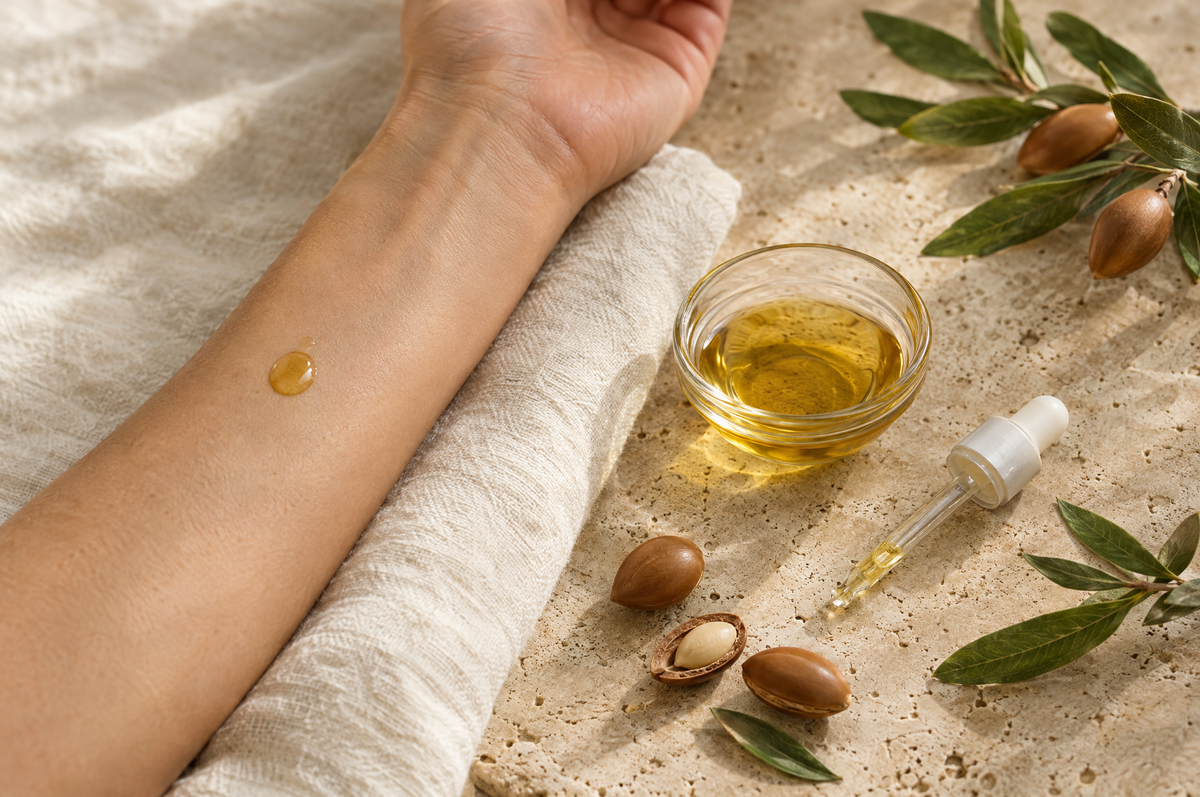
For most people with sensitive skin, pure argan oil is a gentle choice. A single-ingredient, fragrance-free argan oil leaves out the most common irritants found in face oils, and allergy to argan oil itself appears to be rare. Rare isn't never, though, so patch test first, and choose an oil that is fresh and has nothing added.
The short answer
Yes, argan oil is usually well tolerated by sensitive skin, provided it is pure, fresh and fragrance-free. In a large patch-testing series, only 3 of 1,859 patients reacted to it. Patch test on your inner arm for 7 to 10 days, start with one or two drops, and stop if you notice stinging, redness or itching.
What "sensitive skin" really means
Sensitive skin isn't a single diagnosis. Dermatologists describe it as skin that stings, burns, itches or feels tight in response to things that shouldn't normally bother it, such as cosmetics, temperature changes or wind. It is very common: surveys suggest that roughly half to 60% of women and 30 to 40% of men consider their skin sensitive.1
Researchers link sensitive skin to a weaker skin barrier, with higher water loss through the skin, along with nerve endings that react more readily.1 That has two practical implications for choosing a face oil. First, a product that supports the barrier can help. Second, every extra ingredient is another possible trigger, so fewer is better. Dermatologists also warn that switching products frequently can itself make sensitive skin worse.1
Is argan oil good for sensitive skin?
Argan oil has several qualities that suit reactive skin, and one or two cautions worth knowing.
Why it tends to be gentle
- It can be a single ingredient. Pure argan oil is mostly triglycerides, the basic structure of plant oils, with less than 1% made up of minor compounds such as terpenes, phenols and sterols.2
- It needs no added fragrance. Fresh cosmetic argan oil has a faint, nutty scent of its own. Nothing needs to be added to make it pleasant to use.
- It has a balanced fatty acid profile. Argan oil contains roughly 43 to 49% oleic acid and 29 to 37% linoleic acid.5 Linoleic acid plays a direct role in keeping the skin's water barrier intact.6
- Reactions appear to be uncommon. More on the numbers below.
The cautions
Not every natural oil is kind to sensitive skin. Oleic acid, in high concentrations, can loosen the skin barrier.6 In one study of adult volunteers, four weeks of olive oil, which is mostly oleic acid, reduced the integrity of the outer skin layer and caused mild redness, while sunflower seed oil did not.7 Argan oil sits between the two, with substantial amounts of both fatty acids, and it hasn't been tested head-to-head in sensitive skin. That's a good reason to start slowly rather than a reason to avoid it. For a broader look at the evidence, see our review of argan oil for skin.
How common is argan oil allergy?
The best recent data comes from a 2026 study at a specialist patch-testing referral clinic. Over four years, 1,859 patients were patch tested with pure argan oil as part of a standard panel. Three of them reacted.2 These were patients already referred for suspected skin allergies, so the rate in the general population is likely to be lower still. The same study found that people allergic to fragrance did not react to argan oil more often than anyone else.2
Published case reports exist, and they're worth taking seriously. Several describe allergic contact dermatitis, an itchy, red rash where the oil was applied.2 A 2021 report described a woman with multiple food allergies, including peanuts, tree nuts, peach and mustard, who had two severe allergic reactions (anaphylaxis) after applying argan-oil products to her scalp and arm. Testing showed that proteins from the argan fruit were still present in the oil. At the time, the authors noted only one previous anaphylaxis case and two contact dermatitis cases in the medical literature.3
The takeaway: argan oil allergy is rare, but if you have several food allergies, a nut allergy or a history of anaphylaxis, talk with your allergist before trying it. We cover allergy signs and nut concerns in more depth in can argan oil irritate skin.
What actually makes face oils irritating
When people react to a face oil, the oil itself is often not the problem. The usual suspects are:
Added fragrance and essential oils
Essential oils such as lavender, tea tree and jasmine contain known fragrance allergens.2 They're common in blended face oils, sometimes labeled only as botanical extracts. The American Academy of Dermatology advises choosing products labeled "fragrance free" rather than "unscented," since unscented products and some plant-based ingredients may still contain fragrance-related compounds.4
Oxidation
Oils that contain unsaturated fatty acids slowly oxidize when exposed to air, light and heat. Oxidation creates peroxides and other breakdown products, and the first sign is usually a rancid or stale smell.5 In stability studies, cosmetic argan oil kept well for about a year when protected from light at room temperature.5 An old or poorly stored bottle is more likely to irritate than a fresh one. Our guide to whether argan oil expires explains how to store it and when to replace it.
Adulteration
Some products sold as argan oil are blends with cheaper oils or contain added fragrance and preservatives. Read the ingredient list: it should say only Argania spinosa kernel oil.
Applying it to compromised skin
Oil applied straight after a strong exfoliant, a retinoid you're still adjusting to, or onto broken skin can sting. That's the skin's state, not necessarily the oil.
How to patch test argan oil
Dermatologists recommend testing any new product before putting it on your face, and that goes double for sensitive skin. The American Academy of Dermatology suggests:4
- Apply a small amount, about the size of a quarter, to the underside of your arm or the bend of your elbow, where it won't be rubbed or washed off.
- Do this twice a day for 7 to 10 days.
- Watch for redness, itching, bumps or swelling.
- If you react, gently wash the oil off and stop using it. A cool compress can soothe the area. If the reaction is severe or doesn't settle, see a dermatologist.
- If there's no reaction, try one or two drops on a small area of your face, such as along the jaw, for a few days before using it all over.
If you keep reacting to products and can't work out why, a dermatologist can arrange formal patch testing to identify the culprit.14
How to use argan oil on sensitive skin
- Start low. One or two drops, once a day, usually at night.
- Introduce it on its own. Don't start a new serum or cleanser in the same week, so you can tell what's causing any reaction.
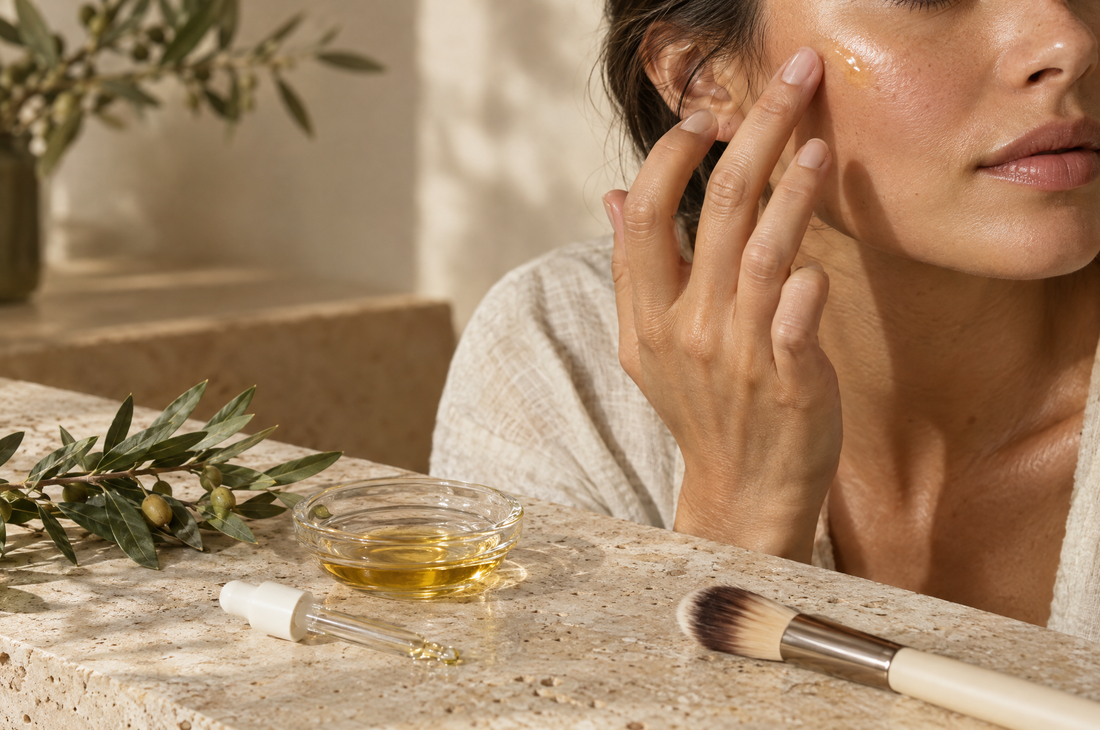
- Press, don't rub. Warm the oil between your fingertips and press it into slightly damp skin.
- Keep the rest of your routine simple. A gentle cleanser, a fragrance-free moisturizer and sunscreen are enough for most sensitive skin.
- Increase slowly. After two weeks without trouble, you can use it morning and night.
Our step-by-step guide to argan oil for face care covers where it fits in a routine. If breakouts are part of your sensitivity, read does argan oil clog pores before you start.
When to see a dermatologist
Sensitivity can sometimes be a sign of an underlying skin condition such as rosacea, eczema or contact dermatitis. See a board-certified dermatologist if your skin reacts to almost everything, if redness or flushing is persistent, or if a rash spreads beyond where you applied a product.
Choosing a fragrance-free face oil
For sensitive skin, look for three things: a single ingredient, no fragrance or essential oils, and packaging that protects the oil from light. Our 100% organic argan oil is USDA-certified organic, cold-pressed from unroasted kernels, and contains nothing but argan oil: no fragrance, dyes or additives. It comes in a glass bottle with a dropper so you can use exactly one drop to start, and it's covered by a 30-day money-back guarantee, even if opened.
Frequently asked questions
Is argan oil hypoallergenic?
No oil can promise that, but reactions to argan oil appear to be uncommon. In one large patch-testing series, 3 of 1,859 patients reacted to pure argan oil, and published allergy cases are few.
Can I use argan oil if I'm allergic to fragrance?
Pure argan oil contains no added fragrance, and a 2026 patch-testing study found no meaningful cross-reaction between fragrance allergy and argan oil. Choose a single-ingredient oil and still patch test first.
Is argan oil safe if I have a nut allergy?
Argan comes from the kernel of a fruit seed, but rare severe reactions have been reported in people with several food allergies, including nuts. If you have a nut allergy or a history of anaphylaxis, ask your allergist before using it.
Why does my face sting after applying argan oil?
Possible causes include an oil that has gone rancid, added essential oils, applying it over freshly exfoliated or broken skin, or a genuine sensitivity. Wash it off, stop using it, and see a dermatologist if the reaction is strong or lasts.
Sources
- Kim HO, Um JY, Kim HB, Lee SY, Choi H, Kim J, Ko E, Chung BY, Park CW. Comprehensive approaches to diagnosis and treatment of sensitive skin. Ann Dermatol. 2025;37(4):173-182. Link
- Karels S, Weber B, Hylwa S, Ophaug S, Lee K, Neeley A. To avoid or not to avoid: cross-reactivity between fragrance and common botanicals. Contact Dermatitis. 2026;94(5):488-493. Link
- de las Marinas Alvarez MD, Martorell Calatayud C, Castillo Fernandez M, et al. Anaphylaxis after cutaneous application of argan oil. J Investig Allergol Clin Immunol. 2021;31(4):332-334. Link
- American Academy of Dermatology. How to test skin care products. Link
- Gharby S, Charrouf Z. Argan oil: chemical composition, extraction process, and quality control. Front Nutr. 2022;8:804587. Link
- Lin TK, Zhong L, Santiago JL. Anti-inflammatory and skin barrier repair effects of topical application of some plant oils. Int J Mol Sci. 2017;19(1):70. Link
- Danby SG, AlEnezi T, Sultan A, et al. Effect of olive and sunflower seed oil on the adult skin barrier: implications for neonatal skin care. Pediatr Dermatol. 2013;30(1):42-50. Link
This article is for general information and isn't medical advice. If you have a skin condition, a known allergy (especially to nuts or foods), or a history of severe allergic reactions, check with your doctor, allergist or dermatologist before trying something new.