Argan Oil for Glowing Skin: Realistic Ways to Get the Glow
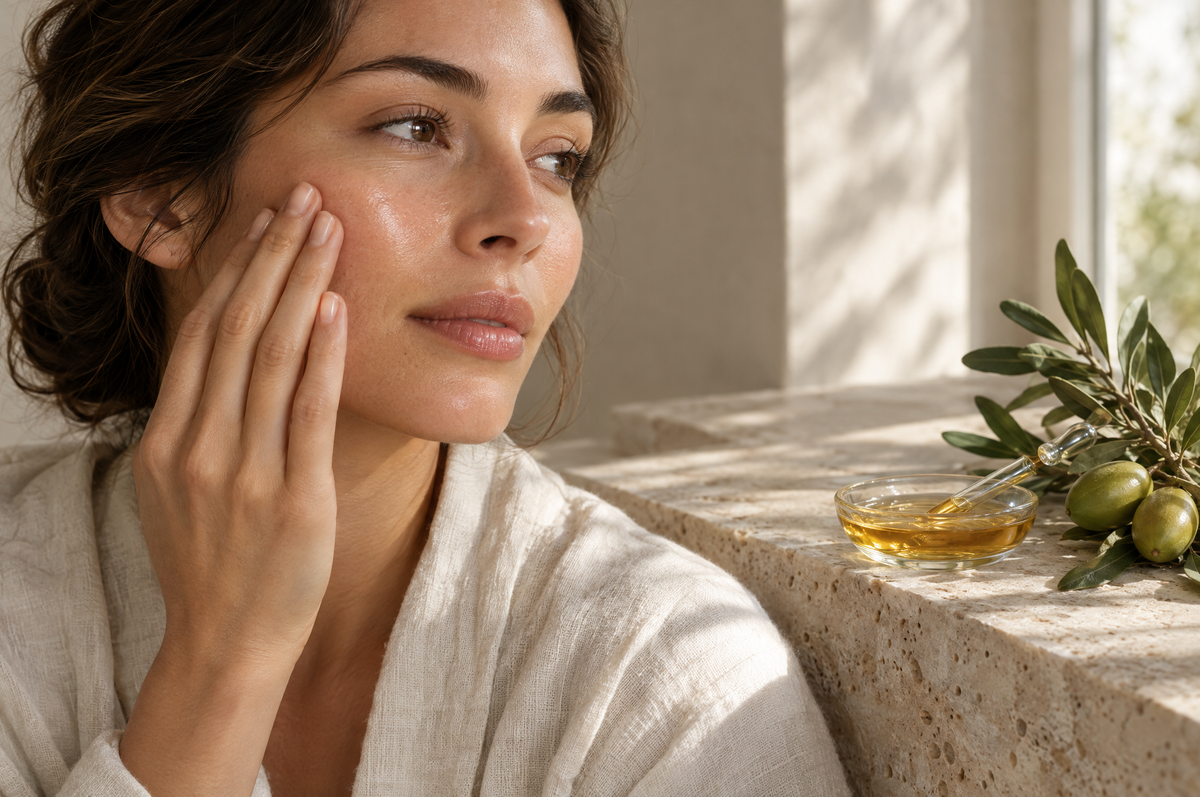
Argan oil can help your skin look more glowing, mostly in a simple, physical way: it softens and smooths the surface and helps skin hold on to water, and smooth, well-hydrated skin reflects light more evenly. It won't change your skin tone, and it can't stand in for sunscreen or sleep. Used as two or three drops on damp skin, it is one small, pleasant part of a glow routine.
The short answer
Argan oil can make skin look more radiant by smoothing the surface and slowing water loss, so light reflects more evenly. In a small study, nightly argan oil improved skin hydration over 60 days. It does not change skin tone. Daily sunscreen, enough sleep and gentle cleansing matter more for long-term glow.
What "glowing skin" actually is
Glow isn't a medical term, and nobody measures it the same way. When people describe glowing skin, they usually mean a mix of things: a soft sheen rather than flat dullness, a smooth texture, skin that looks comfortable and hydrated rather than tight, and an even-looking surface. Almost all of that comes down to how light meets the top layer of your skin.
Dry, flaky skin has a rough surface. Light hitting it scatters in many directions, which reads to the eye as dull or ashy. Well-hydrated skin has a smoother surface, so light behaves differently. In a small laboratory study, researchers dried skin out with acetone and alcohol, then rehydrated it with moisturizers and occlusives. When skin was dehydrated, light scattering at the surface went up; when it was moisturized, scattering went down and the skin became more translucent.1 That is the plain science behind the "dewy" look.
Notice what is missing from that list: color. Glow is about texture and moisture, not about making skin lighter or a different shade. Any product promising to change your natural skin tone is selling something else.
How argan oil contributes to an argan oil glow
It smooths the surface right away
Oils are emollients. A thin layer settles into the tiny gaps between dry flakes at the surface, so skin feels softer and looks smoother within minutes. This is the immediate, optical part of an argan oil glow, and it is the part most people notice first. Two or three drops leave a soft sheen; ten drops leave a greasy shine, which is not the same thing.
It helps skin hold on to water
The longer-lasting effect is about water loss. A review of topical plant oils describes how they can form a protective layer on the skin that helps retain moisture and lowers transepidermal water loss, the steady evaporation of water through the skin.2 Argan oil has been tested directly in one small human study: 60 postmenopausal women applied argan oil to one forearm every night for 60 days, and that skin showed lower water loss and higher water content by the end.3
Be realistic about what that study shows. It was small, it tested forearms rather than faces, and all participants were also eating either argan or olive oil every day, so the effect of the topical oil can't be fully separated from diet. It supports the idea that argan oil helps skin stay hydrated; it doesn't prove a dramatic change in how your face looks.
What's in it
Argan oil is mostly oleic acid (around 43 to 49 percent) and linoleic acid (around 29 to 37 percent), with natural tocopherols, the vitamin E family, mainly in the gamma form.4 Linoleic acid is the fatty acid most associated with a healthy skin barrier in the research literature.2 You will often read that argan's vitamin E "gives you a glow." No trial has shown that, so read it as marketing rather than evidence. For a fuller, honest look at the research, see our guide to argan oil for skin.
What argan oil won't do for your glow
- It won't change your skin tone. Argan oil is not a brightening or tone-altering product, and we don't make that claim. If uneven patches are your concern, our article on whether argan oil helps dark spots explains what the evidence does and doesn't support.
- It doesn't protect against the sun. Argan oil has no meaningful SPF. Use a real sunscreen.
- It can't replace exfoliation for a buildup of dead skin. Oil softens flakes; it doesn't remove them.
- More oil is not more glow. Past a few drops, skin looks oily rather than luminous, and makeup slides.
How to get glowing skin naturally: the habits that matter most
If you want a face oil for radiant skin to actually show results, give it a good foundation. Three habits have better evidence behind them than any oil.
Daily sunscreen
Sun damage is the main thing that makes skin look rough, uneven and older over time. In a randomized trial of 903 adults in Australia followed for about four and a half years, the group told to use sunscreen every day showed no detectable increase in skin aging, and their skin aged about 24 percent less than the group that used sunscreen when they chose to.5 The American Academy of Dermatology recommends a broad-spectrum, water-resistant sunscreen with SPF 30 or higher.6
Sleep
"Beauty sleep" has a real study behind it. Researchers photographed 23 adults after a normal night's sleep and again after sleep deprivation, then asked 65 people to rate the photos without knowing which was which. Sleep-deprived faces were rated as less healthy, more tired and slightly less attractive.7 It was a small study, but it matches what most of us see in the mirror.
Gentle cleansing and moisturizing
Harsh cleansers and long, hot showers strip the skin's own oils and leave it tight and dull. The AAD recommends short showers in warm rather than hot water, fragrance-free products, and moisturizing while skin is still damp.6 That last step is exactly where argan oil fits.
Glow is mostly texture and moisture. Oil helps with both; sunscreen and sleep protect them.
How to use argan oil for glowing skin
The method below works for most skin types. For a full face routine, see our step-by-step guide to argan oil for face care.
- Cleanse gently. Use a mild cleanser and lukewarm water, then pat your face with a towel so it is damp, not dripping.
- Apply your water-based products first. Serums and moisturizers go on before oil. If you are wondering whether you need both, our guide to using argan oil as a moisturizer explains how to layer them.
- Warm two or three drops. Rub them between your fingertips for a few seconds.
- Press, don't rub. Press the oil over your cheeks, forehead, nose and chin, then lightly over the high points of your cheekbones, where light naturally catches.
- In the morning, go lighter. One or two drops is plenty. Let it settle for a few minutes, then apply sunscreen.
- At night, use the full amount. Two or three drops as the last step, so the oil has hours to work on water loss while you sleep.
A simple makeup tip: mixing a single drop into a liquid foundation or tinted moisturizer gives a softer, less matte finish. Start with half a drop; it is easy to overdo.
Because you are using so little, the quality of the oil matters more than the quantity. Our 100% organic argan oil is a single ingredient, cold-pressed from unroasted kernels with no fragrance added, so there is nothing in the bottle except the oil itself.
How long until you notice a difference?
The surface softness is immediate. Any change in how hydrated your skin feels through the day takes consistent use; the study above measured results at 30 and 60 days.3 Give it at least a few weeks before deciding whether it suits you.
Is argan oil right for your skin type?
- Dry or dull, flaky skin: the best match. You may want three drops at night over a moisturizer.
- Combination skin: focus the oil on drier areas such as cheeks and leave the center of the face lighter.
- Oily or breakout-prone skin: start with one drop at night, a few times a week, and see how your skin responds. Our article on whether argan oil clogs pores covers the evidence.
- Sensitive skin: patch test on your inner arm for a week before using it on your face, and stop if you notice redness or itching.
Frequently asked questions
Can argan oil make your skin glow overnight?
You will see some softness and sheen straight away, because the oil smooths the surface. Changes in how hydrated your skin feels take consistent use over several weeks.
Does argan oil change your skin tone?
No. Argan oil can make skin look smoother and more hydrated, which reflects light better, but it does not change your natural skin tone.
Should I use argan oil for glow in the morning or at night?
Both work. Use one or two drops in the morning under sunscreen, and two or three drops at night as the last step of your routine.
Is argan oil better than a highlighter or glow serum?
They do different jobs. A highlighter adds reflective pigment on top of skin, while argan oil softens the surface and helps slow water loss, so the sheen it gives comes from your skin itself.
Sources
- Jiang ZX, DeLaCruz J. Appearance benefits of skin moisturization. Skin Res Technol. 2011;17(1):51–55. Link
- Lin TK, Zhong L, Santiago JL. Anti-inflammatory and skin barrier repair effects of topical application of some plant oils. Int J Mol Sci. 2017;19(1):70. Link
- Boucetta KQ, Charrouf Z, Derouiche A, Rahali Y, Bensouda Y. Skin hydration in postmenopausal women: argan oil benefit with oral and/or topical use. Prz Menopauzalny. 2014;13(5):280–288. Link
- Abdalla S, Aroua MK, Gew LT. A comprehensive review of plant-based cosmetic oils (virgin coconut oil, olive oil, argan oil, and jojoba oil): chemical and biological properties and their cosmeceutical applications. ACS Omega. 2024;9(44):44019–44032. Link
- Hughes MC, Williams GM, Baker P, Green AC. Sunscreen and prevention of skin aging: a randomized trial. Ann Intern Med. 2013;158(11):781–790. Link
- American Academy of Dermatology. Dermatologists' top tips for relieving dry skin. Link
- Axelsson J, Sundelin T, Ingre M, Van Someren EJ, Olsson A, Lekander M. Beauty sleep: experimental study on the perceived health and attractiveness of sleep deprived people. BMJ. 2010;341:c6614. Link