Argan Oil vs. Castor Oil for Hair, Lashes and Brows
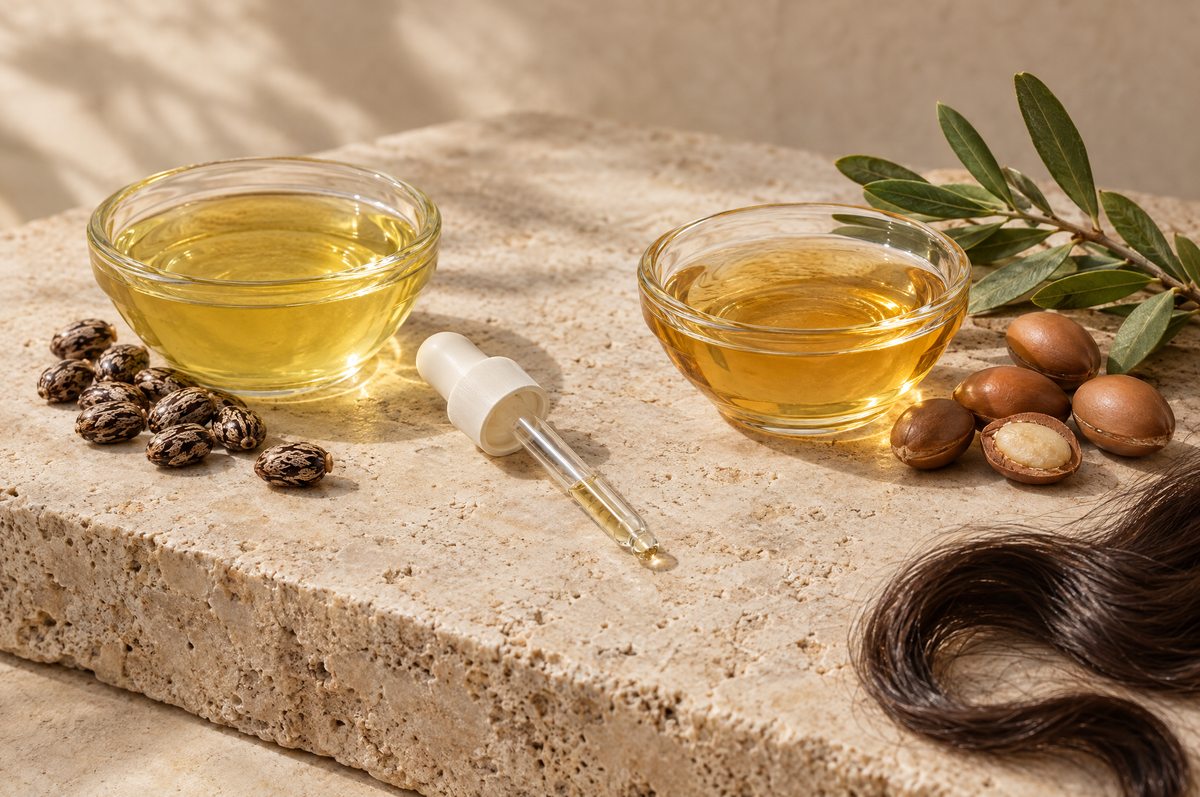
Argan oil and castor oil are both sold as natural hair oils, but they are very different to use. Castor oil is thick, sticky and made almost entirely of one unusual fatty acid; argan oil is light, absorbs quickly and is better for everyday smoothing and shine. Neither has good evidence for growing hair, lashes or brows, so the real choice comes down to texture and how you plan to use it.
The short answer
Choose argan oil for everyday shine, softness and frizz control, because it is light and spreads easily. Castor oil is far thicker and mostly ricinoleic acid, which suits occasional scalp or pre-wash use in small amounts. Despite popular claims, neither oil has solid human evidence for making hair, lashes or brows grow.
What makes castor oil and argan oil so different?
Most plant oils are a mix of several common fatty acids. Argan oil follows that pattern: about 80 percent of its fatty acids are unsaturated, mainly oleic acid (roughly 43 to 49 percent) and linoleic acid (roughly 29 to 36 percent), with smaller amounts of palmitic and stearic acid.1 It also carries notable vitamin E, around 60 to 90 mg per 100 g, most of it gamma-tocopherol.1
Castor oil is the outlier. Roughly 90 percent of its fatty acids are ricinoleic acid, a monounsaturated fatty acid with an extra hydroxyl group that very few other oils contain.2,3 That chemistry is why castor oil is so dense and tacky: dermatologists describing a hair-matting case called it very thick and sticky in consistency.4
What that means in your hands
- Argan oil spreads thinly, sinks in within a minute or two, and leaves a soft satin finish. One or two drops can cover the ends of shoulder-length hair.
- Castor oil drags, clings and can feel gummy. It is hard to distribute evenly and usually needs shampoo, sometimes twice, to remove.
Castor oil or argan oil for hair growth: what the evidence says
This is the question most people are really asking, and the honest answer is that neither oil has been shown to grow hair in well-designed human trials.
Castor oil
A 2026 narrative review of castor oil in dermatology concluded that much of its use is supported by anecdote or extrapolated from preclinical work.2 The idea that it helps with hair loss rests on lab findings that ricinoleic acid may interfere with prostaglandin D2, a molecule linked to hair thinning. But that link has not been confirmed in people, and the same review notes that a drug designed to block the prostaglandin D2 pathway showed no clinical benefit in men with pattern hair loss.2 The one human hair study it describes looked at shine, not growth: castor oil increased the visual contrast between hair strands.2 The authors of the hair-matting case report put it more bluntly, writing that there were no studies on castor oil's benefits for hair and that the long-held beliefs about growth were not scientifically proven.4
Argan oil
Argan oil has no growth trials either. What exists is laboratory work on cut hair samples: tresses pretreated with argan oil lost significantly less protein after oxidative damage (the kind of chemistry involved in bleaching and coloring), and some oil remained on the hair even after washing.5 That supports argan as a protective, smoothing oil, not a growth product. We cover this in more depth in does argan oil help hair grow.
Where both oils genuinely help is breakage. Hair that is smoother and better lubricated snaps less when you brush and style it, and keeping more of the length you already have can look like faster growth. If thinning or shedding is new or sudden, that is a reason to see a doctor rather than reach for any oil.
Argan oil vs. castor oil for eyelashes and brows
Castor oil is the classic DIY lash serum. A 2022 analysis of 275 homemade eye-cosmetic recipes found it was the oil most often used in lash-care recipes, which promised longer, fuller lashes.3 The researchers found no support for that promise and noted that only bimatoprost, a prescription drug, has been proven effective for sparse lashes.3 They also raised safety concerns about DIY eye products in general: many recipes contain oxidizable oils without antioxidants, and preservative-free mixtures can allow bacteria to grow, which is not compatible with use around the eyes.3
Argan oil has no lash-growth evidence either. If you like the ritual of oiling lashes or brows, either oil can make the hairs look darker and glossier for a while, and argan's lighter texture is less likely to drift into the eye or smudge. Use a tiny amount on a clean spoolie, keep it on the outer lash line rather than the waterline, and stop if your eyes sting or your lids become irritated. Our guide to argan oil for eyelashes and brows walks through the technique.
Side-by-side comparison
| Argan oil | Castor oil | |
|---|---|---|
| Main fatty acids | Oleic (~43–49%) and linoleic (~29–36%)1 | Ricinoleic acid (~90%)2 |
| Texture | Light, fast-absorbing, satin finish | Very thick and sticky4 |
| Vitamin E | About 60–90 mg/100 g, mostly gamma-tocopherol1 | Not a notable source |
| Best everyday use | Shine, frizz, dry ends, leave-in finishing | Occasional pre-wash or scalp oiling in small amounts |
| Hair growth evidence | None in humans; lab data on reduced protein loss5 | None in humans; mechanism suggested only in preclinical work2 |
| Lash and brow evidence | None | None; popular in DIY recipes3 |
| Rinses out | Easily; often left in | Needs thorough shampooing |
| Rare risks reported | Rare allergic reactions | Contact dermatitis; one reported case of severe hair matting2,4 |
Is castor oil safe on hair? A note on felting
Castor oil is generally well tolerated, but two rare problems are worth knowing. The first is contact dermatitis: the dermatology review describes allergic skin reactions to castor oil in cosmetic products as the most common adverse effect reported.2 The second is acute hair felting, where hair suddenly mats into a dense, tangled mass. In a published case, a 20-year-old woman who used coconut and castor oil before washing her long hair for the first time developed matting that could not be untangled and had to be cut off.4 The authors suggested castor oil's high viscosity and stickiness, combined with long hair, contributed. This is very rare, but it is a good reason to use castor oil sparingly, diluted, and to detangle gently.
Argan oil is a gentler daily choice for most hair types. Allergic reactions to it are uncommon, but they do happen, so patch test first if you have sensitive skin; see can argan oil irritate skin for how.
Mixing castor and argan oil
Blending the two is a popular way to get some of castor oil's cling with argan's slip, and it makes castor oil much easier to spread. There are no studies on ideal ratios, so think of these as texture guidelines rather than formulas:
- Start mostly argan. Mix about three parts argan oil to one part castor oil in a small clean glass dish. Go no heavier than half and half.
- Use it as a pre-wash. Massage a few drops into the scalp or along the lengths of dry hair, leave for 20 to 30 minutes, then shampoo well. Castor oil is not a good leave-in.
- Detangle gently. Section long hair and comb from the ends upward before and after washing, especially the first time.
- Finish with argan alone. After drying, smooth one or two drops of plain argan oil over the ends for shine and softness.
- Mix fresh. Make a small batch each time rather than storing a homemade blend, particularly anything meant for brows.
For more ways to work it into a routine, see how to use argan oil for hair, and if your main concern is puffiness and flyaways, our guide to argan oil for frizzy hair and dry, damaged lengths covers it step by step.
Which one should you choose?
Choose argan oil if
- You want a leave-in that adds shine and calms frizz without feeling greasy.
- Your ends are dry, colored or heat-styled.
- You want one oil that also works on face, cuticles and body.
Choose castor oil if
- You enjoy a heavy pre-wash scalp oiling ritual and don't mind double shampooing.
- You plan to dilute it, rather than apply it neat to long hair.
If you are shopping for argan, look for a single-ingredient, cold-pressed oil from unroasted kernels; many "argan" hair products are blends, a distinction explained in Moroccan oil vs argan oil. Our 100% organic argan oil is USDA-certified organic, cold-pressed in Morocco and contains nothing else, and it comes with a 30-day money-back guarantee, even if opened.
Castor oil is a heavy pre-wash ritual you rinse out. Argan oil is the light finish you can wear every day.
Frequently asked questions
Is castor oil or argan oil better for hair growth?
Neither has good human evidence for making hair grow. Castor oil's growth reputation rests on tradition and early lab ideas, and argan oil's research is limited to lab studies on protecting hair from damage.
Can I use castor oil and argan oil together?
Yes. A blend of about three parts argan to one part castor is easier to spread than castor alone. Use it as a pre-wash and shampoo it out, then finish with a drop of plain argan oil.
Is argan oil or castor oil better for eyelashes?
Neither has been shown to lengthen lashes; only the prescription drug bimatoprost has that evidence. If you oil your lashes for gloss, use a tiny amount on the outer lash line and stop if your eyes sting.
Can castor oil damage hair?
Rarely. It can cause allergic skin reactions in some people, and there is one published case of sudden, severe hair matting after castor oil use on long hair. Using it diluted and sparingly lowers the risk of tangles.
This article is for general information and isn't medical advice. If you are noticing thinning hair, sudden shedding, or lash or brow loss, see a doctor or dermatologist, and talk to an eye doctor before putting any oil close to your eyes.
Sources
- Gharby S, Charrouf Z. Argan oil: chemical composition, extraction process, and quality control. Front Nutr. 2022;8:804587. Link
- Girdler K, Cabatu A, Olds H, Potts GA. Use of castor oil in dermatology: a narrative review. Cureus. 2026;18(2):e103289. Link
- Couteau C, Girard E, Coiffard L. Analysis of 275 DIY recipes for eye cosmetics and their possible safety issues. Int J Cosmet Sci. 2022;44(4):403–413. Link
- Maduri VR, Vedachalam A, Kiruthika S. “Castor oil” – the culprit of acute hair felting. Int J Trichology. 2017;9(3):116–118. Link
- Sharifi N, Hamedeyazdan S, Shokri J, Monajjemzadeh F. Argan oil as a pretreatment of human hair before exposure to oxidative damage: attenuated total reflectance and protein loss studies. J Cosmet Dermatol. 2022;21(10):5010–5017. Link