Argan Oil for Beards: Softer Hair, Calmer Skin Underneath
Most beard problems aren't really about the hair. They're about the skin underneath: tight, flaky, itchy skin that sheds onto a dark sweater, or a coarse beard that scratches more than it softens. A good beard oil is meant to fix both, and plain argan oil is one of the simplest ways to do it. Here's what argan oil does for a beard, what it doesn't, and how to use it without ending up greasy.
The short answer
Argan oil is a good choice for most beards. A few drops worked through the hair and into the skin after washing can soften coarse hair and help ease dryness and itch underneath. It will not make a beard grow faster or fill patches, and if you're prone to beard acne, a non-comedogenic conditioner may suit you better.
What does argan oil do for a beard?
A beard oil has two jobs. For the hair, it adds slip and softness so coarse facial hair feels less wiry and is easier to comb. For the skin, it slows down water loss, which is where most itch and flaking start.
The American Academy of Dermatology (AAD) puts it plainly: once your beard grows in, moisturizing helps prevent dry, flaky, itchy skin beneath it, and it recommends beard oil for people with normal to dry skin, applied sparingly so the beard doesn't look greasy1. That's the role argan oil fills.
Argan oil is made up mostly of oleic and linoleic acids and contains vitamin E compounds (tocopherols) and plant sterols2. In a 60-day trial in postmenopausal women, argan oil applied to the forearm reduced transepidermal water loss and increased the water content of the skin's outer layer3. That study wasn't about beards, and its participants were women, but it shows argan oil can help skin hold on to moisture, which is exactly what dry skin under a beard needs. A review of topical plant oils also lists argan oil among those with evidence for skin barrier repair, though the research is limited4.
Argan oil beard benefits, honestly graded
| Claim | What the evidence says |
|---|---|
| Softens coarse beard hair | Consistent with how oils work on hair and with common experience; not formally studied in beards. |
| Eases dry, itchy skin under the beard | Reasonable: dermatologists recommend moisturizing to prevent this, and argan oil has been shown to reduce skin water loss in a small human trial. |
| Reduces "beardruff" | Helps with flakes from simple dryness. Flakes from seborrheic dermatitis need medicated care. |
| Makes a beard grow faster or thicker | No evidence. A 2022 systematic review found no significant evidence that argan oil improves hair growth. |
| Prevents ingrown hairs | Not shown. Shaving technique matters far more. |
Does argan oil help beard growth?
This is one of the most common questions, so it deserves a straight answer: no, there's no good evidence that argan oil makes a beard grow. A 2022 systematic review of coconut, castor and argan oils for hair found no significant evidence that argan oil improves hair growth or hair quality in clinical studies5. The authors noted that dermatologists often let patients keep using hair oils because they're unlikely to cause harm, not because they've been proven to work.
What can happen is that a softer, better-groomed beard looks fuller. Hair that lies flat and catches the light reads as denser than dry, frizzy hair pointing in every direction. That's a real cosmetic benefit, just not growth.
If your beard is patchy, the AAD suggests choosing a style that works with sparse areas, giving it time to fill in, and checking with a dermatologist before trying minoxidil on your face because it can irritate the skin6. For more on hair growth claims, read our look at whether argan oil helps hair grow.
Beard itch and beard dandruff
New-beard itch
The first few weeks of growing a beard are often the itchiest, as short, coarse hairs grow out and the skin underneath dries. Washing with a gentle cleanser and moisturizing straight after are the AAD's core recommendations1. A couple of drops of argan oil pressed into the stubble while the skin is still slightly damp is an easy way to do the moisturizing half.
Flakes: dry skin or seborrheic dermatitis?
Flakes that disappear once you start moisturizing were most likely simple dryness. Flakes that keep coming back, especially with redness or greasy-looking scale, may be seborrheic dermatitis, the condition behind most beard dandruff. For that, the AAD recommends gently brushing the beard, a short course of 1% hydrocortisone, and a dandruff shampoo containing zinc pyrithione, ketoconazole or selenium sulfide, and seeing a dermatologist if it doesn't clear6. Argan oil can help with comfort and dryness, but it is not a treatment for seborrheic dermatitis. Our article on argan oil for dandruff and dry scalp covers the same distinction for the scalp.
Beard acne
If you break out under your beard, be cautious with any oil. For beard acne, the AAD specifically suggests a non-comedogenic beard conditioner rather than beard oil6. Some people with acne-prone skin use argan oil without trouble, but if you're breaking out, pause the oil and see whether things settle. More on this in argan oil for acne-prone skin.
How much argan oil to use on a beard
Less than you think. Too much leaves a beard looking wet and collects lint. A starting point:
- Stubble to short beard (under about 1 cm): 2 to 3 drops.
- Medium beard: 3 to 5 drops.
- Long or very coarse beard: 5 to 8 drops, worked in two passes.
Add a drop at a time until the beard feels soft but not slick. If your beard looks shiny an hour later, use less next time.
How to use argan oil on your beard after a shower
After a shower is the ideal time. The hair is soft and the skin is damp, which is when the AAD recommends moisturizing7.
- Wash your beard with a gentle cleanser (not harsh bar soap), massaging it through to the skin. Rinse with lukewarm water1.
- Pat dry with a towel, leaving the beard slightly damp. Don't rub.
- Warm the oil: put your drops in one palm and rub your hands together.
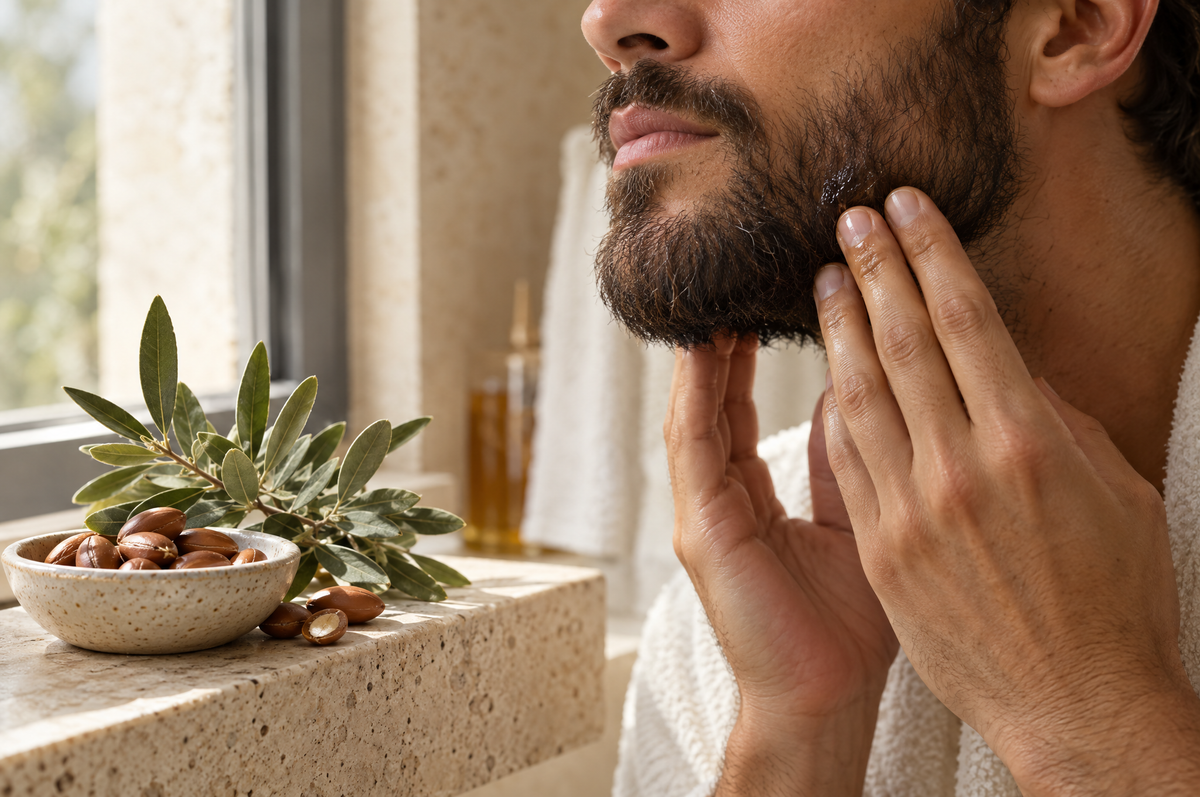
- Work it into the skin first. Use your fingertips to massage the oil down to the skin under the beard, including the jawline and neck.
- Then coat the hair. Smooth your palms over the beard from root to tip, including the mustache.
- Comb through with a wide-tooth beard comb to spread the oil evenly and shape the beard.
Once a day is enough for most beards. In dry winter weather or if you wash often, you might add a drop or two at night. And try to stop stroking your beard throughout the day; the AAD notes it spreads dirt and germs to your skin1.
Argan oil vs. other beard oils
Many commercial beard oils are blends of carrier oils, often including argan, jojoba or sweet almond, plus fragrance. A pure argan oil gives you the conditioning part without the scent, which matters if you have sensitive skin; the AAD advises men with sensitive skin to look for fragrance-free products7.
If you'd rather keep your routine to one product, the same bottle can go on your face, hair and beard. Our organic, cold-pressed argan oil is a single ingredient with no fragrance, which makes it easy to layer with whatever cologne or aftershave you already like. For the wider picture, see argan oil for men.
Argan oil beard Reddit questions, answered
A few themes come up again and again in grooming forums:
- "Does it smell?" Cosmetic argan oil has a faint, slightly nutty scent that fades quickly. A strong roasted or sour smell is a red flag. See what argan oil should smell like.
- "Is pure argan better than a beard oil blend?" Not necessarily better, just simpler. If you like a scented oil and it doesn't irritate you, use it.
- "Will it stain my shirt?" Small amounts absorb well. If you're seeing marks on collars, you're using too much.
Patch test first
Allergic reactions to argan oil are uncommon but have been reported8. Before putting a new oil all over your face, follow the AAD's method: apply it to a small area of your inner arm twice daily for 7 to 10 days, and use it if there's no redness, itching or swelling9.
Frequently asked questions
Is argan oil good for your beard?
Yes, for most beards. It softens coarse hair and helps moisturize the skin underneath, which can ease dryness and itch. If you're prone to beard acne, a non-comedogenic beard conditioner may be a better fit.
Does argan oil make your beard grow?
No. A 2022 systematic review found no significant evidence that argan oil improves hair growth. A well-conditioned beard can look fuller, but the oil doesn't create new hair.
How many drops of argan oil should I use on my beard?
Start with 2 to 3 drops for stubble or a short beard and 3 to 5 for a medium beard. Add more one drop at a time only if the beard still feels dry.
Should I use argan oil on a wet or dry beard?
Slightly damp is ideal. Apply it after a shower once you've patted your beard dry, so the oil helps seal in moisture.
Can argan oil get rid of beard dandruff?
It can help with flakes caused by simple dryness. Persistent greasy flakes with redness are often seborrheic dermatitis, which usually needs a medicated shampoo; see a dermatologist if it doesn't clear.
This article is for general information and isn't medical advice. If you have a persistent rash, scaling or breakouts under your beard, see a doctor or dermatologist.
Sources
- American Academy of Dermatology. A dermatologist's top tips for a healthy beard. Link
- Gharby S, Charrouf Z. Argan oil: chemical composition, extraction process, and quality control. Front Nutr. 2021;8:804587. Link
- Boucetta KQ, Charrouf Z, Derouiche A, Rahali Y, Bensouda Y. Skin hydration in postmenopausal women: argan oil benefit with oral and/or topical use. Prz Menopauzalny. 2014;13(5):280–288. Link
- Lin TK, Zhong L, Santiago JL. Anti-inflammatory and skin barrier repair effects of topical application of some plant oils. Int J Mol Sci. 2017;19(1):70. Link
- Phong C, Lee V, Yale K, Sung C, Mesinkovska N. Coconut, castor, and argan oil for hair in skin of color patients: a systematic review. J Drugs Dermatol. 2022;21(7):751–757. Link
- American Academy of Dermatology. DIY treatment for 5 common beard problems. Link
- American Academy of Dermatology. Skin care tips for men. Link
- Foti C, Romita P, Ranieri LD, Bonamonte D. Allergic contact dermatitis caused by argan oil. Contact Dermatitis. 2014;71(3):183–184. Link
- American Academy of Dermatology. How to test skin care products. Link