
Argan Oil vs. Rosehip Oil: Which Face Oil Suits Your Skin?
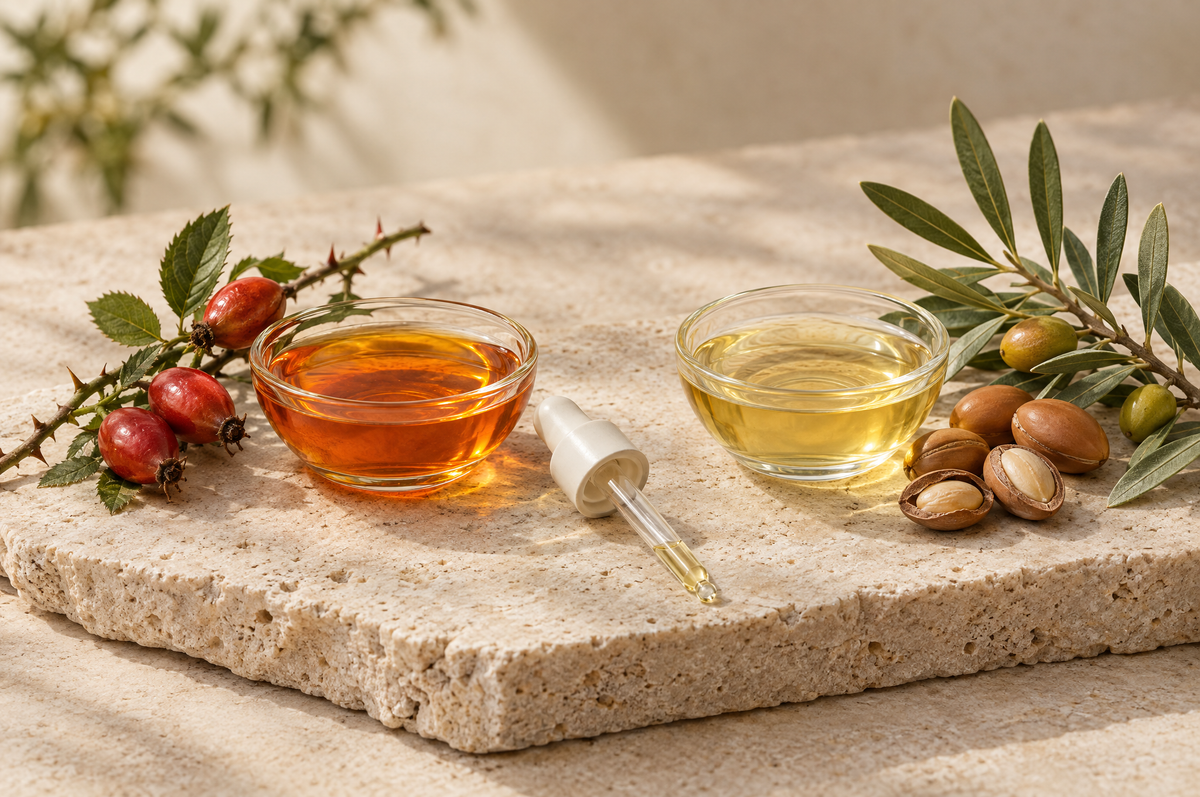
Rosehip oil and argan oil are two of the most popular single-ingredient face oils, and they suit different skin. Rosehip is lighter-feeling and very high in polyunsaturated fats, which makes it appealing for oily or blemish-prone skin but also quicker to go rancid. Argan has a more balanced fatty acid profile, more vitamin E and a longer shelf life, which makes it an easy everyday oil for normal, dry and mature skin.
The short answer
Rosehip oil is richer in linoleic and alpha-linolenic acids and often feels lighter, so many people with oily or combination skin prefer it, but it oxidizes quickly. Argan oil is higher in oleic acid and vitamin E, more stable, and well suited to normal, dry or mature skin. Both have only modest human evidence.
How rosehip and argan oil differ in composition
Rosehip oil is pressed from the seeds of wild roses such as Rosa canina. Its most abundant fatty acid is linoleic acid (about 36 to 55 percent), followed by alpha-linolenic acid (about 17 to 27 percent) and oleic acid (about 15 to 22 percent).1 It also contains tocopherols, carotenoids and phenolic compounds.1
Argan oil, from the kernels of the Moroccan argan tree, leans the other way: oleic acid makes up roughly 43 to 49 percent and linoleic acid roughly 29 to 36 percent, with almost no alpha-linolenic acid.2 Its vitamin E content is notably high, about 60 to 90 mg per 100 g, mostly in the gamma-tocopherol form, alongside unusual plant sterols such as schottenol and spinasterol.2
Why the fatty acid balance matters
Linoleic acid plays a direct role in maintaining the skin's water barrier, while oleic acid applied continuously at high concentrations can disrupt it, according to a review of plant oils on skin.1 That is one reason linoleic-rich oils like rosehip are often recommended for oily or breakout-prone skin. But context matters: argan oil is not pure oleic acid, and in small human studies it improved rather than weakened barrier measurements (more on that below). Fatty acid charts are a useful guide, not a verdict.
Does rosehip oil really contain vitamin A?
Rosehip oil is often marketed as a "natural retinol" or a source of retinoic acid. We could not find reliable, peer-reviewed measurements confirming meaningful amounts of retinoic acid in cold-pressed rosehip seed oil, so we would view that claim with caution. What is documented is that it contains carotenoids,1 which are pigments the body can use to make vitamin A, and which give many rosehip oils their orange color. That is not the same as using a retinoid, and rosehip oil should not be thought of as a replacement for one. If you already use retinol, see our guide to using argan oil with retinol for how to pair an oil with it.
Shelf life and oxidation: the practical difference
This is where the two oils differ most in daily use. The more polyunsaturated fat an oil contains, the faster it reacts with oxygen. In a 2026 laboratory comparison of rosehip, sunflower, olive and jojoba oils, rosehip had the shortest induction period, meaning it was the least resistant to oxidation, and stability tracked closely with polyunsaturated fat content.3
Cosmetic argan oil, by contrast, has been estimated to keep for about a year at room temperature when protected from heat.2 Rancid oil smells sharp or like old crayons and is best thrown away. To get the most from either:
- Buy small bottles in dark glass and close them tightly.
- Store rosehip oil somewhere cool, and consider the fridge once opened.
- Note the date you opened it, and smell it before each use.
Our guide on how long argan oil lasts has more on storage.
Rosehip vs. argan oil for scars
Rosehip has the more specific evidence here, though it is limited. In a single-center study in Spain, people who applied pure rosehip seed oil to fresh post-surgical scars twice a day for six weeks were compared with people who applied nothing.4 At 12 weeks, 73 percent of the rosehip group had no redness versus 50 percent of the comparison group, and differences in discoloration and atrophy also favored rosehip.4 The authors called their results preliminary: scars were rated by one dermatologist, blinding was not described, group sizes were unequal, and the study was sponsored by a pharmaceutical company.4
Argan oil has no comparable scar trial in people. If the look of a scar matters to you, rosehip has the stronger case of the two, and a dermatologist can advise on scar-care options with stronger evidence.
Rosehip or argan oil for face: the evidence for everyday skin
For argan, the best human data come from two related studies of 60 postmenopausal women who applied argan oil to one forearm daily for 60 days. Skin lost less water and held more moisture,5 and measures of elasticity improved.6 These are small studies in one group, and the forearm is not the face, but they are among the better data for any cosmetic oil. For rosehip, a review of plant oils points mostly to laboratory findings on its antioxidant and anti-inflammatory activity, plus an older small clinical report.1 No study has compared the two directly.
So for argan oil for skin, the fair summary is modest but real human support for hydration and elasticity; for rosehip, a plausible profile with thinner direct evidence.
Side-by-side comparison
| Argan oil | Rosehip oil | |
|---|---|---|
| Source | Kernels of the argan tree (Morocco) | Seeds of wild roses such as Rosa canina |
| Main fatty acids | Oleic ~43–49%, linoleic ~29–36%2 | Linoleic ~36–55%, alpha-linolenic ~17–27%, oleic ~15–22%1 |
| Notable extras | High vitamin E (mostly gamma), unusual sterols2 | Carotenoids, tocopherols, phenolics1 |
| Feel | Light, satin, slightly cushioned | Light and dry-feeling; often orange-tinted |
| Oxidative stability | Good; about a year at room temperature (cosmetic)2 | Low; oxidizes quickly3 |
| Often preferred for | Normal, dry and mature skin | Oily, combination and blemish-prone skin |
| Best human evidence | Hydration and elasticity in small trials5,6 | Appearance of post-surgical scars in one open study4 |
Which one should you choose?
Choose rosehip if
- Your skin is oily or combination and you want the lightest-feeling oil.
- Your main interest is the look of a scar, and you will use the bottle up within a few months.
Choose argan if
- Your skin is normal, dry or mature and feels tight by the afternoon.
- You want one stable bottle you can also use on hair ends, cuticles and body.
- You prefer an oil without an orange tint or a strong scent.
If you go with argan, pick a single-ingredient, cold-pressed oil from unroasted kernels. Our 100% organic argan oil is exactly that, USDA-certified organic and covered by a 30-day money-back guarantee, even if opened.
Can you mix rosehip and argan oil?
Yes, and it can be a sensible compromise for combination skin or for anyone who wants rosehip's profile with a little more cushion. Mix in your palm rather than in a bottle, since rosehip's short shelf life would shorten the life of the whole blend.
- After cleansing and any water-based serums, put one drop of each oil in your palm.
- Rub your palms together briefly to warm and blend the oils.
- Press, rather than rub, the oil over your face and neck.
- In the morning, follow with sunscreen once the oil has settled.
Using face oil on its own or over a cream are both fine; our guide to using argan oil as a moisturizer explains layering, and the full routine for argan oil for face covers amounts and timing. Patch test any new oil on your inner arm or jawline for a few days first.
Rosehip is the bright, fast-moving oil; argan is the steady one that stays fresh in the cabinet.
Frequently asked questions
Is rosehip or argan oil better for the face?
It depends on your skin. Rosehip often suits oily and combination skin because it is rich in linoleic acid and feels light, while argan suits normal, dry and mature skin and stays fresh longer. No study has compared them directly.
Is rosehip or argan oil better for scars?
Rosehip has the stronger evidence: one open study found less redness and discoloration in post-surgical scars after six weeks of use. The study was small and preliminary, and argan oil has no comparable scar trial.
Can you mix rosehip and argan oil?
Yes. Mix a drop of each in your palm at the time of use rather than pre-blending a bottle, because rosehip oxidizes quickly and would shorten the shelf life of the mix.
Does rosehip oil contain retinol?
Not in any well-documented way. It contains carotenoids, which are vitamin A precursors, but it is not a substitute for a retinoid product.
Sources
- Lin TK, Zhong L, Santiago JL. Anti-inflammatory and skin barrier repair effects of topical application of some plant oils. Int J Mol Sci. 2017;19(1):70. Link
- Gharby S, Charrouf Z. Argan oil: chemical composition, extraction process, and quality control. Front Nutr. 2022;8:804587. Link
- Fagoaga C, Moreno A, Fernández-Julián N, Castellano G. Oxidative stability and kinetics of oxidation of rosehip, sunflower, olive and jojoba oils. Antioxidants (Basel). 2026;15(5):646. Link
- Valéron-Almazán P, Gómez-Duaso AJ, Santana-Molina N, García-Bello MA, Carretero G. Evolution of post-surgical scars treated with pure rosehip seed oil. J Cosmet Dermatol Sci Appl. 2015;5(2). doi:10.4236/jcdsa.2015.52019. Link
- Boucetta KQ, Charrouf Z, Derouiche A, Rahali Y, Bensouda Y. Skin hydration in postmenopausal women: argan oil benefit with oral and/or topical use. Prz Menopauzalny. 2014;13(5):280–288. Link
- Boucetta KQ, Charrouf Z, Aguenaou H, Derouiche A, Bensouda Y. The effect of dietary and/or cosmetic argan oil on postmenopausal skin elasticity. Clin Interv Aging. 2015;10:339–349. Link