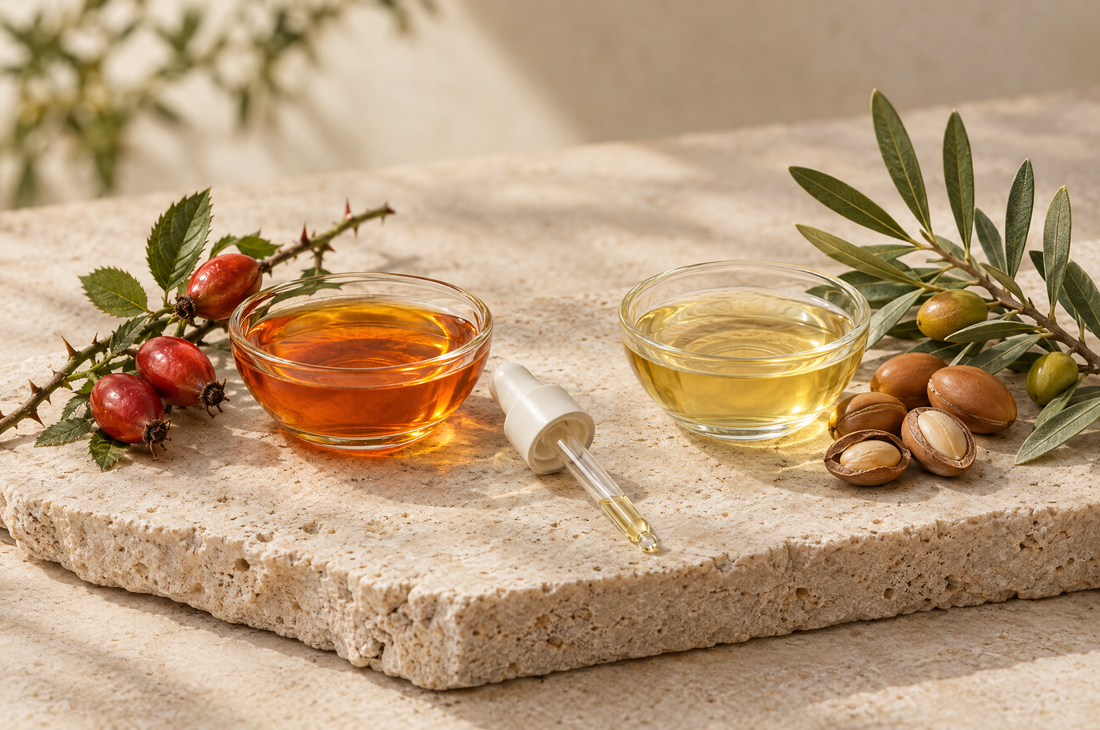
How Much Argan Oil Should You Use? Drops for Face, Hair and Body
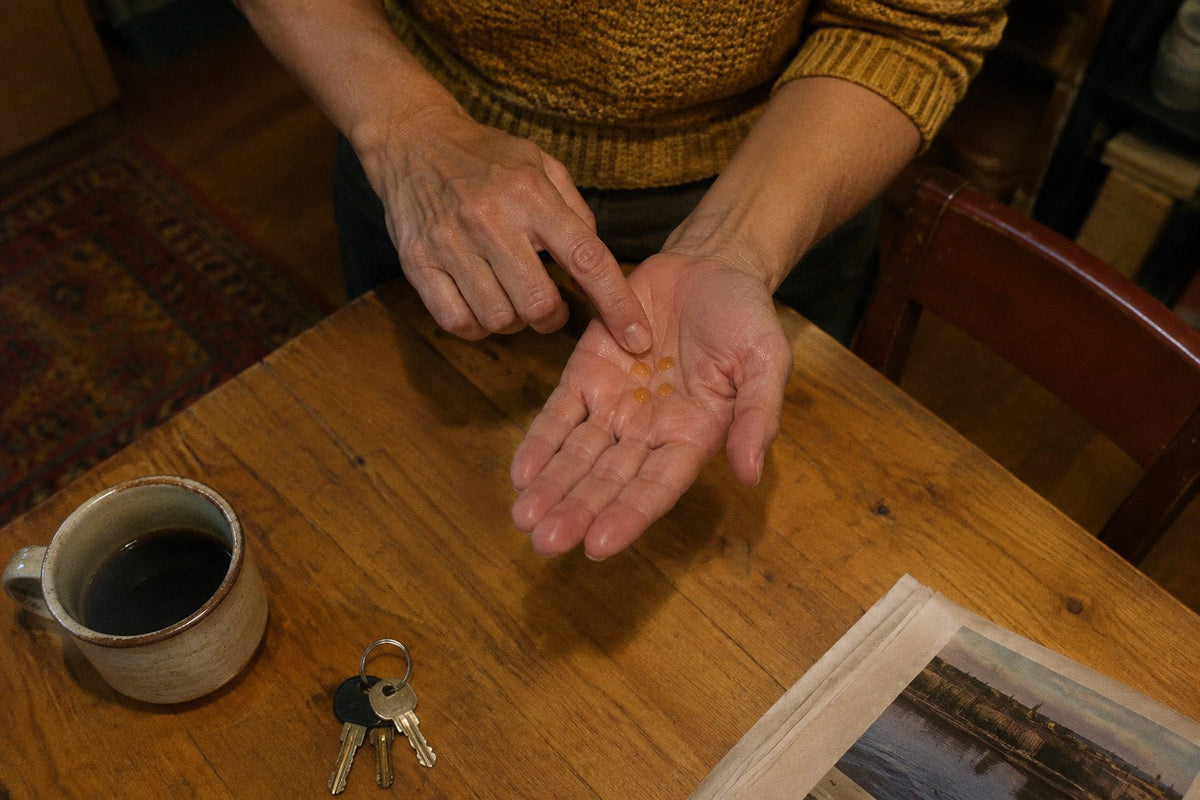
Less than most people think. For the face, 2 to 3 drops of argan oil is enough; for hair, start with 1 drop worked through dry ends (a little more on damp or thick hair); for nails, 1 drop; and for the body, 5 to 6 drops after bathing. If skin still looks shiny or hair looks limp after 15 minutes, you used too much.
The short answer
Use 2–3 drops of argan oil for your face, pressed in as the last step morning or night. Use 1 drop through dry hair ends, or 2–4 drops for thick, coarse or curly hair. Use 1 drop for nails and cuticles and 5–6 drops for the body after a shower. Start low and add more only if needed.
How much argan oil to use: a quick reference
These amounts are the ones we recommend in our own usage guide, plus sensible starting points for a few areas the guide doesn't cover. They're starting points, not rules: skin type, climate, the season and the size of your dropper all shift the right amount.
| Area | Starting amount | How and when |
|---|---|---|
| Face | 2–3 drops | Warm between palms, press onto skin as the last step, morning or night |
| Under eyes | A trace (what's left on your fingertips) | Tap gently along the orbital bone, not on the lids |
| Neck and chest | 1–2 drops | After the face, with the leftover on your palms plus a drop |
| Fine or straight hair | 1 drop | On dry ends only, to smooth flyaways |
| Medium hair | 1–2 drops | Mid-lengths to ends, dry or damp |
| Thick, coarse or curly hair | 2–4 drops | Into damp hair before styling, then a touch more on dry ends if needed |
| Pre-wash hair mask | Enough to coat lengths lightly | 30 minutes or more before shampooing |
| Beard | 2–4 drops, depending on length | Work through the beard and onto the skin underneath |
| Nails and cuticles | 1 drop for a hand | Massage into nail beds and cuticles |
| Body | 5–6 drops | On damp skin right after bathing; add more for very dry legs |
How many drops of argan oil for your face?
Two to three drops covers the face for most people. Argan oil spreads easily, and its main job on skin is to sit on the surface and slow water loss; plant oils work largely this way, by forming a light occlusive layer rather than soaking deep into the skin.2 A thin, even layer does that job. A thick one just sits there.
For a sense of scale, a 60-day clinical study of argan oil on postmenopausal skin used about 240 mg of oil, described as roughly 10 drops, spread over the forearm each night, a dose of 2 mg per square centimeter.1 That's a measured research dose over a larger area than most faces, and it's a reminder that a few drops go a long way. (The trial found improvements in skin elasticity measurements with topical use, though it was small and limited to one group of women.1)
Adjust for your skin type
- Dry skin: 3 drops, or 2 drops over your usual moisturizer at night.
- Normal or combination skin: 2 drops; concentrate on drier cheeks and go lighter on the T-zone.
- Oily skin: 1 to 2 drops, often best at night. Facial oil production tends to be lowest at night and to peak in the early afternoon,6 so a small evening dose usually feels more comfortable than a midday one. See argan oil for oily skin for more.
For the full routine, including where oil goes relative to serums and sunscreen, see our guide to using argan oil for face care.
How much argan oil for hair?
Hair is where people overdo it most, because the right amount looks almost too small. Oils smooth hair by lubricating the shaft and reducing friction between strands, but a thick film can leave hair looking oily and heavy, and a thin layer is preferable.3 Start with one drop, add a second only if the ends still feel dry, and stop there.
By hair type
- Fine hair: 1 drop on dry ends only. Keep it away from the roots.
- Medium hair: 1 to 2 drops from mid-lengths to ends.
- Thick, coarse or curly hair: 2 to 4 drops, ideally into damp hair, where it spreads more evenly.
- Short hair: 1 drop, rubbed between palms and skimmed over the surface.
Be realistic about what that oil is doing: it improves softness, shine and manageability, but a systematic review found no significant evidence that argan oil improves hair growth or hair quality in controlled studies.4 For techniques beyond quantity, our guide on how to use argan oil for hair covers five methods, from styling to pre-wash masks.
How much for nails and body?
One drop is enough for all five nails and cuticles on one hand. Massage it in and let it absorb.
For the body, 5 to 6 drops after a shower covers the arms and legs for most people. Apply while skin is still a little damp; the American Academy of Dermatology recommends moisturizing damp skin right after bathing, leaving a bit of water on the skin.5 Damp skin also helps the oil spread further, so you need less. Our after-shower body oil ritual walks through it step by step.
Signs you used too much argan oil
Too much argan oil won't harm healthy skin, but it wastes oil and feels unpleasant. Watch for:
- Skin still shiny or tacky 15 minutes after applying.
- Makeup or sunscreen pilling or sliding on top of the oil.
- Oil marks on your pillowcase, collar or phone screen.
- Hair that looks limp, stringy or darker at the ends, or roots that look greasy by midday.
How to fix too much argan oil
- On the face: press a clean tissue over the skin to blot the excess without rubbing it off entirely.
- On the body: wait a few minutes before dressing, or blot with a towel.
- In hair: sprinkle a little dry shampoo on the greasy areas or rinse the ends with warm water. If it's everywhere, shampoo once and start again tomorrow with half as much.
- Next time: halve the amount and build up one drop at a time.
Start with less than you think you need. You can always add a drop; you can't take one back.
Dropper tips for getting the amount right
- Drop into your palm, not onto your face. It's easier to count and to spread evenly.
- Count, then squeeze gently. Release the bulb slowly so drops form one at a time; drop size varies with how hard you squeeze.
- Warm it first. Rubbing the oil between your palms for a few seconds helps it spread thinly.
- Press, don't rub. Pressing your palms onto your face distributes a small amount evenly with less tugging.
- Use the leftovers. What's left on your hands after your face is perfect for cuticles or the ends of your hair.
If you're using a single-ingredient oil like our organic cold-pressed argan oil, its glass dropper makes counting easy, and the same bottle covers face, hair, nails and body. For more ideas on where else those few drops can go, see our list of ways to use argan oil.
Frequently asked questions
How many drops of argan oil should I use on my face?
Two to three drops is enough for most faces. Use 1 to 2 drops if your skin is oily and up to 3 if it is dry, pressed in as the last step of your routine.
How much argan oil should I put in my hair?
Start with 1 drop on dry ends for fine hair, 1 to 2 drops for medium hair, and 2 to 4 drops for thick, coarse or curly hair. Add more only if the ends still feel dry.
Can you use too much argan oil?
Yes. Too much leaves skin shiny and hair limp or greasy, and can make makeup pill. Blot the excess and use half as much next time.
Should I apply argan oil to wet or dry skin?
Slightly damp skin is ideal, especially for the body after a shower. The oil spreads further, so you need fewer drops.
Sources
- Boucetta KQ, Charrouf Z, Aguenaou H, Derouiche A, Bensouda Y. The effect of dietary and/or cosmetic argan oil on postmenopausal skin elasticity. Clin Interv Aging. 2015;10:339–349. Link
- Lin TK, Zhong L, Santiago JL. Anti-inflammatory and skin barrier repair effects of topical application of some plant oils. Int J Mol Sci. 2017;19(1):70. Link
- Gavazzoni Dias MF. Hair cosmetics: an overview. Int J Trichology. 2015;7(1):2–15. Link
- Phong C, Lee V, Yale K, Sung C, Mesinkovska N. Coconut, castor, and argan oil for hair in skin of color patients: a systematic review. J Drugs Dermatol. 2022;21(7):751–757. Link
- American Academy of Dermatology. Dermatologists' top tips for relieving dry skin. Link
- Matsui MS, Pelle E, Dong K, Pernodet N. Biological rhythms in the skin. Int J Mol Sci. 2016;17(6):801. Link