Argan Oil for Eyelashes and Brows: Does It Help Them Grow?
Search for ways to grow longer lashes and you will quickly find argan oil, castor oil and a parade of before-and-after photos. It is an appealing idea: a single natural oil, a clean mascara wand, and fuller lashes in a few weeks. The truth is less exciting but more useful, and it will save you from disappointment and from putting the wrong things near your eyes.
The short answer
There is no scientific evidence that argan oil makes eyelashes or brows grow longer or thicker. It may condition existing lashes so they feel softer and look glossier, and that can reduce breakage from rubbing or makeup removal. The only FDA-approved lash growth treatment is prescription bimatoprost (Latisse), which works in a completely different way.
Does argan oil help eyelashes grow? What the evidence says
We looked for clinical studies of argan oil on eyelashes or eyebrows and could not find any. There are also no good studies showing that argan oil makes scalp hair grow, which is the closest comparison. When a product claims growth, it is worth knowing what lash growth actually takes.
Eyelashes have their own growth cycle, just like scalp hair. The American Academy of Ophthalmology (AAO) explains that it is normal to lose one to five lashes a day, and that lashes shed and regrow on a cycle of roughly six to ten weeks.1 Length and density are largely set by that cycle and by the follicles you were born with. Conditioning the outside of a lash does not change how long it grows before it falls out.
Why "argan oil eyelashes before and after" photos can mislead
Most before-and-after images online are unverified and taken weeks apart, in different lighting, with lashes at different points in their natural cycle. Oil itself also changes how lashes look: it darkens them slightly, adds gloss and clumps fine lashes together so they appear thicker. None of that is growth. If you try argan oil on your lashes, judge it by how they feel and whether you are losing fewer to breakage, not by length.
How prescription lash serums are different
Only one lash growth treatment has FDA approval. In December 2008 the FDA approved bimatoprost as Latisse (bimatoprost ophthalmic solution 0.03%) for hypotrichosis of the eyelashes, meaning inadequate lashes, by increasing their length, thickness and darkness.2
It is a prescription drug, not a conditioner: rather than coating the lash, it changes how the follicle grows the lash. The AAO notes that Latisse is the only lash growth serum approved by the FDA, and that it can cause eye redness, irritation and darkening of eyelid skin, which fade after stopping, as well as darkening of the iris, which cannot be reversed.3 The AAO also cautions that many over-the-counter "growth" serums contain a related prostaglandin analog, isopropyl cloprostenate, which is not FDA approved and whose safety and effects are not known.3
| Argan oil | Prescription bimatoprost (Latisse) | OTC "growth" serums | |
|---|---|---|---|
| What it is | Plant oil, cosmetic | FDA-approved prescription drug2 | Cosmetics, often containing prostaglandin analogs |
| Grows lashes? | No evidence | Yes, proven in trials for approval | Not FDA tested; effects unknown3 |
| How it works | Coats and softens the lash surface | Acts on the hair follicle | Varies |
| Main risks | Eye irritation if it gets in the eye; rare allergy | Eye redness, eyelid darkening, permanent iris darkening3 | Safety not established3 |
| Needs a doctor? | No | Yes | No, but ask before using |
What argan oil can do for lashes and brows
Lashes take a lot of wear: waterproof mascara, rubbing, curlers and makeup removal. The AAO lists makeup left on too long, lash extensions and heated curlers among the things that speed up lash shedding.1 A small amount of oil can make lashes feel softer and less brittle, and oil is a gentle way to loosen mascara before you wipe it away, which means less tugging. That is a modest, cosmetic benefit, but it's honest.
For brows, a tiny amount of argan oil can soften coarse hairs and give a groomed, slightly glossy look. As with lashes, there is no evidence it will fill in sparse brows. If your brows or lashes are thinning noticeably, especially together with hair loss elsewhere, see a doctor; the AAO notes that conditions such as alopecia and thyroid disorders can be responsible.1
How to apply argan oil to eyelashes safely
The eye area is delicate, and the AAO advises applying products outside the lash line, away from the eye, to avoid blocking the oil glands along the lid margin.4 Follow the same principle with oil.
- Start with clean hands and a clean face. Remove all eye makeup first.
- Use a clean applicator. A new disposable mascara wand or a clean cotton swab. Never reuse an old mascara wand, which can carry bacteria.
- Use a tiny amount. Put one drop on the back of your hand, touch the wand to it, then wipe off the excess. You want a barely-there coating.
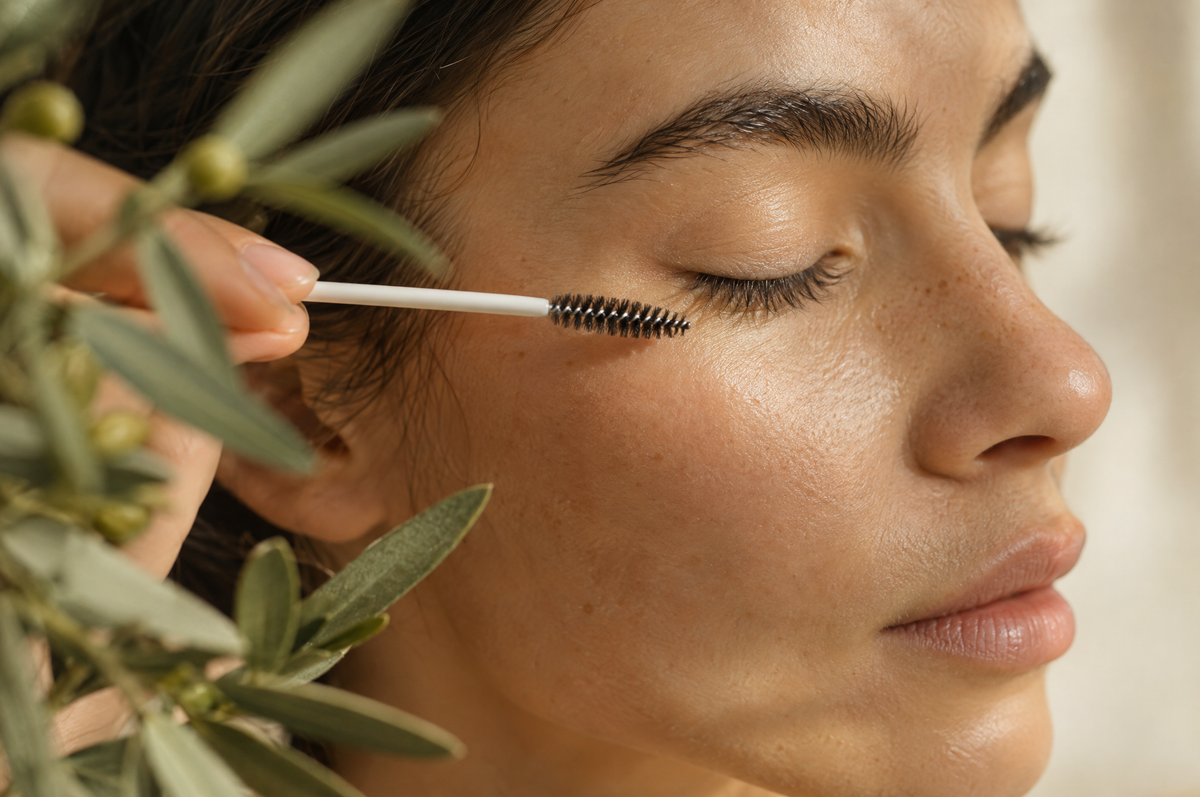
- Apply to the outer two-thirds of the lashes. Brush gently from the middle to the tips, keeping away from the waterline and the roots right at the lid edge.
- Do it at night, eyes closed for a moment. Blot any excess with a tissue so it doesn't migrate into your eyes while you sleep.
- Stop if anything stings. If oil gets into the eye, rinse with clean water. If redness, itching or irritation persists, see a doctor.5
Use a pure, single-ingredient oil for anything near the eyes. Fragrance and essential oils have no place there. Our 100% organic argan oil is just cold-pressed argan kernel oil, with no fragrance, dyes or additives. Introduce it on its own, not in the same week as a new mascara or eye cream; the AAO recommends trying only one new eye product at a time.4
Who should skip it
- Anyone with an eye infection, blepharitis or a stye. Treat that first with your doctor.
- Contact lens wearers should remove lenses first and keep oil well away from the eye.
- Anyone who has reacted to argan oil or other plant oils. See can argan oil irritate skin?
Argan oil after a lash lift or with lash extensions
A lash lift uses chemical solutions to curl natural lashes, and those solutions can leave lashes drier than usual. Many lash technicians suggest keeping lashes dry and avoiding oil-based products for the first day or two while the curl sets. After that, a tiny amount of argan oil on the mid-lengths and tips can help lashes feel softer. Always follow the aftercare your technician gives you, since products and timings vary.
If you wear lash extensions, be careful: oil can weaken many extension adhesives. Ask your technician before using any oil near the lash line. The FDA notes that the eyelid area is delicate and that adhesives and eye cosmetics can cause reactions and, if contaminated, infections.5
Argan oil can make the lashes you have softer and glossier. It can't give you lashes you don't have.
If you'd like to put the same bottle to work elsewhere, see our guides to argan oil under the eyes, whether argan oil helps hair grow, and 20 ways to use argan oil.
Frequently asked questions
Can argan oil make eyelashes longer?
No study shows that it can. It may make lashes look glossier and feel softer, and it may reduce breakage, but it does not change how long lashes grow.
Is argan oil or castor oil better for eyelashes?
Neither has evidence for lash growth. Both can condition lashes; argan oil is lighter and less sticky, which many people find easier to use near the eyes.
Is it safe to put argan oil on your eyelashes every night?
For most people, a tiny amount on the outer lashes with a clean wand is fine. Keep it out of your eyes and off the waterline, and stop if you notice stinging or redness.
Can I use argan oil after a lash lift?
Usually yes, after the first day or two once the curl has set, but follow your technician's aftercare. Use only a small amount on the mid-lengths and tips.
Does argan oil help eyebrows grow back?
There is no evidence it does. It can soften and groom brow hairs; if brows are thinning noticeably, see a doctor to rule out an underlying cause.
This article is for general information and isn't medical advice. If you have sudden or patchy lash or brow loss, an eye condition, or irritation that doesn't settle, see your doctor or an ophthalmologist before trying something new.
Sources
- American Academy of Ophthalmology. Why are my eyelashes falling out? Link
- US Food and Drug Administration. NDA 22-369 approval letter: Latisse (bimatoprost ophthalmic solution) 0.03%. December 2008. Link
- American Academy of Ophthalmology. What you should know about eyelash growth serums. 2019. Link
- American Academy of Ophthalmology. How to use cosmetics safely around your eyes. Link
- US Food and Drug Administration. Eye cosmetic safety. Link