Argan Oil for Braids, Twists and Locs
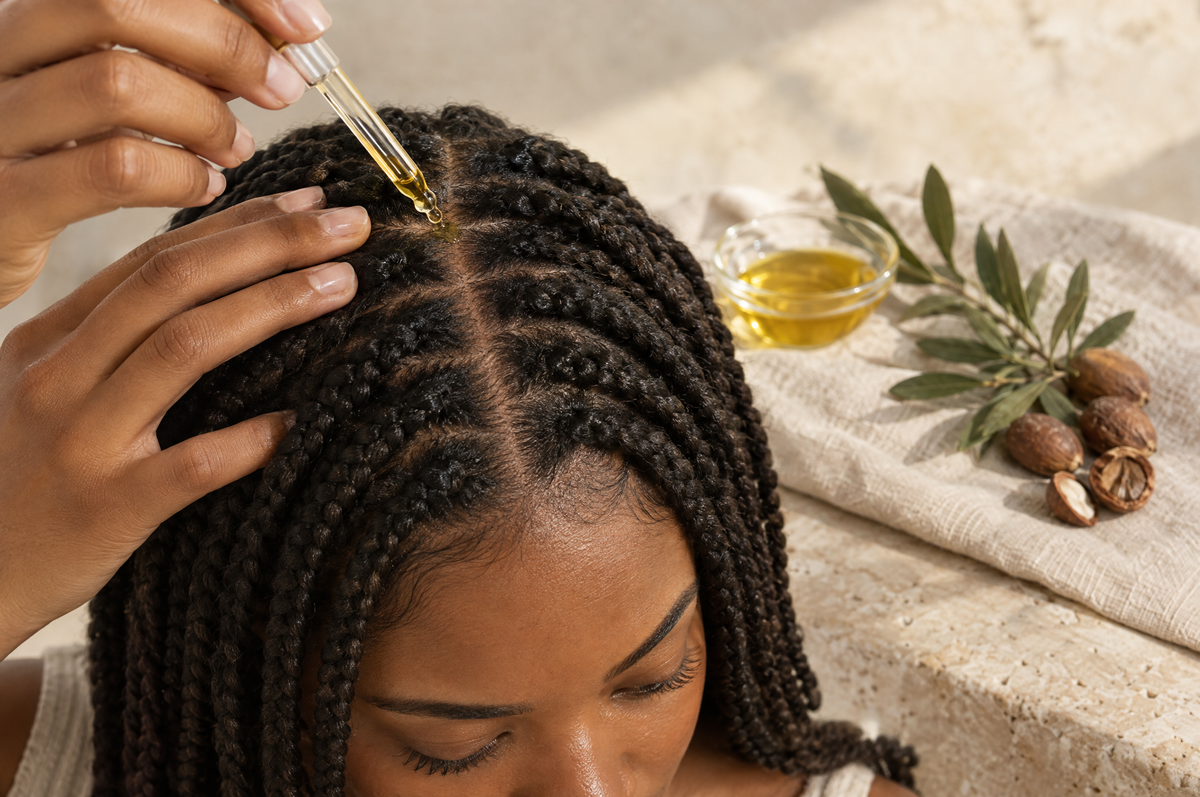
Argan oil works well with braids, twists and locs when you use very little of it: a drop or two along the parts when your scalp feels tight and dry, and a light smoothing over the lengths for softness and shine. The key is restraint. Oil left in a style for weeks can build up, and not every flake under a protective style is simple dryness.
The short answer
Use argan oil for braids by placing single drops directly on the part lines with a dropper, massaging gently with your fingertips, and smoothing one or two warmed drops over the braids or locs. Start on a clean scalp, repeat only when it feels dry, and wash regularly to avoid buildup.
Why your scalp feels dry under braids and locs
Protective styles are popular for good reason. A 2026 dermatology review notes that braids, cornrows and twists reduce friction between strands, help hair retain moisture and make it easier to manage, which is why many people credit these styles with helping them keep length.1 But they change how your scalp behaves.
The first factor is the hair itself. In tightly coiled hair, the twisted shape of the strand makes it harder for sebum to travel from the scalp down the hair shaft, so the scalp can feel dry even when it is producing plenty of oil.2 Locs add another layer: the tightness of each loc can impede natural oil distribution along the hair, leaving it dry and potentially fragile.3
The second factor is washing. One study cited in a dermatologist consensus paper found that Black women with natural styles washed their hair about every 14 days on average, while those wearing braids or weaves washed every 18 to 32 days.2 Longer gaps between washes give product, sweat and skin flakes time to accumulate. Reviewers note that monthly or twice-monthly washing combined with long stretches in protective styles is linked to a higher risk of seborrheic dermatitis, and that weekly washing with appropriate products helps limit product buildup.1 The American Academy of Dermatology suggests washing once a week or every other week for Black hair, partly because buildup can dry hair out.4
Dryness or something else? Read your flakes
This is the most important caveat in the whole article. Fine, white, itchy flakes on a tight scalp may well be dryness, and a little oil can make it feel more comfortable. Greasy, yellowish or stubborn flakes, especially with redness or itching, can be seborrheic dermatitis. A panel of dermatologists specializing in textured hair warns that people often reach for pomades and oils to mask flakes, believing they have a dry scalp, and that these products often make seborrheic dermatitis worse.2 If flakes keep coming back no matter how you oil, stop adding oil and see a dermatologist. Our guide to argan oil for scalp dryness and dandruff explains how to tell the two apart in more detail.
What argan oil can and can't do for protective styles
Argan oil is a light, liquid plant oil made mostly of oleic and linoleic acids, with vitamin E compounds and plant sterols.5 It spreads thinly, which suits applicator-tip application on parts, and it is less likely to leave a heavy, waxy coating than thick butters or greases.
What it does well is cosmetic: softening dry lengths, adding shine, taming frizz and flyaways, and helping a tight scalp feel more comfortable. Laboratory work shows that oil films on hair slow the rate at which moisture moves in and out of the fiber, an effect researchers liken to moisturization.6
What it can't do is grow hair. A 2022 systematic review of coconut, castor and argan oils for hair in skin of color found no significant clinical evidence that argan oil improves hair growth or hair quality.7 We would rather tell you that plainly than sell you on edge regrowth. If growth is your question, our piece on whether argan oil helps hair grow walks through the evidence.
How to oil your scalp with braids, step by step
- Start clean. Oil works best on a freshly washed, fully dry scalp, not on top of last month's product.
- Use a dropper or applicator bottle. Precision is the point. Place one drop directly on a part line, then move two or three rows over and repeat. You do not need to hit every part.
- Massage, don't scratch. Use the pads of your fingers in small circles. Avoid tugging at the base of braids, where tension already sits.
- Keep the total small. As a starting point, a full head of braids rarely needs more than 6 to 10 drops on the scalp. If your scalp looks shiny or feels greasy an hour later, use less next time.
- Smooth the lengths separately. Warm one or two drops between your palms and glide them down the braids or twists to calm frizz and add sheen. Our guide to argan oil for frizzy hair has more on smoothing dry ends.
- Repeat only when needed. Once or twice a week is plenty for most people. Daily oiling is the fastest route to buildup.
A single-ingredient oil makes this easier to judge, because you know exactly what is going onto your scalp. Our organic argan oil comes in a glass bottle with a dropper, contains only cold-pressed argan oil, and has no added fragrance, which is one less variable if your scalp is sensitive.
Argan oil for locs: go lighter still
Locs need the most restraint. Because each loc is a dense, matted structure, anything that goes in does not comb out, and residue from heavy products can stay trapped. Reviewers list product buildup among the problems linked to common products for textured hair.1
- Scalp first. Apply a drop or two to the scalp between locs rather than coating the locs themselves.
- Lengths sparingly. If locs feel dry or dull, rub a single drop between your palms and press it over the surface. Don't saturate.
- Rinse thoroughly on wash day. Take extra time rinsing so shampoo and oil don't remain inside the locs.
- Dry completely. Locs hold water for a long time. Let them dry fully before tying them up or covering them.
If your locs are new, ask your loctician before adding any oil, since some prefer to keep the early stages product-free.
Protect your edges: tension matters more than any oil
No oil can make up for a style that is too tight. The American Academy of Dermatology lists tightly braided hair, cornrows and locs among the styles that can lead to traction alopecia, a form of hair loss caused by repeated pulling, when they are worn too tight.8 The hairline is one of the first places it shows: broken hairs around the forehead, a receding hairline, or patches of loss where hair is pulled hardest.8 The AAD warns that traction alopecia can become permanent the longer it goes on.8
The AAD's practical tips are worth following on every install:8,4
- If styling hurts, the style is too tight. Ask your stylist to stop and redo it.
- Loosen braids, especially around the hairline.
- Choose thicker braids and locs, and keep them shorter, because longer hair is heavier and pulls more.
- Wear braids for no longer than 6 to 8 weeks, and switch styles regularly to give your hair a break.
Gently smoothing a drop of oil over your edges for softness is fine. Brushing them flat with strong tension every day is not. If your edges are thinning, see a board-certified dermatologist early; the AAD says it is never too early to get hair loss checked.8
A quick guide by style
| Style | Where to apply | How much | Watch for |
|---|---|---|---|
| Box or knotless braids | Part lines, then a light coat on braids | A drop every few parts, 1 to 2 drops for lengths | Tension at the hairline, flaking at the parts |
| Cornrows | Along the rows between braids | Single drops along a few rows | Tightness and tender spots |
| Two-strand twists | Scalp and twist ends | 1 to 2 drops warmed in palms for ends | Frizz, unraveling ends |
| Locs | Scalp between locs | The least of all, 1 to 2 drops | Residue, locs that stay damp |
Between styles, when your hair is loose, the usual guidance on how to use argan oil for hair applies: a few drops through damp lengths after washing. If your natural texture is curly or coily, our curly hair routine covers wash-day layering.
Frequently asked questions
Is argan oil good for braids?
Yes, in small amounts. A drop on the part lines can make a tight, dry scalp feel more comfortable, and one or two drops smoothed over the braids add softness and shine. Too much oil, applied too often, leads to buildup.
How often should I oil my scalp with braids?
Once or twice a week is enough for most people, and only when the scalp feels dry. If you see greasy or persistent flakes, stop adding oil and check with a dermatologist, because oils can make seborrheic dermatitis worse.
Can I use argan oil on locs?
Yes, sparingly. Focus a drop or two on the scalp between locs rather than coating the locs, rinse thoroughly on wash day, and let locs dry completely. Ask your loctician first if your locs are new.
Will argan oil grow my edges back?
There is no good evidence that argan oil grows hair. Thinning edges are often a sign of traction from tight styles, which can become permanent. Loosen your styles and see a board-certified dermatologist early.
Should I oil my scalp or my braids?
Both, separately and lightly. Apply single drops directly to the scalp along the parts, then warm a drop or two in your palms and smooth it over the lengths.
This article is for general information and isn't medical advice. If you notice thinning edges, scalp pain, bumps, or flaking that doesn't settle, see a board-certified dermatologist, ideally one experienced with textured hair.
Sources
- Humphrey JG, Harding MJ, Cartwright KM, Thomas LE, Luke J. Afro-textured hair care: a narrative review and recommendations for dermatologists. Int J Womens Dermatol. 2026;12(1):e246. Link
- Callender V, Burgess C, Harvey VM, Heath C, Mitchell H, Woolery-Lloyd H, Andriessen A, McMichael A. High curl pattern hair and scalp care considerations to mitigate seborrheic dermatitis. J Cosmet Dermatol. 2026;25(4):e70842. Link
- Cedirian S, Prudkin L, Piraccini BM, Santamaria J, Piquero-Casals J, Saceda-Corralo D. The exposome impact on hair health: etiology, pathogenesis and clinical features, Part I. An Bras Dermatol. 2025;100(1):131–140. Link
- American Academy of Dermatology. Black hair: tips for everyday care. Link
- Gharby S, Charrouf Z. Argan oil: chemical composition, extraction process, and quality control. Front Nutr. 2021;8:804587. Link
- Keis K, Huemmer CL, Kamath YK. Effect of oil films on moisture vapor absorption on human hair. J Cosmet Sci. 2007;58(2):135–145. Link
- Phong C, Lee V, Yale K, Sung C, Mesinkovska N. Coconut, castor, and argan oil for hair in skin of color patients: a systematic review. J Drugs Dermatol. 2022;21(7):751–757. Link
- American Academy of Dermatology. Hairstyles that pull can lead to hair loss. Link