Argan Oil for Swimmer's Hair: Before and After the Pool
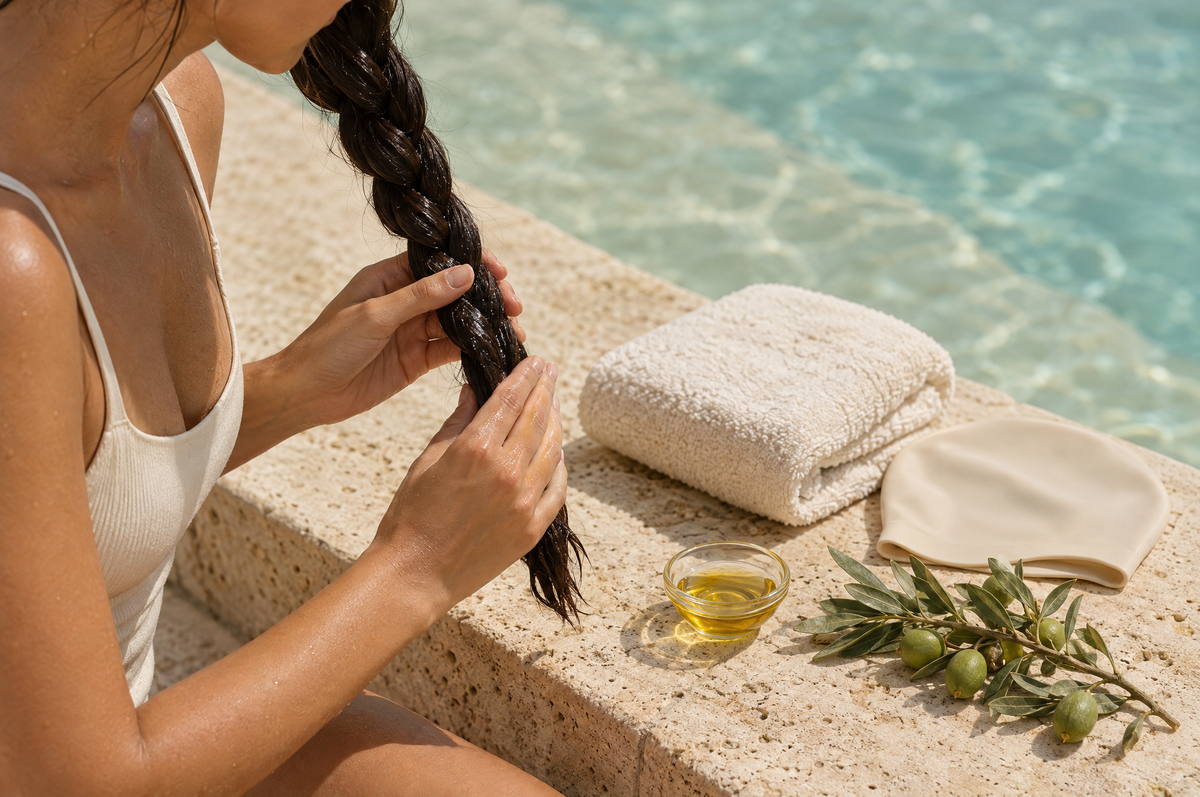
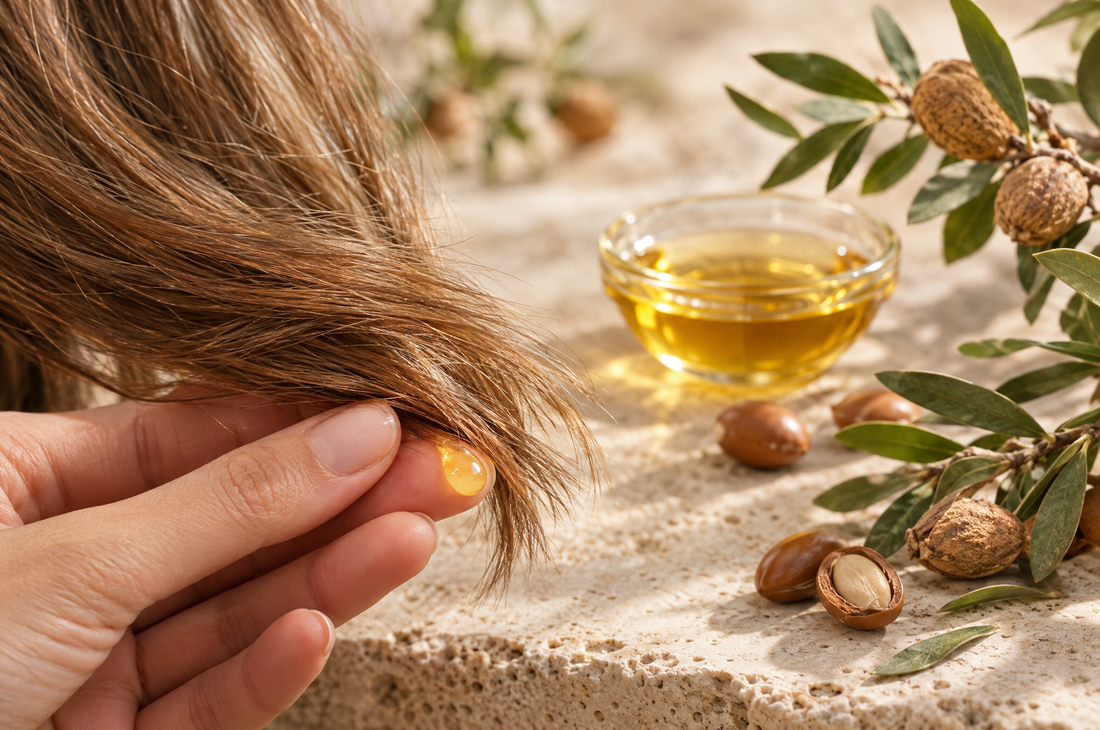
Yes, argan oil before swimming is a sensible habit, as long as you think of it as one layer of a routine rather than a force field. Soak your hair with fresh water first, smooth a few drops of oil over the lengths, tuck everything under a cap, and wash soon after you get out. The oil adds slip and a light surface film; the fresh water, the cap and the post-swim rinse do the rest.
The short answer
Argan oil before swimming works best as a thin coat over hair you have already soaked with fresh tap water. The water saturates the strands first, the oil adds a film that slows further water uptake, and a snug cap limits contact. Rinse and shampoo soon after swimming, then finish damp ends with a drop or two.
What chlorine and pool water actually do to hair
Pools are kept clean with chlorine, usually present in the water as hypochlorous acid. A 2025 dermatology review of environmental effects on hair describes chlorinated water as a significant source of hair weathering: chlorine can penetrate into the cortex, start oxidative reactions that break down melanin (which is why hair can lighten or discolor), speed the breakdown of keratin, and weaken the cuticle, which can lead to breakage.1
In everyday terms, a dermatologist at the University of Alabama at Birmingham puts it this way: chlorine and salt water both dry hair out, leaving it more porous and more prone to frizz and breakage, and both can dull or fade color-treated hair.2 She also offers some reassurance. Healthy hair usually is not damaged by swimming unless it is worn loose and tangles often, while hair that is already damaged can show the effects after only a few swims.2
Why some swimmers' hair turns green
The green tint many people blame on chlorine is mostly a copper story. Medical case reports describe green hair as copper deposits in the hair, most often traced to copper-based algaecides in pool water or to copper from household plumbing.3,4,1 Copper alone is not the whole picture, though. Clinicians who reviewed these cases listed predisposing factors: hair that is already damaged by sun, bleaching, dyeing or perming, frequent contact with chlorinated water, and alkaline shampoos.3 Light blonde and highlighted hair is the classic case.4
That is why color-treated and lightened hair needs the most care around pools. If you have bleached or dyed hair, our guide to argan oil for bleached or colored hair covers how to use oil around color appointments as well as day to day.
Saltwater is different, but not gentle
Ocean swimming swaps chlorine for salt. Salt water dries hair too, and as it dries on the strands it can cause tangling.2 The routine below works for both, with an extra emphasis on detangling after the sea.
Does argan oil protect hair from chlorine?
Here is the honest version. No published study has tested argan oil on swimmers' hair, so nobody can tell you exactly how much protection a pre-swim coat provides. What we do have is indirect evidence, and it points in a useful direction.
- Oil films slow water uptake. In a laboratory study, hair coated with various oils absorbed less moisture and took it up more slowly than untreated hair, though a considerable amount of moisture still got through.5 So a film helps, but it does not seal hair off.
- Reviewers see oils as a protective layer. The follow-up dermatology review describes mineral and vegetable oils as protecting hair from weathering by reducing water absorption and limiting the penetration of harmful substances, while noting that argan oil specifically still needs more research.6
- Argan oil held up against oxidative stress in the lab. Hair tresses pretreated with argan oil lost significantly less protein when exposed to an oxidizing agent, and the oil was still detectable on the hair after washing.7 That test used a lab oxidant, not pool water, so it supports the idea rather than proving it.
Put together, a reasonable expectation is this: argan oil before swimming may reduce how much pool water your lengths soak up and make wet hair easier to manage, and it costs you very little to try. It will not stop copper or chlorine from reaching hair that sits in the water for an hour without a cap.
Why wet your hair with fresh water first
This is the simplest step and arguably the most important. Wetting your hair before you enter the water reduces how much chlorine or salt water it absorbs, according to dermatologist guidance.2 Hair that is already holding fresh tap water has less capacity to take on pool water. The oil then goes on top of damp hair, where it spreads thinly and evenly.
Fresh water first, a little oil second, a cap third. The order matters more than the amount.
How to use argan oil before swimming
- Rinse thoroughly. Use the poolside shower, or wet your hair at home, until it is fully soaked through to the scalp.
- Squeeze, don't wring. Press out the excess water so the oil can spread instead of sliding off.
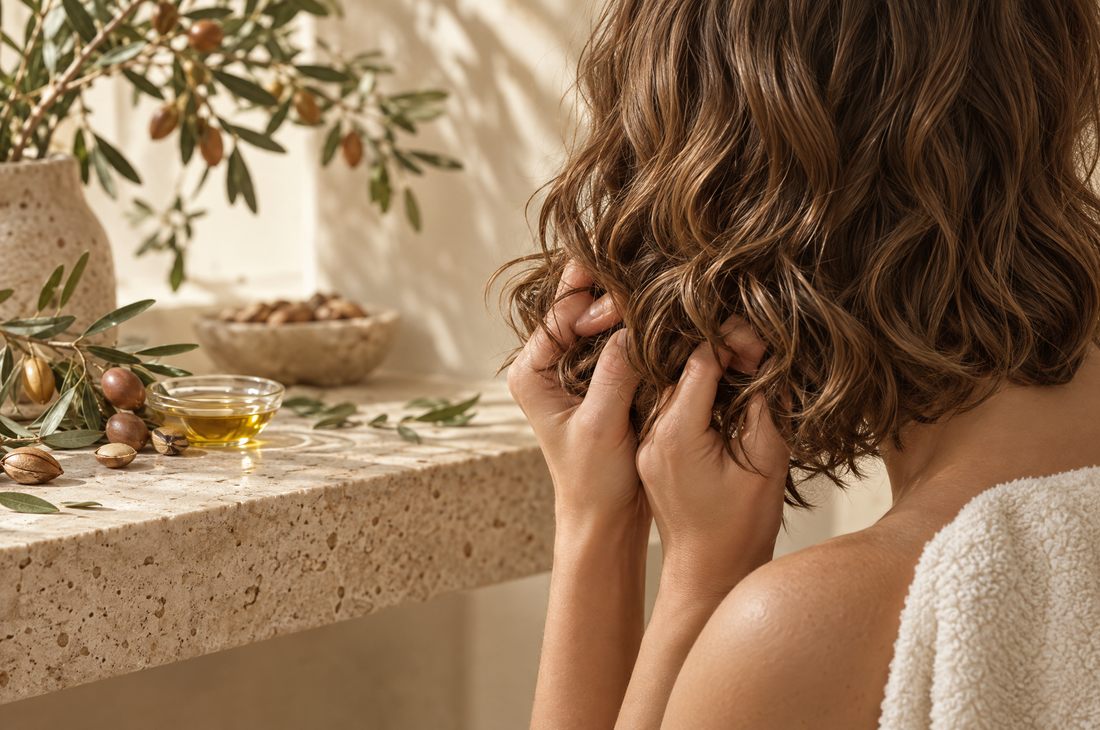
- Warm a few drops. Rub 2 to 5 drops between your palms, depending on length and thickness. Fine hair needs the low end.
- Smooth over mid-lengths and ends. These are the oldest, most weathered parts of the hair. Skip the roots if your scalp tends to get oily.
- Add conditioner if your hair is long or thick. A rinse-out conditioner layered over the oil gives extra coverage. Either one alone is fine for shorter hair.
- Tie it up. A loose bun or braid limits tangling and the amount of hair exposed to the water.2 Use a fabric-covered tie rather than a bare elastic.
- Put on a cap. A well-fitting swim cap cuts contact with pool water. It will not keep every strand dry, which is why the earlier steps still matter.
A single-ingredient oil keeps this simple. Our 100% organic argan oil is cold-pressed from unroasted kernels with no fragrance or additives, so you are not layering extra ingredients onto hair that is about to meet chlorine.
Swimmers' hair care after the pool
What you do in the first half hour after swimming matters as much as the prep.
- Rinse right away. The longer pool or sea water sits on your hair, the longer it has to dry the fiber.
- Shampoo gently. Dermatologist advice is to use a sulfate-free shampoo immediately after swimming, and for regular swimmers to add a clarifying shampoo once a week, followed by a gentle conditioner to replenish moisture.2
- Condition every time. Focus conditioner on the lengths and detangle with a wide-tooth comb from the ends upward while it is in.
- Finish with argan oil. Once the hair is towel-blotted, smooth 1 to 3 drops through damp ends. Our guide on how to use argan oil for hair covers amounts for different hair types.
- Go easy on heat. Pool-dried hair is already stressed. Air-dry partway, or read our notes on using argan oil before blow-drying if you need to style.
If post-swim frizz is your main complaint, the same habits apply, and our piece on argan oil for frizzy hair goes deeper into smoothing dry, porous lengths.
If your hair has turned green
Mention it to the pool operator, because the water itself may be the cause: in one published case, a swimmer's highlighted hair turned green after a swim in a pool with excess copper in the water.4 Chelating shampoos designed to lift mineral deposits are among the options described in the medical literature,3 and a professional colorist can help with stubborn tints. Avoid stacking harsh home remedies on hair that is already fragile.
A routine for every kind of swimmer
| Swimmer | Before | After | Weekly |
|---|---|---|---|
| Occasional pool swimmer | Wet hair, 2 to 3 drops of oil on ends, cap if you have one | Rinse, gentle shampoo, conditioner | Nothing extra needed |
| Regular lap swimmer | Wet hair, oil or conditioner on lengths, tie up, cap | Sulfate-free shampoo, conditioner, a drop of oil on damp ends | Clarifying shampoo, then conditioner |
| Ocean swimmer | Wet hair, oil on lengths, braid or bun | Rinse thoroughly, condition and detangle carefully | An oil mask on dry lengths if hair feels rough |
| Bleached or color-treated hair | Wet hair, oil plus conditioner, tie up, snug cap | Rinse immediately, gentle shampoo, conditioner, oil on ends | Clarify only as needed, watch for green tints |
For the weekly oil mask, our guide to using argan oil as a hair mask covers timing and rinsing.
When to see a dermatologist
Most swimming-related dryness responds to a better routine. See a dermatologist if you notice redness, scaling, burning, persistent stinging or itching on the scalp, excessive breakage, or shedding with areas of thinning.2
Frequently asked questions
Does argan oil protect hair from chlorine?
It can help, but it is not a barrier. Lab studies show oil films slow how much water hair absorbs, yet a considerable amount still gets through. Pair a few drops of argan oil with wetting your hair first, a swim cap and a prompt rinse afterward.
Should I put oil in my hair before swimming?
A small amount on hair you have already soaked with fresh water is a reasonable step, especially for dry, long or color-treated hair. Focus it on the mid-lengths and ends, and skip the scalp if it tends to get oily.
Is it OK to leave argan oil in hair under a swim cap?
Yes. A few drops on the lengths under a cap is fine. Rinse and shampoo soon after swimming so pool water, oil and residue do not sit on the hair for hours.
Does argan oil help chlorine-damaged hair?
It can make dry, chlorine-stressed hair feel softer and smoother as a leave-in on damp ends, and it may add slip that makes detangling easier. It cannot rebuild damaged fiber, so trimming badly damaged ends and adjusting your swim routine matter more.
Is salt water bad for your hair?
Salt water dries hair and can cause tangling as it dries on the strands. Wetting hair first, braiding it, rinsing promptly and conditioning afterward keep most ocean swimmers' hair in good shape.
Sources
- Cedirian S, Prudkin L, Piraccini BM, Santamaria J, Piquero-Casals J, Saceda-Corralo D. The exposome impact on hair health: etiology, pathogenesis and clinical features, Part I. An Bras Dermatol. 2025;100(1):131–140. Link
- UAB Medicine (University of Alabama at Birmingham). Summer skincare: protect your skin and hair from chlorine and salt water. Interview with dermatologist Rachel Falkner, MD. Link
- Mascaró JM, Ferrando J, Fontarnau R, Torras H, Domínguez A, Mascaró JM. Green hair. Cutis. 1995;56(1):37–40. Link
- Tomas X, Nogueras M, Bartolome A, Ferrando J. Pseudo green hair. Int J Trichology. 2022;14(2):65–67. Link
- Keis K, Huemmer CL, Kamath YK. Effect of oil films on moisture vapor absorption on human hair. J Cosmet Sci. 2007;58(2):135–145. Link
- Cedirian S, Prudkin L, Santana JA, Piquero-Casals J, Saceda-Corralo D, Piraccini BM. The exposome impact on hair health: non-pharmacological management, Part II. An Bras Dermatol. 2025;100(2):322–327. Link
- Sharifi N, Hamedeyazdan S, Shokri J, Monajjemzadeh F. Argan oil as a pretreatment of human hair before exposure to oxidative damage: attenuated total reflectance and protein loss studies. J Cosmet Dermatol. 2022;21(10):5010–5017. Link